Contents
Research Article
Arithmetic Functions Satisfying a Congruence Property
-
- Published online by Cambridge University Press:
- 20 November 2018, pp. 143-146
-
- Article
-
- You have access
- Export citation
Unitary Perfect Numbers
-
- Published online by Cambridge University Press:
- 20 November 2018, pp. 147-153
-
- Article
-
- You have access
- Export citation
-
Let σ*(N) denote the sum of the unitary divisors of N, that is,

It is easily seen that σ*(N) is multiplicative. In fact σ*(l) = 1
 if N > 1 has the prime decomposition
 . Let us define a positive integer to be unitary perfect whenever σ*(N) = 2N. The first four such numbers are 6, 60, 90 and 87, 360. In a recent abstract [ l ] published by one of us, the last of these numbers was overlooked. No other unitary perfect numbers are known to the authors.
Some Remarks on a Combinatorial Theorem of Erdös and Rado
-
- Published online by Cambridge University Press:
- 20 November 2018, pp. 155-160
-
- Article
-
- You have access
- Export citation
-
P. Erdös and R. Rado [1] proved that to each pair of positive integers n and k, with k ≥ 3, there corresponds a least positive integer φ(n, k) such that if
 is a family of more than φ(n, k) sets, each set with n elements, then some k of the sets have pair-wise the same intersection.
 is a family of more than φ(n, k) sets, each set with n elements, then some k of the sets have pair-wise the same intersection.
Some Inequalities Related to the Wald-Wolfowitz-Noether Condition*
-
- Published online by Cambridge University Press:
- 20 November 2018, pp. 161-169
-
- Article
-
- You have access
- Export citation
-
If {avα: or = 1, 2, …, N }, with Nv → ∞ as v → ∞, is a double sequence of real numbers with the property that
 , then
1.1

is known in statistical literature as the Wald- Wolfowitz- Noether condition and it plays an important role in the proofs of certain types of central limit theorems (see e. g., [ l ], [2] ).
 , then

Total Digraphs
-
- Published online by Cambridge University Press:
- 20 November 2018, pp. 171-176
-
- Article
-
- You have access
- Export citation
-
The line - graph
 of an ordinary graph G is that graph whose points can be put in one-to-one correspondence with the lines of G in such a way that two points of are adjacent if and only if the corresponding lines of G are adjacent. This concept originated with Whitney [ 5 ], has the property that its (point) chromatic number equals the line chromatic number of G, where the point (line) chromatic number of graph is the minimum number of colors required to color the points (lines) of the graph such that adjacent points (lines) are colored differently.
 of an ordinary graph G is that graph whose points can be put in one-to-one correspondence with the lines of G in such a way that two points of
Sequences of Euler Graphs
-
- Published online by Cambridge University Press:
- 20 November 2018, pp. 177-182
-
- Article
-
- You have access
- Export citation
On the Injective Hulls of Cyclic Modules Over Dedekind Domains
-
- Published online by Cambridge University Press:
- 20 November 2018, pp. 183-186
-
- Article
-
- You have access
- Export citation
On the Quotients of Indecomposable Injective Modules
-
- Published online by Cambridge University Press:
- 20 November 2018, pp. 187-190
-
- Article
-
- You have access
- Export citation
On Very Large One Sided Ideals of a Ring
-
- Published online by Cambridge University Press:
- 20 November 2018, pp. 191-196
-
- Article
-
- You have access
- Export citation
Some Simple Properties of Simple Nil Rings
-
- Published online by Cambridge University Press:
- 20 November 2018, pp. 197-200
-
- Article
-
- You have access
- Export citation
A Universal Factorization Theorem in Topology
-
- Published online by Cambridge University Press:
- 20 November 2018, pp. 201-207
-
- Article
-
- You have access
- Export citation
A Generating Function for Jacobi Polynomials
-
- Published online by Cambridge University Press:
- 20 November 2018, pp. 209-213
-
- Article
-
- You have access
- Export citation
-
The following notations will be employed throughout this note.

The object of the present note is to obtain a new generating function for the Jacobi polynomials defined by [4, page 268]

On the Reducibility of Appelles Function F4 *
-
- Published online by Cambridge University Press:
- 20 November 2018, pp. 215-222
-
- Article
-
- You have access
- Export citation
-
It is a well-known fact in the theory of Appell's hypergeometric function of two variables F4, defined by
1

where |x|1/2 + |y|1/2 < 1, that it can be expressed interms of products of ordinary hypergeometric functions when γ + γ' = α + β + 1.

A Remarkable Class of Mannheim-Curves
-
- Published online by Cambridge University Press:
- 20 November 2018, pp. 223-228
-
- Article
-
- You have access
- Export citation
On Strict Monotonicity of Continuous Solutions of Certain Types of Functional Equations
-
- Published online by Cambridge University Press:
- 20 November 2018, pp. 229-232
-
- Article
-
- You have access
- Export citation
-
It is a commonplace that F is continuous on the cartesian square of the range of f if f is continuous and satisfies
1

say, for all real x, y (cf. e.g. [2]). A.D. Wallace has kindly called my attention to the fact, that this is trivial only if f is (constant or) strictly monotonic and asked for a simple proof of the strict monotonicity of f. The following could serve as such: if on an interval f is continuous, nonconstant and satisfies (1), then f is strictly monotonic there.

Some Remarks on Angular Derivatives and Julia's Lemma
-
- Published online by Cambridge University Press:
- 20 November 2018, pp. 233-241
-
- Article
-
- You have access
- Export citation
-
Let w = f(z) be holomorphic on the unit disk D = { z: | z | < 1}, with the additional restrictions that | f ( z ) | < l and
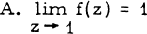 , where
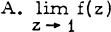 denotes the (outer) angular limit of f (z) at z = 1. Let us now define
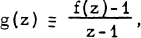 and then focus our attention on the behaviour of g(z) in an arbitrary angular neighbourhood of z = 1. Whenever
 exists, this limit is commonly referred to as the angular derivative of f(z) at z = 1.
 , where
 denotes the (outer) angular limit of f (z) at z = 1. Let us now define
 and then focus our attention on the behaviour of g(z) in an arbitrary angular neighbourhood of z = 1. Whenever
 exists, this limit is commonly referred to as the angular derivative of f(z) at z = 1.