Contents
Research Article
Extensions of Topological Spaces
-
- Published online by Cambridge University Press:
- 20 November 2018, pp. 1-22
-
- Article
-
- You have access
- Export citation
A Number Theory Problem Concerning Finite Groups and Rings
-
- Published online by Cambridge University Press:
- 20 November 2018, pp. 23-34
-
- Article
-
- You have access
- Export citation
On Subgraphs of the Complete Bipartite Graph
-
- Published online by Cambridge University Press:
- 20 November 2018, pp. 35-39
-
- Article
-
- You have access
- Export citation
-
G(n) denotes a graph of n vertices and Ḡ(n) denotes its complementary graph. In a complete graph every two distinct vertices are joined by an edge. Let Ck(G(n)) denote the number of complete subgraphs of k vertices contained in G(n). Recently it was proved [1] that for every k
1

where the minimum is over all graphs G(n).

A Note on Regular Measures
-
- Published online by Cambridge University Press:
- 20 November 2018, pp. 41-44
-
- Article
-
- You have access
- Export citation
On Almost Uniform Convergence of Families of Functions
-
- Published online by Cambridge University Press:
- 20 November 2018, pp. 45-48
-
- Article
-
- You have access
- Export citation
Remarks on a Paper by S. Trott
-
- Published online by Cambridge University Press:
- 20 November 2018, pp. 49-51
-
- Article
-
- You have access
- Export citation
-
There are several statements in [3] which require clarification.
Theorem 1 [3, p. 246] states that U3= U2U4 U2 -1U4 U2 U4. In fact this is (essentially) the relation O = PUPU-1PU given in [1, p. 91, (7.35)]. To see this we note that 0 = U3, P = U4, U = U4U2U4 (as explained in [1, p. 88]); since U4 2, = E,


On the Number of Triangles Contained in Certain Graphs
-
- Published online by Cambridge University Press:
- 20 November 2018, pp. 53-56
-
- Article
-
- You have access
- Export citation
On the Consistency of the Two-Sample Empty Cell Test
-
- Published online by Cambridge University Press:
- 20 November 2018, pp. 57-63
-
- Article
-
- You have access
- Export citation
A Distribution Function of Cantor-Vitali Type
-
- Published online by Cambridge University Press:
- 20 November 2018, pp. 65-75
-
- Article
-
- You have access
- Export citation
-
In his 1922 article [l] on functions of bounded variation, Vitali gave a method for constructing monotone non-absolutely continuous functions, generalizing ideas from the ternary set introduced in another connection by Cantor. In [2], Hille and Tamarkin gave a full account of the "middle-third" function, showing it to be a singular distribution function, and finding its characteristic function. In [3], Evans obtained a generalization of the middle - third function by discarding middle intervals of length other than one-third, and obtained algorithms by which the moments of his function could be calculated. Invarious papers, among them [4], Wintner studied infinite convolutions of symmetric Bernoulli distributions, finding a great variety of distributions whose characteristic functions were of the form


On the Principle of Superposition in Quantum Mechanics
-
- Published online by Cambridge University Press:
- 20 November 2018, pp. 77-83
-
- Article
-
- You have access
- Export citation
Some Properties of the Rank and Invariant Factors of Matrices*
-
- Published online by Cambridge University Press:
- 20 November 2018, pp. 85-96
-
- Article
-
- You have access
- Export citation
A New Proof of an Inequality of Heinz
-
- Published online by Cambridge University Press:
- 20 November 2018, pp. 97-100
-
- Article
-
- You have access
- Export citation
-
In a recent paper, [l], Dixmier has proved Heinz' inequality by deducing it from a lemma due to Thorin. In this note it is proved directly from a convexity theorem.
Let(M(k), ℳ(k), μ(k)), k = 0, …, n, be measure spaces and Lq(k) (M(k), ℳ(k), μ(k)) be all the functions on M(k) such that


Remarks on Quasi-Hermite-Fejér Interpolation
-
- Published online by Cambridge University Press:
- 20 November 2018, pp. 101-119
-
- Article
-
- You have access
- Export citation
-
Let
1

be n+2 distinct points on the real line and let us denote the corresponding real numbers, which are at the moment arbitrary, by
2

The problem of Hermite-Fejér interpolation is to construct the polynomials which take the values (2) at the abscissas (1) and have preassigned derivatives at these points. This idea has recently been exploited in a very interesting manner by P. Szasz [1] who has termed qua si-Hermite-Fejér interpolation to be that process wherein the derivatives are only prescribed at the points x1, x2, …, xn and the points -1, +1 are left out, while the values are prescribed at all the abscissas (1).


On Extremal Properties of the Derivatives of Polynomials and Rational Functions
-
- Published online by Cambridge University Press:
- 20 November 2018, pp. 121-131
-
- Article
-
- You have access
- Export citation
-
Let p(z) be a polynomial of degree n, i. e. a finite sum of the form
 where cν are any given numbers and z=x+iy is a complex variable. To answer a question raised by the chemist Mendelieff, A. Markoff [3] proved the following theorem.
 where c
Computation of the Number of Score Sequences in Round-Robin Tournaments
-
- Published online by Cambridge University Press:
- 20 November 2018, pp. 133-136
-
- Article
-
- You have access
- Export citation
-
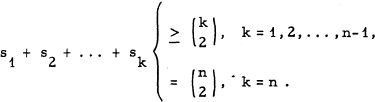
We consider round-robin tournaments of n players in which, at each encounter, the winner is awarded 1 point and the loser 0 (ties are excluded).
Let
1

be the n scores, ordered in a non-decreasing sequence. Clearly
2
Book Reviews: Comptes Rendus Critiques
Local Rings, by Masayoshi Nagata. Interscience Tract Number 13, New York, 1962. xiii + 234 pages. $11.00.
-
- Published online by Cambridge University Press:
- 01 April 2019, pp. 154-155
-
- Article
-
- You have access
- Export citation
Mathematical Theory of Elastic Equilibrium (recent results), by Giuseppe Grioli. Ergebnisse derangewandten Mathematik No. 7. Academic Press Inc. New York and Springer-Verlag (Berlin-Gottingen- Heidelberg), 1962. viii + 168 pages. $7.25.
-
- Published online by Cambridge University Press:
- 01 April 2019, p. 158
-
- Article
-
- You have access
- Export citation
Écrits et Mémoires Mathématiques d'Évariste Galois, Édition critique intégrale de ses manuscrits et publications par Robert Bourgne et J.-P. Azra. Préface de J. Dieudonné. Publié avec le concours du centre nationale de la recherche scientifique. Gauthier-Villars, Paris, 1962. xxii + 541 pp.
-
- Published online by Cambridge University Press:
- 01 April 2019, pp. 160-161
-
- Article
-
- You have access
- Export citation
Numerical Analysis, by N. Macon. John Wiley and Sons, Inc., New York, 1963. xiii +161 pages. $5. 50 U. S.
-
- Published online by Cambridge University Press:
- 01 April 2019, pp. 149-150
-
- Article
-
- You have access
- Export citation
Other
Journal of Applied Probability
-
- Published online by Cambridge University Press:
- 01 April 2019, p. 171
-
- Article
-
- You have access
- Export citation