




No CrossRef data available.
Article contents
A Weighted Generalization of Gao's n + D − 1 Theorem
Published online by Cambridge University Press: 01 November 2008
Abstract
Core share and HTML view are not available for this content. However, as you have access to this content, a full PDF is available via the 'Save PDF' action button.
Let G denote a finite abelian group of order n and Davenport constant D, and put m = n + D − 1. Let x = (x1,. . .,xm) ∈ Gm. Gao's theorem states that there is a reordering (xj1, . . ., xjm) of x such that
Let w = (x1, . . ., wm) ∈ ℤm. As a corollary of the main result, we show that there are reorderings (xj1, . . ., xjm) of x and (wk1, . . ., wkm) of w, such that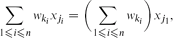 where xj1 is the most repeated value in x. For w = (1, . . ., 1), this result reduces to Gao's theorem.
Information
- Type
- Paper
- Information
- Copyright
- Copyright © Cambridge University Press 2008
References
[2]Erdős, P., Ginzburg, A. and Ziv, A. (1961) A theorem in additive number theory. Bull Res. Council Israel 10F 41–43.Google Scholar
[3]Erdős, P. and Heilbronn, H. (1964) On the addition of residue classes mod p. Acta Arith. 9 149–159.CrossRefGoogle Scholar
[4]Gao, W. D. (1996) A combinatorial problem on finite abelian groups. J. Number Theory 58 100–103.CrossRefGoogle Scholar
[5]Gao, W. D. and Jin, X. (2004) Weighted sums in finite cyclic groups. Discrete Math. 283 243–247.CrossRefGoogle Scholar
[6]Geroldinger, A. and Halter-Koch, F. (2006) Non-Unique Factorizations: Algebraic, Combinatorial and Analytic Theory. Vol. 278 of Pure and Applied Mathematics, Chapman & Hall/CRC, Boca Raton, FL.Google Scholar
[7]Grynkiewicz, D. J. (2006) A weighted Erdős–Ginzburg–Ziv theorem. Combinatorica 26 445–453.CrossRefGoogle Scholar
[8]Hamidoune, Y. O. (1992) On a subgroup contained in some words with a bounded length. Discrete Math. 103 171–176.Google Scholar
[9]Hamidoune, Y. O. (1995) On weighted sequence sums. Combin. Probab. Comput. 4 363–367.CrossRefGoogle Scholar
[10]Kempermann, J. H. B. (1956) On complexes in a semigroup. Nederl. Akad. Wetensch. Proc. Ser A 59, Indag. Math. 18247–254.Google Scholar
[11]Scherk, P. and Moser, L. (1955) Advanced problems and solutions: Solutions 4466. Amer. Math. Monthly 62 46–47.Google Scholar
[12]Shepherdson, J. C. (1947) On the addition of elements of a sequence. J. London Math. Soc. 22 85–88.CrossRefGoogle Scholar
 You have
Access
- 8
- Cited by