




No CrossRef data available.
Article contents
Partitions by congruent sets and optimal positions
Published online by Cambridge University Press: 16 June 2010
Abstract
Core share and HTML view are not available for this content. However, as you have access to this content, a full PDF is available via the 'Save PDF' action button.
Let X be a metrizable space with a continuous group or semi-group action G. Let D be a non-empty subset of X. Our problem is how to choose a fixed number of sets in {g−1D; g∈G}, say σ−1D with σ∈τ, to maximize the cardinality of the partition ℙ({σ−1D; σ∈τ}) generated by them. Let  An infinite subset Σ of G is called an optimal position of the triple (X,G,D)if
 holds for any k=1,2,… and τ⊂Σ with #τ=k. In this paper, we discuss examples of the triple (X,G,D)admitting or not admitting an optimal position. Let X=G=ℝn (n≥1) , where the action g∈G to x∈X is the translation x−g. If D is the n-dimensional unit ball, then
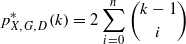 holds and the triple (X,G,D)admits an optimal position. In fact, if n≥2and Σ is an infinite subset of G such that for some δ with 0<δ<1 , Σ⊂{x∈ℝn ; ‖x‖=δ}, and that any subset of Σ with cardinality n+1is not on a hyperplane, then Σ is an optimal position of the triple (X,G,D) . We have determined the primitive factor of the uniform sets coming from these optimal positions. We also show that in the above setting with n=2and the unit square D′ in place of the unit disk D, the maximal pattern complexity is unchanged and p*X,G,D′(k)=k2 −k+2 , but there is no optimal position.
Information
- Type
- Research Article
- Information
- Copyright
- Copyright © Cambridge University Press 2010
References
[1]Gjini, N., Kamae, T., Tan, B. and Xue, Y.-M.. Maximal pattern complexity for Toeplitz words. Ergod. Th. & Dynam. Sys. 26 (2006), 1–14.CrossRefGoogle Scholar
[2]Kamae, T.. Uniform set and complexity. Discrete Math. 309 (2009), 3738–3747.CrossRefGoogle Scholar
[3]Kamae, T. and Rao, H.. Maximal pattern complexity over ℓ letters. European J. Combin. 27 (2006), 125–137.CrossRefGoogle Scholar
[4]Kamae, T., Rao, H., Tan, B. and Xue, Y.-M.. Language structure of pattern Sturmian words. Discrete Math. 306 (2006), 1651–1668.CrossRefGoogle Scholar
[5]Kamae, T., Rao, H., Tan, B. and Xue, Y.-M.. Super-stationary set, subword problem and the complexity. Discrete Math. 309 (2009), 4417–4427.CrossRefGoogle Scholar
[6]Kamae, T., Rao, H. and Xue, Y.-M.. Maximal pattern complexity for two-dimensional words. Theoret. Comput. Sci. 359 (2006), 15–27.CrossRefGoogle Scholar
[7]Kamae, T. and Zamboni, L.. Sequence entropy and the maximal pattern complexity of infinite words. Ergod. Th. & Dynam. Sys. 22 (2002), 1191–1199.CrossRefGoogle Scholar
[8]Kamae, T. and Zamboni, L.. Maximal pattern complexity for discrete systems. Ergod. Th. & Dynam. Sys. 22 (2002), 1201–1214.CrossRefGoogle Scholar
[9]Xue, Y.-M.. Transformations with discrete spectrum and sequence entropy. Master’s Thesis, Osaka City University, 2000 (in Japanese).Google Scholar
 You have Access