


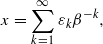
 , then, as is well known, there always exist x∈(0,1/(β−1)) which have a unique β-expansion. We study (purely) periodic unique β-expansions and show that for each n≥2 there exists
 such that there are no unique periodic β-expansions of smallest period n for β≤β


Crossref Citations

This article has been cited by the following publications. This list is generated based on data provided by Crossref.
Allouche, Jean-Paul
and
Wen, Zhi-Xiong
2010.
Recent Developments in Fractals and Related Fields.
p.
383.
Hare, Kevin G.
and
Sidorov, Nikita
2014.
On cycles for the doubling map which are disjoint from an interval.
Monatshefte für Mathematik,
Vol. 175,
Issue. 3,
p.
347.
Sidorov, N.
2014.
Supercritical Holes for the Doubling Map.
Acta Mathematica Hungarica,
Vol. 143,
Issue. 2,
p.
298.
Šíma, Jiří
2014.
Theory and Practice of Natural Computing.
Vol. 8890,
Issue. ,
p.
243.
Barrera, Rafael Alcaraz
2014.
Topological and ergodic properties of symmetric sub-shifts.
Discrete and Continuous Dynamical Systems,
Vol. 34,
Issue. 11,
p.
4459.
GLENDINNING, PAUL
and
SIDOROV, NIKITA
2015.
The doubling map with asymmetrical holes.
Ergodic Theory and Dynamical Systems,
Vol. 35,
Issue. 4,
p.
1208.
Baker, Simon
2015.
On small bases which admit countably many expansions.
Journal of Number Theory,
Vol. 147,
Issue. ,
p.
515.
GE, Yuehua
and
TAN, Bo
2017.
Periodicity of the univoque β-expansions.
Acta Mathematica Scientia,
Vol. 37,
Issue. 1,
p.
33.
Bandt, Christoph
2017.
Recent Developments in Fractals and Related Fields.
p.
39.
Šíma, Jiří
and
Savický, Petr
2017.
Language and Automata Theory and Applications.
Vol. 10168,
Issue. ,
p.
311.
Sima, Jiri
2017.
Neural networks between integer and rational weights.
p.
154.
Bandt, Christoph
2018.
Finite orbits in multivalued maps and Bernoulli convolutions.
Advances in Mathematics,
Vol. 324,
Issue. ,
p.
437.
Šíma, Jiří
and
Savický, Petr
2018.
Quasi-periodic β-expansions and cut languages.
Theoretical Computer Science,
Vol. 720,
Issue. ,
p.
1.
BAKER, SIMON
and
KONG, DERONG
2019.
Numbers with simply normal β-expansions.
Mathematical Proceedings of the Cambridge Philosophical Society,
Vol. 167,
Issue. 01,
p.
171.
Anušić, Ana
Bruin, Henk
and
Činč, Jernej
2020.
Topological properties of Lorenz maps derived from unimodal maps.
Journal of Difference Equations and Applications,
Vol. 26,
Issue. 8,
p.
1174.
BAKER, SIMON
2020.
Digit frequencies and self-affine sets with non-empty interior.
Ergodic Theory and Dynamical Systems,
Vol. 40,
Issue. 7,
p.
1755.
Li, Y.-Q.
2020.
Digit frequencies of beta-expansions.
Acta Mathematica Hungarica,
Vol. 162,
Issue. 2,
p.
403.
2021.
Li, Yao-Qiang
2021.
Hausdorff dimension of frequency sets of univoque sequences.
Dynamical Systems,
Vol. 36,
Issue. 2,
p.
340.
BARRERA, RAFAEL ALCARAZ
2021.
On the specification property and synchronization of uniqueq-expansions.
Ergodic Theory and Dynamical Systems,
Vol. 41,
Issue. 9,
p.
2659.