Contents
Research Article
On the dimensions of a family of overlapping self-affine carpets
-
- Published online by Cambridge University Press:
- 21 July 2015, pp. 2463-2481
-
- Article
-
- You have access
- Export citation
Algebraic independence of multipliers of periodic orbits in the space of polynomial maps of one variable
-
- Published online by Cambridge University Press:
- 15 December 2014, pp. 1156-1166
-
- Article
-
- You have access
- Export citation
-
We consider the space of complex polynomials of degree
 $n\geq 3$ with
 $n-1$ distinct marked periodic orbits of given periods. We prove that this space is irreducible and the multipliers of the marked periodic orbits, considered as algebraic functions on that space, are algebraically independent over
 $\mathbb{C}$. Equivalently, this means that at its generic point the moduli space of degree-
 $n$ polynomial maps can be locally parameterized by the multipliers of
 $n-1$ arbitrary distinct periodic orbits. We also prove a similar result for a certain class of affine subspaces of the space of complex polynomials of degree
 $n$.


Actions of finite rank: weak rational ergodicity and partial rigidity
-
- Published online by Cambridge University Press:
- 13 April 2015, pp. 2138-2171
-
- Article
-
- You have access
- Export citation
A global two-dimensional version of Smale’s cancellation theorem via spectral sequences
-
- Published online by Cambridge University Press:
- 19 March 2015, pp. 1795-1838
-
- Article
-
- You have access
- Export citation
-
In this article, Conley’s connection matrix theory and a spectral sequence analysis of a filtered Morse chain complex
 $(C,{\rm\Delta})$ are used to study global continuation results for flows on surfaces. The briefly described unfoldings of Lyapunov graphs have been proved to be a well-suited combinatorial tool to keep track of continuations. The novelty herein is a global dynamical cancellation theorem inferred from the differentials of the spectral sequence
 $(E^{r},d^{r})$ . The local version of this theorem relates differentials
 $d^{r}$ of the
 $r$ th page
 $E^{r}$ to Smale’s theorem on cancellation of critical points.


Superattracting fixed points of quasiregular mappings
-
- Published online by Cambridge University Press:
- 10 November 2014, pp. 781-793
-
- Article
-
- You have access
- Export citation
-
We investigate the rate of convergence of the iterates of an
 $n$-dimensional quasiregular mapping within the basin of attraction of a fixed point of high local index. A key tool is a refinement of a result that gives bounds on the distortion of the image of a small spherical shell. This result also has applications to the rate of growth of quasiregular mappings of polynomial type, and to the rate at which the iterates of such maps can escape to infinity.

Functorial properties of Putnam’s homology theory for Smale spaces
-
- Published online by Cambridge University Press:
- 19 March 2015, pp. 1411-1440
-
- Article
-
- You have access
- Export citation
Large deviation principles of one-dimensional maps for Hölder continuous potentials
-
- Published online by Cambridge University Press:
- 04 August 2014, pp. 127-141
-
- Article
-
- You have access
- Export citation
Combinatorial and probabilistic properties of systems of numeration
-
- Published online by Cambridge University Press:
- 16 September 2014, pp. 422-457
-
- Article
-
- You have access
- Export citation
-
Let
 $G=(G_{n})_{n}$ be a strictly increasing sequence of positive integers with
 $G_{0}=1$. We study the system of numeration defined by this sequence by looking at the corresponding compactification
 ${\mathcal{K}}_{G}$ of
 $\mathbb{N}$ and the extension of the addition-by-one map
 ${\it\tau}$ on
 ${\mathcal{K}}_{G}$ (the ‘odometer’). We give sufficient conditions for the existence and uniqueness of
 ${\it\tau}$-invariant measures on
 ${\mathcal{K}}_{G}$ in terms of combinatorial properties of
 $G$.


Stable sets and mean Li–Yorke chaos in positive entropy actions of bi-orderable amenable groups
-
- Published online by Cambridge University Press:
- 01 June 2015, pp. 2482-2497
-
- Article
-
- You have access
- Export citation
-
It is proved that positive entropy implies mean Li–Yorke chaos for a
 $G$ -system, where
 $G$ is a countable, infinite, discrete, bi-orderable amenable group. Examples are given for the cases of integer lattice groups and groups of integer unipotent upper triangular matrices.


A Franks’ lemma that preserves invariant manifolds
-
- Published online by Cambridge University Press:
- 15 December 2014, pp. 1167-1203
-
- Article
-
- You have access
- Export citation
-
D’après un célèbre lemme de John Franks, toute perturbation de la différentielle d’un difféomorphisme
 $f$ le long d’une orbite périodique est réalisée par une
 $C^{1}$-perturbation
 $g$ du difféomorphisme sur un petit voisinage de ladite orbite. On n’a cependant aucune information sur le comportement des variétés invariantes de l’orbite périodique après perturbation. Nous montrons que si la perturbation de la dérivée est obtenue par une isotopie le long de laquelle existent les variétés stables/instables fortes de certaines dimensions, alors on peut faire la perturbation ci-dessus en préservant les variétés stables/instables semi-locales correspondantes. Ce résultat a de nombreuses applications en systèmes dynamiques de classes
 $C^{1}$. Nous en démontrons quelques unes.


Lyapunov spectrum for multimodal maps
-
- Published online by Cambridge University Press:
- 19 March 2015, pp. 1441-1493
-
- Article
-
- You have access
- Export citation
Positive area and inaccessible fixed points for hedgehogs
-
- Published online by Cambridge University Press:
- 13 April 2015, pp. 1839-1850
-
- Article
-
- You have access
- Export citation
-
Let
 $f$ be a germ of holomorphic diffeomorphism with an irrationally indifferent fixed point at the origin in
 $\mathbb{C}$ (i.e.
 $f(0)=0,f^{\prime }(0)=e^{2{\it\pi}i{\it\alpha}},{\it\alpha}\in \mathbb{R}-\mathbb{Q}$ ). Perez-Marco showed the existence of a unique family of non-trivial invariant full continua containing the fixed point called Siegel compacta. When
 $f$ is non-linearizable (i.e. not holomorphically conjugate to the rigid rotation
 $R_{{\it\alpha}}(z)=e^{2{\it\pi}i{\it\alpha}}z$ ) the invariant compacts obtained are called hedgehogs. Perez-Marco developed techniques for the construction of examples of non-linearizable germs [Fixed points and circle maps. Acta Math. 179(2) (1997), 243–294]; these were used by the author to construct hedgehogs of Hausdorff dimension one, and adapted by Cheritat [Relatively compact Siegel disks with non-locally connected boundaries, Preprint, 2009] to construct Siegel disks with pseudo-circle boundaries. We use these techniques to construct hedgehogs of positive area and hedgehogs with inaccessible fixed points.


(Uniform) convergence of twisted ergodic averages
-
- Published online by Cambridge University Press:
- 13 April 2015, pp. 2172-2202
-
- Article
-
- You have access
- Export citation
-
Let
 $T$ be an ergodic measure-preserving transformation on a non-atomic probability space
 $(X,\unicode[STIX]{x1D6F4},\unicode[STIX]{x1D707})$ . We prove uniform extensions of the Wiener–Wintner theorem in two settings: for averages involving weights coming from Hardy field functions
 $p$ , and for ‘twisted’ polynomial ergodic averages,
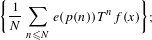 $$\begin{eqnarray}\displaystyle \bigg\{\frac{1}{N}\mathop{\sum }_{n\leq N}e(p(n))T^{n}f(x)\bigg\}; & & \displaystyle \nonumber\end{eqnarray}$$for certain classes of badly approximable
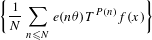 $$\begin{eqnarray}\displaystyle \bigg\{\frac{1}{N}\mathop{\sum }_{n\leq N}e(n\unicode[STIX]{x1D703})T^{P(n)}f(x)\bigg\} & & \displaystyle \nonumber\end{eqnarray}$$
 $\unicode[STIX]{x1D703}\in [0,1]$ . We also give an elementary proof that the above twisted polynomial averages converge pointwise
 $\unicode[STIX]{x1D707}$ -almost everywhere for
 $f\in L^{p}(X),p>1,$ and arbitrary
 $\unicode[STIX]{x1D703}\in [0,1]$ .


Chaotic planar piecewise smooth vector fields with non-trivial minimal sets
-
- Published online by Cambridge University Press:
- 05 August 2014, pp. 458-469
-
- Article
-
- You have access
- Export citation
Odd and even Maass cusp forms for Hecke triangle groups, and the billiard flow
-
- Published online by Cambridge University Press:
- 04 August 2014, pp. 142-172
-
- Article
-
- You have access
- Export citation
-
By a transfer operator approach to Maass cusp forms and the Selberg zeta function for cofinite Hecke triangle groups, Möller and the present author found a factorization of the Selberg zeta function into a product of Fredholm determinants of transfer-operator-like families:
In this article we show that the operator families $$\begin{eqnarray}Z(s)=\det (1-{\mathcal{L}}_{s}^{+})\det (1-{\mathcal{L}}_{s}^{-}).\end{eqnarray}$$
 ${\mathcal{L}}_{s}^{\pm }$ arise as families of transfer operators for the triangle groups underlying the Hecke triangle groups, and that for
 $s\in \mathbb{C}$,
 $\text{Re}s={\textstyle \frac{1}{2}}$, the operator
 ${\mathcal{L}}_{s}^{+}$ (respectively
 ${\mathcal{L}}_{s}^{-}$) has a 1-eigenfunction if and only if there exists an even (respectively odd) Maass cusp form with eigenvalue
 $s(1-s)$. For non-arithmetic Hecke triangle groups, this result provides a new formulation of the Phillips–Sarnak conjecture on non-existence of even Maass cusp forms.


Ergodic multiplier properties
-
- Published online by Cambridge University Press:
- 10 November 2014, pp. 794-815
-
- Article
-
- You have access
- Export citation
-
In this article we will extend ‘the weak mixing theorem’ for certain locally compact Polish groups (Moore groups and minimally weakly mixing groups). In addition, we will show that the Gaussian action associated with the infinite-dimensional irreducible representation of the continuous Heisenberg group,
 $H_{3}(\mathbb{R})$, is weakly mixing but not mildly mixing.

Fixed points of nilpotent actions on
 $\mathbb{S}^{2}$
-
- Published online by Cambridge University Press:
- 05 August 2014, pp. 173-197
-
- Article
-
- You have access
- Export citation
-
We prove that a nilpotent subgroup of orientation-preserving
 $C^{1}$ diffeomorphisms of
 $\mathbb{S}^{2}$ has a finite orbit of cardinality at most two. We also prove that a finitely generated nilpotent subgroup of orientation-preserving
 $C^{1}$ diffeomorphisms of
 $\mathbb{R}^{2}$ preserving a compact set has a global fixed point. These results generalize theorems of Franks et al for the abelian case. We show that a nilpotent subgroup of orientation-preserving
 $C^{1}$ diffeomorphisms of
 $\mathbb{S}^{2}$ that has a finite orbit of odd cardinality also has a global fixed point. Moreover, we study the properties of the 2-points orbits of nilpotent fixed-point-free subgroups of orientation-preserving
 $C^{1}$ diffeomorphisms of
 $\mathbb{S}^{2}$.


Measurable rigidity for Kleinian groups
-
- Published online by Cambridge University Press:
- 01 June 2015, pp. 2498-2511
-
- Article
-
- You have access
- Export citation
-
Let
 $G,H$ be two Kleinian groups with homeomorphic quotients
 $\mathbb{H}^{3}/G$ and
 $\mathbb{H}^{3}/H$ . We assume that
 $G$ is of divergence type, and consider the Patterson–Sullivan measures of
 $G$ and
 $H$ . The measurable rigidity theorem by Sullivan and Tukia says that a measurable and essentially directly measurable equivariant boundary map
 $\widehat{k}$ from the limit set
 $\unicode[STIX]{x1D6EC}_{G}$ of
 $G$ to that of
 $H$ is either the restriction of a Möbius transformation or totally singular. In this paper, we shall show that such
 $\widehat{k}$ always exists. In fact, we shall construct
 $\widehat{k}$ concretely from the Cannon–Thurston maps of
 $G$ and
 $H$ .


On the ergodicity of hyperbolic Sinaĭ–Ruelle–Bowen measures: the constant unstable dimension case
-
- Published online by Cambridge University Press:
- 11 February 2015, pp. 1494-1515
-
- Article
-
- You have access
- Export citation
-
In this paper we consider diffeomorphisms preserving hyperbolic Sinaĭ–Ruelle–Bowen (SRB) probability measures
 ${\it\mu}$ having intersections for almost every pair of the stable and unstable manifolds. In this context, when the dimension of the unstable manifold is constant almost everywhere, we show the ergodicity of
 ${\it\mu}$ . As an application we obtain another proof of the ergodicity of a hyperbolic SRB measure for transitive surface diffeomorphisms, which is shown by Rodriguez Hertz, Rodriguez Hertz, Tahzibi and Ures [Uniqueness of SRB measures for transitive diffeomorphisms on surfaces. Comm. Math. Phys.306(1) (2011), 35–49].


Equivalence classes of codimension-one cut-and-project nets
-
- Published online by Cambridge University Press:
- 11 November 2014, pp. 816-831
-
- Article
-
- You have access
- Export citation
-
We prove that in any totally irrational cut-and-project setup with codimension (internal space dimension) one, it is possible to choose sections (windows) in non-trivial ways so that the resulting sets are bounded displacement equivalent to lattices. Our proof demonstrates that for any irrational
 ${\it\alpha}$, regardless of Diophantine type, there is a collection of intervals in
 $\mathbb{R}/\mathbb{Z}$ which is closed under translation, contains intervals of arbitrarily small length, and along which the discrepancy of the sequence
 $\{n{\it\alpha}\}$ is bounded above uniformly by a constant.


