We partner with a secure submission system to handle manuscript submissions.
Please note:
You will need an account for the submission system, which is separate to your Cambridge Core account. For login and submission support, please visit the
submission and support pages.
Please review this journal's author instructions, particularly the
preparing your materials
page, before submitting your manuscript.
Click Proceed to submission system to continue to our partner's website.
To save this undefined to your undefined account, please select one or more formats and confirm that you agree to abide by our usage policies. If this is the first time you used this feature, you will be asked to authorise Cambridge Core to connect with your undefined account.
Find out more about saving content to .
To send this article to your Kindle, first ensure no-reply@cambridge.org is added to your Approved Personal Document E-mail List under your Personal Document Settings on the Manage Your Content and Devices page of your Amazon account. Then enter the ‘name’ part of your Kindle email address below. Find out more about sending to your Kindle.
Find out more about saving to your Kindle.
Note you can select to save to either the @free.kindle.com or @kindle.com variations. ‘@free.kindle.com’ emails are free but can only be saved to your device when it is connected to wi-fi. ‘@kindle.com’ emails can be delivered even when you are not connected to wi-fi, but note that service fees apply.
When new mothers do not understand how to interact with their newborn babies, they would increase anxiety, even decrease the quality of parent-infant interactions. Previous studies indicate that the postpartum parenting education for first-time-mothers can improve the quality of mother-infant interactions in first two months. This study aimed to evaluate the long-term effectiveness of parenting education for postpartum women during the first year.
Methods
The study recruited 81 healthy first-time-mother infant dyads from the medical center in Taipei city. The experimental and control groups received extra education by way of a 40-minute videotape and normal postpartum care, respectively. Data from around first week (T1), followed by the third (T2), sixth (T3), ninth (T4), and twelfth (T5) month postpartum are collected. Assessment scales such as the Edinburgh perinatal depression scale (EPDS), the Chinese version of the parenting sense of competence scale (C-PSOC), and the Nursing child assessment teaching scale (NCATS) used for videotaped mother-infant interactions measurement were used in the study.
Results
The analytical results show that the quality of mother-infant interaction increased at T2, T3, T4, and T5 in the experimental group (Fig. 1). No different change in maternal sense of competency was found in the experimental and control groups from T1 to T4. However, a positive change in sense of parenting competency at T5 was found in the experimental group (Fig. 2). No difference in postpartum depression was found between the two groups (Fig. 3).
Conclusions
The first-time-mothers parent education has long-term effectiveness in the mother-infant dyad interaction quality.
Disclosure of interest
The authors have not supplied their declaration of competing interest.
EW0746
e-Poster Walk: Posttraumatic stress disorder; Women, gender and mental health
Childbirth represents for women a time of vulnerability to postpartum mood disorders. These disorders range in severity from the early maternal blues to postpartum psychosis. Along this spectrum is postpartum depression (PPD) that may have many risk factors.
Objectives
The study aims to examine the prevalence of PPD and associated risk factors among a sample of Tunisian women receiving cares in the hospital of Sfax.
Methods
This is a descriptive cross-sectional study regarding 150 parturients examined during the first and the sixth week post-delivery. The EPDS (Edinburgh postnatal depression scale) was used to assess PPD.
Results
The total sample had a mean age of 29.61 years. During the sixth week study period, 126 of 150 were examined. Almost all of the women have a low school level (82.7%). Only 9.3% had a personal psychiatric history. Multiparity was found in 43.3% of cases. The current pregnancy was undesired in 15.3% of cases. Sympathetic signs of pregnancy were reported by 64.7% of women. The prevalence of PPD in the first week was 14.7% and 19.8% in the sixth week after delivery. The PPD was associated with the maternal age (> 35 years), the low school level, the existence of mood personal background, the parity, the difficulty to accept the pregnancy and sympathetic signs of pregnancy.
Conclusion
Postpartum depression is common on our sample. Identifying risk factors of PPD allows clinicians to detect subgroups of women with an increased vulnerability who might receive early psychiatric care.
Disclosure of interest
The authors have not supplied their declaration of competing interest.
EW0747
e-Poster Walk: Posttraumatic stress disorder; Women, gender and mental health
Despite growing acceptance of same-sex sexuality in the Western World, identity development of lesbian, gay and bisexual (LGB) individuals is still restricted by negative societal attitudes, which maintain the experience of stigmatization and discrimination.
Objectives
The purpose of this study was to document the frequency of discriminatory events experienced by sexual minorities and their association with indicators of mental health in a Portuguese self-identified LGB sample.
Aims
To determine the association of harassment and discrimination with levels of mental health, and to establish a predictive relation between these variables.
Methods
A total of 610 LGB participants completed an online survey (mean age = 34.48, SD = 11.54). Most participants were single and self-identified as gay (73.8%). The survey included the following categories of survey items: demographic information, mental health, and discrimination experiences. Mental health was measured using the subscale of Emotional Wellness from the SF-36 questionnaire and the K10 questionnaire.
Results
Between one-fifth and one-fourth of the participants in this sample frequently felt the need to hide their sexual orientation to prevent discrimination experiences. Close to 20% reported having suffered from verbal abuse, followed by close to 10% who suffered from written threats, harassment, and physical threats. A hierarchical multiple regression analysis was performed to assess the effects of anticipated and actual discrimination on mental health. The analysis explained 17% of the overall variance.
Conclusions
Stigma/discrimination create discriminatory experiences which impact LGB people's mental health.
Disclosure of interest
The author has not supplied his declaration of competing interest.
EW0748
e-Poster Walk: Posttraumatic stress disorder; Women, gender and mental health
In the literature, the growing interest to the gender such as variable expression and treatment of psychiatric disorders, it is emerged in a considerable number of fields. Gender differences have become the subject of numerous investigations, in order to verify how the sex variable might affect the psychopathology.
Aims
We propose to evaluate the role of gender differences in the development of traits of schizotypal personality, impulsivity, SS and their influence in the definition of temperamental component.
Materials
We recruited 173 healthy subjects, between 18 and 65 years, who completed the following tests: BIS-11; SPQ; SDS; SAS; HCL-32; TEMPS-A; SSS.
Results
The bivariate analysis by gender shows scores for the hyperthymic temperament significantly higher among males compared to the scores for the female sex, which, in turn, presents higher scores for cyclothymic. The levels of anxiety and depression are higher among women while levels of sensation seeking are higher among men. Although the male gender is associated with a greater sensation seeking, compared to women, it is not showed a higher correlation with the different types of impulsivity. We can find significant differences to the subscales for the SPQ between the two genders.
Conclusions
The examination of these data may suggest the existence of differential specific features of gender that, in the presence of psychopathology, become more easily detectable; particularly in the male gender, it seems to emerge more impulsive behavior and activation compared to the female gender in which instead it seems to prevail a tendency to emotionality and introversion.
Disclosure of interest
The authors have not supplied their declaration of competing interest.
EW0749
e-Poster Walk: Posttraumatic stress disorder; Women, gender and mental health
Systematic assessment of risks is an essential component of care in psychiatric mother baby units. Self-harm, infant neglect and harm or the vulnerable physical health of both mother and infant may all pose risks.
Aim
Development of a risk assessment tool and risk assessment among mother-infant dyads at a MBU in Bangalore, India.
Methods
Based on data from 200 admissions, doctors and nurses of the unit developed a 15-item tool for risk assessment. Risk was assessed by both nurses and doctors among 58 consecutive mothers admitted to the unit. Risk domains included risks to self, to infant, related to infant health and feeding and violence faced by mother. Frequencies of various risks were calculated. Nurses’ risk assessments were compared to the residents’ risk assessments.
Results
The mean age of the mothers was 25 (±4) years, age of infant 4 (±4) months and duration of episode was 4 (±14) months. Diagnoses included acute polymorphic psychosis (30%), BPAD (27%) and depression (21%). 47% had high suicidal risk and 28% had made an attempt in the current episode. 22% had expressed ideas of infant harm and 24% had physically harmed the infant. 48% of mothers had been physically violent. Multiple risks were seen in 47%. Doctors were able to identify risks more often than nurses.
Conclusion
Risks for self-harm, infant harm and related to infant health were high. Systematic risk assessment by both nurses and doctors is important in an MBU to ensure adequate care for the mother infant dyad.
Disclosure of interest
The authors have not supplied their declaration of competing interest.
EW0750
e-Poster Walk: Posttraumatic stress disorder; Women, gender and mental health
The aim of this study was to investigate the prevalence of postpartum depression among women and determine which factors are related this clinical condition.
Methods
The study included 206 women who were admitted to the department of child health and diseases neonatal intensive care unit in Selcuk university faculty of medicine within six weeks postpartum period. First SCID-I and demographic data form for the participants who were volunteer to participate the study were filled. Then, Edinburgh postpartum depression scale, multidimensional scale of perceived social support, Beck anxiety inventory and maternal bonding scale were applied to all participants.
Results
We found that 6.8% (n = 14) of mothers have postpartum depression. Than we compared the two grups postpartum depression (PPD) and non-postpartum depression (NPPD). In terms of socio-demographic characteristics and found a significant difference only in the level of economic status. Socio-economic status was lower in the group with PPD. In addition, social support received during pregnancy was significantly lower in the group with the PPD. Peripartum or any time depression history and comorbid psychiatric disorders were related factors with PPD. EPDS scores were significantly higher and MSPSS scores were significantly lower in the group with PPD.
Conclusion
Postpartum depression has many negative consequences for both mother and baby. In the present study, we found that postpartum depression rates were consistent with previous studies. Early detection, prevention and treatment of postpartum depression is very important for the postpartum women who have a higher risk for depression.
Disclosure of interest
The authors have not supplied their declaration of competing interest.
EW0751
e-Poster Walk: Posttraumatic stress disorder; Women, gender and mental health
Depression is one of the most common mental disorders worldwide. Women are more at risk of depression while they are pregnant, and during the first weeks and months of postpartum period. Perinatal depression, might influence the children‘s development during pregnancy as well as it can have negative affect and delay in child postnatal development.
Materials and methods
Pregnant women undergoing antenatal care in Latvia, Riga were interviewed using PHQ-9 and GAD-7 scales, the obtained data from the scale's results were analyzed and summarized in an analystic cross-sectional study. Literature overview.
Results
There is a high correlation between the depressive episodes before pregnancy, during pregnancy and postpartum depression, as well as it have negative effects and delay in child postnatal development. Using Patient Health Questionnaire-9 and Generalised Anxiety Disorder Assessment-7 screening scales, was set up an inquiry among 200 pregnant women in Riga, Latvia. Depressive symptoms have 45% of pregnant women. 36% of pregnant women have mild depression symptoms, 3% moderate symptoms, 5% moderate serve symptoms and 1% serve depression symptoms. In its turn anxiety disorder screening results are following: 35% of pregnant women have mild anxiety symptoms, 9% moderate anxiety symptoms; 3% serve anxiety symptoms. Anxiety disorder symptoms note 47% of pregnant women. 36% of respondents note both depression symptoms and anxiety disorder symptoms.
Conclusion
HQ-9 and GAD-7 scales are informative, quick and easy for patients to complete. Children development and behavior has association with maternal depressive state during pregnancy. There is high prevalence of depression symptoms among preganant women in Latvia.
Disclosure of interest
The authors have not supplied their declaration of competing interest.
EW0752
e-Poster Walk: Psychopharmacology and pharmacoeconomics and psychoneuroimmunology
Depression is a disease with high prevalence all over the world. Selective serotonine reuptake inhibitors (SSRIs) and dual antidepressants (DA) are worldwide used to treat the different types of depressive episodes. Between the adverse events of these compounds, an unusual but potentially severe side effect is the syndrome of inapropriate antidiuretic hormone secretion (SIADH).
Results and discussion
Several cases published, and an amount of cases series have documented the association of SIADH to the use of SSRIs and DA. All SSRIs and DA are at risk of producing SIADH (fluoxetine, paroxetine, fluvoxamine, sertraline, citalopram, escitalopram, venlafaxine and duloxetine). Old age has been found as a risk factor for developing SIADH. There are not enough data to conclude that other risk factors can play a role in the development of this adverse event. Treatment should include the immediate withdrawal of the antidepressant. The introduction of other antidepressants is controversial, as SIADH has been related with all antidepressive treatments; but the risk of relapse into a depressive episode must be considered also. Between symptomatic treatments, the control of water intake and the use of low doses of loop diuretics can be recommended. Severe cases can be treated with higher doses of loop diuretics and saline hypertonic solution.
Conclusions
SIADH has been related with SSRIs and DA antidepressants and it is an infrequent but severe adverse event. Its risk must be considered when prescribing treatment with them. If this adverse event is produced, the substitution of the antidepressant should be done.
Disclosure of interest
The authors have not supplied their declaration of competing interest.
EW0753
e-Poster Walk: Psychopharmacology and pharmacoeconomics and psychoneuroimmunology
Purinergic 2X7 receptor (P2X7R) activation has recently been considered to be involved in depression at least partially by triggering microglial activation. The aim of the present study was to examine whether the chronic administration of brilliant blue G (BBG), a highly selective P2X7R antagonist, has antidepressant-like effects and microglial (Iba-1) immunoreactivity in chronic unpredictable mild stress (CUMS) model in rats.
Methods
Male Wistar Albino rats (290–360 g) were divided into groups such as control (saline), CUMS, CUMS + Imipramine (20 mg/kg; i.p.), CUMS + BBG25 (25 mg/kg; i.p.), CUMS + BBG50 (50 mg/kg; i.p.) groups (n = 10–12 in each). In CUMS model, various stressors were applied for 40 days. On day 20, the treatment of BBG was started for 20 days. At the end, sucrose preference and forced swimming tests were performed. Then brains were removed with paraformaldehyde perfusion for Iba-1 immunohistochemical analysis in hippocampus. One-way analysis of variance and Tukey's test were used for statistical analysis.
Results
The time of immobility in forced swim test was significantly reduced while sucrose preference was increased in Imipramine and CUMS + BBG50 groups compared to control and CUMS groups, respectively. In immunohistochemical experiments, Iba-1 was overexpressed in CUMS group and BBG significantly reduced the overexpression of Iba-1.
Conclusion
Our results suggest that chronic administration of BBG has an antidepressant-like activity supporting the notion of P2X7 receptors involvement in depression by modulating microglial activation.
This research was supported by grant from Marmara University, Scientific Research Projects – SAG-C-YLP-110915-0416 and SAG-E-120613-0233.
Disclosure of interest
The authors have not supplied their declaration of competing interest.
EW0754
e-Poster Walk: Psychopharmacology and pharmacoeconomics and psychoneuroimmunology
Harmane is a beta-carboline, which binds to imidazoline receptors and it has been previously shown that it may have an antidepressant effect when administered acutely. This study is planned to investigate the effect of harmane on chronic unpredictable mild stress (CUMS) model and microglial (Iba-1) immunoreactivity in the same model as markers of neuroinflammation.
Methods
Male Wistar Albino rats (290–360 g) were divided into groups such as control (saline), CUMS, CUMS + Imipramine (20 mg/kg; i.p.), CUMS + Harmane5 (5 mg/kg; i.p.), CUMS + Harmane10 (10 mg/kg; i.p.) groups (n = 10–12 in each). In CUMS model, various stressors were applied for 40 days. On day 20, harmane administration was started for 20 days. At the end, sucrose preference and forced swimming tests were performed. Then, brains were removed with paraformaldehyde perfusion for Iba-1 immunohistochemical analysis in hippocampus. One-way analysis of variance and Tukey's test were used for statistical analysis.
Results
The time of immobility in forced swim test was significantly reduced while sucrose preference was increased in Imipramine and CUMS + harmane10 groups. In immunohistochemical experiments, Iba-1 were overexpressed in CUMS group and Harmane significantly reduced the overexpression of Iba-1.
Conclusion
Our results suggest that chronic administration of harmane has an antidepressant-like activity in chronic stress model of depression. These results support the notion of imidazoline receptors involvement in depression by modulating neuroinflammation and at least a part of its antidepressant effect might be through modulating microglial activation as a reflection of neuroinflammation.
This research was supported by Marmara University, Scientific Research Projects – SAG-C-YLP-110915-0415 and SAG-E-120613-0233.
Disclosure of interest
The authors have not supplied their declaration of competing interest.
EW0755
e-Poster Walk: Psychopharmacology and pharmacoeconomics and psychoneuroimmunology
Dopamine receptors perform various functions essential to vertebrate central nervous systems and they are the major targets of antipsychotic drugs. Our recent studies pioneered to perform molecular modeling studies of the dopamine D2 receptor (D2R), describing the mechanism and binding affinities of marketed antipsychotics into the active sites of the D2highR and D2LowR [1]. Another study provided significant information about changes of binding cavity properties of D2R [2].
Objectives
Since the marketed antipsychotics have serious side effects, we aim to explore ligands with better inhibition profiles on D2R with less unwanted outcomes. For this aim, we compare the effectiveness of the marketed drugs with small peptides and vitamin substances.
Aims
The main goal of the research is to explore novel small molecules that inhibit D2R to be used in schizophrenia.
Methods
In this study, we used a large number of endogen vitamins and peptides with dopamine D2R active-inactive forms in monomeric-dimeric patterns to understand their interactions at the active sites of targets. Nineteen of antipsychotic drugs, which are widely used in schizophrenia treatment are selected as reference molecules. Molecular docking, molecular screening and molecular modeling approaches were used.
Results
Some of these endogen molecules showed similar or better inhibition profiles on D2R compared to the known standard inhibitors of the target.
Conclusions
Proposed molecules may be potent for D2 receptor inhibition with less side effects for the use for schizophrenia.
Disclosure of interest
The authors have not supplied their declaration of competing interest.
EW0756
e-Poster Walk: Psychopharmacology and pharmacoeconomics and psychoneuroimmunology
Given the poor compliance of schizofrenic patients to antipsychotic therapies, are been developed drugs in long-acting formulation that for their pharmacokinetic ensures prolonged therapeutic activities. Currently, we consider that their efficacy depends on hereditary tracts, influencing both pharmacodynamic and pharmacokinetic parameters.
Objective
Investigate relationships between clinical efficacy and genetic polymorphims of long-acting drugs’ pharmacodynamic targets.
Methods
Seventy-eight psychotic patients, treated with atypical long-acting antipsychotics (olanzapine pamoate, paliperidone palmitate, risperidon and aripiprazole), were examined. We carried out a blood sampling to evaluate dopaminergic DRD2 and glutamatergic GRM3 genetic receptors polymorphisms. PANSS and BPRS scales were used to assess clinical condition.
Results
Regarding the GRM3 genes, the study of rs2228595 and rs6465084 polymorphisms showed a prevalence of wild type genotypic frequency of 81.2% and 56.2%, respectively. The prevalence of the patients with mutated heterozygote genotype (rs6465084 polymorphisms) resulted high (40.6%). Considering rs1989796 e rs274622 polymorphisms, the sample showed a prevalence of mutated heterozygote genotype in the 53.1% e 45.3%, respectively, with a percentage of 43.7% of patients with a mutation in homozygosis. Considering the rs146812 polymorphism, the 53.1% of patients resulted with a wild type genotype. Finally, findings showed a prevalence of 56.2% for the mutated heterozygote genotype in the DRD2 rs6277 polymorphism. The genotypic categorization analysis demonstrated a significative association between the GRM3 rs274622 polymorphism and higher BPRS scores.
Conclusions
The relationship between rs274622 polymorphism and worse clinical conditions could indicate a major resistance to long-acting antipsychotics in patients with genotypic frequency CT (mutated heterozygosis) for this polymorphism.
Disclosure of interest
The authors have not supplied their declaration of competing interest.
EW0757
e-Poster Walk: Psychopharmacology and pharmacoeconomics and psychoneuroimmunology
The multicenter, cross-sectional survey summarizes the current prescription patterns of psychopharmacological medications in patients with major depressive disorder (MDD) treated in European university psychiatric centers.
Methods
The study included a total of 1181 MDD patients who were recruited in 9 academic sites across 8 European countries. Socio-demographic, clinical, and psychopharmacological characteristics were collected within a detailed clinical interview and the current depressive symptom severity was measured by the Montgomery and Åsberg Depression Rating Scale (MADRS). Symptom reduction during the present MDD episode was analyzed by calculating retrospective MADRS scores. Descriptive statistics, analyses of variance (ANOVAs), and Spearman correlation analyses were performed to examine the impact of various features on the applied pharmacological strategies.
Results
Regarding first-line antidepressant medication, the most frequently prescribed drug classes were selective serotonin reuptake inhibitors (SSRIs) (53.4%), serotonin-norepinephrine reuptake inhibitors (SNRIs) (23.6%), noradrenergic and specific serotonergic antidepressants (NaSSAs) (8.2%), tricyclic antidepressants (TCA) (5.1%), and the melatonergic antidepressant agomelatine (5.0%). The most commonly used individual antidepressants were escitalopram (18.4%), venlafaxine (15.2%), sertraline (12.9%), paroxetine (9.1%), mirtazapine (8.2%), duloxetine (7.0%), and fluoxetine (6.5%). Among the patients, 59.4% were treated with polypsychopharmaceutical medications (mean: 2 drugs) and for the number of individual drugs, we found a significant correlation with the present MADRS total score and the MADRS total score change during the current depressive episode.
Conclusion
Consistent with surveys investigating primarily municipal psychiatric treatment centers, we could replicate the observation that SSRIs are the most commonly used antidepressants in MDD for the first time for European university centers.
Disclosure of interest
The authors have not supplied their declaration of competing interest.
EW0758
e-Poster Walk: Psychopharmacology and pharmacoeconomics and psychoneuroimmunology
Depression has sleep disturbances as a key symptom and recently sleep has been suggested as a new area to optimize treatment in depression. Orexin is produced in the hypothalamus and projected throughout the brain innervating a number of structures important in depression. It controls a number of physiological processes including sleep, arousal, cognitive processes and stress, which are affected during depression.
Objective
The study examines the possible implications for abnormalities in the orexinergic system in depression. We aim to determine whether treatment targeting this system relieves depressive symptoms.
Methods
Using real-time qPCR and Western blotting optimal sampling time is determined by an assessment of the diurnal variation of orexin expression. Expression of orexin and its receptors are investigated in the hypothalamus, the hippocampus, and the prefrontal cortex of the Flinders Sensitive Line (FSL) and the Chronic Mild Stress model of depression. Behavioral and molecular response to treatment with a conventional antidepressant and an orexin receptor antagonist will be addressed in FSL rats. In addition, we will include exercise as a noninvasive treatment, which has shown positive effects on both sleep and depression in humans.
Results
Real-time qPCR analysis showed increased expression of the orexin-1 receptor (40%) and the orexin-2 receptor (39%) in the prefrontal cortex of FSL rats compared to the control rats, the Flinders Resistant Line rats.
Conclusion
This study may provide a platform for screening of drugs with effects on both sleep and depressive symptoms with perspectives for the development of novel strategies for treatment of depression.
Disclosure of interest
The authors have not supplied their declaration of competing interest.
EW0759
e-Poster Walk: Psychopharmacology and pharmacoeconomics and psychoneuroimmunology
Introduction
Patients with schizophrenia have 3-fold higher mortality from lifestyle diseases, and a long-lasting exposure to antipsychotic medication may contribute to the development of somatic illnesses. Region of Central Jutland was inspired by European initiatives to establish a lifestyle intervention program in an attempt to reduce mortality among individuals with severe mental illness.
Objectives
To investigate whether this intervention could possibly lower the need for antipsychotic treatment, and to provide a unique view of actual medication practice.
Aims
To investigate the influence of a lifestyle intervention program on changes in antipsychotic medication and polypharmacy in an unselected cohort of patients with newly diagnosed schizophrenia.
Methods
Observational study of outpatients participating in a program with individual consultations, group sessions and exercise groups.
Results
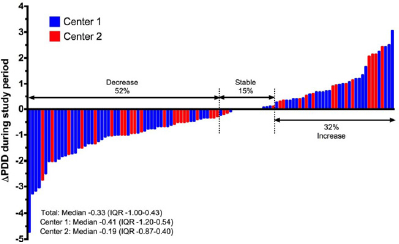
One hundred and eleven patients were eligible for analysis. Fifty-four percent of the patients were subject to antipsychotic monotherapy. Median Defined Daily Dose (DDD) of antipsychotics was 1.3 at index (interquartile range [IQR] 0.67–2.00). Fifty-two percent of the patients experienced a decrease in DDD during the period with median change of −0.33 DDD (IQR −1.00 to 0.43). We found no significant difference in baseline variables or extend of participation between patients with decrease in doses and patients with increase (Fig. 1).
Conclusions
Most patients decreased or stabilized their doses of antipsychotic medication during the study period. Half of the patients were subject to antipsychotic polypharmacy. Extend and type of participation in the lifestyle intervention program did not correlate to changes in dosing of antipsychotic medication.
Disclosure of interest
The authors have not supplied their declaration of competing interest.
Fig. 1
Change in total DDD from index to follow-up (111 patients).
Fibromyalgia is characterized by skeletal muscle pain and axial stiffness, with elective multiple points of tenderness (tender points). According to scientific literature, the prevalence of depression, anxiety and a worse quality of life is higher in patients with fibromyalgia. Trauma (sexual abuse and physical aggression) has a key role in the pain perception.
Objectives
To describe the clinical characteristics of patients with fibromyalgia and/or autoimmune rheumatic diseases admitted to O.O.R.R. Foggia (Department of Rheumatology), to detect correlation between fibromyalgia and psychiatric disorders.
Aims
To underline psychiatric comorbidity in patients affected by fibromyalgia and/or autoimmune rheumatic diseases.
Methods
Diagnostic tests at Baseline (T0): Mini International Neuropsychiatric Interview and Structured Clinical Interview for DSM Disorder 2 to assess psychopathology, 12-Item Short Form survey for the quality of life, Diagnostic Criteria for Psychosomatic Research for disorders of somatic symptoms, Insight Scale for the awareness of the disease, Davidson Trauma scales to assess the presence of a post-traumatic stress disorder, Pittsburgh Sleep Quality Index about the quality of sleep. After 3 months (T1): further psychodiagnostic assessment for patients with positive mental status exam in drug treatment.
Results
Affectivity disorders, feelings of anger, irritability, hostility, impaired stress response, increased vulnerability to traumatic events are very frequent in patients affected by fibromyalgia.
Conclusions
The preliminary results of this study show that patients with fibromyalgia have diagnoses of major depression, anxiety disorders, post-traumatic stress disorder and personality disorders (cluster B). Multidisciplinary interventions are needed integrating the rheumatologic therapy with the psychiatric one, based on the detected diagnosis.
Disclosure of interest
The authors have not supplied their declaration of competing interest.
EW0761
e-Poster Walk: Psychopharmacology and pharmacoeconomics and psychoneuroimmunology
Patients with psychosis are treated in outpatient community clinics during most of their lifetime. Antipsychotic treatments are commonly used in regular clinical practice. However, the non-adherence is one of the main causes of relapses. Long-acting injectables (LAIs) could be a safe option to guarantee the efficacy.
Aim and objectives
Our purpose is to evaluate the efficacy of the switch to paliperidone palmitate from other oral or LAI antipsychotics, in terms of hospital and emergency admissions.
Methods
We performed a mirror-image study in an outpatient mental health clinic, comparing patients before and after paliperidone palmitate change over 43 months. Fifty-seven patients were included, most of them (n = 47) were diagnosed with psychotic disorders (82.5%) while 4 were bipolar patients (7%), and the remained patients (n = 6; 10.6%) were classified as behavioral disorders. The following variables were studied before and after the switching: number of admissions, days of stay and emergency visits.
Results
From those 57 patients, 44 were previously treated with other LAIs, whereas 13 were taking oral antipsychotics. The median age at switch was 49 years (SD = 12.31). The reasons for switching were: inefficacy (26.3%), non-adherence (19.3%), side effects (38.6%), and non-specified (15.8%). We found significant differences between the three main variables: number of admissions (t = 4.59; P ≤ 0.001), days of stay (t = 2.27; P = 0.027) and emergency visits (t = 3.74; P ≤ 0.001).
Conclusions
Paliperidone palmitate seems to be an effective treatment in order to guarantee the adherence. Our preliminary data show that paliperidone palmitate might reduce the sanitary cost in outpatients.
Disclosure of interest
The authors have not supplied their declaration of competing interest.
EW0762
e-Poster Walk: Psychopharmacology and pharmacoeconomics and psychoneuroimmunology
Persons using the Internet generate large amounts of health-related data, which are increasingly used in modern health sciences.
Objectives/aims
We analysed the relation between annual prescription volumes (APV) of several antidepressants with marketing approval in Germany and corresponding web search query data generated in Google to test, if web search query volume may be a proxy for medical prescription practice.
Methods
We obtained APVs of several antidepressants related to corresponding prescriptions at the expense of the statutory health insurance in Germany from 2004–2013. Web search query data generated in Germany and related to defined search-terms (active substance or brand name) were obtained with Google Trends. We calculated correlations (Pearson's r) between the APVs of each substance and the respective annual “search share” values; coefficients of determination (R2) were computed to determine the amount of variability shared by the two variables.
Results
Significant and strong correlations between substance-specific APVs and corresponding annual query volume were found for each substance during the observational interval: agomelatine (r = 0.968; R2 = 0.932; P = 0.01), bupropion (r = 0.962; R2 = 0.925; P = 0.01), citalopram (r = 0.970; R2 = 0.941; P = 0.01), escitalopram (r = 0.824; R2 = 0.682; P = 0.01), fluoxetine (r = 0.885; R2 = 0.783; P = 0.01), paroxetine (r = 0.801; R2 = 0.641; P = 0.01), and sertraline (r = 0.880; R2 = 0.689; P = 0.01).
Conclusions
Although the used data did not allow to perform an analysis with a higher temporal resolution our results suggest that web search query volume may be a proxy for corresponding prescription behaviour. However, further studies analysing other pharmacologic agents and prescription data that facilitates an increased temporal resolution are needed to confirm this hypothesis.
Disclosure of interest
The authors have not supplied their declaration of competing interest.
EW0763
e-Poster Walk: Psychopharmacology and pharmacoeconomics and psychoneuroimmunology
Drug safety surveillance strongly depends on the spontaneous and voluntary reporting of adverse drug reactions (ADR). A major limiting factor of spontaneous reporting systems is underreporting (UR) which describes incorrectly low reporting rates of ADR. Factors contributing to UR are numerous and feature country-dependent differences.
Objectives/aims
Understanding causes of UR is necessary to facilitate targeted interventions to improve ADR reporting and pharmacovigilance.
Methods
A cross-sectional questionnaire-based telephone survey was performed among physicians in outpatient care in a federal state of Germany.
Results
From n = 316 eligible physicians n = 176 completed the questionnaire (response rate = 55.7%). Most of the physicians (n = 137/77.8%) stated that they report ADR, which they have observed to the competent authority rarely (n = 59/33.5%), very rarely (n = 59/33.5%) or never (n = 19/10.8%); the majority (n = 123/69.9%) had not reported any ADR in 2014. Frequent subjective reasons for ADR non-reporting were (specified response options): lack of time (n = 52/29.5%), the subjective evaluation that the required process of reporting is complicated (n = 47/26.7%) or requires too much time (n = 25/14.2%) or the assessment that reporting of an ADR is needless (n = 22/12.5%); within free answers the participants frequently stated that they do not report ADR that are already known (n = 72/40.9%) and they only report severe ADR (n = 46/26.1%).
Conclusions
Our results suggest a need of interventions to inform physicians about pharmacovigilance and to modify the required procedure of ADR reporting or to offer other reporting options.
Disclosure of interest
The authors have not supplied their declaration of competing interest.
EW0764
e-Poster Walk: Psychopharmacology and pharmacoeconomics and psychoneuroimmunology
Adherence to prescribed antipsychotic drugs is a crucial factor in predicting medium- to long-term clinical outcome in schizophrenia. A helpful approach to promote adherence in schizophrenia is the use of long-acting injectable (LAI) antipsychotics.
Object
To evaluate:
– the global functioning and the hospitalization rate occurred in the year before and in the year following the switch from a low-efficacy oral antipsychotic to either a LAI once-monthly therapy (palmitate paliperidone or olanzapine pamoate) or the corresponding oral compound (paliperidone\risperidone or olanzapine) in schizophrenic patients;
– the treatment attitude and the insight in patients treated with second-generation antipsychotic (SGA)-LAIs and with the corresponding oral compounds.
Method
Sixty adult schizophrenic outpatients: thirty were switched to LAIs and thirty to the corresponding oral antipsychotic. We used the following scales: Drug Attitude Inventory (DAI), Schedule for the Assessment of Insight (SAI), Life Skill Profile (LSP).
Results
Number of hospitalizations per year decreased in both groups (LAIs: from 1.3 ± 0.5 to 0.3 ± 0.5; oral: from 1.3 ± 0.5 to 0.6 ± 0.5). We found a direct association between the “hospitalization event” and the oral drug compared to the corresponding LAI formulation (P = 0.049; OR: 3.05; 95% IC: 1.01–9.26). Patient receiving LAIs achieved a more significant improvement at the LSP score compared to the oral group (P < 0.001 vs. P = 0.0034) and higher DAI (5.9 ± 4.3 vs. −1.1 ± 4.3) and SAI (8.7 ± 2.9 vs. 5.6 ± 2.1).
Conclusions
Our data suggest that SGA-LAIs, improving the adherence to the treatment, may sensitively reduce costs in mental health services.
Disclosure of interest
The authors have not supplied their declaration of competing interest.