We partner with a secure submission system to handle manuscript submissions.
Please note:
You will need an account for the submission system, which is separate to your Cambridge Core account. For login and submission support, please visit the
submission and support pages.
Please review this journal's author instructions, particularly the
preparing your materials
page, before submitting your manuscript.
Click Proceed to submission system to continue to our partner's website.
To save this undefined to your undefined account, please select one or more formats and confirm that you agree to abide by our usage policies. If this is the first time you used this feature, you will be asked to authorise Cambridge Core to connect with your undefined account.
Find out more about saving content to .
To send this article to your Kindle, first ensure no-reply@cambridge.org is added to your Approved Personal Document E-mail List under your Personal Document Settings on the Manage Your Content and Devices page of your Amazon account. Then enter the ‘name’ part of your Kindle email address below. Find out more about sending to your Kindle.
Find out more about saving to your Kindle.
Note you can select to save to either the @free.kindle.com or @kindle.com variations. ‘@free.kindle.com’ emails are free but can only be saved to your device when it is connected to wi-fi. ‘@kindle.com’ emails can be delivered even when you are not connected to wi-fi, but note that service fees apply.
Football is the world’s most-watched and played sport. Even though sports psychiatry is steadily gaining importance, the stigma on mental illness in sports, especially football, and the limited number of articles on this topic means there is a pressing need for more study in this area. This narrative review begins to fill this gap. This review summarises the work on addictive disorders in sports, with a close focus on football, as well as mentioning some initiatives that are advancing our understanding of how mental illnesses in sports can be addressed.
Objectives
This view also contributes to understanding the reasons behind mental illness and sports, and raises awareness.
Methods
This review was conducted by searching for the keywords ‘addiction’ and ‘football’ on three different database search engines, namely, PubMed, Cochrane Library, and Medline. We found 26 articles based on this literature search with these keywords from 2005 to 2020. After data extraction, we cited 10 of them considering the specificity of addiction disorders in the football industry. 16 additional articles found by backwards citation chaining are also included in this review.
Results
The articles reviewed here investigate addictive disorders within the football sector by looking at the incidence of particular addictive disorders, their underlying reasons and their consequences. This piece concludes by showing the need for more research and new initiatives regarding addictive disorders within the target group of footballers.
Conclusions
A holistic, multidisciplinary and biopsychosocial approach is essential to provide long term solutions considering different factors contributing to addictive disorders in the football sector.
Quetiapine has been the subject of case reports documenting its abuse. In Morocco, no study has been done showing the prevalence of this misuse. The methods of administration are diverse: oral or nasal, injection, inhalation, consumption with cannabis (smoked) or alcohol, combination with other drugs. The abuse is associated in 75% of cases with another product.
Objectives
The objective of this work is to describe the management of quetiapine dependence, through a clinical vignette.
Methods
Through a clinical vignette, and by reviewing the literature, we will describe the management of quetiapine addiction.
Results
Treatment consists of reducing the consumption of this substance until stopping. When possible, it is recommended to change this antipsychotic to another with low abuse potential and low antihistamine properties such as haloperidol, risperidone or aripiprazole. If, however, this solution was inapplicable, then limit the quantity of tablets by prescribing smaller amounts of antipsychotics and increase the frequency of visits.
Cope and relieve:
Sometimes other medicines can be used to relieve potential withdrawal symptoms, including benzodiazepines or hypnotics to manage insomnia.
Warnings :
Ideally, the drug should be reduced gradually with a gradual and planned decrease in the dose taken over the months.
There should also be periodic evaluations.
Long term treatment:
Management must be biopsychosocial.
Treating comorbidities is a fundamental step in preventing relapse.
Conclusions
It is a “prescription” use disorder! Each prescription should be carefully weighed and time bound. It seems important to be vigilant with regard to the dosages administered and the treatment regimens offered to the patients.
Multiple tissue and organ damage induced by ethanol toxic effects requires prescription of a wide range of drugs that have a positive symptomatic effect, while simultaneously increasing the toxic load on the body, which necessitates the search for new approaches to the therapy of alcoholism, possibly with the use of parapharmaceuticals.
Objectives
The anti-inflammatory, antioxidant and neuroprotective properties of curcuminoids, as well as their ability to influence the epigenetic mechanisms of gene expression regulation, can provide a positive therapeutic effect in alcoholism by influencing the pathogenetic mechanisms of this pathology, which determines the relevance and prospects of studying their effects during chronic ethanol intoxication.
Methods
(CBAxC57Bl/6) F1 male mice with 6-month 10% ethanol exposure were undergoing administration of original composition of flavonoids based on Curcumin for 40 days. Animal’s alcohol consumption, behavior and immune parameters were estimated.
Results
As a result of flavonoids original composition administration, correction of the changes in the nervous system functional activity, caused by the chronic toxic effect of ethanol has been achieved (decrease in alcoholic motivation, exploratory behavior stimulation, modulation of the cytokines level in brain, indicating a neuroinflammation decrease). We also registered the immune system functional activity modulation (stimulation of immune response and lymphocytes proliferative activity) in mice with alcohol dependence.
Conclusions
The original composition of flavonoids against the background of long-term alcohol consumption has a positive psychoneuroimmunomodulatory effect, which serves as an experimental substantiation of the prospects of using the composition as an adjuvant in the treatment of chronic alcoholism.
Gender differences have been found in treatment-seeking older adults with AUD, concerning areas such as quality of life, drinking patterns, and prevalence of AUD. However, little is known about how these gender differences may relate to treatment.
Objectives
To investigate gender differences in quality of life, problematic areas at treatment start, and subsequent choice of treatment, in a clinical sample of 60+ year old patients receiving treatment for AUD.
Methods
We will utilize data from the Elderly Study; a multi-national (USA, Germany, and Denmark), single-blind randomized controlled trial. Participants (n=693) were randomized to brief, outpatient treatment based on motivational enhancement therapy alone (4 sessions) or motivational enhancement therapy followed by a community reinforcement approach age-adapted to older adults (up to 8 sessions). The latter was a module-based treatment where participants chose which module(s) they deemed most relevant. Modules focused on coping with aging, building sober networks, mood management, etc. The gender differences at baseline will be described by means of descriptive statistics (e.g. one-way analysis of variance, χ2 statistics, etc.). Gender differences, including choice of modules, will be investigated by means of multivariate statistics, e.g. generalized linear models. Analyses will be controlled for relevant confounders such as age, country, education, work situation, marital status, family and friends, type of housing, etc.
Kratom (Mitragyna speciosa) is an herb found in South East Asia belonging to the Rubiacea family, the active constituents being Mitragynine and 7-hydroxymitragynine. Sold as a dietary supplement in the form of a leaf, tablet, and powder, it has been gaining popularity as a natural supplement to alleviate pain, anxiety, depression, and manage opioid withdrawal symptoms. Our case report centers around a patient encountered with high-dose Kratom use who presented to our Psychiatric ER with psychosis.
Objectives
The objectives of this case report are to raise awareness regarding the use of a newly popular substance easily available over-the-counter and the potential impacts it has on mental health.
Methods
PubMed was searched for the criteria Kratom AND Intellectual Disability, with a secodary search for Kratom AND Psychosis.
Results
A 29-year-old male with a past psychiatric history of Schizoaffective Disorder, Borderline Intellectual Functioning, Polysubstance Use, ADHD, and six prior suicide attempts was brought to the Psychiatric ED by ambulance activated by his mother for severe psychiatric decompensation following ingestion of 270 pills of Kratom over the course of three days.
Conclusions
This case report further increases awareness of the dangers of Kratom use as well as brings to light the psychoactive properties of Kratom. This case report exposes areas where research can further expand understanding regarding the impacts Kratom can have on psychiatric populations.
Individuals with substance use disorders are considered unpredictable and violent by the public. Besides, health care workers (HCW) may have negative attitudes towards them, despite their knowledge about addiction; which is related to lower quality of care. In Turkey, addiction service users are predominantly male, over ninety percent; while women make up a large percentage of psychiatrists.
Objectives
The present study aims to evaluate if the HCWs level of stigma towards individuals with substance use disorder changes due to gender and mental health sector experience of the HCWs.
Methods
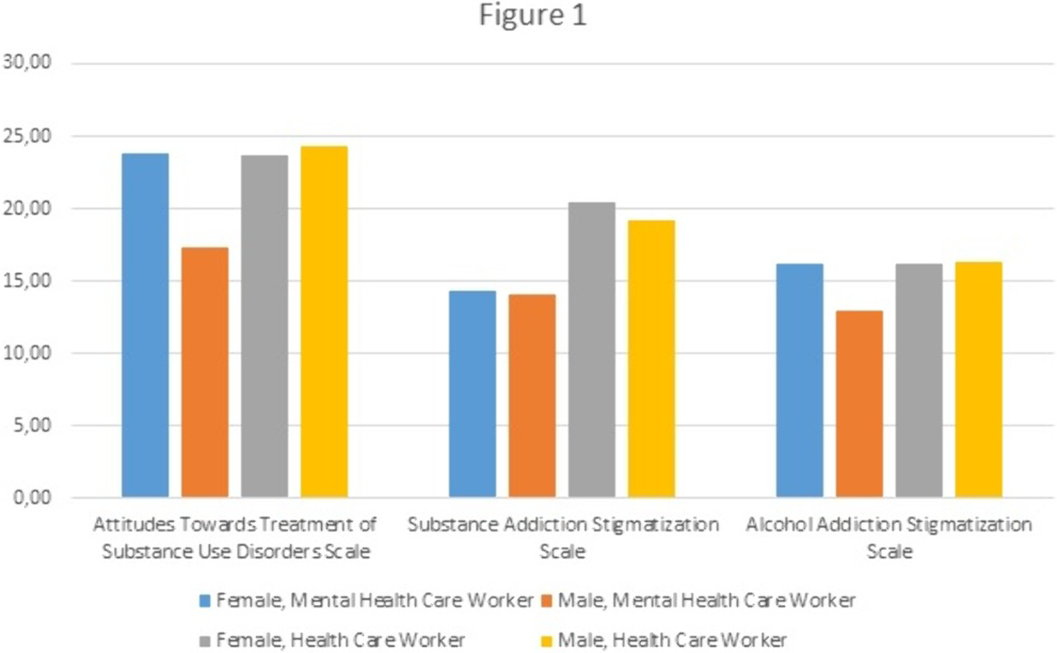
Within an online survey, participant HCWs answered Attitudes Towards Treatment of Substance Use Disorders Scale, Substance Addiction Stigmatization Scale, Alcohol Addiction Stigmatization Scale; in addition to sociodemographic questions.
Results
Three hundred ninety-eight HCWs were included in the analyses. 22.7% of them (n=91) were recruited in mental health sector. Mental health care workers had lower levels of stigma towards individuals with alcohol use disorders (14.78 vs 16.21, p=0.048) and substance use disorders (14.21 vs 20.09, p<0.001) and, lower levels of stigma towards addiction treatments (20.89 vs 23.93, p=0.007). Among mental health care workers, women scored higher numbers of stigmatization towards alcohol use disorder and addiction treatments (16.26 vs 12.98, p=0.003; 23.84 vs 17.29, p<0.001). On the other hand, women and men in other HCWs groups did not differ from each other in terms of stigmatization measurements (See Figure 1)
Conclusions
The gender of mental health care workers may be related to stigmatization towards addictive disorders. Future research should evaluate underlying factors.
Addiction isfrequent in youngsubjects, particularly in students, who are in contact with psychoactive substances such as drugs, tobacco, alcohol, and cannabis
Objectives
The objectives of our study were to investigate the prevalence of addictions among ESSTSS students and to determine the factors associated with addictions.
Methods
A descriptive correlational cross-sectional study was conducted at ESSTSS among 122 students for 2 months (March and April 2021). The data was collectedusing a questionnaire administered to the students.
Results
There were 102 women and 20 men with an averageage of 20.96 years. theprevalence of drug use was 56.6% according to DAST-10, with addiction notedin 5.7% of cases. The prevalence of tobacco use was 35.3% according to the Fagerstörm test, with 23.3% of the students being highlyaddicted to tobacco. The prevalence of alcohol use was 29.5%, 35% for men, and 28.43% for womenaccording to the AUDIT, alcoholdependence was notedin 14.3% of men and 6.9% of women. The prevalence of cannabis use was 16.4% according to the CAST test, a high risk of dependence was observedin 20% of cases. The analytical study showedthat the factors associated with addiction were age, gender, year of study, and specialty
Conclusions
The prevalence of substance use among health science students is significant and since the use of these substances has a detrimental effect on health itisbetter to understand the associated factors and this obliges us to establish appropriate preventive interventions
Frontal lobe syndrome (FLS) is a clinical condition characterized by personality and behavioral changes that usually occur after a traumatic brain injury (TBI). The main features of this syndrome are related to the deterioration of basic functions of the frontal lobe. Substance use disorder (SUD) is rare but also serious comorbiditiy seen after TBI.
Objectives
In this case report, we aimed to discuss a case who developed SUD after TBI.
Methods
Case report
Results
A 40-year-old male patient with history of using cannabis, methamphetamine, synthetic cannabinoid was admitted to our alcohol and substance use disorders research and treatment centre (AMATEM) inpatient unit for detoxification. He has reported that he was injured by a car accident five years ago, had a surgery and was hospitalized for a few months, and started to use substance to relieve pain. According to the medical records, the left frontal and temporoparietal regions were affected. He reported no history of substance abuse before injury, no previous history of psychiatric admission. Personality and behavior changes had been observed after TBI. In the first examination he had depressed mood and loss of interest. Sertraline (gradually titrated up to 150 mg/d) and risperidone (1 mg/d) were started. Also N-acetylcysteine (1,200 mg/d) was added to reduce craving and drug-seeking behaviours for four weeks.
Conclusions
Frontal lobe syndrome and TBI may differ in terms of clinical presentations. Substance use may be a way to cope with mental, cognitive or behavioural changes, psychosocial stressors, anxiety, sleep problems or pain after TBI.
Seizures occur in about 3% cases of alcohol withdrawal. They usually appear within 48 hours after abrupt cessation, and are characterized by a reduction in seizure threshold secondary to adaptation to alcohol. More than 50% of individuals will experience a new seizure and in 5% of these cases, progression to a sustained epilepticus status can occur.
Objectives
The aim is to do a review of the literature on alcohol withdrawal and the onset of seizures in individuals with alcohol addiction.
Methods
A literature review was conducted using the PubMed search database.
Results
Alcohol is a central nervous system (CNS) depressant and chronic consumption causes neuroadaptation in order to maintain homeostasis. This adaptation involves the upregulation of excitatory neurotransmitters systems and the downregulation of inhibitory ones. When consumption is abruptly discontinued, the depressive contribution of alcohol to a previously established balance is disrupted, resulting in withdrawal symptoms associated to a generalized CNS’ hyperexcitability state.Critical episodes increase the risk of delirium tremens, a fatal condition in 20% of untreated cases. Thus, the treatment and prevention of seizure recurrences is essential: the clinical guidelines of the American Society of Addiction Medicine 2020, offer an action proposal. Pharmacological therapy after seizures is the preferential treatment: intravenous administration of fast-acting benzodiazepines (lorazepam and diazepam) is the first line treatment.
Conclusions
It is essential to monitor signs and symptoms that alert us to the appearance of seizures associated to alcohol withdrawal, effectively treat these cases, prevent recurrences, and provide a quality follow-up for these patients.
Opioid withdrawal symptoms classically include severe muscle cramps, bone aches, autonomic symptoms, anxiety. Patients seldom have other complications like delirium and convulsions unless they have comorbid medical illnesses.
Objectives
We hereby report a case of opioid withdrawal delirium.
Methods
A 20-year-old man with dependence for opiods and nicotine was admitted after compete history and mental status and physical examination, last intake for both substances 2 days back. There was no history of fever, head injury, siezures and other substance use. All investigations done were normal and urine drug screen was negative for other substances. Treatment was started with clonidine and quetiapine for sleep and Nsaids on prn basis. After 2 days there was hallucinatory behaviour, agitation, fleeting episodes of recognising family members, hearing voices and decreased sleep observed. Patient required sedation with 10 mg of lorazepam and haloperidol before he went to sleep.Later on lorazepam 8 mg in divided doses and clonidine was tapered off gradually and patient as discharged on naltrexone 50mg.
Results
In our case we could not find any other reason for delirium.These complications are rare feature of delirium, parker et all reported 5 such cases. One of limitations was we didnt do blood alcohol levels which could have ruled out alcohol use.
Conclusions
This case is unique in terms of presenting with delirium without convulsions after 4 days of abstinence. No associated comorbidities, organic causes, and other substance use in dependence pattern or recently used. Use of a street variety (mixed with impurities) could be a risk factor for delirium in our patient.Psychiatrist need to be aware of complication.
The social media platform Reddit is a contemporary context where we have an opportunity to identify problems experienced by people regarding different aspects of life. The platform is virtually anonymous which might make users discuss their problems more freely. Reddit is divided in subreddits where different subjects are discussed and the discussions are controlled by creators and moderators. I have identified a quite active subreddit targeted towards recovering addicts of benzodiazepines; r/benzorecovery.
Objectives
* To analyze strategies of recovery in user narrative * To identify techniques commonly used and the how they are described * To construct metadata in order to assess how frequent the discussion of a different techniques are
Methods
Technically, what is done in this study, is adding mark-up metadata to different discussion. A rudimentary form of analysis suitable with a larger digital corpus where content metadata is added (Gilliland Swetland 2000). The metadata is constructed through a hermeneutical method in which the researcher analyses the subreddit.
Results
Answering question like: Example: DIY-tapering; different ways to limit drug use by using less. 1) how common are discussion of taperings in relation to other subjects? 2) Is tapering commonly discussed together with other subjects and techniques?
Conclusions
Using a method of categorization and metadata mark-up we could gain a good understanding of the problems among recovering benzodiazepine addicts. We will also have the possibility to identify concepts that addicts themselves discuss and relate these to professional concepts thus creating better possibilities of communication between professionals and clients.
According to the World Health Organisation goals of treatment of drug addiction are: reducing of drug use and craving, improving of health, well-being and social functioning of the affected individual, prevention of future harms by decreasing the risk of complications and relapse. Wellness means a sense of overall well-being incorporating numerous aspects of an individual’s life. These include physical, mental, emotional, intellectual, occupational, and spiritual aspects. For those who suffer from mental and substance use disorders, wellness means feeling a sense of purpose in life, being actively involved in work or play that is satisfying, finding happiness, having joyful relationships, and having a healthy body and living environment. .
Objectives
We will present different dimensions of wellness and describe how to incorporate these dimensions into drug addiction treatment.
Methods
Presentation of theoretical frame and description of treatment programme at the Center for Treatment of Drug Addiction Ljubljana.
Results
When each of wellness dimensions is balanced, it is easier to maintain recovery process and avoid the triggers of relapse.
Conclusions
In the context of wellness, treatment goal is to maximize the capacity of person to feel, think and act in ways that enhance his/her ability to enjoy life and deal with the challenges he/she face. Wellness lifestyle includes a balance of health habits such as adequate sleep and rest, productivity, exercise, participation in meaningful activity, nutrition, productivity, social contact, and supportive relationships.
The use of cannabis is likely to increase as regulations on its consumption are diminishing throughout the world.
Objectives
to identify the prevalence of anxiety and depression symptoms in a group of cannabis users in Tunisia.
Methods
this a transversal descriptive study about 137 participants in the University Hospital Of Mahdia during 2 months.
Results
In our study population , the consumers were young adults aged between 18 and 35 years old ,of whom 40.8% were professionally active, 23.2% had psychiatric history. Moreover, the use of other substances was regular among users as follows: tobacco among 74.6% of users, alcohol among 72.5% of users, ecstasy among 41.3% of users, cocaine among 25.4% of users. The use of cannabis was considered as a means of exultation for 66.7%, as an anxiolytic for 26.8% and as a sedative for 23.9%. Overall, the effect of cannabis use on anxiety and depression on the HAD scale showed the following results: probable anxiety in 53% of cases, probable state of depression in 72% of time.
Conclusions
The correlation between cannabis use, anxiety and depression remains unclear. Equally concluded, the assumption of self-medication by cannabis stills a topic of discussion.
Ketamine, synthesized in 1962 as phencyclidine derivate, is denominated a “dissociative anesthetic” because of its side-effects, such as dissociative episodes and psychotic-like symptoms, which have limited its applicability on clinical practice. Otherwise, in the last decades the non-medical use of ketamine has been growing and today is one of the most popular illicit substances consumed between adolescents and young adults.
Objectives
Increasing the knowledge and understanding of the factors related to crescent use of ketamine and the experiences and consequences associated to its consumption.
Methods
Clinical interview with patients diagnosed with ketamine use disorder and bibliographic research in Pubmed database using the terms “Ketamine use” and “Ketamine addiction”.
Results
Pat et al. (2002) describes a clinical case of a young male, diagnosed with substance use disorders, specifically alcohol and cocaine use disorders, that started a treatment with ketamine. After the treatment, pleasant depersonalization experiences contributed to the development of patient’s ketamine dependence. Other patient’s reports confirm the association of ketamine use with psychedelic effects and dissociative episodes and pointed these effects as main reason for its consumption.
Conclusions
The adverse effects that limited the medical use of ketamine are the same that promote its utilization with recreational purposes by adolescents and young adults in parties and nightclubs. About the ketamine dependence, the literature is scarce and doesn´t clearly identify a physical withdrawal syndrome, pointing only to a serious psychological dependence. Thus, with the crescent non-medical use of ketamine, it’s urgent to develop an intervention plan directed to this problem.
Gambling disorder involves repeated problematic gambling behavior that causes significant problems or distress. It is also called gambling addiction or compulsive gambling.
In Tunisia, a muslum country, gambling is prohibited and casinos are non-existent or only for tourists with foreign currency. Lately, with the spread of casinos online and sites of sports betting, gambling’s become problematic in Tunisia. People accumulated huge debts with feelings of shame and guilt leading to suicidal attempts.
Objectives
Studying the link between gambling disorder and suicidal attempts and comparing the different preventive measures proposed for online gambling.
Methods
a case of a patient with gambling disorder that was hospitalized in a psychiatric hospital for a suicidal attempt by stabbing himself and a review of a literature.
Results
Mr R.A was a 42-year-old man with no family nor personal psychiatric history. He has no history of a particular substance use disorder. He was married and a father of two children and has a regular job.
A year ago, he stated gambling on internet sites using his phone cell and, in several months, he lost a lot of money and accumulated debts.
Lately he committed two attempts of suicide. The first one was by swallowing rat poison. The second one was a month later, by stabbing himself with a knife that caused evisceration and required surgery then an hospitalization in a psychiatric unit.
Conclusions
There’s evidence that GD and SB are associated, although there’s disagreement about the nature of this association. Adequate preventive measures should be considered by governments
We present the case of a 33-year old man that suffer chronic cocaine and cannabis use since adolescence and at age of 25 develops depressive symptoms and later psychotic symptoms not congruent with mood state. He met criteria for schizoaffective disorder at that moment and was treated with antidepressants and antipsychotic drugs, improving symptomatology even without stopping completely substance use.
Objectives
To study the relationship between schizoaffective disorder and cannabis and cocaine use, including the neurobiological disturbance secondary to these drugs that can lead to the development of this disorder and the relevance of diagnosing it in context of active substance use.
Methods
We carried out a literature review of scientific papers in Medline data base. We used the following terms: “Schizoaffective disorder” “cocaine use” and “cannabis use”. We considered English and Spanish papers for the last 5 years.
Results
After 4 months of cocaine withdrawal and 1 month of cannabis withdrawal, the patient progressively improved depressive and positive psychotic symptoms. However, we reported the persistence of negative symptoms as psychomotor slowdown and cognitive and affective flattening.
Conclusions
The use of cocaine and cannabis is related to depressive and psychotic symptoms in intoxication and can also precipitate chronic psychotic and affective disorders. Induced schizoaffective disorder has not been widely described in literature. Our patient could be a case of schizoaffective induced disorder, but we should consider other pathogenic factors, differential diagnosis and clinical evolution in permanent withdrawal to confirm this diagnosis.
Tobacco-use is currently one of the major public health problems and is more common among patients with schizophrenia.
Objectives
We aimed in this study to estimate the prevalence of smoking in a population of patients with schizophrenia, to assess tobacco dependence and to identify its correlated factors.
Methods
This is a descriptive and analytical cross-sectional study carried out on 50 outpatients at the Department of Psychiatry (Tunisia) over a period of two months. For the data collection, we used: a general questionnaire on sociodemographic characteristics and tobacco consumption and the Fagerström test for nicotine dependence.
Results
All the patients were male with a mean age of 32.7±7.02 years and 84% of them were tobacco consumers. More than half of the sample were single (68%) and had a primary school level (52%). A professional irregularity and low socio-economic level were found successively in 84% and 78% of cases. Half of the patients (52%) were diagnosed with paranoid schizophrenia and 46% of them were treated by atypical antipsychotics. Cigarette dependence was strong or very strong in 82% according to the Fagerstrom test. A positive correlation was found between strong tobacco dependence on the one hand and low socio-economic level, professional irregularity, smoking in a first-degree relative and treatment with a typical neuroleptic on the other hand.
Conclusions
Our study and data from the literature show that subjects with schizophrenia constitute a population of highly dependent smokers. A smoking cessation assistance program for this vulnerable population is a priority to improve their quality of life.
Tobacco use is clearly harmful for mental as well as physical health especially among persons <18 yeards age. It is used in multiple forms in many countries such as, somoling chewing etc. It is impotant to know the pattern of tobacco use and the comorbid psychiatric illnesses inthis age group.
Objectives
To identify the pattern of tobacco use among cases <18 years age with various psychiatric disorders.
Methods
It was a cross-sectional study conducted at a psychiatric clinic at Karachi, on all consecutive cases <18 years. Diagnostic criteria of ICD-10 were used.
Results
A total number of 700 consecutive cases below the age of 18 years reporting to psychiatric clinic were inducted in this study. Out of them 107 (15%) patients reported use of tobacco. Among them 83 (77% ) used pan with tobacco. The psychiatric illnesses identified were depressive disorder (39%) & conversion disorder (15%).
Conclusions
Tobacco use (predominantly in the form of chewing), is common amongst children and adolescents reporting for psychiatric consultation. It is important to develop strategies at a community level with legal restriction/implementation selling tobacco to children. Moreover, psychiatric evaluation should be done in all children and adolescents identified as using tobacco, and the term “smoking cessation clinic” should be replaced with “tobacco cessation clinic/ services”.
Alcohol screening and brief interventions (ASBIs) for risky drinkers are known to reduce alcohol consumption and alcohol-related harm. The present study was the first to investigate the effectiveness of an ASBI for high-risk drinkers of low socioeconomic status (SES) in the Korean community social service setting.
Objectives
This study aims to evaluate the effectiveness of an ASBI for clients in community social service settings in South Korea.
Methods
A total of 153 clients in social service agencies participated in this study. Clients in the experimental group received alcohol use screening and two sessions of brief motivational interventions (MI). Clients in the comparison group received alcohol problems screening test only. Primary outcome variable was the amount of weekly alcohol consumption, which was measured once before the intervention and three times after the intervention.
Results
When analyses were conducted separately for participants from the self-sufficiency centers and those from the community welfare centers, there was a significant time and group interaction effects. The amount of weekly alcohol consumption of the experimental group was gradually reduced over time. However, the amount of the comparison group was reduced at the four-week follow-up but was increased both at the eight-week and 12-week follow-ups.
Conclusions
This study demonstrates the need to provide training and education in the ASBI to social service workers working with the underprivileged, as such training would increase the identification of alcohol-related risks of the people most vulnerable to alcohol-related problems.
Internet addiction disorder (IAD) is characterized by an individual’s inability to control his/her Internet use, which may result in marked distress and functional impairment. Systematic reviews show that excessive screen-time is negatively associated with well-being and positively associated with reduced quality of life in young people. There is growing evidence that IAD is related to comorbidities such as depression but relatively little is known about fatigue in adolescents with IAD.
Objectives
Accumulating evidence suggests that fatigue is a central component of IAD. Depression is also related to IAD. However, there is a lack of evidence regarding whether there is a strong correlation between the severity of IAD and the rate of depression. Our objectives were to describe depression and fatigue in adolescents diagnosed with IAD.
Methods
Study included 94 participants with IAD and 88 controls, all aged 12–17 years. Depression was assessed by the Beck Depression Inventory Scale (Georgian version), and fatigue by the Pediatric Quality of Life Initiative (Georgian version) multidimensional fatigue scale.
Results
Adolescents with severe IAD are 5.63 times more likely to show symptoms of moderate or severe depression than children with mild or moderate Internet addiction. Those with severe IAD showed 6.62 times more cognitive fatigue, 7.81 times higher sleep/rest fatigue and 11.11 times higher general fatigue than children with mild and moderate Internet addiction.
Conclusions
IAD can lead to depression and fatigue, which can affect adolescent’s psychological and social well-being. Mechanisms for prevention and ongoing support are needed for adolescents and their families.