We partner with a secure submission system to handle manuscript submissions.
Please note:
You will need an account for the submission system, which is separate to your Cambridge Core account. For login and submission support, please visit the
submission and support pages.
Please review this journal's author instructions, particularly the
preparing your materials
page, before submitting your manuscript.
Click Proceed to submission system to continue to our partner's website.
To save this undefined to your undefined account, please select one or more formats and confirm that you agree to abide by our usage policies. If this is the first time you used this feature, you will be asked to authorise Cambridge Core to connect with your undefined account.
Find out more about saving content to .
To send this article to your Kindle, first ensure no-reply@cambridge.org is added to your Approved Personal Document E-mail List under your Personal Document Settings on the Manage Your Content and Devices page of your Amazon account. Then enter the ‘name’ part of your Kindle email address below. Find out more about sending to your Kindle.
Find out more about saving to your Kindle.
Note you can select to save to either the @free.kindle.com or @kindle.com variations. ‘@free.kindle.com’ emails are free but can only be saved to your device when it is connected to wi-fi. ‘@kindle.com’ emails can be delivered even when you are not connected to wi-fi, but note that service fees apply.
Personal Health Budget (PHB) has been provided to consumers with severe mental illness within a policy shift toward a person-tailored mental healthcare treatment based on individual unmet needs. PHB is an amount of money to support patient’s health and wellbeing needs, which is planned and agreed between patients and their local NHS team. It is not new money, but it may mean spending money differently so that patients can get the care that they need. However, evidence of beneficial effects of PHB is still scarce.
Objectives
The aim of this study was to provide preliminary data on clinical and social benefits of adding PHB to a standard pharmacotherapy in patients with severe mental illness across a 24-month follow-up period.
Methods
137 individuals with severe mental illness (aged 18–50 years) were recruited in one of the adult mental health services of an Italian Department of Mental Health. They completed the Global Assessment of Functioning scale, the Health of the Nation Outcome Scale and the Brief Psychiatric Rating Scale. Friedman’s test for repeated measure was used to assess the longitudinal stability of functioning and clinical parameters. A linear regression analysis was also performed.
Results
A significant decrease in all GAF scale, HoNOS and BPRS scores along the 24 months of follow-up was observed. Regression analysis results specifically showed a relevant association between a PHB multiaxial intervention and the longitudinal reduction in BPRS ‘Negative Symptoms’ and HoNOS ‘Social Problems’ subscores.
Conclusions
Our findings support the useful implementation of a PHB approach for severe mental illness patients within the Italian mental health service network.
Technology-based interventions (TBIs), including computer and Internet-based interventions, mobile interventions, health applications, social media interventions, and interventions using technological devices, could become a useful, effective, accessible, and cost-effective approach (Berry et al., 2016; Firth, 2016) to complement conventional interventions for psychosis
Objectives
to compare TBIs with conventional interventions for psychosis, focusing mainly on functioning and quality of life.
Methods
The systematic review preceding this work was based on 58 RCT of TBIs for psychosis. We selected the studies that analyzed functioning (N = 23) and quality of life (N = 15). We calculated the standardized mean change (SMC) and applied a three-level model because there were several effect sizes within the same study.
Results
There were significant differences between TBIs and conventional interventions for functioning (d = 0.25, SE = 0.09, z = 2.72, p = <.01), but not for quality of life (d = 0.14, SE = 0.08, z = 1.78, p = .076) in patients with psychosis.
Conclusions
On average, patients who received TBIs performed better in functioning, but not in quality of life. Functioning is impaired in patients with psychosis, so TBIs should be considered a complement and efficacious intervention, highlighting the power of these type of interventions in improving some outcomes.
First-episode psychosis is a critical period for early interventions to reduce the risk of poor outcomes and relapse as much as possible. There are now many studies revealing the patterns of course in the short and medium terms, but uncertainties about the long-term outcomes of symptomatology remain to be ascertained.
Objectives
First, we ascertained whether the structure of psychopathological symptoms, dimensions and domains of psychopathology remains invariant over time between first-episode psychosis and long-term follow-up. Second, we analysed the changes in the interrelationships of psychopathological symptoms, dimensions and domains of psychopathology between FEP and long-term follow-up at three levels.
Methods
We performed network analysis to investigate first-episode and long-term stages of psychosis at three levels of analysis: micro, meso and macro. The sample was a cohort of 510 patients with first-episode psychoses from the SEGPEP study, who were reassessed at the long-term follow-up (n = 243). We used the Comprehensive Assessment of Symptoms and History (CASH) for their assessments.
Results
Our results showed a similar pattern of clustering between first episodes and long-term follow-up in seven psychopathological dimensions at the micro level, 3 and 4 dimensions at the meso level, and one at the macro level. They also revealed significant differences between first-episode and long-term network structure and centrality measures at the three levels.
Conclusions
Our findings suggest that disorganization symptoms have more influence in long-term stabilized patients. The main results of the current study add evidence to the hierarchical, dimensional and longitudinal structuring of first-episode psychoses.
Schizophrenia is heterogeneous in terms of symptoms and outcome, but neurobiology of this heterogeneity is not well-studied. Local correlation analysis of fMRI data provides a measure of local coherence, i.e., average correlation between BOLD-signal in a voxel and its neighbours. Local correlation is a promising approach, and it seems important to find links between local brain coherence and schizophrenia outcome.
Objectives
We aimed to compare brain local coherence between schizophrenia patients with varied long-term outcomes and healthy controls (HC).
Methods
Patients with chronic schizophrenia spectrum disorders (37 males, mean age 41.5±5.5) and HC (17 males, mean age 38±7.7) underwent resting-state fMRI (3T). Cluster analysis based on PANSS and PSP allowed us to allocate patients into two subgroups (N = 13/24). The second subgroup had significantly more marked negative and general psychopathology symptoms and worse functioning than the first subgroup. Local coherence in the brain was compared between clinical subgroups and HC (ANOVA, p<.001 voxelwise, p[FDR]<.05 clusterwise).
Results
Local coherence in the paracingulate gyri bilaterally ({-2; 58; 14}; 2712 mm3) differentiated the groups. Post hoc analysis revealed decreased local coherence in the subgroup with poorer outcome compared to HC, along with the absence of differences between the subgroup with better outcome and HC. There were no differences between clinical subgroups.
Conclusions
Hypoactivity of the cingulate cortex is related to negative symptoms (Bersani et al., 2014). Their severity, in turn, is strongly associated with outcome. Thus, local coherence in the cingulate cortex may be one of the factors which underlie outcome heterogeneity.
There is evidence that metabolic syndrome (MetS) is common in chronic psychosis but also exists in the early stages.
Objectives
To study the prevalence and course of MetS over a period of 2 year after a first episode psychosis. To determine whether there may be differences in its prevalence according to the type of antipsychotic used over two years.
Methods
A sample of 300 patients participate in the PEPsNa Early Intervention Programme. SMet was determined at baseline and at 6, 12, 18 and 24 months. The type of antipsychotic used at each assessment moment is collected (none, aripiprazole, paliperidone, others). Adult Treatment Panel III (ATP III) criteria were used to define MetS.
Results
The prevalence of MetS at baseline is 4.44% and increases to 7.96% at 6 months, 10.1% at 12 months, 8.62% at 18 months and 9.01% at 24 months. The prevalence of MetS increases at 6 (p<0.021) and 12 months (p<0.003) compared to baseline and then remains stable. Only at 6 months assessment there are significant differences (F-Ficher p<0.022) in the presence of MetS (15.8%) in the paliperidone group treatment (oral or LAI).
Conclusions
Metabolic syndrome (MetS) exists from the early stages of psychosis and increases in the first 6-12 months and remains stable thereafter. The type of antipsychotic treatment only seems to have an influence at 6 months, with no differences at other follow-up times.
Schizophrenia is essentially related to one’s self-perception and the relationship to the world. One possible explanation for symptoms of schizophrenia in activities is the disruption of timing, which can develop into a disorder of activity perception and attribution.
Objectives
Our study aimed to investigate the specificity of time perception disorder within the schizophrenia-bipolar spectrum, within the time interval around one second.
Methods
In the study, N = 15 schizophrenic (M = 37.28 years, SD = 9.49 years), N = 9 bipolar (M = 49.44 years, SD = 8.48 years), N = 10 schizoaffective (M = 41.32 years, SD = 10.75 years) patients with compensated clinical condition and N = 28 healthy control subjects (M = 36.5 years, SD = 9.9 years) participated. Time processing was examined with a perceptual (discrimination) and a productive (synchronization) task.
Results
Concerning the interval discrimination, patients with schizophrenia and schizoaffective disorder lag behind controls in the majority of indicators (0.373–0.772). In terms of production and reproduction, the deviation of schizoaffective patients indicates a moderate difference, but subjects with schizophrenia show a large effect size, and subjects with bipolar disorder demonstrate a small effect size.
Conclusions
Our results suggest that the schizophrenic group exhibits a comprehensive time-processing disorder and in this respect can be distinguished from the bipolar affective and the control group. People with schizoaffective disorder show an intermediate performance in reproduction between the schizophrenic and bipolar groups, while in the case of discrimination deficit, they approach schizophrenics.
Social phobia is frequent comorbidity in schizophrenia. It`s clinical correlates and consequencies for clinical practice in late-onset schizophrenia (LoS) are unclear.
Objectives
The study aimed to compare clinical correlates and therapeutic options in LoS patient with and without social phobia.
Methods
16 LoS patients with social phobia (ICD-11 diagnosis, age 59,6±6,2, 25% males) were compared with 16 LoS patients without social phobia (69,9±10,9, 0% males). Results of clinical assessment (PANSS, HDRS-17), cognitive examination (MMSE, MoCA), CT data were analysed. Type of antipsychotics (conventional\conconventional) was registed, dose of antipsychotics and antidepressants was randed from 1 (low) to 3 (high). Mann-Whitney test and χ2statistic was used.
Results
There was no group differences in age, age manifestation, illness duration, number of psychotic episodes, PANSS and HADRS scores, rates results of cognitive tests, atrophy scores, length of hospital state, types of received antipsychotics. LoS patients with social phobia received more frequently medium and high doses of antipsychotics than LoS patient without social phobia (χ2 (2)=6,432, p=0,040).
Conclusions
Increased doses of antypsychotics in patients with social phobia don`t correlate with severity of psychotic symptoms and nay reflect some treatment resistance as well as misinterpretation of symptoms of social phobia as insufficient retreat of the psychosis. Active detection of social phobia is significant for treatment optimization.
Schizophrenia is a chronic mental illness with unclear etiology. It is characterized by symptoms in various psychopathological domains (e.g. positive, negative). One of the concepts explaining the etiology of schizophrenia is the disconnection hypothesis. It assumes the existence of structural and functional disorders within the connections of brain regions. White matter is largely responsible for the quality of these connections. One of the important structures of white matter is the superior longitudinal fascicle (SLF) which connects many cortical structures.
Objectives
The main aim of our study was to search for a relationship between the integrity of SLF and various psychopathological dimensions among schizophrenia patients.
Methods
42 schizophrenia subjects (SS) and 32 healthy controls (HC) participated in the study. All study participants underwent DTI-MRI analysis. The psychopathology of SS was assessed using the Positive and Negative Syndrome Scale (PANSS). In the study, we used the PANSS dimensions proposed by Shafer. Then, the SLF analysis was performed using fractional anisotropy (FA) and mean diffusivity (MD) parameters.
Results
The differences in FA and MD values in SLF bilaterally between groups were confirmed. A correlation was found between MD values in left SLF and positive symptoms (p = 0.040) and excitement (p = 0.012). A correlation was found between the MD values in the right SLF and the symptoms of disorganization (p <0.000) and excitement (p = 0.004).
Conclusions
SLF seems to play a role in the etiopathogenesis of schizophrenia. Disturbed SLF integrity may be involved in the development of positive, disorganization and excitement symptoms.
Known risk factors for developing of first-time psychosis in patients with deep brain stimulator (DBS) include older age, short time after implant placement and cerebral target for stimulation. In particular, stimulation of subtalamic nucleus and globus pallidus internus has been shown to elicit psychotic symptoms in various case reports. To date, there are no cases describing onset of psychosis due to DBS in the ventralis intermediate nucleus (Vim) of the thalamus.
Objectives
Case describtion of psychotic episode provoked by DBS in Vim region
Methods
Case report of 70 y.o. female with unilateral DBS from 2012 in Vim for essential tremor, who developed therapy resistant psychotic symptoms right after adjusted settings of the DBS.
Results
Psychotic onset of otherwise healthy 70 y.o. patient occurred and gradually worsened after adjustment of DBS settings in absence of other iatrogenic factors, including medication and comorbidity, and required involuntary hospitalization one week after beginning of psychosis. Treatment after hospitalization comprised olanzapine 10 mg. 1dd1 did not cause resolvent of psychosis. Because of therapy resistance to psychofarmaca and worsening of psychotic symptoms, by way of exception neurologists had to change the settings back to basic leading to complete and sustained remission of psychosis within two days.
Conclusions
Among side effects of DBS in Vim, psychotic symptoms have never been reported. However, as in our patient, psychosis occurred after changes of settings in DBS and presented acutely, was severe, resulted in involuntary hospitalization and was therapy resistant. Pathophysiology of DBS-induced psychosis in Vim region is not known and requires further investigation.
Obesity has increased worldwide and concerns comorbidity in patients with schizophrenia, and is linked to a high mortality rate in this group. Although bariatric surgery is the gold standard treatment for refractory obesity, it rarely is indicated for subjects with schizophrenia due to psychotic symptoms recurrence.
Objectives
Report weight-loss outcome and psychopathology changes over 36 months follow-up of 5 patients with schizophrenia submitted to bariatric surgery.
Methods
Patients have been followed for 36 months. Clinical and anthropometric assessments such as percentage of excess weight loss (EWL) and body mass index (BMI) have been performed at 6, 12, 24, and 36 months follow-up. The Positive and Negative Syndrome Scale (PANSS) was used to assess psychopathology status. Wilcoxon test was used to assess statistical differences.
Results
The sample included four female and one male subject, with BMI at baseline 42,81± 5,66. The results of BMI and EWL over time are described in Table 1. A significant statistical difference was found between BMI at baseline and at T6, T12, T24, and T36 (p<0,05). EWL was higher at T12 ( compared with T6), but not different from other measurements. PANSS scores at the baseline were 7,7 ± 1,6 for a positive domain, 8,7 ± 2,3 for a negative domain, and 19,2 ± 6 for general psychopathology, with no statistically significant differences during the follow-up.

Conclusions
Despite the small sample, bariatric surgery has been shown a safe and efficient refractory obesity treatment in patients with schizophrenia.
The Interpersonal Needs Questionnaire (INQ-15) and the Acquired Capability for Suicide Scale - Fearlessness About Death (ACSS-FAD) have been introduced to evaluate the theoretical constructs posit by Joiner’s Interpersonal Psychological Theory of Suicide (IPTS).
Objectives
The present study aimed to evaluate the psychometric properties of the INQ-15 (which measures Thwarted Belongingness, TB, and Perceived Burdensomeness, PB) and the ACSS-FAD (measurement of Fearlessness About Death, FAD, dimension of the acquired capability) in a population of Italian university students.
Methods
Since there was no Italian version of the ACSS-FAD, we have translated it through an accurate multistage procedure. ACSS-FAD and INQ-15 have been administered to a sample of 1,665 Italian university students. We analyzed the factorial structure of the INQ-15 and the ACSS-FAD, their reliability, criterion, convergent and discriminant validity.
Results
Principal Component Analysis confirmed a two-dimensional structure for INQ-15 and a one-factor structure for ACSS-FAD. Internal consistency reliability of the scales was good, respectively TB: α = .85; PB: α = .90; and FAD: α = .85. The INQ-15 demonstrated concurrent associations with suicidal ideation, while the ACSS-FAD with a history of suicidal planning/suicide attempt. Convergent and discriminant validity were also in line with previous studies.
Conclusions
Both INQ-15 and ACSS-FAD appropriately capture the respective constructs, proving to be valid measures for the assessment of suicide risk factors among Italian university students according to the IPTS. The valuable psychometric properties of the two scales established with this study in the Italian context encourages their use to advance the clinical understanding and prevention of suicide.
Previous research highlighted that adolescents with attention-deficit/hyperactivity disorder (ADHD) are four times as vulnerable to suicidal behavior as the healthy population. Maladaptive perfectionism is also viewed as an important risk factor for suicide. Yet, there are no studies which focused on the relationship between perfectionism and suicide among adolescents with ADHD.
Objectives
The objective of the present study was to explore if perfectionism may be a risk factor for suicidal behavior in adolescents with ADHD.
Methods
The clinical group was recruited from outpatient clinics, while the non-clinical group was recruited from high schools around Hungary. The clinical group’s inclusion criterion was ADHD diagnoses, while the non-clinical group required the absence of any current or past psychiatric treatment or diagnoses.
Results
In the ADHD group 88 adolescents participated, and 96 adolescents participated in the non-clinical group. There was no difference regarding the level of perfectionism in the groups, except one dimension of perfectionism, which is ‘Organization’. The ADHD group had significantly higher level of suicidal behavior than the control group ((χ2 (1) = 11.222, p < .001, V = 0.25). Among the ADHD group adaptive perfectionism was significantly negatively correlated with suicidal behaviour.
Conclusions
Adolescents with ADHD did not have a different level of perfectionism than the healthy control group only in ‘Organization’ trait. This result could add to the therapeutic work with adolescents diagnosed with ADHD with underlining the importance to focus on organizational skills. The result highlights that adaptive perfectionism appears to be a protective factor against suicidality.
Self‑harm is an ‘act of self‑poisoning or self‑injury carried out by a person, irrespective of their motivation’. A history of self-harm is linked with suicide risk. A study in Pakistan found self-harm to be more common in young people with unemployment and interpersonal difficulties as common triggers. Expanding liaison psychiatry services leads to an earlier assessment of patients with self-harm.
Objectives
To study the demographic and clinical variables of patients along with methods and precipitating factors of self-harm.
Methods
A retrospective chart review of patients presenting with self-harm seen as a part of liaison psychiatry from October 2018 to June 2021.
Results
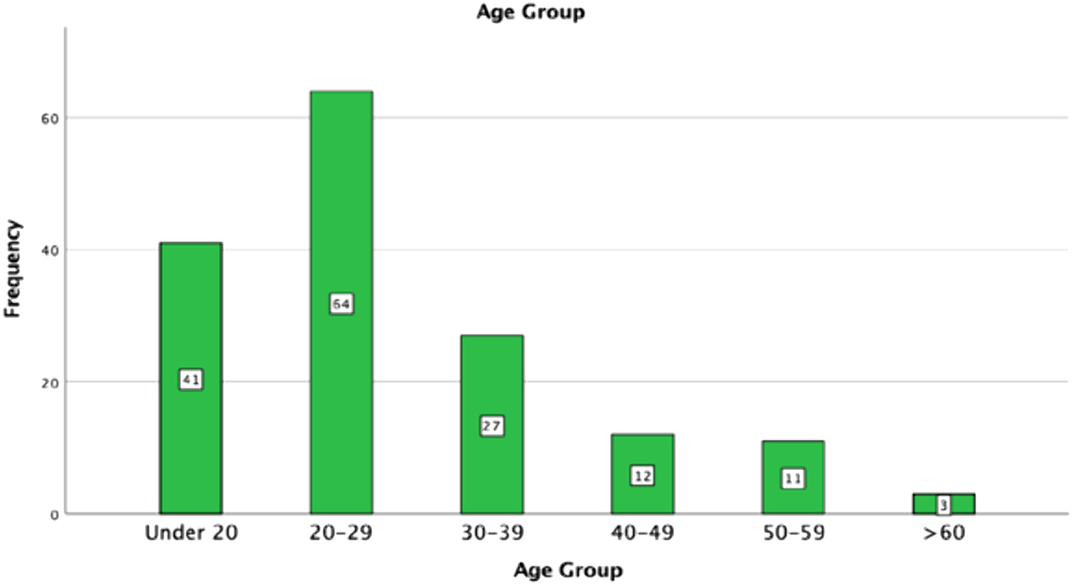
A total of 168 cases were seen of which 10 were excluded due to incomplete data. Of 158 cases gender split was roughly in the middle, with 49.4% males (n=78) and 50.6% females (n=80). The mean age of patients was 27.59 with a range of 12-70, 40.5% belonged to the age group of 20-29 (n=64) (Figure 1).
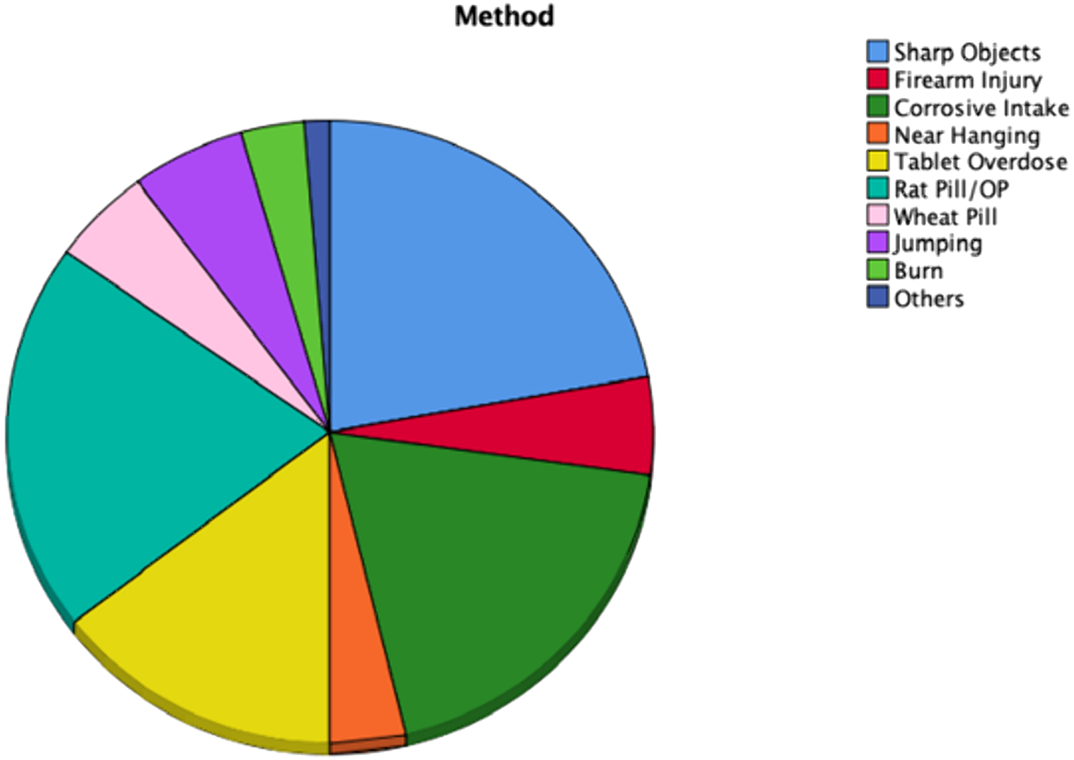
77.8% (n=123) had a past psychiatric history. The most common being depressive disorder 31.6% (n=50) and borderline personality disorder 30.4% (n=48). 35.4% of patients reportedly had previous attempts of self-harm. The most common methods being the use of sharp objects, rat-pill poisoning, and corrosive intake (Figure 2).
Conflicts with family and relationship difficulties were reported to be the most common precipitating factors.
Conclusions
Self-harm is a challenging and frequent presentation. Patients may present with diverse characteristics and varying needs. Hence physicians must be prepared for timely liaison and prompt management.
Suicide is the second leading cause of death (8.5% of all deaths) in adolescents. The search for neurobiological markers of suicidal behavior seems to be highly actual. Such markers may include quantitative EEG parameters and signs of neuroinflammation that plays an important role in the pathogenesis of various mental disorders.
Objectives
The aim of the study was to reveal the relationships between pre-treatment clinical, EEG, and neuroimmunological parameters in depressive adolescents with suicidal attempts in their history.
Methods
35 female depressive patients (all right-handed, age 16–25, mean 18,7±2.9 years old) were enrolled in the study. Total HDRS-17 scores varied from 13 to 43 (mean 27,7±8.1). Multichannel resting EEG was recorded with spectral power (SP) measurements in narrow frequency sub-bands. Functional activities of leukocyte elastase (LE) and of its antagonist α1-proteinase inhibitor (α1-PI), as neuroinflammation markers, were measured in the blood plasma. Leukocyte/inhibitory index (LII=LE/α1-PI) was calculated. Spearman’s correlations between clinical, EEG, and neuroimmunological parameters were analyzed.
Results
Sum of anxiety cluster of HDRS-17 scale (items 9, 10, 11) correlated positively (p<0.02) with LE and α1-PI values, as well as with theta1 (4-6 Hz) and theta2 (6-8 Hz) SP in EEG leads of the right hemisphere. In turn, α1-PI values correlated negatively and LII values correlated positively with alpha3 (11-13 Hz) SP in majority of EEG leads.
Conclusions
The data obtained confirm the contribution of neuroinflammation to clinical conditions, especially to anxiety level, and to EEG pattern in depressive female adolescents with suicidal attempts. The study supported by RBRF grant No.20-013-00129a.
Patient and public involvement (PPI) in suicide research is ethical, moral and can deliver impact. However, inconsistent reporting of meaningful PPI, and hesitancy in sharing power with people with experience of suicidality (i.e.co-researchers) in research makes it difficult to understand the full potential impact of PPI on the research, researchers and co-researchers.
Objectives
To describe how our ecological momentary assessment (EMA) study, examining the sleep-suicide relationship in young psychiatric inpatients (aged 18-35) transitioning to the community, has been co-produced, whilst reflecting on impact, challenges, and recommendations.
Methods
We built on our experience of co-produced mental health research to conduct meaningful PPI in our study. Young adults with experience of psychiatric inpatient care and suicidality were appointed November 2020 to work across all research stages. Reflections on challenges, recommendations and impact have been collected throughout.
Results
Three young people became co-researchers. Researcher and co-researcher reflections indicated establishing and maintaining safe environments for open discussion, and continued communication (e.g.WhatsApp group) were vital to effectively share power and decision making. Safeguarding and support requirements for both co-researchers (e.g.individualised strategy) and researcher (e.g.clinical supervision) were particularly evident. To date, the co-produced recruitment poster, research documentation, and research article have demonstrated significant impact.
Conclusions
This is the first EMA study focused on suicide-sleep during transitions to be co-produced with young people with experience of suicidality. Co-producing suicide research is intensive, time-consuming, and challenging but makes a significant impact to the research, researchers, and co-researchers. We expect our learning will directly influence, and help others produce, meaningful co-produced suicide research.
Previous studies underline the importance of internalising disorders as risk factors of nonsuicidal self-injury (NSSI), meanwhile only a few research draw the attention to the role of externalising disorders. The possible association between NSSI and pathological internet use (PIU) is also understudied.
Objectives
The purpose of this study was: 1) to investigate the frequency of NSSI among adolescents with different psychopathology and in different internet user groups of adolescents, 2) to understand the mediator role of psychiatric disorders between NSSI and PIU.
Methods
Adolescents were enrolled from a clinical (Vadaskert Child Psychiatric Hospital, Budapest, Hungary) and a school based population (high schools in Budapest, Hungary). The used measurements were: Strengths and Difficulties Questionnaire (SDQ), Deliberate Self-Harm Inventory, Young Diagnostic Questionnaire for Internet Addiction, Mini International Neuropsychiatric Interview Kid.
Results
There was significant difference in the frequencies of NSSI in SDQ subgroups (U=2127.000; z=-6.170; p <0.001). There was also significant difference in NSSI frequency between normal- and pathological internet users (U=2020.000; z=-2,501; p <0.017 p=0.012). According to the mediator model there was no direct association between PIU and NSSI, however it was mediated by different psychiatric disorders (affective disorders, anxiety disorders, attention deficit/hyperactivity disorder, conduct disorder, opposition defiant disorder, psychoactive substance abuse/dependence, psychotic disorders, suicidal behavior).
Conclusions
The results strengthen that both internalising- and externalising psychopathology are associated with NSSI. Moreover this study underlines the importance of careful screening and treating of comorbid disorders with PIU, which can have a role in the prevention of NSSI and suicide as well.
Mortality from intentional self-harm is an urgent medical and social problem in most countries of the world. According to the World Health Organization, suicide mortality is the second leading cause of death among young people aged 15-29 years globally. In the Republic of Belarus, this is one of the main causes of death from external causes.
Objectives
To identify statistically significant social factors and individual characteristics of people who had attempted suicide.
Methods
Three patient groups were formed: persons who had suicidal attempt with high probability of death (mainly hanging) (GSAD), persons who had suicidal attempt in other ways (GSAO), and persons who had diagnosed adjustment disorder and did not have suicidal attempts (comparison group CG). The groups consisted of 40, 80 and 40 people, respectively. Socio-demographic data were determined, the level of stress was assessed according to the Holmes and Rahe Stress Scale, depressive symptoms on the Montgomery-Åsberg Depression Rating Scale, individual features were determined using the Eysenck personality questionnaire and the Leonhard-Shmishek personality characteristics questionnaire. The obtained data were analyzed using the Spearman linear correlation coefficient.
Results
Statistical analysis revealed one significant factor interconnected with a high level of motivation for committing suicide - the method of suicide (rₛ=-0.68) and 2 factors were at the significance boundary: the presence of a diagnosis of mental disorder (rₛ=0.28), and the education factor (rₛ=-0.28).
Conclusions
The method of suicide, the presence of a mental disorder and the level of education are the most significant factors interrelated with a pronounced motivation for committing suicide.
Suicide-loss survivors (SLSs) are recognized as an at-risk population for several psychiatric complications, including complicated grief (CG) and suicide ideation (SI). However, limited data are available concerning the contribution of CG to SI among suicide survivors. Moreover, knowledge about possible psychological processes which may increase SI levels following CG is rare.
Objectives
In this study, we aim to examine the role of two important emotion regulation variables––mentalization deficits and entrapment––as possible moderators of the association between CG and SI in the aftermath of suicide loss.
Methods
Participants were 152 suicide-loss survivors, aged 18-70, who completed questionnaires tapping CG, SI, mentalization deficits, and entrapment.
Results
The findings revealed SI to have high and positive associations with CG, entrapment, and metallization deficits. Regression analysis showed mentalization deficits and entrapment contributing to SI beyond the contribution of CG. Notably, a significant interaction was found, indicating that CG and SI became more strongly associated at higher levels of mentalization deficits.
Conclusions
The study’s findings highlight the critical link between complicated grief and suicide ideation among SLSs and the role of metallization deficits as a possible facilitator of this link. Practical implications relating to suicide risk among SLSs are discussed, as well as focused clinical recommendations. The importance of mentalization-based interventions for decreasing SI levels in the aftermath of suicide loss is highlighted.
Poor management in healthcare can have significant consequences in the workers’ health, performance, and quality of care. Several risks worsened during the COVID-19 pandemic, namely among the workforce caring for patients with suspected/confirmed COVID-19 infection.
Objectives
We aimed to assess psychosocial risks among a sample of 235 healthcare workers deployed in COVID-19-related services in Portugal’s Lower Alentejo.
Methods
Participants filled out with ten sociodemographic questions and the Euro-Portuguese medium version of the COPSOQ II questionnaire. Data collection occurred February 2021. Tertiles were used to render a traffic light risk categorization. Results were processed with qualitative and quantitative descriptive statistical analysis. To compare groups relative to each outcome, t-tests were used for variables with two categories. Whenever data was not normally distributed, Mann-Whitney tests were used. For variables with more than two groups non-parametric Kruskal-Wallis was applied. Bonferroni correction was also applied, testing each individual hypothesis at the level of significance of αi=0.05/29. A statistically significant difference between two groups did not necessarily yield a different risk colour.
Results
Overall, cognitive demands, emotional demands and influence at work showed the highest risk, while 19 domains showed intermediate risk. The burnout domain showed to be highest among nurses and operational assistants working in the Intensive Care Unit. Several associations between COPSOQ domains and sociodemographic variables are also discussed.
Conclusions
Assessment of psychosocial stressors in healthcare units is needed to promote risk reduction policies and workplace reforms. Accessible occupational services, therapeutic and rehabilitative strategies should play a role in improving health hazards in unhealthy workplaces.
Despite the fact that adolescents have been at higher risk of distress during the COVID-19 pandemic, the effect of pandemic on psychotic-like experiences (PLEs) is not well described.
Objectives
The study’s objective is to evaluate if PLEs are induced in young individuals aged 18-24 during the pandemic.
Methods
A total of 201 college students from Pakistan (ages 18-24) were recruited for a cross-sectional research. We investigated the incidence of PLEs in Pakistan during the pandemic, their links to socio-demographic factors, COVID-19-related characteristics, depression, anxiety, and sleep difficulties. Community Assessment of Psychic Experience’s positive symptom component (CAPE), Patient Health Questionnaire, Generalized Anxiety Disorder Scale, and IBM SPSS 25 were used.
Results
CAPE-Frequency and CAPE-stress were positively associated with PHQ total (p<0.0010); GAD total (p<0.001); time spent indoors due to COVID-19 (p<0.001). Psychiatric disorder other than bipolar disorder or psychosis (p<0.001 for CAPE-frequency and stress), family history of psychiatric disorders (p<0.001 for CAPE-frequency and stress), chronic medical disease (p=0.021 CAPE-frequency and p=0.026 CAPE-stress), illegal drug usage (p<0.001 for CAPE-frequency and stress) were associated with CAPE-Frequency and CAPE-stress. In linear stepwise regression analysis, the best model predicted CAPE-Frequency explained 77.4% of variance with the following variables: PHQ total (B=0.552, SE= 0.08, t=6.909, p<0.001), GAD total (p<0.001), duration at home (p<0.001), and psychiatric disorder in family (p<0.001).
Conclusions
PLEs have been linked with anxiety and depression during the pandemic. Individuals with a mental condition, family history of psychiatric disorder, chronic medical illness, illicit drug use, and increased time spent at home experienced more PLEs and stress.