We partner with a secure submission system to handle manuscript submissions.
Please note:
You will need an account for the submission system, which is separate to your Cambridge Core account. For login and submission support, please visit the
submission and support pages.
Please review this journal's author instructions, particularly the
preparing your materials
page, before submitting your manuscript.
Click Proceed to submission system to continue to our partner's website.
To save this undefined to your undefined account, please select one or more formats and confirm that you agree to abide by our usage policies. If this is the first time you used this feature, you will be asked to authorise Cambridge Core to connect with your undefined account.
Find out more about saving content to .
To send this article to your Kindle, first ensure no-reply@cambridge.org is added to your Approved Personal Document E-mail List under your Personal Document Settings on the Manage Your Content and Devices page of your Amazon account. Then enter the ‘name’ part of your Kindle email address below. Find out more about sending to your Kindle.
Find out more about saving to your Kindle.
Note you can select to save to either the @free.kindle.com or @kindle.com variations. ‘@free.kindle.com’ emails are free but can only be saved to your device when it is connected to wi-fi. ‘@kindle.com’ emails can be delivered even when you are not connected to wi-fi, but note that service fees apply.
Sexual dysfunctions in men are complex disorders that consist of organic and psychogenic components. The most common sexual dysfunction is erectile dysfunction. It is the inability to achieve or maintain an erection for satisfactory sexual performance. This disorder can be caused by high blood pressure, heart disease, vascular problems, psychological and hormonal factors such as problems with testosterone and prolactin levels.
Objectives
The most common sexual dysfunction is erectile dysfunction. It usually affects men over the age of 40. The causes of erectile dysfunction can be organic, psychogenic or a combination of both. The most common organic causes of erectile dysfunction may be high blood pressure, diabetes mellitus, obesity or hormonal disorders. Psychogenic reasons are usually related to psychosocial stress. In this study, we tested the relationship between erectile dysfunction, hyperprolactinemia, and psychosocial stress.
Methods
Clinical examinations of 60 patients with erectile dysfunction, which also included psychosocial stress, focused on patient history, comprehensive sexological examination, biochemical analyzes of serum prolactin, total testosterone, thyroid stimulating hormone with psychometric evaluation of erectile function and a checklist of trauma symptoms (TSC-40)
Results
The results show significant Spearman correlations of psychometric evaluation of erectile function with prolactin (R = 0.50) and results of the trauma checklist score (R = 0.55) as well as significant Spearman correlations between TSC-40 and prolactin (R = 0.52). This result indicates a significant relationship between erectile dysfunction, hyperprolactinemia and stress symptoms in men.
Conclusions
Our result indicates a significant relationship between erectile dysfunction, hyperprolactinemia and stress symptoms in men.
Sexual dysfunction is a frequent adverse drug reaction (ADR) of antidepressants that considerably affects quality of life and adherence to therapy. We previously investigated the potential underlying neurofunctional mechanisms by neuroimaging methods and revealed a dampening of the dopaminergic mesolimbic-mesocortical reward system along with decreased sexual functioning under serotonergic antidepressants compared to placebo.
Objectives
Within a combined pharmacoepidemiologic and pharmacodynamic approach, we examined the association between serotonin transporter (SERT) affinity of various antidepressants and corresponding alterations in sexual desire as ADR.
Methods
Using disproportionality analyses, reporting odds ratios (RORs) were calculated for reports indicating decreased sexual desire as ADR under the antidepressants. The data were extracted from the WHO global database of individual case safety reports VigiBase and several MedDRA terms were grouped for “Sexual Desire Disorders”. For the pharmacodynamic assessment, we calculated Pearson correlation coefficients between SERT affinity and corresponding RORs
Results
16 signals were detected for “Sexual Desire Disorders”. We observed a statistically significant (r (20) =. 65, p = 0.001) association between SERT affinity and decreased sexual desire. Higher SERT affinity was associated with higher risk of sexual desire.
Conclusions
While sexual dysfunctions under serotonergic medication were previously described, we now elaborated that in particular attenuated sexual desire as ADR is associated with SERT affinity of the antidepressant. These results strengthen our previously described neurofunctional model regarding sexual dysfunction under antidepressant medication and indicate that the specific SERT affinity of the antidepressant drug should be considered in clinical practice to minimize the risk of this ADR.
A growing body of literature has increased our understanding of interpersonal autonomic synchrony (IAS), or exchanges across biological systems resulting in physiological covariation. While research suggests that IAS is more likely in relationships characterized by emotional intimacy, no research to date has examined the connection between IAS and the quality of sexual relationships.
Objectives
The current study seeks to elucidate the relationship between IAS and sexual satisfaction (SS) using tasks that have previously been used to assess synchrony (i.e.,gazing, mirroring), as well as several conversation-based tasks (i.e., neutral and sex-related conversation tasks).
Methods
Couples (n=28) completed procedures in a laboratory-based setting where they completed survey measures of SS before connecting to an electrocardiogram. Subsequently, heart rate (HR) data for each dyad were analyzed using a moderated multi-level modeling approach.
Results
IAS was detected, with men reliably predicting the HR of female partners, and women reliably predicting the HR of male partners (respectively, β=0.383, p<0.001; β=0.222, p<0.001). AIC values indicate a better fitting model for men predicting female HR. As such, moderation analyses were conducted for that model by study task, finding a significant interaction between SS and observed IAS during the mirroring task (β=0.004, p=0.009) and neutral-conversation task (β=0.016, p=0.009).
Conclusions
These findings reflect evidence that IAS may be relevant to SS at the couple-level. The ability of couples to coregulate while attempting to synchronize (as in the mirroring task) or exchange information (as in the neutral-conversation task) may meaningfully change how they experience their sexual relationship.
BDSM is an acronym describing bondage & discipline, dominance & submission and sadism & masochism. Afflicting or receiving pain is usually an important part of the BDSM interaction.
Objectives
This research focuses on better understanding the aspect of pain within a BDSM interaction by investigating the differences in 1) baseline pain thresholds, 2) the impact of a BDSM interaction on those thresholds and 3) threshold moderating factors like pain cognition between submissive and dominant BDSM participants and control individuals.
Methods
Submissive and dominant counterparts of 35 couples were recruited to participate in a BDSM interaction, of which 34 dominants and 33 submissives were included in analyses. A non-BDSM interested control group (n=27) was included to control for social interaction, of which 24 were included in analyses. Pain threshold measurements were measured at three points in time and pain cognitions scales were taken.
Results
BDSM practitioners have a higher pain threshold overall and a BSDM interaction will result in a temporary elevation of pain thresholds for submissives. Additionally, pain thresholds in dominants will be dependent upon their fear of pain and tendency to catastrophize pain and submissives will experience less fear of pain than the control group.
Conclusions
This study helps shed further light on the biological processes behind a BDSM interaction through pain threshold measurements. By enhancing our understanding of the mechanisms behind a BDSM interaction in this way, we aspire to relieve the stigma these practitioners still endure.
Transgender people are more vulnerable to psychiatric morbidities compared to cisgender people. This increased vulnerability can be partly due to the discrimination and stigma transgender people experience.
Objectives
Several studies have tried to assess the stigma by studying the public attitudes and beliefs about transgender people. This study aims to explore the attitudes of a large sample of Iranian citizens toward transgender people.
Methods
In this cross-sectional study, attitudes and beliefs towards transgender individuals were evaluated using the GTS among citizens of the Mashhad city of Iran. Participants were interviewed, and demographic data and socio-economic status of participants were also obtained.
Results
A total of 1202 participants with a mean age of 41.57±13.41, including 27.4% males and 72.6% females, participated in the study. In our sample, the GTS mean score indicated a moderately positive attitude toward transgender individuals. Our results pointed out the significant difference between sex (p=0.002), marital status (p<0.001), educational and economic levels (p<0.001) in GTS. Furthermore, people who knew a Transgender individual indicated higher GTS (p<0.001).
Conclusions
In Iran, with religious culture and a closed community, the situation for transgender people can be more challenging compared to that of Western countries. Although intolerant views toward transgender people have faded in recent years, society’s attitude is still negative. This investigation revealed that educational level accounted for much of the variance in transgender attitudes. Therefore, we can say that increasing informative trans-related content in social media can educate the general population and reduce anti-trans attitudes and behaviors.
Despite recent legislative changes through the enactment of 2017-58 law on the elimination of violence against women and children, sexual violence remains fairly frequent and is often underestimated.
Objectives
to describe the epidemiological peculiarities of victims of sexual assault in the Mahdia region and to discuss their medico legal implications.
Methods
this is retrospective study of 110 cases of victims of sexual assault examined at the legal medicine department of the TAHER SFAR University Hospital in Mahdia. This work was carried out over the period from January 2016 to August 2018.
Results
the majority of victims were female (80%) and the main vulnerability factor was an age under 15 (26%). The perpetrator was generally unique (74%). Sexual assault by penetration was mostly reported (51% of cases), and was almost exclusively penile (98,2 of cases). The gynecological examination revealed a torn hymn in 43 victims, a compliant hymen without traumatic lesions in 7 victims (8%) and recent vulvar traumatic lesions without hymenal crossing in 5 victims (5,6%). Recent anal penetration was diagnosed in 6 male victims (6,8%). Among female victims, recent anal penetration was diagnosed in 5 victims (22,7%). One in four victims reported a market psychological impact with female predominance in 85% of cases. Complications of the most reported sexual assaults were pregnancy in 7% of cases. In total, only 57,3% of the certificates issued made it possible to conclude that the injuries.
Conclusions
The care of victims of sexual assault requires a multi- disciplinary approach; medical, psychiatric, social and legal.
Epilepsy is a neurological disease that interferes negatively with many areas of the patient’s life. Sexual dysfunction is a frequent comorbidity in epileptic patients. Quality of life is particularly affected in women, who are also culturally stigmatized because of their illness.
Objectives
To assess the sexual function of women with epilepsy compared to healthy women.
Methods
This was a case-control study of female patients with generalized epilepsy, carried out at the national institute of neurology in Tunisia in 2018. The controls were the patients’ companions in the department. They were matched by age with the cases. Sexual function was assessed by the female sexual function index (FSFI).
Results
We included 40 cases and 40 controls.Their averge age was 30.45years. In comparison to the controls,the women with epilepsy had less kids ( p=0.04) and more miscarriages (p=0.032). On the other hand, women with epilepsy presented more sexual dysfunctions (p=0. 03) and had a lower total score on the FSFI (p=0.015) as well as significantly lower scores in the domains “desire” (p=0.009), “orgasm” (p=0.026), “satisfaction” (p=0.001) and pain (p=0.015).
Conclusions
The findings of this study are consisting with the literature, the women with epilepsy in this survey had impaired sexual function. More attention should be paid to these sexual disorders, previously considered secondary or even neglected.
The majority of researchers agree that transgender people have an increased burden of mental disorders compared to the general population. However, it is strongly suggested that transgender people still do not receive mental health care that they need.
Objectives
To assess the mental health care needs of transgender people living in Russia.
Methods
An anonymous online survey was conducted throughout November 2019. 588 transgender adults living in all Federal Districts of Russia (mean age 24.0±6.7) were included in the final analysis.
Results
It was found that 308 respondents (52.4%) had visited mental health professional prior to gender transition. 150 people (25.5%) reported to had been diagnosed with a mental disorder before gender transition, and a further 77 respondents (13.1%) indicated that they had been diagnosed with a mental disorder after transition began. 157 people (26.7%) received treatment from a mental health professional. 222 respondents (37.8%) had experience of taking medication off-prescription to improve mental wellbeing. 464 people (78.9%) reported being in need of psychological care. 289 people (49.1%) indicated that they were experiencing barriers in obtaining psychiatric (psychotherapeutic, psychological) care, which was associated with a perceived need for psychological support (OR=4.33 [95% CI: 2.49;7.80], p<0.001), being diagnosed with a mental disorder prior to gender transition (OR=2.19 [95% CI: 1.30;3.77], p=0.004), poorer housing conditions (OR=0.86 [95% CI: 0.79;0.93], p<0.001).
Conclusions
Our research shows that there is a high perceived need for qualified mental health care for transgender people in Russia.
Recent findings indicate that men with premature ejaculation report more frequent sexual problems associated with increased anxiety and interpersonal difficulties. Also the neuroendocrine changes were examined and compared to other indicators of stressful experiences.
Objectives
Premature Ejaculation (PE) is defined as an ejaculation occurring within one minute after the start of sexual intercourse and occurs in 20-30% of men. They report frequent problems with partnerships and increased anxiety, irritability and orgasmic dysfunction. Premature ejaculation is likely to be associated with decreased serotonergic neurotransmission and higher levels of leptin. Also the role of hyperactive thyroid and prostate disease was investigated. On the other hand there is no evidence as to how previous stressful experience and distrubed partnership might contribute PE.
Methods
Our study comprised 60 male outpatients diagnosed as having secondary premature ejaculation. Clinical examinations were focused on biochemical analysis of cortisol and psychometric scoring using a diagnostic tool for premature ejaculation, traumatic stress and somatoform dissociation. The control group consisted of a 60 healthy men.
Results
The results showed significant Spearman correlations of the Premature Ejaculation Diagnostic Tool score with Trauma symptoms checklist score (R=0.86), cortisol level (R=0.47) and Somatoform dissociation questionnaire score (R=0.61). In the control group, the results did not reach statistical significance. Spearman correlations of the Premature Ejaculation Diagnostic Tool score with Trauma symptoms checklist score was (R=0.21), cortisol (R=0.27) and with Somatoform dissociation questionnaire score (R=0.25).
Conclusions
These results represent the first reported findings documenting the relationship of traumatic stress indicators with the experience of secondary premature ejaculation and cortisol levels.
There are no comprehensive studies on sexual dysfunctions among people with paroxysmal and persistent atrial fibrillation after excluding concomitant somatic and mental disorders, even though their presence has a significant impact on observed changes in sexual activity and behaviour. Most of the available studies among males are focused on erectile dysfunction due to well established relationship of it with the occurrence of cardiovascular disorders in the future.
Objectives
The aim of the study was to assess the prevalence of sexual disorders among male patients treated for paroxysmal and persistent atrial fibrillation.
Methods
The study group included 54 men diagnosed with paroxysmal and persistent atrial fibrillation, qualified for electrical cardioversion and/or ablation of circumferential pulmonary vein, not burdened with additional somatic diseases. The control group consisted of 55 men matched in terms of sex, age and health condition. The study used standard CSFQ-14 sexuality assessment questionnaires, and the WHOQoL-BREF quality of life survey. Mental status examination was performed to exclude those with mental disorders, currently or in the past receiving psychiatric and/or addiction treatment.
Results
The analysis of the survey studies showed that among the surveyed men with paroxysmal and persistent atrial fibrillation, the prevalence of sexual problems is high (61.1% study group vs 47.3% control group). There were significant differences between the study group with lower sexual function scores in pleasure, desire/interest, arousal/erection, orgasm/ejaculation, and in the overall CSFQ-14’s score. The desire/frequency ratio did not differ between the groups.
Conclusions
Comprehensive care requires the assessment of sexual satisfaction and the presence of possible dysfunctions using standardized tools.
ADHD is a neurodevelopmental disorder displaying inattention, hyperactivity, and impulsivity as core symptoms. It can affect several areas of life including sexual health. Clinicians have often made assumptions concerning the bound of specific ADHD symptoms affecting sexual desire by increasing its frequency and intensity. Yet, there is still a lack of knowledge about the comorbidity between ADHD, hypersexuality, and paraphilias. A recent literature review could show that some individuals who suffer from ADHD report about hypersexual and paraphilic fantasies and behaviors, but as far as we know, no clear empirical data has emerged supporting the idea that hypersexuality and paraphilias are more frequent in individuals with ADHD.
Objectives
The present investigation aimed to compare several sexuality related aspects between individuals with and without ADHD.
Methods
Therefore, we designed an extensive online survey based on established questionnaires, such as the Hypersexual Behavior Inventory (HBI). The survey was implemented in a outpatient sample, ADHD specific fora as well as other general online channels.
Results
In total, N = 238 individuals participated in the survey (n = 160 with ADHD). Thereby, individuals with ADHD reported significantly more often about a wide range of hypersexual fantasies and behaviors in comparison to individuals without ADHD. Furthermore, individuals with ADHD reported significantly more often about paraphilic fantasies and behaviors including fetishistic and sadistic sexual fantasies. No differences were found concerning other paraphilias. Further results regarding other facets of sexuality, such as sexual orientation, are to be presented and discussed.
Conclusions
The present study contributes to closing the knowledge gap regarding sexuality in individuals with an ADHD.
Elevated levels of anxio-depressive symptoms and perceived stress are widely researched in case of female factor infertility; however, there is scant information on their emergence in case of male factor infertility.
Objectives
The aim of the present study is to assess whether a 5-course paramedical counselling accompanying infertility treatment would have a decreasing impact on anxio-depressive symptom severity and perceived stress and would increase the level of self-esteem in infertile men.
Methods
108 patients were divided into control (n = 51) and experimental (n = 57) groups, where the latter participated in the aforementioned paramedical counselling. Anxio-depressive symptom severity was measured with the Beck Depression Inventory and the Spielberger’s State Anxiety Inventory; perceived stress was registered with the Perceived Stress Scale and Brief Stress and Coping Inventory, while self-esteem was evaluated by the Rosenberg Self-Esteem Scale.
Results
Participation in an infertility programme itself affected positively patients’ self-esteem and decreased their levels of depressive symptom severity (t(50) = 2.738, p = 0.009, 95%CI = 0.167 – 1.088), but an additional 5-session paramedical counselling resulted in a significant lowering of state anxiety symptoms (t(106) = -2.093, p = 0.039, 95%CI = -6.372 – 0.173) contrasted with infertile men not receiving this additional counselling.
Conclusions
Conclusion: Screening for psychological factors is advisable in the course of an infertility treatment, and the implementation of an accompanying paramedical counselling focusing on the alleviation of concomitant psychopathological symptoms would be advisable among male infertile patients.
In schizophrenia research, little is known about the relationship of environmental exposures with social cognition deficits.
Objectives
We aimed to investigate the relationship between social cognitive performance and well-defined environmental risk factors (childhood adversities, birth season, paternal age, obstetric complications, urban living i.e.) in schizophrenia.
Methods
54 schizophrenia patients and 37 healthy controls (HCs) were included in our study. Participants in both groups were of similar age, gender, and educational level. Two theory of mind (ToM) tests (DEZIKÖ and RMET), and the Childhood Trauma Questionnaire (CTQ) were applied. ToM test scores among groups (patients with/ without risk factors, and HC) were compared using analysis of variance.
Results
Overall, the schizophrenia group scored higher on the CTQ and performed worse on ToM tests than the HCs. Patients were more likely to report obstetric complications, advanced paternal age, winter and rural birth. Both the patients having high and low CTQ scores performed poorer on the RMET and false belief test than HCs. However, there was no significant difference in DEZİKÖ-total scores of patients with low CTQ scores and HCs. Patients with advanced paternal age at birth achieved lower faux pas sub-scores. Urban birth and RMET scores were positively correlated in patients.
Conclusions
Our findings suggest the environmental factors such as childhood traumas, advanced paternal age, and rural birth seem to negatively affect the social cognitive performance of schizophrenia patients.
Long-acting injectable antipsychotics (LAIs) hold an important place in the treatment of psychosis. Knowledge of the best way to administer LAIs is important to maximize the efficacy and minimize the side-effects
Objectives
To assess the effectiveness of flexible doses of palmitate paliperidone long-acting injectable (PPLAI) against standard doses in initiation regimen in the subset of acutely hospitalized patients with schizophrenia and other psychosis
Methods
Retrospective, noninterventional study. Group of initiation regimen: A)“Standard-doses” (recommended PPLAI initiation regimen: 150mg-Day-1 and 100mg-Day-8±4days), B)“Low-doses” (any dosage lower than the Standard-dose) C)“High-doses” (150mg-Day-1 and 150mg-Day-8±4days) Effectiveness was measured with the number of psychiatric hospital admission and psychiatric emergency visit 6-months post-discharge. Length of stay of the index hospitalization, adherence to treatment and adverse events was confirmed in the medical record. Concomitant use of biperiden was recorded.
Results
51 patients were included. We found no statistically differences in study variables between groups (Table-1). Table-1.
Standard doses(n=31)
Low-doses(n=13)
High-doses(n=7)
Length of stay mean±sd
17.23±13.09
13.77±9.02
17±10.55
No psychiatric hospitalizations 6-month post-discharge, %patients( n)
71%(n=22)
84.6%(n=11)
85.7%(n=6)
No psychiatric emergency visits 6-month post-discharge, %patients(n)
61.3%(n=19)
69.2%(n=9)
85.7%(n=6)
Prescription of biperiden 6-month post-discharge, %patients(n)
13.3%(n=4)
0%(n=0)
14.3%(n=1)
Adherence to treatment 6-month post-discharge, %patients(n)
80.6%(n=25)
84.61%(n=11)
57.1%(n=4)
Conclusions
No differences were found in the effectiveness of flexible-doses in PPLAI initiation regimen. The use of low doses of PPLAI could keep the efficacy of the standard dose with a better side effect profile and treatment adherence. The strength of the conclusion is limited by the design and the number of patients.
As all first line options in treating First Episode Psychosis (FEP) are similarly effective there is a consensus among prescribing guidelines that clinicians and patients should consider side-effect profile as the ‘driver’ of initial choice of antipsychotic. Anecdotally it has been observed that different care teams prescribe particular medications preferentially.
Objectives
To evaluate the patterns of antipsychotic prescribing in patients with FEP at the time of initial treatment and over the first year with the Early Intervention Service (EIS).
Methods
Medical records of all patients who had completed 1 year of follow-up with EIS in Sussex Partnership Foundation Trust (n=274) were reviewed. The first antipsychotic prescribed and antipsychotic prescribed at 12-months was recorded alongside initiating care team (EIS, non-EIS community services, inpatient services).
Results
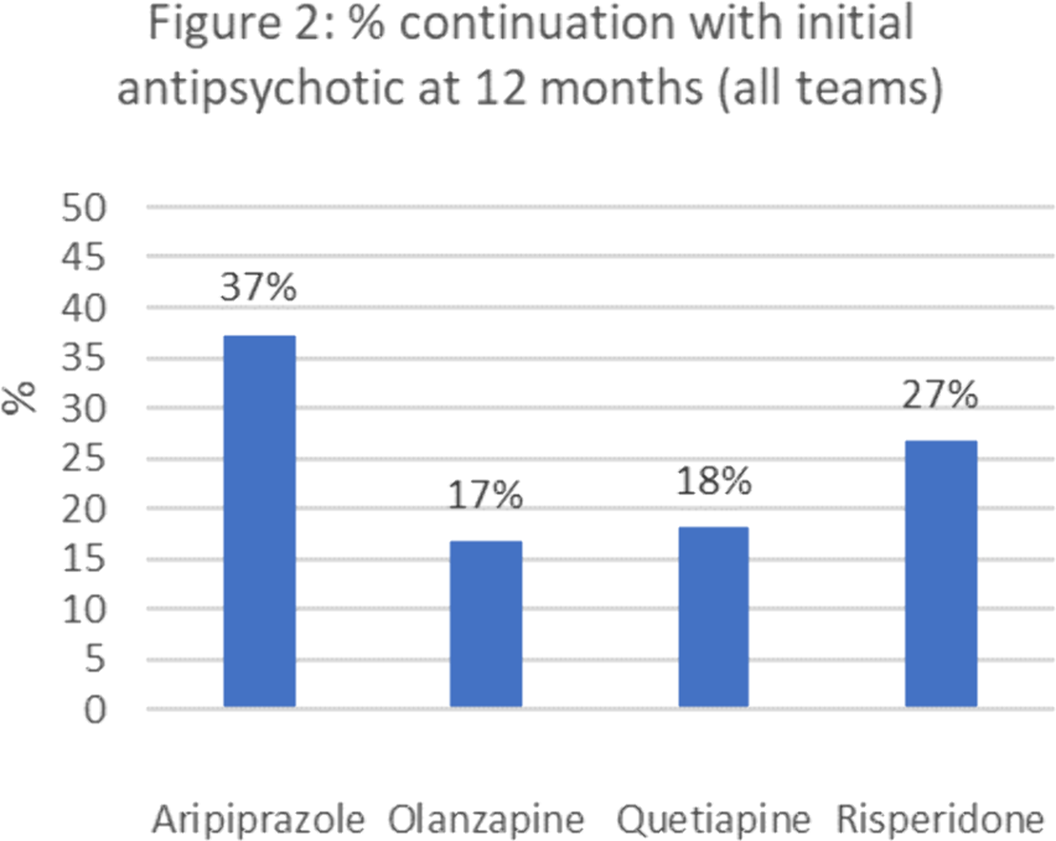
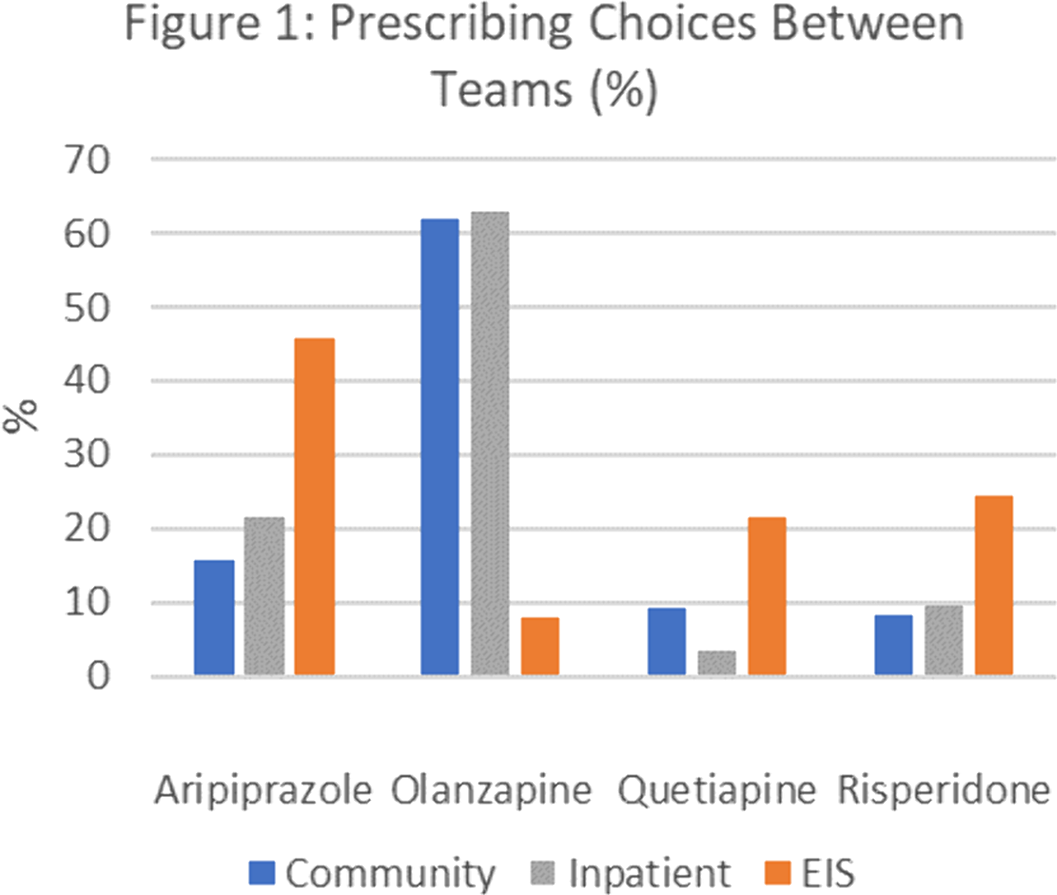
99% (n=272) of patients were prescribed an antipsychotic. 46% were initiated by inpatient serves, 40% non-EIS community services and 14% EIS. Aripiprazole, olanzapine, quetiapine and risperidone accounted for 95% of initial prescriptions. Different care teams prescribed antipsychotics preferentially (p=<0.005) (Fig.1). Rates at which initial medication was continued at 12-months varied according to initial prescription (P=<0.05) (Fig.2).
Conclusions
The frequency that specialist EIS services prescribed aripiprazole as initial treatment contrasts the preference for olanzapine in other services. Olanzapine has a significant metabolic side effect profile, is sedating and was least likely to be continued at 12 months. This raises questions about why non-FEP specialist services prefer olanzapine and whether EIS services can support these services around initial medication choices more likely to be continued throughout the key first year of treatment.
Paliperidone Palmitate 3-month formulation (PP3M) has shown a significantly longer time to relapse compared to placebo, with similar efficacy and safety to Paliperidone Palmitate 1-month (PP1M). However, studies of longer duration are required.
Objectives
The main objective of this study is to determine the effectiveness of PP3M in the prevention of hospitalizations in patients with non-acute schizophrenia in a naturalistic outpatient psychiatric setting.
Methods
Sample: 30 patients diagnosed with schizophrenia (DSM 5) that started treatment with PP3M after being stabilized with PP1M (the treatment dose was not changed in the four months before study inclusion) The mean dose of PP3M was 401. 55 mg Quarterly basis, the following evaluations were performed during a follow-up period of 60 months: The Clinical Global Impression-Schizophrenia scale (CGI-SCH) Treatment adherence, concomitant medication, and the number of hospitalizations. Efficacy values: Percentage of patients who remained free of admissions at the end of 60 months of follow-up. Other evaluation criteria: Average change from baseline visit to the final evaluation as assessed by score obtained on the following scale: GSI-SCH; percentage of patients on antipsychotic monotherapy, and treatment adherence rate.
Results
The percentage of patients who remained free of admissions at the end of the 60 months was 83.25%. Mean variations from baseline scores at 60 months were: (-0.36 ±0-37) on the GCI-SCH. The rate of adherence to treatment with PP3M after 60 months was 86.58%.
Conclusions
In our study, we found that paliperidone palmitate 3-month formulation effectively prevents admissions under daily clinical practice conditions.
Clozapine is an atypical antipsychotic, which has been shown to have superior efficacy in the remission of positive and negative symptoms in patients with treatment-resistant schizophrenia, compared to other antipsychotics. However, its benefits have been limited by the lethal adverse effects that this drug can cause, the most common, agranulocytosis. Other less serious and more common adverse effects are sedation, hypersalivation, hypo and hypertension, weight gain and urinary incontinence. It is estimated that approximately 1% of patients treated with Clozapine suffer from urinary incontinence. Data that varies from 0.3% to 42% in the articles reviewed, being undervalued in some of these for many reasons; it is stigmatizing and the patient is ashamed to express it.
Objectives
The objective of this study is to assess the percentage of urinary incontinence in patients in treatment with clozapine, taking into account the presence or absence of this side effect as the main variable, and the diagnosis, gender and dose of clozapine as secondary variables.
Methods
A retrospective observational study was carried out in which 40 patients belonging to the Adult Mental Health area of the Nuestra Señora del Prado Hospital, were collected, all of them diagnosed with some type of psychotic disorder and undergoing treatment with Clozapine.
Results
Of the total of patients studied, 25% presented urinary incontinence as an adverse effect, and of these, 60% were with doses equal to or greater than 400 mg of Clozapine.
Conclusions
We must be careful and bear this side effect in mind in all patients taking Clozapine.
Negative symptoms (NS) are a core feature of schizophrenia. NS show heterogeneity proven by factor analysis, which revealed two distinct negative symptoms subdomains: diminished expression (DE) and avolition/apathy (AA) (Marder et al. 2017, Fleischhacker et al. 2019). Some studies showed the different effects of these subdomains on clinical features of schizophrenia that suggest different pathophysiological mechanisms for their development (Stanculete 2021). It has been also shown that the levels of peripheral interleukins (IL) specifically correlate with NS (Enache et al. 2021), in particular, increased IL levels were determined in patients with deficit syndrome compared to non-deficit schizophrenia (Goldsmith et al. 2018).
Objectives
To search for the association of genes for IL-4, IL-6, IL-10 and C-reactive protein (CRP) with NS subdomains.
Methods
The total sample included 551 patients (women 51,4%, aged 18-72 years) with ICD-10 diagnosis of schizophrenia. NS were assessed by PANSS. PANSS-derived factors include AA (items N2, N4, G16) and DE (N1, N3, N6, G5, G7, G13). Genotyping was performed for the following polymorphisms: C-589T IL-4, C-174G IL-6, C-592A IL-10, G-1082A IL-10, CRP (rs2794521).
Results
There are effects of C-592A IL-10 (p=0.017) and G-1082A IL-10 (p=0.012) on AA subdomain. Post-hoc Bonferroni corrected comparisons show that carriers of the haplotype AA (C-592A)- AA (G-1082A) have the highest AA score. A significant effect of CRP (rs2794521) on AA is identified (p=0.007). There is a trend towards the association of C-589T IL-4 and C-174G IL-6 with AA. No association of these polymorphisms with DE was found.
According to recent research violations of the oxidative-antioxidant balance may play an important role in the pathogenesis of schizophrenia, by changing generate, conduct and reproduce a nerve impulse. Antibodies with oxidoreductase activity may be involved in protection against oxidative stress in schizophrenia.
Objectives
The study was to compare the superoxide dismutase (SOD) activity of IgG in patients with acute schizophrenia and during remission.
Methods
The study included 20 patients with acute schizophrenia (mean PANSS total score 94,3±14), 18 people with schizophrenia during remission (mean PANSS total score 54,7±9), and 10 healthy individuals. All participants signed informed consent for the research. Isolation of IgG from blood serum was performed using affinity chromatography on Protein-G-Sepharose columns. The homogeneity of the substances is confirmed by the SDS PAGE method. SOD activity of IgG was carried out spectrophotometrically. Statistical processing was conducted with Statistica v.10.
Results
IgG of schizophrenia patients and healthy individuals have a SOD activity and studied activity is proved to be antibodies intrinsic property. The activity of antibodies in acute schizophrenia was 1.7 times higher than in healthy individuals (p<0.05). In patients with schizophrenia during remission SOD activity of IgG was 2.4 times higher than in healthy individuals (p<0.05).
Conclusions
We can assume that in the conditions of oppression antioxidant activity in schizophrenia patients, antibodies partially take over the function of protecting the body from patients with generalized oxidative stress. This work is supported by the Russian Scientific Foundation, grant # 18-15-00053P.
Schizophrenia is a severe and chronic disorder causing significant disability and functional decline. Schizophrenia is a polygenic disease, with about 100 monogenic sites and 11 sites of chromosomal deletions / duplications involved in its pathogenesis identified. It is a pleiotropic disease, with causative genetic changes leading to multiple symptoms, including bipolar disorder, autism spectrum disorders, ADHD, mental retardation and epilepsy. The chromosomal microarray (CMA) technology detects submicroscopic chromosomal changes, which are involved in neurodevelopmental disorders, and are subject to prenatal diagnosis. Pathological findings in CMA are detected in 10-20% of patients with neurodevelopmental disorders and can contribute significantly to medical follow-up, prognosis assessment, influence treatment choice, and allow prenatal diagnosis. Preliminary studies in schizophrenia identified pathological CMA findings in 10–30% of patients.
Objectives
CMA testing of schizophrenia patients to detect genetic changes causing the disease.
Methods
Recruitment of schizophrenia patients from the Haifa and Western Galilee districts of Clalit, genetic counseling in Carmel Hospital, CMA testing of the consenting patients.
Results
Schizophrenia patients with and without neurodevelopmental disorders underwent CMA analysis, with the findings of significant chromosomal submicroscopic disorders (such as 22q11 microdeletion, among others) in 30% of the patients, providing the explanation for the patients’ symptoms and enabling specific medical follow-up and adjusted pharmacological treatment.
Conclusions
CMA can be used in diagnosing schizophrenia, assessing prognosis, adjusting pharmacological treatment and follow-up and providing genetic counseling including prenatal diagnosis, as in cases neurodevelopmental disorders. The findings support the application of CMA as part of a routine procedures in schizophrenia.