We partner with a secure submission system to handle manuscript submissions.
Please note:
You will need an account for the submission system, which is separate to your Cambridge Core account. For login and submission support, please visit the
submission and support pages.
Please review this journal's author instructions, particularly the
preparing your materials
page, before submitting your manuscript.
Click Proceed to submission system to continue to our partner's website.
To save this undefined to your undefined account, please select one or more formats and confirm that you agree to abide by our usage policies. If this is the first time you used this feature, you will be asked to authorise Cambridge Core to connect with your undefined account.
Find out more about saving content to .
To send this article to your Kindle, first ensure no-reply@cambridge.org is added to your Approved Personal Document E-mail List under your Personal Document Settings on the Manage Your Content and Devices page of your Amazon account. Then enter the ‘name’ part of your Kindle email address below. Find out more about sending to your Kindle.
Find out more about saving to your Kindle.
Note you can select to save to either the @free.kindle.com or @kindle.com variations. ‘@free.kindle.com’ emails are free but can only be saved to your device when it is connected to wi-fi. ‘@kindle.com’ emails can be delivered even when you are not connected to wi-fi, but note that service fees apply.
Nurses and firefighters are professions characterized by exposure to high occupational stress.
Objectives
The purpose of the present study was to investigate the intensity of coronavirus anxiety and its associations with depressive symptoms and burnout in samples of Polish nurses and firefighters during the COVID-19 pandemic.
Methods
Fifty nurses and 55 firefighters were recruited for the study. Respondents were administered the Coronavirus Anxiety Scale (CAS), the Center for Epidemiologic Studies Depression Scale-Revised (CESD-R) and the Oldenburg Burnout Inventory (OLBI). Descriptive statistics, Pearson product-moment correlations and one-way ANOVA were used to analyze the data.
Results
Nurses scored significantly higher than firefighters on the CAS (M = 2.76, SD = 4.18 vs. M = 1.15, SD = 2.24; p < 0.05), the CESD-R (M = 11.64, SD = 10.80 vs. M = 5.85, SD = 7.34; p < 0.01) and both dimensions of the OLBI, i.e. exhaustion (M = 2.38, SD = 0.56 vs. M = 1.91, SD = 0.55; p < 0.001) and disengagement from work (M = 2.28, SD = 0.48 vs. M = 1.93, SD = 0.43; p < 0.001). In the both study groups coronavirus anxiety significantly correlated with depressive symptoms and exhaustion, and only in nurses also with disengagement from work.
Conclusions
This study demonstrated that coronavirus anxiety was more pronounced in nurses than in firefighters. The findings provide preliminary evidence for the positive associations of coronavirus anxiety with depressive symptoms and burnout in both groups.
Disclosure
The study was supported by the grant of the National Centre for Research and Development (NCBR) No. I.PB.08 “Occupational burnout and depression in professions with exposure to high levels of occupational stress: determinants, prevalence, interrelations a
Covid-19 does not only have repercussions on the physical level, representing a new way of life, both individually and in society. The pandemic results in invisible consequences for the population’s mental health.
Objectives
This study aimed to explore the consequences of Covid-19 on mental health in Portugal with a view to understanding and promoting the well-being and happiness of the Portuguese.
Methods
The study included 111 young people and adults, aged between 18 and 58 years (M= 21.81, SD= 5.34), with 43.7% males and 52.7% females. A sociodemographic questionnaire was applied to all participants, as well as the Échelle de Mesure des Manifestations du Bien-Être Psychologique (ÈMMBEP; Massé et al., 1998 - Portuguese translation by Monteiro, Tavares & Pereira, 2012) which translates into a response scale 5-point Likert type, with five subscales, including happiness. In addition, a semistructured interview with data collection instruments was administered.
Results
The results obtained demonstrate the negative impact of Covid-19 on the level of well-being, regardless of the participant’s gender or age.
Conclusions
The data presented point to the need to sensitize individuals to the risk of the pandemic in terms of mental health, thus increasing society’s awareness of the psychological effects of this new global disease. Therefore, coping mechanisms are essential to promote well-being and successfully overcome the pandemic.
Since the beginning of the pandemic, the Sars-cov2 virus remains unclear concerning its clinical manifestations and its sequelae. Few studies have evaluated the existence of cognitive impairment in patients with COVID-19 and estimated its imputability in the development of these disorders.
Objectives
The objectives of this study is to assess cognitive disorders in post-COVID patients.
Methods
A descriptive observational survey was conducted by the psychiatry department of Mongi Slim hospital in Tunis-Tunisia during May-June 2021 among covid-19 patients selected at the first post covid consultation (at 1 month). First, sociodemographic and clinical data were collected, then the evaluation of the cognitive disorders was carried using many scales: MMS (mini mental state), FAB, TMT and the maze task.
Results
Eight patients met the selection criteria with a sex ratio of 6:2 and an average age of 67.5 years (6 with a primary level). The extent of the lesions varied between 10% and 75%. Among the participants, 4 required hospitalization in intensive care: 3 with non-invasive ventilation and 1 needed intubation. The 1-month evaluation found that all the patients had good memory and execution skills with MMS scales >25 and FAB scales >14. Regarding flexibility and planification: 4 of them needed more than 78 seconds to complete the TMT-A ,3 took more than 273 seconds to complete the TMT-B and 2 needed more than 60 seconds to accomplish the maze task (deficient scores).
Conclusions
The screening of cognitive disorders in post-COVID patients is very important for a better management that may require early neurocognitive rehabilitation.
Together with agranulocytosis, fever and immflamatory manifestations are clozapine side effects to be monitorized during initial treatment. In the context of COVID-19 pandemic, implied mechanisms, and symptomatology should be carefully controlled.
Objectives
To analyze the clinical analytic and inflammatory chracterisctics the resembles and differenciates clozapine immune response and SARS-CoV-2 infection. To describe a case of clozapine induced fever and pneumonitis during COVID-19 pandemic.
Methods
A case of clozapine-induced pneumonitis during COVID-19 pandemic is described.- A mini-review of clozapine inflamamtory effects, induced-pneumonitis and SARS-CoV-2 was performed.
Results
A 33 year old afrolatin male started treatment with clozapine up to 250 mg daily. He developed fever and respiratory symptoms in the 11th day of treatment. The exploration revealed pulmonary sounds decreased and 91% basal saturation, making the probable causes viral infection (local incidence of SARS-CoV-2 >800/100000hab), nosocomial bacterial infection or pulmonary thromboembolism. The patient was isolated due to probable COVID-19. Blood tests showed leucocytosis (13400/mcL), Lymphocytopenia (11.8%), high PCR (14.4mg/dL), Ferritine (506.9ng/mL), Fibrinigen (663.83 mg/dL), D-Dimer (1.61mg/dL), and Interleukin-9 /25.8pg/mL). The angioTC revealed a pleural efusion and ground glass infiltrates (figure1). Only after 2 weeks eosinophilia was discovered (88/mcL) After 2 negative consecutieve PCRs for SARS-CoV-2, no imrovement with ampirical antibiotics and all infectious pannels negative, we started decreasing clozapine with improvement of the symptoms and resolution after suspending clozapine completely.
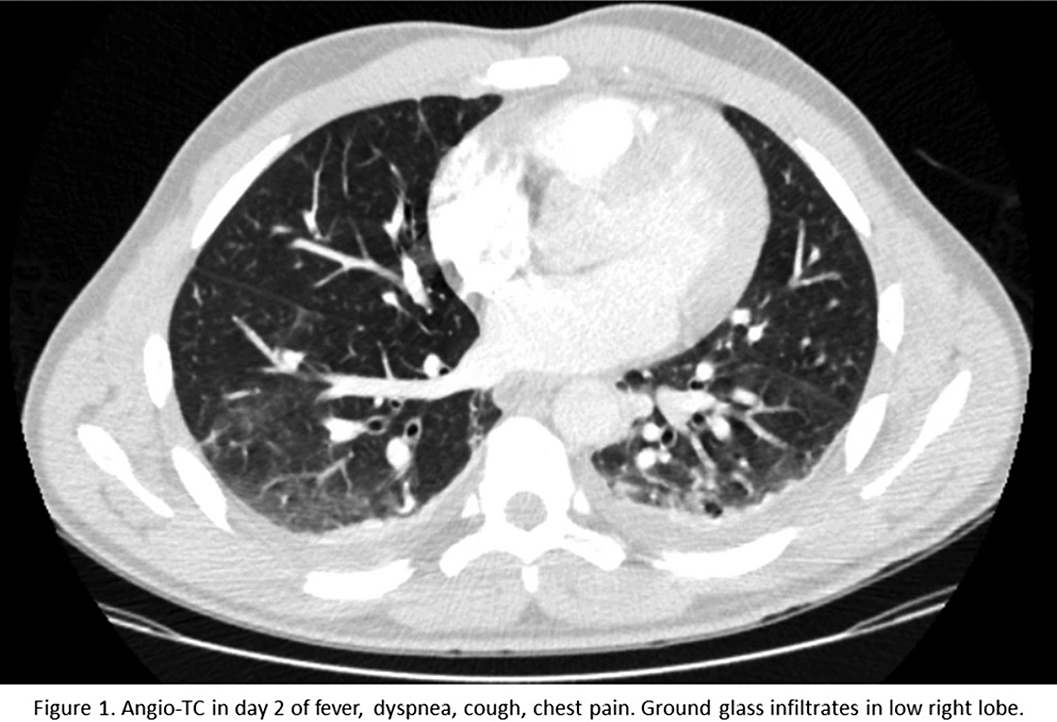
Conclusions
Clozapine may induce a generalize inflammatory response mediated by interleukin-6. Patients treated with clozapine may exhibit fever and rarely, insterstitial lung inflammation. The expression of induced pneumonitis resembles viral infections, particularly SARS-CoV-2
Paediatric and adult psychiatric emergency department (ED) visits decreased during the initial COVID-19 pandemic outbreak. Long-term consequences of the pandemic will include increases in mental healthcare needs especially among especially vulnerable groups such as children and adolescents.
Objectives
This study examined changes in the number of overall and diagnosis-specific mental health ED visits among patients aged <18 years following onset of the COVID-19 pandemic in Madrid, Spain.
Methods
We used electronic health records to extract the monthly numbers of total and diagnosis-specific mental health ED visits among patients aged <18 years, between October 2018 and April 2021, to La Paz University Hospital. We conducted interrupted time-series analyses and compared trends before and after the day of the first ED COVID-19 case (1st March 2020).
Results
In March 2020, there was a marked initial decrease of -12.8 (95%CI -21.9, -7.9) less monthly mental health ED visits. After April 2020, there was a subsequent increasing trend of 3.4 (95%CI 2.6, 4.2) additional monthly mental health ED visits.
Conclusions
After onset of the COVID-19 pandemic, there was an increase in paediatric psychiatric ED visits, especially due to suicide-related reasons. These data reinforce the crucial role of the ED in the management of acute mental health problems among youth and highlight the need for renovated efforts to enhance access to care outside of and during acute crises during the pandemic and its aftermath.
The sudden changes in daily routine due to the containment measures adopted for facing the COVID-19 pandemic have had an impact on the mental health of the general population. In particular, young adults are exposed to a higher risk compared to the general population to suffer from the consequences of the pandemic, in terms of anger and irritability, depressive symptoms and somatic complaints, insomnia, lack of motivation and loneliness. In particular, loneliness can be particularly pronounced during young adulthood.
Objectives
This study aimed to describe the levels of loneliness in a sample of Italian young people during the national lockdown in 2020, evaluating clinical and socio-demographic differences and the role of coping strategies and levels of resilience.
Methods
A sub-analysis of a sample of adults aged 18-34 years has been drawn on a larger cross-sectional observational national trial (COMET, 2020) in which, among other psychopathological dimensions, the levels of loneliness have been assessed by the UCLA scale short version.
Results
Levels of loneliness were particularly severe in a third of cases (risk factors: unemployment, low income and vulnerability in mental health), in association with depression, anxiety, stress, OCD symptoms, higher rates of suicidal ideation, sleep disturbance and excessive use of Internet. Levels of loneliness tended to increase over time.
Conclusions
Overall, during the Italian COVID-19 lockdown young people have experienced quite high levels of loneliness: this dimension could represent a useful domain to assess in routine clinical practice.
The epidemic of COVID-19 has affected the psychological health of people, especially frontline medical and paramedical staff. Several coping strategies have been used to combat the impact of this virus on their lives.
Objectives
Describe the impact of coronavirus on mental health and identify coping strategies
Methods
We carried out a cross-sectional, descriptive and analytical study, conducted over a period of two months ( september and october 2020), in 22 hospitals in Tunisia, including frontline medical and paramedical staff. To evaluate anxiety and depression, we used the Beck Inventory. To identify coping strategies, we used the Brief COPE.
Results
We collected 78 professionals. The mean age was 29.86+-5.4. The majority were medical residents (67.9%) working in covid units in 39.7% of cases. The rythm of work was daily in almost half of the cases, giving direct care to the patients tested positive in 76.9%. More than half had not received adequate training, and protective equipment was available in only 50% of cases. We found 35.9% of the staff who had to move for fear of infecting their families. More than half of the frontline staff were victims of stigma (57.7%). Depression and anxiety were tested minor in 40%. The most used coping strategy in the face of this distressing virus was social support (64.1%) followed by emotion-focused mechanisms (53,8%). Social support strategy was significantly correlated with prevention of anxiety (p=0.048)
Conclusions
Participants practiced and recommended various coping strategies to deal with stress, depression and anxiety emerging from COVID-19 pandemic.
The spread of the corona virus (COVID-19) has an enormous psychosocial impact on humanity across the globe, resulting in an increase in mental health issues. There are no specific diagnostic instruments that could identify COVID-19 related mental health problems. In recent months, new scales have been developed to identify COVID-19 related problems.
Objectives
Our objective was to investigate the clinical utility of these new assessment instruments.
Methods
We performed a literature search, using Pubmed, EMBASE, Scopus and Cochrane library databases, to search for new scales identifying COVID-19 related mental health problems.
Results
During the first half of the year 2020, we found five published new self-report measurement instruments: Coronavirus Anxiety Scale (CAS), the COVID Stress Scales (CSS), the Fear of COVID-19 Scale (FCV-19S), the Obsession with COVID-19 Scale (OCS), and the Questionnaire on Perception of Threat from COVID-19. These instruments have been validated in a group of middle-aged ambulatory patients.
Conclusions
These new instruments might be useful in non-clinical settings. Although the psychometric reports are promising, the instruments have been validated in a less vulnerable group of patients. Future validation studies should also comprise other age groups, particularly the old and more vulnerable population.
Patients with mental disorders mainly schizophrenia represent a vulnerable population. In Covid-19 pandemic situation, could schizophrenia be considered as a significant mortality risk factor ?
Objectives
In this study, we aimed to explore the odds of significant COVID-19 mortality among schizophrenia patients
Methods
Our literature review was based on the PubMed interface and adapted for 2 databases: Science Direct and Google Scholar using the following combination ( schizophrenia [MeSH terms]) AND (COVID-19, mortality[MeSH terms])
Results
Our review included 4 population-based cohort studies covering the period from december 2019 to May 2021. The data showed increased mortality risk among individuals with schizophrenia who have had COVID-19. Indeed, this high rate of mortality maybe associated with multiple factors such as unhealthy lifestyle, low socioeconomic status and comorbidities as obesity, diabetes and cardiovascular conditions. The use of antipsychotics can be considered as a risk factor regarded its immunomodulatory effects. Furthermore, stigma and discrimination towards mental illnesses particularly schizophrenia might have contributed to a worse prognosis.
Conclusions
Schizophrenia is a severe mental disorder ,associated with an increased high risk Covid-19. Thus, this population require enhanced preventive and disease management strategies.
Recent research showed that persons with mental disorders may represent a population at increased risk for coronavirus disease (COVID-19) infection with more adverse outcomes.
Objectives
We aimed to analyze clinical profile of psychiatric inpatients during their infection with COVID-19, and to explore factors associated with the disease progression.
Methods
We analyzed retrospectively the medical records of 32 psychiatric inpatients, hospitalized in psychiatry “B” department at Hedi Chaker hospital (Sfax, Tunisia), and who contracted the COVID-19 infection. We used “Charlson Comorbidity Index Score” (CCIS), predicting 10-year survival in patients with multiple comorbidities.
Results
Somatic history was reported in 50% of patients. The CCIS ranged between 0 and 4. Psychiatric diagnosis was schizophrenia in 81.3% and bipolar disorder in 18.7% of cases. The clinical symptoms reported were fever (50%), dry cough (75%); dyspnea (34.4%). Biological assessment showed a lymphopenia in 40.6% and a high C-Reactive Protein (CRP) in 53.1%. Among our patients, 37,5% needed oxygen, and 25% were transferred to the intensive care unit. The COVID-19 complications were mostly bacterial pulmonary superinfections (21.9%) and pulmonary embolism (9.4%). Only three (9.4%) patients died from the virus. Patients with medical history were more likely to need oxygen (p<0.001). Clinical and paraclinical parameters associated with oxygen need were: fever (p<0.001); dyspnea (p<0.001); lymphopenia (p<0.001); high CRP (p=0.001). Patients presenting pulmonary superinfection or embolism were more likely to require oxygen (p=0.006 and p=0.044 respectively).
Conclusions
This study highlighted factors that may worsen the COVID-19 infection evolution, and which require special attention, in order to improve the prognosis of this disease.
Heath workers especiallyin the emergency rooms and emergency medical services are exposed to sustained stress which had increased due to the Pandemic situation
Objectives
To search for factors associated with mental disorders among health workers during the Covid 19 pandemic
Methods
Data were collected through a questionnaire,with demographic variables anddifferentscales to evaluate the degree of symptoms of depression, anxiety, insomnia, distress, and the level of work engagement(PHQ-9,GAD-7,ISI,IES-R,UWES-9).
Results
Of the 217 participants, 46% were physicians, 42% were nurses and 12% were emergency medical technicians. We also found a femalepredominance of 66%, 55% were single and a total of 155 participants of whom 71% were frontline health workers. In our study, 54.8% of the HCWs had symptoms of depression, 68.2% had symptoms of anxiety and insomnia and 71.4% had symptoms of distress. Binarylogisticregressionanalysisshowedthat being married was associated with depression, anxiety, and insomnia, and being a frontlineworkerappeared to be a risk factor for depression and insomnia. Psychiatric support was an independentrisk factor for all psychiatric symptoms.In addition, living in a rural area was associated with depression, and age 31 or older was associated with anxiety. In addition, having a history of psychiatric illness was a risk factor for insomnia. Being a nurse was identified as a risk factor for psychiatric distress. We also found a moderatelevel of professional commitment to be a protective factor.
Conclusions
Protecting healthcare workers is a crucial part of the public health response to the COVID-19 outbreak.
The COVID-19 pandemic has focused attention on the challenges and risks faced by frontline healthcare workers (HCW).
Objectives
To describe the quality of management of HCW affected by the COVID-19.
Methods
This is a cross-sectional study enrolling all HCW of Farhat Hached Academic hospital who had been affected by COVID-19 during the period from september to December 2020.
Results
During the study period, 267 HCW were affected with a mean age of 42.3 ±10 years and a ratio-sex of 0.25. The most represented category was nurses (33.3%) followed by technicians (26.1%). Gynecology department had the highest number of affected HCW (14.4%).The majority of participants (97.4%) reported a medical care. Twelve HCW (4.5%) were hospitalized with an average length of hospital stay of 7.55 ± 6.12 days. The average length of sick leave was 18.68 ± 10.99 days. During the lockdown, 38.6% of HCW took care of their children without any external help. All of the HCW were supported by phone calls from colleagues in 88.4% of cases, the hierarchy in 67.4% of cases, occupational medicine in 60.3% of cases.
Conclusions
The impact of COVID 19 is greater in HCW than in the general population. The affected staff should have a multidimensional management to avoid post covid sequelae in both physical and mental levels.
Burnout is understood as a stable professional and personal deformation, which can be typical for teachers (Maslach, Schaufeli, 1993). Multilevel structure of burnout that include physiological, affective-cognitive, and behavioral dimensions was described (Perlman, Hartman, 1998). С. Maslach proposes a three-dimensional burnout model, including emotional exhaustion, depersonalization and reduction of personal achievements (Maslach, 2000; Schaufeli, Enzman, 1998). It is especially important to prevent burnout by effective using of self-regulation resources during the COVID-19 pandemic, when the level of stress increases (Samanta et al., 2020; Pascale, 2020).
Objectives
The study was held in 50 teachers, who worked remotely during the self-isolation due to COVID-19 pandemic, and aimed to estimate the relationship between psychological resources of self-regulation and signs of reduced professional burnout in teachers during the COVID-19 pandemic.
The results revealed that the teachers with high and medium burnout differ in terms of engagement as a component of hardiness (p=0,002). The teachers with less pronounced burnout syndrome have more developed involvement, which means that these teachers enjoy their own activities and, perhaps, this is what becomes a psychological resource and allows to overcome emotional exhaustion. There is an inverse relationship between such a sign of professional burnout as emotional exhaustion and involvement as a component of hardiness (r=- 0,521, p=0).
Conclusions
The results of the study can be applied to develop programs to improve the psychological well-being and performance of teachers working under stress due to COVID-19 pandemic.
According to recent reports Covid-19 patients may exhibit psychiatric co-morbidities that cause dysfunction, loss of autonomy and emotional suffering even after the physical illness is treated. Considering the high impact Covid-19 may have on mental health, we have created a psychiatric consultation dedicated to the study, observation and support of patients that developed mental illness after being hospitalized due to Covid-19.
Objectives
We aim at 1) describe the profile of patients that developed psychiatric comorbidities following a hospitalization due to Covid-19 and 2) recognize and treat early psychiatric symptoms in Covid-19 patients.
Methods
Based on what was described in other epidemic crisis, we established a semi-structured interview to evaluate several dimensions of the patients’ life that may have been affected by Covid-19 and that may impact on mental health. The interview included the Depression, Anxiety and Stress Scale (DASS-21), the Impact of Event Scale – Revised (IES-R) and the Insomnia Severity Index (ISI). Each patient was observed multiple times over several months. Our evaluation was done in parallel with consultations in Internal Medicine.
Results
Most patients complained of symptoms directly related with the infection of SARS-CoV-2, namely fatigue, short breath and reduced tolerance to efforts. Importantly, many patients also reported de novo or aggravation of anxiety, stress, depression, sleep disturbances and grief often associated with feelings of existential emptiness and lack of purpose.
Conclusions
Hospitalization due to Covid-19 has a high impact on mental health, raising important questions on purpose and emptiness. An early psychiatric intervention is highly recommended.
Over the course of COVID 19 illness, olfactory dysfunction was largely described as hyposmia and anosmia. What about phantosmia?
Objectives
In this study, we aimed to explore olfactory hallucinations among COVID 19 patients.
Methods
Our literature review was based on the PubMed interface and adapted for 2 databases: Science Direct and Google Scholar using the following combination ( phantosmia [MeSH terms]) OR (olfactory hallucinations[MeSH terms]) AND (COVID-19 [MeSH terms]).
Results
Smell dysfonction is one of the most revealing sign of COVID 19 infection. However, other symptoms particularlty phantosmia tend to emerge later in the course of the disease. Female predominance was noted among patients sufferning from olfactory hallucinations regardless to their medical history. An unpleasant olfactory sensation was the most described sign. The occurene of phantosmia was also described in one case of women suffering from schizophrenia whom tested positive for COVID 19 infection.
Conclusions
Olfactory hallucinations are more and more associated with COVID-19 disease regardless to psychiatric disorders. The pathological mechanism remains unclear and further studies are needed for a better comprehension and management.
Since the beginning of the pandemic, 4,745,519 cases, 396,878 hospitalizations and 82,884 deaths with COVID-19 have been reported in Spain. As of August 24, 2021, 76.4% of Andalusians over 12 years of age have the complete vaccination regimen
Objectives
Main: to calculate the prevalence of COVID 19 infection, clinical evolution and vaccination rate in a population of patients diagnosed with dual depression. Secondary: compare these data with those obtained in patients diagnosed with non-dual depression
Methods
Retrospective descriptive study. The study population is made up of patients diagnosed with dual depression and non-dual depression (according to DSM 5 criterion). Infection, admission, death, and vaccination data were obtained from the patient’s medical history
Results
Of the 10 patients diagnosed with dual depression, the prevalence of COVID 19 infection, since the beginning of the pandemic is 0% and of the 30 patients diagnosed with non-dual depression the prevalence is 3.33% (1/28). Of the patients with COVID 19 infection, none required hospital admission and no deaths occurred. The vaccination rate in the group of patients with dual depression is 30% (3/10) and in the group of non-dual depression is 86.66% (26/30), finding statistically significant differences (P<0.01) between both groups.
Conclusions
In our study the prevalence of COVID 19 infection in patients diagnosed with dual depression is 0% and the vaccination rate is 30%. While in patients with non-dual depression the prevalence is 3.33%, there were no admissions, no deaths and the vaccination rate is 86.66%.
Healthcare services are primarily focusing on medical and physical treatment of COVID-19 while psychosocial and mental health needs are not considered a priority.
Objectives
The purpose of this study was to explore how recovered individuals with COVID-19 adapted to their psychological and social stressors during infection period.
Methods
A descriptive phenomenological approach conducted using a purposeful sample of 13 individuals recovered from COVID-19 in Jordan. Data collected using unstructured interviews.
Results
Perception of being diagnosed with COVID-19 revealed to three major themes; positive learning (acceptance, avoiding social pressure, and normalizing), tolerating ambiguity (denial and seeking information and guidance), and resilience (caring family, professionals’ support, self-grieving, optimism, positive thinking, and spirituality).
Conclusions
The study indicates that there is a need to integrate psychosocial and mental health care services into healthcare plans provided to individuals with COVID-19.
Vaccination has proved to be an effective tool in decreasing infectious diseases incidence and their mortality rate. Negative public vaccine attitude can significantly undermine efforts to combat the pandemic that makes vaccine hesitancy one of the WHO main concerns
Objectives
Examination of the relationships in population between vaccine attributes and COVID-19 personal experience, social and demographic characteristics
Methods
Cohort cross-sectional study of the population attitude to vaccination against coronavirus infection COVID-19 was performed online during the first 2 months of mass vaccination in Russia, using the special designed questionnaire assessing social demographic variables, COVID-19 related factors, and preferable sources of information about COVID-19 vaccines. 4977 participants in the age from 18 to 81 years were enrolled in the study to vaccination against coronavirus infection COVID-19 was performed online during the first 2 months of mass vaccination in Russia, using the special designed questionnaire assessing social demographic variables, COVID-19 related factors, and preferable sources of information about COVID-19 vaccines .
Results
34.2% of respondents consider vaccination useful. 31.1% ‑ doubt its effectiveness. 9.9% ‑ consider vaccination unnecessary. 12.2% ‑ dangerous. indifference to vaccination was formed in 7.4% of respondents. They indicated that they do not plan to be vaccinated. 32.3%. postpones their decision until more remote data on the results and effectiveness of vaccination are obtained ‑ 34.0%. were vaccinated at the time of the study ‑ 11.6%.
Conclusions
Attitude towards vaccination depends on age, gender, education, fear of possible complications, coronaphobia. Young people are less focused on vaccination than middle-aged and older people.
Facing educational difficulties related to COVID-19, some teachers can no longer adapt, making them potential candidates for burnout.
Objectives
We aimed to assess burnout among high school teachers during the COVID-19 pandemic and to determine its prevalence and factors associated with it.
Methods
We conducted a cross-sectional, descriptive and analytical study, carried out on google drive in May 2021, and relating to 97 Tunisian junior and secondary school teachers from the Sfax region. Burnout was evaluated by the Burnout Measure Short version (BMS-10).
Results
The sex-ratio (M/F) of our population was 0.32 and the average age was 44.23 ± 7.81 years old. The labor load was low, medium and high in respectively 1.4%, 57.6% and 41% of cases. Almost a third of participants (30.6%) reported a low satisfaction with working conditions. The average BMS score was 40.19 ± 13.98. According to the BMS scores, 36.1% of teachers had a very low to a low degree of burnout, 23.6% had burnout while 40.3% had a high to very high degree of exposure to burnout. Furthermore, the BMS score was associated with the female gender (p=0.002), sleep disturbances (p<0.001), suicidal thoughts (p<0.001) and with a medium to a high labor load (p=0.045).
Conclusions
In this study, Tunisian high school teachers in times of COVID-19 reported a high burnout rate. Thus, the protection of this vulnerable population must be an important component of public health measures.
The COVID-19 (Coronavirus Disease 2019) pandemic is associated with several stressful factors that can negatively affect peoples’ sleep quality and mental health.
Objectives
The aim of the current study was to prospectively identify decreased sleep quality and associated risk factors in general population during COVID-19 pandemic.
Methods
We conducted a prospective, observational online study on a Romanian sample of 667 respondents aged >18 years. Sleep quality and quantity was evaluated with Athens Insomnia scale (AIS) and the main concerns associated with the pandemic context were evaluated through a multiple-choice question.
Results
The data collected identified important evidence regarding the prevalence and intensity of insomnia. The average score for AIS was 6.13 (cut-off point for was set at 8). However, it is worth noting that 179 respondents (26.8%) meet the criteria for insomnia. Of the 8 self-assessment items, daytime sleepiness was the criterion evaluated with the highest average score (1.01), all other items getting subunit values. A low quality of sleep was linearly related with fear of illness/death (p=0.053), fear of illness/death of close people (p=0.032), social isolation (p<0.001), economic impact (p=0.003), losing the job (p<0.001) and social stigma associated with COVID-19 infection (p=0.009).
Conclusions
More than a qurter of respondes scored above the threshold of 8 at the insomnia scale, while losing the job, social stigma associated with COVID-19 infection and social isolation are the main risk factors for a low quality and quantity of sleep.