We partner with a secure submission system to handle manuscript submissions.
Please note:
You will need an account for the submission system, which is separate to your Cambridge Core account. For login and submission support, please visit the
submission and support pages.
Please review this journal's author instructions, particularly the
preparing your materials
page, before submitting your manuscript.
Click Proceed to submission system to continue to our partner's website.
To save this undefined to your undefined account, please select one or more formats and confirm that you agree to abide by our usage policies. If this is the first time you used this feature, you will be asked to authorise Cambridge Core to connect with your undefined account.
Find out more about saving content to .
To send this article to your Kindle, first ensure no-reply@cambridge.org is added to your Approved Personal Document E-mail List under your Personal Document Settings on the Manage Your Content and Devices page of your Amazon account. Then enter the ‘name’ part of your Kindle email address below. Find out more about sending to your Kindle.
Find out more about saving to your Kindle.
Note you can select to save to either the @free.kindle.com or @kindle.com variations. ‘@free.kindle.com’ emails are free but can only be saved to your device when it is connected to wi-fi. ‘@kindle.com’ emails can be delivered even when you are not connected to wi-fi, but note that service fees apply.
Facial covering and mask use is generally considered a preventive measure in reducing spread of infectious respiratory illnesses. With the COVID-19 pandemic, covering of the face, except the eyes, has become the norm for the first time for most people. Social interactions and clinical observation rely heavily on non-verbal communication of which facial expression is of utmost importance. While clinicians, especially in mental health settings, are acutely aware of the loss of information transmitted through the lower half of the face, signs of tardive dyskinesia may be forgotten in the list of potentially missed information.
Objectives
To reflect on possible failure to detect orobuccolingual movements of tardive dyskinesia due to use of facial masks.
Methods
Reflection on a clinical case of a patient with a treatment refractory psychosis who presents to an outpatient appointment with a facial mask. After the appointment, a family member transmitted having observed what appeared to be involuntary masticatory movements in the patient.
Results
Facial masks and coverings occult signs that may be visible on the lower half of the face.
Conclusions
Facial masks and coverings are essential in preventing COVID-19 contagion. Clinicians must keep in mind loss of information when part of the face is not visible. Tardive dyskinesia with orobuccolingual movements may be missed behind a mask. Family or other people who cohabit with the patient are essential information providers.
SARS-CoV-2 is having an important direct impact, and also due to treatments used such as corticosteroids. Among its effects, we have focused on psychosis.
Objectives
The objective of this paper is to study, from following case, incidence of steroid-induced psychosis in context of COVID-19.
Methods
A bibliographic search was performed from different database (Pubmed, TripDatabase) about psychiatric symptoms associated with use of corticosteroids during pandemic. 64-year-old woman with no psychiatric history, who is hospitalized for pneumonia secondary to SARS-Cov2 and treated with antibiotics, bronchodilators, and corticosteroids. At 4 days she began with injury and nihilistic delusions. The corticosteroids were progressively reduced, adding 2.5 mg Risperidone, resolving after ten days.
Results
Corticosteroids are currently being used to treat the systemic inflammatory response associated with COVID-19, but they can produce other effects such as psychiatric symptoms (3-6%): 75% affective (mainly hypomanic symptoms); and 25% psychotic. Steroid-induced psychosis are characterized by confusion, delusions, and hallucinations, and they usually begin 3-4 days after onset, and resolve within a week. They are associated especially with oral systemic steroids and high doses: 1.3% with 40mg of prednisone, and 18% with 80mg; increased this incidence due to the greater use that is being made to treat COVID-19 and the higher doses used in severe cases (up to 120 mg).
Conclusions
To conclude, we need to know characteristics of these episodes in order to be able to prevent and treat them properly (minimum effective dose and less time), since they will probably occur more frequently at this time.
The new coronavirus has spread rapidly across the planet confining entire populations, filling hospitals overwhelmed by massive arrivals of patients This new health situation was traumatic especially for health-professionals
Objectives
To study the prevalence and predictors of post-traumatic stress disorder, among health-workers.
Methods
Our study was descriptive and analytical cross-sectional, between May until June 2020. An anonymous online-survey was sent to collect those parameters Sociodemographic-information Physical symptoms The existence of contact with a suspected case The need for quarantine The stressful event The state of mental health, using: PCL-5: 20 items which measures the 20 symptoms of post-traumatic stress-disorder according to DSM-5. PSQI: 9 questions to see the existence or not of a disturbance in sleep
Results
125 participants: 28 university-hospital doctors, 55 residents, 5 interns, 4 specialist-doctors, 2 general-practitioners, 14 nurses, 14 senior-technicians, 2 midwives and a pharmacist. The average seniority at the job was 6 years. Two factors were the most stressful: The characteristics of this pandemic 37.6% The fear of caching the virus and transmit it to their families: 37.6%. 42.4% of participants presented a post-traumatic stress disorder. 3 parameters were correlated with post-traumatic stress disorder: young age, having children (p = 0.007) and fewer years of professional-experience. This pandemic altered the quality of sleep of caregivers, 62.4% of them had a bad quality of sleep. The bad sleepers developed more post-traumatic stress disorder
Conclusions
This health crisis had a major impact on the mental health of our heroes that is why we should provide them with the necessary psychological support.
The COVID-19 outbreak poses a challenge for health care professionals due to a surge in care demands, overwork, fear of contagion and concerns on the availability of protective equipment, and coping with distress of patients and their families. Although there is emerging evidence on prevalence of stress and its predictors, less is known on the trajectory of stress symptoms and the differences between cohorts of health care professionals.
Objectives
To sustain and restore health care professionals the Leiden University Medical Center has launched the Digital Stress Buddy, a mobile app, to assess psychological stress, depressive symptoms, anxiety and posttraumatic stress symptoms.
Methods
Participants fill in a 14-item questionnaire on stress and resilience resources, followed by a COVID-related questionnaire and finally a set of validated questionnaires on depression and anxiety (DASS-21), posttraumatic stress-symptoms (IES-R), burn-out (CBI) and resilience (RES).
Results
To date, 959 health care workers have completed the stress monitor, of whom 223 (23%) showed relevant stress levels. Within this group, anxiety and posttraumatic symptoms were most prevalent (45%), followed by depressive symptoms (15%). Predictors of stress were being female, coping with distress of patients and their families, teleworking, and overwork.
Conclusions
By identifying vulnerabilities and resilience for psychological distress, we are able to tailor the support interventions for health care workers within our hospital. This is an ongoing study and future follow-up during the second wave of the pandemic will provide more insight on the trajectories of stress-related symptoms.
Although some philosophers recognize in the loneliness an evolutionary existential process, a 2019 declaration of World Health Organization underlines the major health problem in the worldwide is the perception of state of loneliness. The feeling of loneliness linked to the social isolation (SI) or a lack of social opportunity activate a stressful condition associated to an increase of social dependence. This ‘learned social helplessness’ can be dangerous so that it is associated with an increased prevalence of suicides (Cacioppo and Cacioppo, 2018; Bzdok and Dunbar, 2020). Considering the impact of loneliness on the mental health we can assume that the COVID-19 forced SI affects the state of health and psychosocial well-being.
Objectives
To evaluate the psychosocial impact of the SI in Italy.
Methods
An ad hoc survey have been sent from May to June 2020.
Results
These results refer to the Italian survey of a multicenter investigation with partnership of Spain and Portugal universities. The investigation is in progress being a longitudinal study. Of the total 292 subjects investigated (age xM: 34; sD14.13), 118 (40,41%) had been in SI. Subjects forced into SI report more interference in the life satisfaction (p=0.003) though no more anxiety, depression and hostility we found in the SI group.
Conclusions
During the phase 2 of Italian COVID-19 diffusion, we found an impact on the life satisfaction more than psychopathology. We can assume that the impact of mental health it may occur as the reduction in life satisfaction associated with forced SI continues.
The COVID-19 pandemic made neccessary the declaration of emergency state in Hungary from 11 March 2020 to 18 June 2020. During this period hospitals were reserved for emergency use, ambulatory care was limited and replaced by telemedicine.
Objectives
We assessed the opinions of patients of two ambulatory psychiatric care units in Budapest regarding the emergency state.
Methods
We enrolled 438 outpatients in the survey (305 women and 133 men, mean age:51.9±16.2 years).Our questionnaire comprised 10 items on emotions and mental state and a 12 item „Problem evaluation scale”(included ’Fear’, ’Isolation’ and ’Health status’ subscales).General linear model (GLM), pairwise comparison and Tukey’s post hoc test were performed.
Results
Up to 34% of patients considered that their condition worsened during this period, but 12% of them thought that this was not related to emergency state. Twice as many participants (12.8%) were concerned about their financial situation than about their health status (6.1%). Worsening health status, higher fear and more common adaptation difficulties were reported by patients < 50 years, than by subjects> 50 years (p=0.001; p=0.045; p=0.003). Isolation caused higher distress among women than in men (p=0.003). The abundance of information caused higher distress in patients with anxiety disorder than with psychotic disorders (p=0.024).Patients with affective disorders perceived higher vulnerability compared to subjects with psychotic disorders (p=0.004).
Conclusions
Adaptation difficulties were reported by the half of the sample.Depletion of psychological resources can be expected during the next stage of the pandemic.
The devastating effects of the current pandemic are profoundly affecting peoples’s physical and psychological health. Numerous studies on the effects of previous infectious outbreaks have been published. Similarly, an increasingly growing body of research on COVID-19 has been developed and released, reporting a substancial psychological impact of both the outbreak and the response, suggesting that the population may express high levels of psychological symptoms.
Objectives
This presentation aims to synthesize existent literature that reports on the effects of COVID-19 on psychological outcomes of the general population, groups with higher vulnerability and its associated risk factors.
Methods
Bibliographic research was made through scientific databases such as PubMed and EMBASE. No time limit was used. Pertinent articles were carefully reviewed for additional relevant citations.
Results
Generally, there is a higher prevalence of symptoms of adverse psychiatric outcomes among the public when compared to the prevalence before the pandemic. Psychological reactions to pandemics include maladaptive behaviours, emotional distress and symptoms of stress, anxiety, depression, and avoidance behaviors. The groups known to be at higher risk for mental health problems during the pandemic are: women, healthcare workers, people under 40 years old and with chronic diseases. Other risk factors are: frequent exposure to social media/news relating to COVID-19, poor economic status, lower education level, and unemployment.
Conclusions
The COVID-19 pandemic represents an unprecedented threat to mental health. In addition to flattening the curve of viral transmission, special attention needs to be paid to the challenges it poses to the mental health of the population at a global scale.
Amid the COVID-19 pandemic the trend points to universal use of protective face masks. The impact posed on verbal and non-verbal communication by masks is yet another challenge to be addressed in clinical care.
Objectives
To reflect on the consequences of face mask and covering use on communication in the clinical setting, including mental health settings.
Methods
Pubmed and Google Scholar literature search using terms face mask / face covering and communication / emotion.
Results
There is a lack of literature on the impact of protective face masks and coverings on communication in clinical settings. Face masks and coverings may have a significant impact on patient-healthcare professional relationship due to disruption of verbal (poorer quality of speech transmission) and non-verbal communication (emotional expression and recognition) with consequences on: 1) clarity of communication with potential for misunderstanding clinical information, advice and prescriptions posing safety issues, 2) emotion perception, expression and reciprocity, 4) perception of healthcare professionals’ empathy and therefore, 3) patient satisfaction, 4) quality of care, and 5) clinical outcomes. Difficulties in communication between the patients´family or other carers and healthcare providers and between healthcare professionals are likewise challenged. People with hearing impairment, children and people with mental illness may be especially vulnerable to these difficulties in communication.
Conclusions
Protective face masks and coverings are undoubtedly important in preventing spread of COVID-19, nonetheless mental healthcare professionals should take into account their significant impact on verbal and non-verbal communication in clinical care. Alternative strategies to enhance communication and rapport may be warranted.
The global health crisis due to Coronavirus Disease 2019 (COVID-19) and related containment measures have led to changes in daily life and, therefore, social and psychological impacts on the population.
Objectives
To explore the psychological and social impact of COVID-19 in the general population of Bolivia.
Methods
Cross-sectional study was implemented using an anonymous and self-administered online questionnaire. Adult people were invited to participate through social networks between May to June 2020. The questionnaire included sociodemographic information, coping strategies, changes in income and working conditions and psychological distress (K10 Scale).
Results
A total of 878 adults living in Bolivia answered the questionnaire. Most people considered COVID-19 as a quite/very serious health problem that affects the entire population, without distinction. 65% reported to accomplish lock down measure, however, one of the main reasons for non-compliance is the need to go out to work. Half of participants (50%) reduced worked hours and 18% modified their employment contract. However, 70% reduced household income. A considerable percentage (62%) reported psychological distress (46% with moderate or severe). It was higher in women, young people and among those with lower household income. In addition, social networks and watching series and movies were the main coping strategies reported.
Conclusions
The COVID-19 pandemic has a considerable impact on psychological and social level. The negative impact was greater in some population groups such as women, young people, and those with a lower socioeconomic level, which may further increase inequities.
Proactive coping helps to reduce stress “in advance” – by possible stressors’ anticipating (Greenglass & Fiksenbaum, 2009). Does it helps to reduce distress in hazardous work environment with extremely high uncertainty level – like in healthcare professionals’ work at the beginning COVID-19 pandemic? Data showed the lover level of proactive coping in healthcare professionals in comparison with non-medical group (Pearman, Hughes, Smith & Neupert, 2020). The acute issue is to investigate proactive coping among medical professionals with different stress level.
Objectives
Specialists of Moscow public dispensaries (doctors, n=209; nurses, n=131) were checked during pandemic breakout (April 2020) - in order to compare proactive coping and job stressors’ subjective evaluation in groups with high and low chronic states.
Methods
The diagnostic set included: the job stress survey (Spielberger, 1994); the proactive coping inventory (Greenglass, 2002); the chronic stress and fatigues inventories (Leonova, 2012).
Results
Cluster analysis by combination of stress-fatigue scores extracted equal 22% of professionals in risk subgroups. Surprisingly no proactive coping differences were found in nurses; among doctors preventive coping is significantly lower in risk subgroup (t=7.05; p=0.009). Revealed job stressors in risk groups for nurses are quite typical; but for doctors they are unusual: extreme workload (t=33.97; p<0.001), low coworkers support (t=48.94; p<0.001), lack of positive feedback (t=62.29; p<0.001).
Conclusions
Despite the undeniable workload increase, well-to-do professionals perceived no high job stressors. In risk subgroup with lack of preventive coping, perceived stressors are likely connected with inability to predict strain increase and to minimize the impact of its negative effects (Moore, 2017).
The mental health care system in Ukraine is centralized and largely focuses on capacity for inpatient psychiatric treatment with 90% of funding allocated to inpatient psychiatric care at hospitals, much higher than countries who already have more decentralized care. Community-based mental health care options, including mental health provided at the primary health care level are currently limited or absent in the mental health system. Psychosocial support, as well as self-care and mental health promotion are also insufficiently developed. Covid-19 pandemic is serious challenge for health care system, especially for consultation liaison psychiatry.
Objectives
Mental health monitoring and psychological support in University Clinic of Kharkiv National Medical University, Ukraine during COVID-19 epidemic.
Methods
HADS, SCL-90, HDRS, HARS
Results
During COVID-19 epidemic, implemented combination of off-line and eye-to-eye methods of mental health monitoring and psychological counselling for patients and medical staff in University clinic of Kharkiv National Medical University. Model of early detection and management of mental disorders based on multidisciplinary teamwork principles, сombination of off-line and eye-to-eye methods of screening, monitoring and psychological counselling for patients and medical staff. The online format proved beneficial because many patients of University clinic have trust issues and preferred not to deal with psychiatric services locally when it comes to mental health problems and it was accessible on epidemic conditions. An important part of the outreach work by the project was to destigmatize mental health problems.
Conclusions
Combined model (off-line and eye-to-eye services) of mental health care is preferred compare to traditional approach in modern conditions.
In pandemic conditions, obsessive rituals such as hygiene can be considered adaptive together with the extreme measures that must be followed to avoid contagion by Covid-19, we suggest that the stress the pandemic has caused may result in an increase in the percentage of OCD symptom and severity in the Chilean population at Santiago.
Objectives
Study OCD symptoms and their severity during a contamination pandemic such as COVID and quarentine, and compare them to national reports of OCD prevalence in Chile. We hypothesize that OCD symptoms would be higher in these stressfull situations.
Methods
An online voluntary and annonymous survey was carried out asking about sociodemographic variables and the Y-BOCKS scale, an OCD symptom severity scale version already validated in Chile.
Results
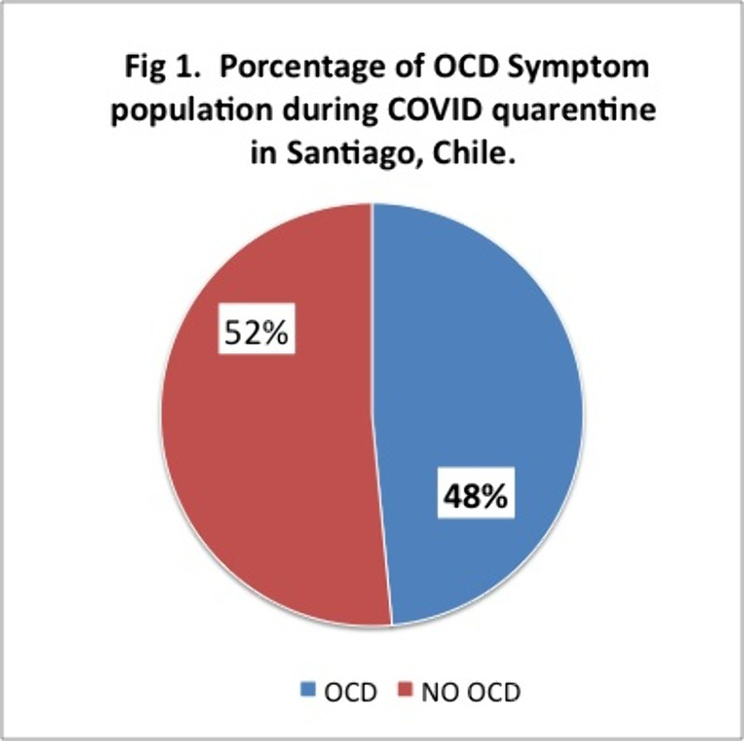
497 completed the survey and Y-BOCKS scale. 241 people which is equivalent to 48% of the sample presented scores that classified them as having OCD.Off these 30% had mild, 12% moderate and 7% severe symptoms. 85% of them were inquarantine for more than 2 months.
Conclusions
These results are above the 2% of OCD reported at the national level. These percentages may be due to a smaller sample size, but even so, the high percentages of people with symptoms during COVID and those who were in quarentine or lockdown for 2 months or more, stand out. Future analysis and research needs to be made. We ask ourselves wether is Covid, quarentine, or both and of so, how much each pf these contribute to these high percentages of OCD symptoms observed.
Covid-19 pandemic represents o very stressfull period for many individuals. Intimate partner violence is typically experienced by women but can also be experienced by men. During quarantine due to the Covid-19 pandemic, the risk for domestic violence increased.
Objectives
The aim of this study was to compare domestic violence durind two different periods - 14.03.2019-30.09.2019 and the same period of the year 2020.
Methods
We analyzed the data base of the Legal Institut from Cluj-napoca and we selected the cases with domestic violence.
Results
The violent behaviour incresed durind 2020. Due to the feelings of frustration and agitation, agression arises with possible trasgenerational transmission of trauma and violence.
Conclusions
Taking into consideration that Covid19 pandemic is a very stressfull period for all individuals, a need of programms aimed to prevent acts of domestic violence and to achieve accurate assessment of multiple domains of abuse (psychological, physical, sexual) provided by psychologists, psychiatrists, social and legal services emerged.
Indigenous people think about mind and mental health differently from contemporary psychiatry, particularly in relation to the symptoms that comprise psychosis.
Objectives
We aim to present the Maori (New Zealand) and the North American indigenous (primarily Lakota, Cherokee, and Wabanaki) views of extraordinary experience and to explore opportunities for dialogue and understanding among these perspectives, leading to genuine, respectful collaboration.
Methods
Auto/ethnographic methodology was used to describe a process in which psychiatrists and traditional cultural healers came to understand each others’ perspectives, dialogued, and forged a collaboration. We describe how this process unfolded in New Zealand and in North America, discussing similarities and differences among these two regions and cultures. We present cases to illustrate the level of cultural collaboration.
Results
The opportunity for cross-cultural dialogue arose when the psychiatrists observed that the traditional cultural healers were reaching and helping patients with whom they had been unsuccessful. This led to dialogue in the fashion of Two-Eyed Seeing, a North American indigenous concept of explanatory pluralism. We present the case of a young man whom the psychiatrist described as hallucinating and prescribed medication that did not help. The cultural healer assisted the young man to see how he had broken cultural taboos, helped him repair the damage, and the hallucinations disappeared. Other cases further illustrate the collaboration. Two-eyed seeing allows both perspectives to be correct and permits genuine dialogue.
Conclusions
Through cultivation of genuine listening without interpretation or judgment (see Jacques Lacan), cultures can begin to understand and collaborate together for the benefit of patients.
The derogation and violence associated with describing others as less than human is documented in a wide range of research (e.g., Bandura, 1992; Optow, 1990). However, this research has only explored one side of the social comparisons that humanity can evoke. Integrating dehumanization research and that of social comparison, which suggests the different effects of upward and downward targets, we explore social comparison which lowers human nature and therefore raises the target (Suls et al., 2002; Suls et al., 2018).
Objectives
While dehumanization places others below humanity, we explore hyper-humanization which places humanity below other comparison classes. When humanity is characterized as a low social comparison class, this should lead people to reintegrate transgressors, evoke forgiveness and reduce revenge motives.
Methods
To test this hypothesis 577 participants viewed a vignette about a social transgression and completed the benevolence and avoidance subscales of the TRIM (McCullough et al., 2006). We manipulated dehumanization and hyper-humanization using a conversational prompt which asked participants to elaborate on descriptions of the social transgressor. In the dehumanization condition the target was described as “barely human”, and in the hyper-humanization condition the target was described as “only human”.
Results
Using a mixed-model ANOVA, results indicate that in the rehumanization condition benevolence increased (F=5.30, p<.01) and avoidance decreased (F=4.75, p<.01) relative to dehumanization and controls.
Conclusions
While lower groups below humanity may facilitate genocide and other social ills, other forms of social comparison with humanity may act to restore relationships and facilitate forgiveness.
Going abroad for employment is one of the common social problems which have been faced by the young males of developing countries. This included both highly qualified individuals as well as the labor class.
Objectives
To determine the difference in the presence of depressive symptoms among pregnant women with husbands living abroad and those with husbands living with them in Azad Jammu and Kashmir
Methods
The sample population comprised of pregnant women reporting for ante natal checkup at Amna hospital Rawalakot. Cases constituted the pregnant women with husbands living abroad while controls were the pregnant women with husbands living with them.PHQ-9 was used to record the presence and severity of depressive symptoms. Age, gestation, parity, rural or urban origin, education, level of family income, daily contact hours on telephone or what’s app, previous pregnancy loss or complications, number of years abroad and visits to home per year were associated with depressive symptoms.
Results
Mean age of the study participants was 29.73±5.395 years. 66 (66%) had significant depression in the case group while 14 (14%) had in the control group (p-value<0.001). Education and rural background had significant difference among the case and control group. Less number of visits per year of husband was strongly linked with presence of depressive symptoms among the cases.
Conclusions
This study showed a high frequency of depressive symptoms among pregnant women with husbands abroad as compared to those with husbands living with them. Special attention should be paid to the women whose husband had lesser number of visits to the country
Conventional psychiatric services are not always acceptable to indigenous communities and people.
Objectives
We used qualitative methodology to explore a successful collaboration of psychiatrists and addiction medicine specialists with indigenous communities in Maine, USA, in North America, comparing these results to previously unsuccessful collaborations. We wanted to delineate what leads to success.
Methods
We used constant comparative, iterative methodology within a constructivist, grounded theory approach to generate differences to discuss.
Results
Successful strategies address the highly relational approach to defining the self of the indigenous communities, a collectivist mindset in which the needs of the group can supersede the needs of the individual, a reliance upon stories for transmission of knowledge and culture, and a commitment to a biopsychosocial and spiritual approach, which, in North America, is often symbolized by the metaphor of the Four Cardinal Directions. Successful psychiatrists working in these communities needed to share more personal details than what they are usually accustomed to provide. They acknowledged local culture and spirituality and worked with traditional knowledge holders to create collaborative approaches. As part of this, the use of a narrative approach worked best in which the psychiatrist worked within the stories and beliefs of the community which required taking the time in dialogue to learn those stories and beliefs.
Conclusions
We addressed the challenges of consulting to tribal-based treatment programs, of modifying usual counseling techniques such as motivational interviewing to an indigenous population. We propose that these sorts of participatory-action-based approaches go far to improve service delivery to indigenous people and reduce health disparities.
Young people, regarded as less susceptible to the virus, may differently perceive the situation associated with the COVID-19 outbreak.
Objectives
To determine the differences in perception of COVID-19 and preventive actions taken against it by domestic and international university students under the spreading threat of COVID-19 illness.
Methods
During the outbreak of COVID-19, 224 domestic and 312 international students of Russian universities responded via on-line to the self-constructed Attitude towards COVID-19 Questionnaire.
Results
The showings of the international students were surely higher than those of domestic students in seriousness of their evaluation of the COVID-19-related situation in the world (p=.0006), in the country (p=.0096), and in the region (p=.0390); in the evaluation of the virus-related risks for aged and chronic patients (p=.0075), in adequacy of measures taken by the government against COVID-19 (p=.0114), in degree of disturbing their customary way of life (p=.0363), and ruining their plans for the future (p=.0161). The international students, who live mostly not at their homes and have a higher stress level (p=.0227), showed higher interest to COVID-19-related news (p=.0001), they were stricter in taking preventive measures: in wearing a mask, washing hands, keeping the distance in order to reduce the risk of the virus infection (p=.0009).
Conclusions
During the COVID-19 outbreak, both the international and domestic students are calm in perceiving the threat to their health and life. At the same time, with a higher stress level, the international students are more watchful concerning the situation of COVID-19 spread, and they more strictly obey the restrictive measures.
Antipsychotics have been classically considered the treatment of choice for delusional disorder (DD) and antidepressant medications have been restricted to patients with comorbid depression.
Objectives
Our aim is to describe the case of a patient with DD with delusions of parasitosis, who responded to paroxetine as monotherapy. We also aimed to review the recent literature on the potential use of antidepressants as the main treatment for somatic type DD.
Methods
After the case report, we present a narrative review on the use of antidepressants in DD, somatic type (DSM-criteria) by using PubMed database from inception until 2020.
Results
Case: 74 year-old woman without previous psychiatric diagnosis who suffered from long-term cutaneous and vulvar pruritus. She was referred to psychiatry from dermatology to assess thought content and sensoperceptive disturbances. In the past, she had received unsuccessful treatment with antihistamines. The patient brought a collection of “the identified parasite” (matchbox sign) to our first appointment. On assessment, she was diagnosed with DD with delusions of parasitosis. Risperidone 1mg/day was poorly tolerated (excessive sedation). She refused further antipsychotic treatment, so we started paroxetine up to 20mg/day. The patient went into total remission of her pruritus and delusions of parasitosis. Review. In line with our case, 6 studies reported on the successful use of antidepressants as monotherapy for DD, somatic type. Most of studies report the successful use of an antipsychotic/antidepressant combination (case-series, case reports).
Conclusions
Although antipsychotics are the treatment of choice, antidepressant medications may be an effective alternative in somatic type DD when patients refuse antipsychotics.
A psychosomatic disorder, Stendhal Syndrome, causes tachycardia, dizziness, sweating, disorientation, fainting, and confusion when someone is looking at artwork with which he or she connects deeply emotionally. In 1817, a French author named Marie-Henri Beyle, whose pseudonym was Stendhal, described his experience visiting the Basilica of Santa Croce in Florence and feeling overwhelmed by all the beauty and rich history surrounding him. Over a century later, visitors to Florence continued to suffer from similar symptoms. In 1979, Dr. Graziella Magherini, Chief of Psychiatry at the Hospital of Santa Maria Nuova in Florence, observed more than 100 tourists who were hospitalized after looking at art in Florence and coined the term Stendhal Syndrome.
Objectives
To review literature on Stendhal syndrome, a bizarre travel-related syndrome.
Methods
PubMed and Google Scholar search using the keywords Stendhal syndrome, travel syndromes, culture shock
Results
Victims are typically impressionable, single people between 26-40 years old, who are stressed by travel and may be struggling with jet lag. For art lovers, the thrill of arriving somewhere like Florence that gathers so much famous art is like meeting all your heroes at once. This strange aesthetic sickness is surely evidence of the special power of Renaissance art.
Conclusions
Stendhal Syndrome does not currently appear in the DSM-5 (Diagnostic and Statistical Manual of Mental Disorders). Psychiatrists have however, documented the syndrome in medical journals and advise that tourists pace themselves in art museums and get enough rest in between viewings of Italy’s breathtaking, powerful masterpieces.