We partner with a secure submission system to handle manuscript submissions.
Please note:
You will need an account for the submission system, which is separate to your Cambridge Core account. For login and submission support, please visit the
submission and support pages.
Please review this journal's author instructions, particularly the
preparing your materials
page, before submitting your manuscript.
Click Proceed to submission system to continue to our partner's website.
To save this undefined to your undefined account, please select one or more formats and confirm that you agree to abide by our usage policies. If this is the first time you used this feature, you will be asked to authorise Cambridge Core to connect with your undefined account.
Find out more about saving content to .
To send this article to your Kindle, first ensure no-reply@cambridge.org is added to your Approved Personal Document E-mail List under your Personal Document Settings on the Manage Your Content and Devices page of your Amazon account. Then enter the ‘name’ part of your Kindle email address below. Find out more about sending to your Kindle.
Find out more about saving to your Kindle.
Note you can select to save to either the @free.kindle.com or @kindle.com variations. ‘@free.kindle.com’ emails are free but can only be saved to your device when it is connected to wi-fi. ‘@kindle.com’ emails can be delivered even when you are not connected to wi-fi, but note that service fees apply.
There is a huge resource gap in mental health service provision & service utilisation in LAMIC including Pakistan. SOUL Programme has been established in the City of Larkana, on charitable donations, which utilises principles of home-based outreach and produces clinical and functional outcomes.
Objectives
SOUL programme focuses on collaborative working with patients & families. The objectives include recognition, treatment, family education & psychosocial support to maximize clinical, functional & occupational outcomes.
Methods
Single cohort intervention (patients recruited on continual basis over time) with innovative service structure and culturally relevant open label intervention design developed with local academic psychiatric unit in Larkano, Pakistan. Training was provided to local mental health professionals on diagnosis, delivering care & use of recognized clinical outcome measures.
Results
We have recruited a cohort of 160 patients on continual basis over time. Our analysis show a higher BPRS and lower GAF ratings for men in comparison to female cohort at the baseline. Our Ten year follow up has demonstrated statistically significant clinical / functional improvement on BPRS, CGI & GAF measures. The mean differences recorded for the individual measures after 12 months were BPRS, CGI-I and GAF and were all statistically significant. Innovative home-based community mental health intervention shows significant improvements in clinical and functional outcomes (with good effect size).
Conclusions
SOUL Programme is a highly effective and cost-efficient intervention model for treatment of schizophrenia in a developing country setting. Our 10 year follow up study confirms the feasibility of this intervention model through close working with families of our patients.
As all first line options in treating First Episode Psychosis (FEP) are similarly effective there is a consensus among prescribing guidelines that clinicians and patients should consider side-effect profile as the ‘driver’ of initial choice of antipsychotic. Anecdotally it has been observed that different care teams prescribe particular medications preferentially.
Objectives
To evaluate the patterns of antipsychotic prescribing in patients with FEP at the time of initial treatment and over the first year with the Early Intervention Service (EIS).
Methods
Medical records of all patients who had completed 1 year of follow-up with EIS in Sussex Partnership Foundation Trust (n=274) were reviewed. The first antipsychotic prescribed and antipsychotic prescribed at 12-months was recorded alongside initiating care team (EIS, non-EIS community services, inpatient services).
Results
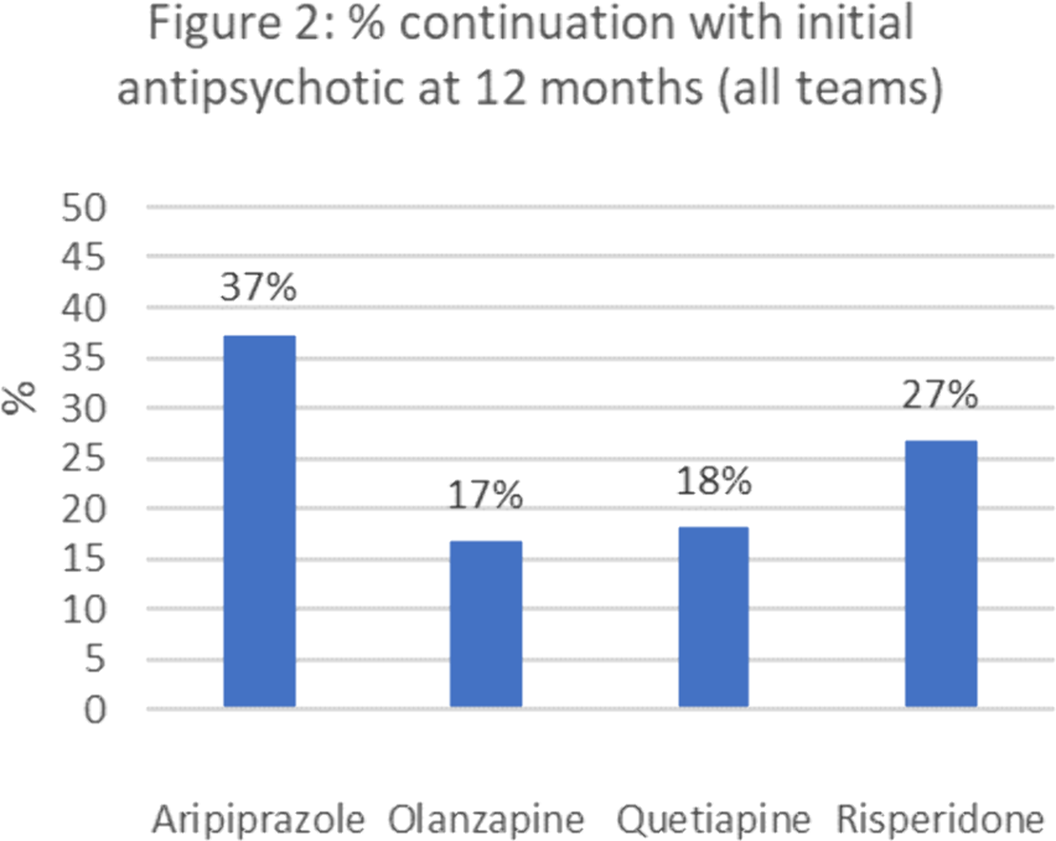
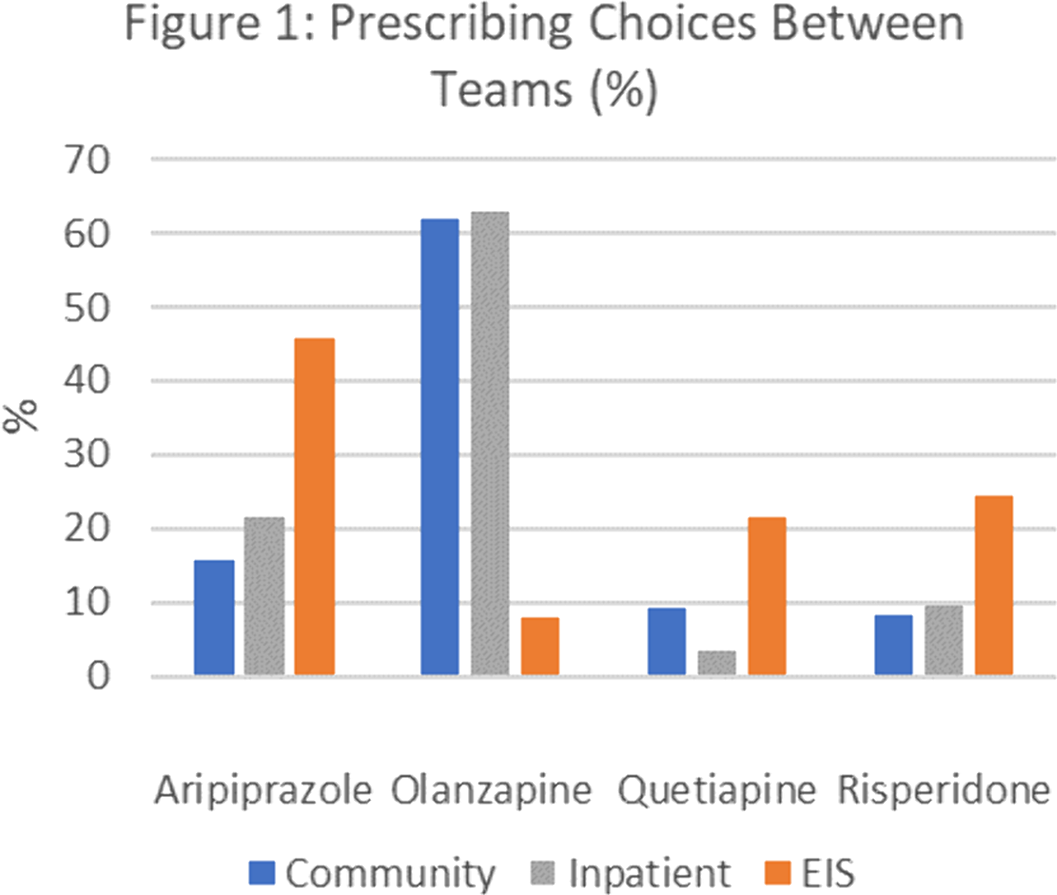
99% (n=272) of patients were prescribed an antipsychotic. 46% were initiated by inpatient serves, 40% non-EIS community services and 14% EIS. Aripiprazole, olanzapine, quetiapine and risperidone accounted for 95% of initial prescriptions. Different care teams prescribed antipsychotics preferentially (p=<0.005) (Fig.1). Rates at which initial medication was continued at 12-months varied according to initial prescription (P=<0.05) (Fig.2).
Conclusions
The frequency that specialist EIS services prescribed aripiprazole as initial treatment contrasts the preference for olanzapine in other services. Olanzapine has a significant metabolic side effect profile, is sedating and was least likely to be continued at 12 months. This raises questions about why non-FEP specialist services prefer olanzapine and whether EIS services can support these services around initial medication choices more likely to be continued throughout the key first year of treatment.
We have recently validated the Portuguese shortest version of the Perinatal Depression Screening Scale-PDSS-7 (items selected from the PDSS-21; each one representing a dimension evaluated by the PDSS-35), for the assessment of depression severity in pregnancy, both in Portugal and Brazil.
Objectives
To analyze the validity and reliability of the PDSS-7 Portuguese version to evaluate postpartum women both from Portugal and Brazil.
Methods
The Portuguese sample was composed of 304 women between the 2nd-6th postpartum months (Mean=20.09±7.21 weeks postpartum). These participants were not the same who participated in the psychometric study that led to the selection of the seven items. The Brazilian sample was composed of 121 women (Mean=10.51±4.53 weeks postpartum). All the participants completed the European/Brazilian Portuguese versions of PDSS-21, which was composed of the same items and included the seven items of PDSS-7. Participants also filled in the validated versions of Perinatal Anxiety Screening Scale and Profile of Mood States.
Results
Confirmatory Factor Analysis revealed that the unidimensional model of PDSS-7 presented acceptable/good fit indexes in both samples (Portuguese/Brazilian: χ2/d.f.=2.6598/1.7897; RMSEA=.0740/.0807, CFI=.8289/.7934, TLI=.7901/.8434, GFI=.9298/.9496; p<.001). The PDSS-7 Cronbach’s alphas were of .841/.856 and all the items contributed to the internal consistency. Pearson correlations with postpartum anxiety (.646/.763) and negative affect (.666/.676) were significantly (p<.01) high. PDSS-7 mean scores were higher in the Brazilian sample (16.06±7.39 versus 11.37±4.37, p<.01).
Conclusions
PDSS-7 presented validity (construct and convergent), reliability and utility in clinical and research settings, including in transcultural studies, in Portugal and Brazil, namely in the postpartum.
Oral health behavior is based on an acquired experience and cultural traditions. University education may smooth out cultural differences in oral health practice.
Objectives
Our goal is to study self-reported oral health attitudes and behavior of university students and the cultural basis for it.
Methods
We used the English version of the Hiroshima University Dental Behavioral Inventory to carry out an online survey of 136 university students of Morocco and Russia.
Results
Over half of the students (60.3%) do not feel anxious when visiting a dentist. Most of them take care of their gums (41.2%), teeth color (49.3%) and the degree of their cleanness (38.2%). The overwhelming majority of the students brush their each tooth very thoroughly (62.5%), they regularly examine their teeth in the mirror after brushing them (90.4%). They are well aware that tooth brushing alone cannot prevent a gum disease (63.2%), and they feel concerned about the possibility of having bad breath (73.6%). At the same time, over half of the students (61.7%) put off their visit to a dentist until they have a toothache, which is a negative behavioral factor. We did not reveal any gender or cultural differences between the students of the two countries, which can be regarded as a universalization factor of oral health behavior in young people who get higher education in universities.
Conclusions
The majority of the surveyed Russian and Moroccan university students have similar patterns of oral health attitudes and behavior. This assumption needs verification on a larger sample of students.
The role of sensitivity to punishment on aggression is controversial, both positive and negative relationships have been observed in previous literature.
Objectives
The aim of this research was to clarify the role of sensitivity to punishment in different types of aggression and provide a better understanding of the influence of emotional regulation on this relationship.
Methods
Two hundred and twenty-nine participants took part in the study (130 women; average age = 21.52 years). All of them were assessed for levels of verbal aggression, physical aggression, anger, and hostility (by Buss-Perry Aggression Questionnaire), levels of sensitivity to punishment (by SPSRQ–20), and emotional regulation ability (by MSCEIT).
Results
A higher reactivity to punishment had a direct negative effect on physical and verbal aggression. However, a higher reactivity to punishment also showed a positive indirect effect on verbal and physical aggression through an increase in anger and hostility. In addition, ability in regulating emotions moderated the indirect effects of sensitivity to punishment on physical aggression.
Conclusions
Our results suggest that sensitivity to punishment can act both as a protective factor and as a risk factor for aggression. This relationship depended on the type of aggression studied and the emotional regulation abilities. These findings can help to inform the design of programs aimed at reducing aggressive behaviour. This work was funded by Junta de Andalucía (projects: EMERGIA20_00056 and UMA18-FEDERJA-137) to Alberto Megías Robles.
Sleep disturbances are common following traumatic brain injury (TBI) worsening morbidity and other neuropsychiatric symptoms. Post-TBI alterations in sleep architecture require further study.
Objectives
(1) To evaluate polysomnographic measures of sleep architecture in participants with history of TBI compared to controls and as meta-analyses of pooled means. (2) To evaluate effects of timing and severity of TBI on polysomnographic outcomes.
Methods
PRISMA compliant systematic review was conducted of MEDLINE, PsycINFO, EMBASE and Scopus. Inclusion criteria: 1) reporting polysomnography in the context of TBI and 2) operationalizing TBI using clear/formalized criteria. Data were pooled in random-effects meta-analyses with outcomes expressed as mean differences (MD).
Results
In participants with TBI, sleep was comprised of 19.39% REM sleep, 8.13% N1, 51.18% N2, and 17.53% N3, as determined by meta-analyses of single means. Total sleep time was reduced in chronic (>6 months) TBI compared to acute-intermediate TBI (<6 months) (p=0.01). Compared to controls, participants with TBI differed with increased N1 sleep (MD=0.64%; 95%CI=0.02,1.25; p=0.04), reduced sleep efficiency (MD=-1.65%; 95%CI=-3.18,-0.12; p=0.03), and reduced sleep latency on the multiple sleep latency test (MD=-5.90mins; 95%CI=-10.09,-1.72; p<0.01). On sub-group analyses, participants with mild TBI differed from controls with reduced total sleep time (MD=-29.22mins, 95%CI=-54.16,-4.27; p=0.02). Similarly, participants with acute-intermediate TBI exhibited increased sleep latency compared to controls (MD=8.96mins; 95%CI=4.07,13.85; p<0.01) and differed significantly from participants with chronic TBI (X2(1,N=608)=6.54; p=0.01).
Conclusions
Sleep architecture is altered following TBI with potential implications regarding functional outcomes and recovery. These alterations appear to differ based on severity of injury and time since injury.
Exposure to violence affects employees and has implications for the quality of care provided.
Objectives
This study aims to describe the effects of workplace violence on nurses in psychiatric and emergency departments.
Methods
This was a cross-sectional and descriptive study involving 60 nurses practising in the psychiatry and emergency services at the Hedi Chaker and Habib Borguiba University Hospital in Sfax. We collected the socio-demographic and professional data of the participants using a pre-established questionnaire.
Results
The average age was 35 years and 51 % of respondents were female. Ninety-three percent of the respondents were victims of an act of violence. The violence was verbal in 90%, physical in 70%, psychological in 62% and sexual in 11% of cases. The classification of acts of violence according to the scale of seriousness of the national observatory of violence in health care revealed a predominance of level 1 violence characterised by insults (66%) and level 2 violence with threats to physical integrity (65%). Level 3 violence (physical violence) was the most frequent (70%). Two cases of level 4 violence with knives were reported. These acts of violence generated wounds in 21%, fractures in 10%, haematomas in 10% and bruises in 8% of cases. Thirty-six nurses (60%) reported that the act of violence was responsible for a feeling of insecurity.
Conclusions
The results of this study indicate the need for hospital center managers to set up organizational policies against workplace violence and to apply them in a rigorous and transparent manner.
The use of technological supports in psychotherapeutic interventions has been widespread in recent years. Since the COVID-19 pandemic, the increase has been greater. The feasibility of online group interventions has been proved in previous studies. Research comparing dropout rates in group interventions with clinical population that include mindfulness training is infrequent.
Objectives
To compare the difference in dropout rates between online and face-to-face mindfulness-based group interventions.
Methods
This study was carried out in a Mental Health Unit in Colmenar Viejo (Madrid, Spain). One hundred thirty-five adult patients with anxiety disorders were included in group interventions (74 face-to-face; 61 online). The group treatments were Acceptance and Commitment Therapy and a Mindfulness-based Emotional Regulation intervention, during 8 weeks, guided by two Clinical Psychology residents. A descriptive analysis of dropout rates (participants attending 3 or fewer sessions out of the total number of participants starting the intervention) was performed.
Results
Of the 135 patients included, 8 did not participate in the interventions (5 face-to-face; 3 online), which represents a 5.93% rejection rate; 6.76% for the face-to-face intervention and 4.92% for the online intervention. Of the remaining sample (127 participants), a total dropout rate of 12.6% was obtained, with 8.69% in the face-to-face intervention versus 17.24% online.
Conclusions
A higher dropout rate was obtained in online interventions compared to face-to-face, with an increase of almost double. Research on specific factors that may interfere with treatment adherence to online group interventions is needed.
22q11.2 deletion syndrome is the most common microdeletion syndrome. Its clinical presentation varies and it may present several medical complications, namely heart defects, cleft palate, autoimmune diseases, delayed development, and psychiatric disorders. In these patients, psychiatric disorders are frequent and may include attention-deficit hyperactivity disorder, anxiety disorders, autism spectrum disorder, and schizophrenia spectrum disorders.
Objectives
We aim to characterize psychosis in patients diagnosed with 2q11.2 deletion syndrome, which is one of the most frequent psychiatric presentations.
Methods
To introduce the topic of 22q11.2 psychiatric symptoms, we will start by presenting a clinical case. Then, a review of the related literature using the Pubmed database using the following expression “22q11.2 deletion syndrome”; “DiGeorge syndrome”; “velocardiofacial syndrome”; “psychosis”; “psychiatric disorders”.
Results
Patients diagnosed with 22q11.2 deletion syndrome are considered high-risk for psychosis. In this clinical case, we present a 19-year old man diagnosed with 22q11.2 deletion syndrome who was admitted to a psychiatric ward for psychosis. The knowledge of the increased risk for psychosis in these patients should be taken into account in the face of behavioral changes de novo to assure a timely therapeutic approach. Currently, the treatment does not differ from other patients, but this is mainly due to the lack of knowledge on the best therapeutic approach in this specific diagnosis.
Conclusions
Genetic syndromes are often associated with psychiatric disorders. Patients diagnosed with 22q11.2 deletion syndrome are at high risk for psychosis and should deserve a multidisciplinary approach so that their diagnosis and treatment are established as early as possible.
Schizophrenia is a chronic disease that requires lifelong medical care and supervision. There is a high rate of relapse, mostly caused by poor adherence to oral antipsychotics. Long-acting injectable (LAI) antipsychotics have proved effective in schizophrenia and other severe psychotic disorders due to the stable blood levels, leading to a reduction of the risk of relapse. LAIs are associated with better functioning, quality of life, and patient satisfaction. In Treatment-resistant schizophrenia the combination of antipsychotics is a common practice. Nevertheless, the combination of two different long-acting injectable antipsychotics is not frequent.
Objectives
A case of a 34-year-old man is presented, previously diagnosed of Schizophrenia, with highly disabling chronic positive symptoms. With no in-sight and no will in receiving treatment. Has been stable for a year while being in treatment with paliperidone 525mg LAI/ 10 weeks, and aripiprazole 400mg LAI/28 days.
Methods
The patient was closely observed and given oral paliperidone, after 5 days long-acting paliperidone was introduced. He was discharged with mild improvement of his psychiatric symptoms. While being in treatment with Paliperidone 525mg, he kept vivid delusions and hallucinations. The patient still refused to take any oral medications. Long-acting aripiprazole 300mg was added to the treatment.
Results
He showed clinical improvement after a month. He has been stabilized for one year.
Conclusions
Treating resistant schizophrenia is among the most challenging clinical endeavors. A very helpful approach to improve adherence in schizophrenia is the use of long-acting injectable (LAI) antipsychotics. A major effort on scientific research of combination of LAI is needed.
Domestic violence is a critical global and social phenomenon.
Objectives
- To describe the socio-demographic and clinical characteristics related to the abuser in the context of domestic violence. - To study risk factors for acting out in the abuser.
Methods
We conducted a descriptive cross-sectional study related to male abusers of their wives who consulted the Forensic Medicine Department of Taher Sfar Hospital in Mahdia between January 2020 and October 2020 for a forensic examination.
Results
We collected 67 cases of domestic violence out of a total of 688 female consultants. The age of the abuser exceeded 35 years in 84% of cases. The average age of the abusers was 33.8 years. Almost half of the abusers had a primary school education. In 43% of the cases, the abuser was unemployed or had a job with a salary below the minimum wage. We found an association between domestic violence and the unfavorable professional status of the spouse. Only in 6% of the cases did the abuser have a psychiatric disorder. He had a history of chronic alcoholism in 35% of the cases and the use of illicit substances (cannabis) in 9% of the cases. Approximately one out of every two abusers (48%) was under the influence of alcohol at the time of the violent act. Alcoholism was associated with all forms of domestic violence. He had a criminal history in 30% of cases.
Conclusions
Our results provide real areas for reflection regarding the adoption of specific therapeutic strategies with domestic violence abusers.
The covid19 pandemic has led to a major health crisis and the healthcare workers, who are the first to respond, are generally the ones who pay the highest price. Their safety, both physical and psychological, should be a priority in the management of this pandemic.
Objectives
We aim to assess anxiety and depression in caregivers with covid19 and to identify the many factors that may be responsible for this psychological distress.
Methods
A cross-sectional survey was conducted among healthcare workers at the different health structures located in Kairouan-Tunisia from October to December 2020 within the framework of a crisis unit set up by the Ministry of Health. Through phone interviews, demographic and clinical data were collected at first, then psychological impact was evaluated using hospital anxiety and depression scale (HAD).
Results
68 healthcare workers (47 females) with covid-19 were included in this study with an average age of 44.12 years: 38 nurses, 21 hospital employees and 9 doctors working at the Ibn Jazzar hospital (47%), the Aghlabite hospital (20%) and the dispensaries of Kairouan (33%). Among them, 8 had a depression score >10 and 20 had an anxiety score >10. Moreover, 90% feared contaminating their loved ones and 43% reported sleep disturbance and irritability during the containment period. The most important causes reported were the non-availability of means of protection (41,2%) and the increase in workload (64,7%).
Conclusions
The prevention of the negative psychological impact of COVID-19 on the affected health professionals is essential to preserve their well-being and to ensure the continuity of care.
Climate change is increasing the frequency and intensity of severe heatwaves, storms, floods, droughts, and wildfires. These events cause widespread economic and social disruption and are undermining population health worldwide. Despite a growing literature on how climate change threatens mental health, its influence on harmful substance use has not been systematically addressed.
Objectives
We propose an explanatory framework explicating the plausible links between climate change-related stressors and an increase in harmful substance use.
Methods
We critically review and synthesise literature documenting the pathways, processes and mechanisms linking climate change to increased substance use vulnerability.
Results
Several plausible pathways link climate change to increased risk of harmful substance use worldwide. These include: (1) anxiety about the impacts of unchecked climate change, (2) destabilisation of psychosocial and economic support systems, (3) increasing rates of mental disorders, and (4) increased physical health burden. Children may face disproportionate risk due to their vulnerability to both mental disorders and substance use, particularly during adolescence. We argue that a developmental life-course perspective situated within a broader ‘systems thinking’ approach provides a coherent framework for understanding how climate change is aggravating the multiple, persistent, interacting risks that influence harmful substance use pathways.
Conclusions
Climate change is already undermining health and wellbeing of global populations. By inference, it is also aggravating pathway to harmful substance use. This is a critical psychosocial problem for individuals and communities alike. Conceptual and methodological work is urgently needed so that effective adaptive and preventive action can be taken.
In Denmark, about 14% of patients with depression develops treatment resistant depression (TRD) in the following year after the first hospital contact. Possible explanations for TRD include lack of adequate clinical effect of pharmacological treatment and reluctance to treatment due to unacceptable side effects. Cold water swimming (CWS), also known as winter swimming, describes swimming outdoors - mainly during the winter season in cold to ice-cold water on a regular basis. Many winter swimmers believe that exposure to cold water is beneficial for their health. However, evidence of health effects have been anecdotal or based on results from small sample-size studies. The availably studies report that winter swimming abolishes general tiredness, boosts self-esteem and improves mood and/or general well-being.
Objectives
To test if it is possible for patients with depression to participate in two weekly sessions of CWS and to measure the effects of CWS on general well-being and depression among the participating patients.
Methods
All psychiatric in- and outpatients from the department of psychiatry at Little Belt Hospital, Vejle with a diagnose of depression are eligible for inclusion. CWS-sessions will include a dip in an inlet - and if desired a short swim for a few minutes – depending on individual preferences. The CWS sessions will take place at the local inlet at a recreational area with sauna and changing facilities available.
Results
The study starts in October 2021 and we expect to have results by April 2022.
Numerous studies have documented high rates of functional impairment among bipolar disorder patients, even during phases of euthymia.
Objectives
To study different domains of functioning impairment in bipolar patients during euthymic phase.
Methods
A cross-sectional and descriptive study of 78 patients followed for bipolar disorder, during euthymia, at the psychiatric outpatient clinic at CHU Hédi Chaker in Sfax. We used a socio-demographic and clinical data sheet and the Functioning Assessment Short Test (FAST) to assess functionning : A functional impairment was retained for a total FAST score > 11.
Results
The average age was 36.27 years, the sex ratio was 5.5. Bipolar I disorder was diagnosed in 88.5% of patients. The mean age of onset was 27.73 years, and the mean duration of illness was 8.4 years. *The mean total score at the FAST was 22.23. *Functioning was altered on 69.2% of patients. *The occupational and the cognitive functioning were the two most altered domains in our population (respective mean scores : 8.69 and 5.74). *Autonomy was altered on 17.9% of patients. *Occupationnal functioning was altered on 76.9% of patients. *Cognitive functioning was altered on 70.5% of patients. *Financial issues were observed on 34.6% of patients. *Interpersonal relationships were altered on 41% of patients. *Leisure time difficulties were present with 24.4% of patients.
Conclusions
This work has focused on the very high frequency of functional handicap in euthymic bipolar patients. Thus, several measures must be put in place to prevent or mitigate the negative effects of the impaired functioning on these patients.
Clinical relapses in schizophrenia remain a frequent event. Long-acting injectable (LAI) antipsychotics enhance adherence, but low blood levels can sometimes be observed despite an adequate posology. Nonetheless, the evaluation of this parameter is uncommon in clinical practice.
Objectives
To explore the potential advantages of therapeutic drug monitoring (TDM) of LAIs as a predictor of relapse in clinically stable outpatients with schizophrenia.
Methods
44 individuals who had reached the pharmacokinetic steady state of LAI treatment (paliperidone, olanzapine, aripiprazole) underwent an anamnestic and psychopathological assessment. LAI blood levels were measured using liquid chromatography-mass spectrometry and classified as “in range” or “under range” according to the Arbeitsgemeinschaft für Neuropsychopharmakologie und Pharmakopsychiatrie (AGNP) guideline values. Individuals who relapsed during the one-year follow-up were compared to non-relapsers (Fisher’s exact test, χ2 or Mann-Whitney U). An exploratory binary logistic regression tested the role of other possible relevant predictors of relapse.
Results
No differences were observed in baseline use of mood stabilisers (p=0.211), antidepressants (p=0.530), or prescribed LAI (p=0.563). Other comparisons are presented in the table: among these variables, in-range LAI levels were the only significant predictor of relapse (F=5.95, p=0.015; OR 0.04, 95%CI 0.02-0.56).
Relapse (n=6)
No relapse (n=38)
p
Age (years)
41.33±10.78
43.95±12.98
0.667
Male
4 (66.7%)
21 (55.3%)
0.600
Illness duration (years)
21.83±2.64
19.13±11.82
0.289
Previous acute episodes
3.50±1.05
3.29±1.47
0.652
PANSS-total
49.33±14.83
42.74±14.14
0.231
In-range LAI
2 (33.3%)
32 (84.2%)
0.006
Conclusions
TDM of LAIs may optimise the clinical management of schizophrenia by highlighting a suboptimal dosage and a consequent higher relapse risk. Large-scale, drug-specific assessments are needed to confirm these findings.
Various studies have reported differences in early visual processing, gain control and integration for patients with schizophrenia spectrum disorders (SSD). However, Oppel – Kundt (OK) illusion is not studied well enough among subjects affected by SSD. We decided to study the illusion to get more insights in visual perception for individuals with SSD.
Objectives
To investigate the OK illusion manifestation among people with SSD.
Methods
In the prospective study were included 15 patients, who were diagnosed with SSD and 15 matched comparison group (CG) without any mental, neurological diseases or visual impairment. OK figures used in the experiments consisted of three white spots presented horizontally against the black background. We used 3 different types of distractor stimuli – either straight one or two-sided line or circle. Using computerized equipment in OK figures the subjects were asked to adjust the unfilled part of the stimulus to be equal in length to the filled (referential) one. ANOVA, T-test and post hoc Bonferroni correction were used for statistical analysis.
Results
People with SSD tended to make bigger mistakes when evaluating OK figures with the statistical difference which was the most eminent for the subgroup of individuals affected by paranoid schizophrenia. The manifestation of the illusion in the SSD group was contrariwise (respectively to zero point) to the CG group.
Conclusions
OK illusion tended to manifest stronger for patients with SSD, this tendency was mostly expressed for the patients diagnosed with paranoid schizophrenia. The manifestation of OK illusion among persons with SSD was diametrically opposite to that seen for the healthy individuals.
Migratory flows are increasing more and more, especially regarding the refugee crisis during the last years. There are around 86,7 million migrants in Europe. Migrants share similar experiences that may affect their physical and mental health, such as loss of a social network, lack of economical support or high levels of stress and discrimination.
Objectives
To analyze the obstacles that migrants must face to obtain a mental health assistance and the importance of an intercultural approach.
Methods
A narrative review of the existing literature on the subject.
Results
Although there exists evidence that shows that migrants tend to have more health needs, they usually seek less medical advice and receive a poor-quality attention, fulfilling the inverse-care law. This is due to several reasons. Many migrants are excluded of the health care system due to bureaucratic impediments. Also, the language has a determining role, since a higher quality of communication could lead to a better understanding of the symptoms, reducing the risk of erroneous evaluations. Besides, different background and culture between the patient and the doctor can result in lack of communication, mistrust, mistreatment, poor adherence, and worse prognosis.
Conclusions
Despite the exponential growth of migration in the last decade and the continue progression, migrants still face many barriers to receive healthcare. It is necessary to do more research on the mental health of migrants and ethnic minorities to ensure quality care to different cultures.
The dissociative disorders are characterized by a disruption of and/or discontinuity in the normal integration of consciousness, memory, identity, emotion, perception, body representation, motor control, and behavior.
Objectives
We present the case of a 22-year-old patient, who has been following up for just over a year. The patient refers that two people inhabit her body, talk to each other, exchange opinions and both have control over the body, one giving the turn to the other depending on the circumstances. To this is added delusional symptoms of grandeur and sensorial-perceptual symptoms. In turn, depressive symptoms have appeared that have led the patient to have several suicide attempts throughout the follow-up time.
Methods
During this time, the patient has required hospital admission on two occasions due to the autolytic ideation. Treatment with neuroleptics and antidepressants has been established that have helped control delusions and thoughts of death, but not the dissociative clinic.
Results
Dissociative Identity disorder 300.14 (F44.81)
Conclusions
The different symptoms presented by the patient, as well as the social and occupational deterioration that he presents, make this an extremely complicated case, both in diagnosis and in treatment. Dissociative identity disorder has been very controversial, changing its diagnostic criteria over time. More studies are needed and perhaps future research can give us more clues about this disorder.
COVID-19 pandemic reality raise multiple problems that need effective ways of coping. Not only for people experienced contracting COVID-19 but those who did not the positive ways of coping are important way to overcome distress associated with COVID-19. Post-traumatic Growth of personality may be effective coping factor. To test this hypothesis we used several instruments: one of them - Peritraumatic Distress Index (CPDI) for assessing the level of distress specific to Covid-19
Objectives
463 participants (including 66 patients in COVID-19 clinics)
Methods
Russian version of Covid-19 Peritraumatic Distress Index (CPDI) validated in Psychological Helping and resocialization Department Moscow State University; Impact of Event Scale (Horowitz), Post-Traumatic Growth Inventory – PTGI (Tadeshi & Calhoun) adapted by M. Magomed-Eminov
Results
Russian version of CPDI has high reliability-consistency (Cronbach’s α -0.87). We obtained from our data: significant correlation between CPDI and PTG for people experienced COVID-19 contamination. Content analysis of narratives and incomplete sentences showed: those who had higher scores on PTG and CPDI have differences in personal meaning of their traumatic experience.
Conclusions
CPDI is presented in research as brief effective tool to identify COVID-19 related distress and plan helping strategies and psychiatric interventions for various people suffering by continuing pandemic crisis. Correlation between CPDI and COVID-19 contamination: could suggest more severe distress is associated with higher PTG. And PTG could be considered as positive factor coping with distress. We suggest cultural-activity approach to personality work with stressful experience of individual to confront distress, existential evaluation of life situation taking into account also resilience, growth .