We partner with a secure submission system to handle manuscript submissions.
Please note:
You will need an account for the submission system, which is separate to your Cambridge Core account. For login and submission support, please visit the
submission and support pages.
Please review this journal's author instructions, particularly the
preparing your materials
page, before submitting your manuscript.
Click Proceed to submission system to continue to our partner's website.
To save this undefined to your undefined account, please select one or more formats and confirm that you agree to abide by our usage policies. If this is the first time you used this feature, you will be asked to authorise Cambridge Core to connect with your undefined account.
Find out more about saving content to .
To send this article to your Kindle, first ensure no-reply@cambridge.org is added to your Approved Personal Document E-mail List under your Personal Document Settings on the Manage Your Content and Devices page of your Amazon account. Then enter the ‘name’ part of your Kindle email address below. Find out more about sending to your Kindle.
Find out more about saving to your Kindle.
Note you can select to save to either the @free.kindle.com or @kindle.com variations. ‘@free.kindle.com’ emails are free but can only be saved to your device when it is connected to wi-fi. ‘@kindle.com’ emails can be delivered even when you are not connected to wi-fi, but note that service fees apply.
COVID-19, was declared a pandemic by World Health Organisation on March 11, 2020. Older people with dementia or those with multimorbidity are more vulnerable to infection with severe acute respiratory syndrome coronavirus 2 (SARS-CoV-2), the virus responsible for the development of COVID-19. Given absence of a vaccine or treatment, prevention is the fundamental aspect of COVID-19 control. This requires early identification of contagious people with COVID-19 and isolation keeping them apart from non infected group of people. Early identification of infection in elderly with dementia or functional psychiatric condition is often difficult, due to difficulty in obtaining history or evaluating medical symptoms.
Objectives
1) To establish the current standards of interventions provided at the unit to control COVID-19, with current recommendation by Government guidance. 2) To address difficulties in early identification of people of COVID-19 in Old Age Psychiatry wards. 3) To introduce sustainable interventions aimed at controlling COVID-19 risk, targeted to this group.
Methods
Trust guidance for COVID-19 testing on the ward and guidance of isolation were reviewed. Literature review of currently available scientific evidence for testing for controlling COVID-19 was conducted.
Results
We have created a bi-weekly mass testing guidance for Old Age Psychiatry inpatient wards with clear guidane of when to start isolation and when to stop isolation.
Conclusions
There is no specific interventions to target older adult within our service currently and it was felt that it is necessary to develop a sustainable mass testing programme for this group of people for control of COVID-19.
People with schizophrenia experience higher levels of stigma compared with other diseases. The analysis of social media content is a tool of great importance to understand the public opinion toward a particular topic.
Objectives
The aim of this study is to analyse the content of social media on schizophrenia and the most prevalent sentiments towards this disorder.
Methods
Tweets were retrieved using Twitter’s Application Programming Interface and the keyword “schizophrenia”. Parameters were set to allow the retrieval of recent and popular tweets on the topic and no restrictions were made in terms of geolocation. Analysis of 8 basic emotions (anger, anticipation, disgust, fear, joy, sadness, surprise, and trust) was conducted automatically using a lexicon-based approach and the NRC Word-Emotion Association Lexicon.
Results
Tweets on schizophrenia were heterogeneous. The most prevalent sentiments on the topic were mainly negative, namely anger, fear, sadness and disgust. Qualitative analyses of the most retweeted posts added insight into the nature of the public dialogue on schizophrenia.
Conclusions
Analyses of social media content can add value to the research on stigma toward psychiatric disorders. This tool is of growing importance in many fields and further research in mental health can help the development of public health strategies in order to decrease the stigma towards psychiatric disorders.
The topic of research was phenomenon of impaired age self-consciousness in non-psychotic latent schizophrenia patients defined.
Objectives
To explore features of impaired age self-identity and to determine syndromic affiliation of the syndrome in comparison with premorbid personality disorders traits.
Methods
The study sample comprised 141 patients with latent schizophrenia (pseudo neurotic (F21.3 - 64.5%, 91 patients), coenesthopathic (F20.8 - 25.5%, 36 patients) and pseudo psychopathic (F21.4, - 9.9%, 14 patients)) aged 16-31 (average 22.1 years old) in 2007-2019. A follow-up, experimental psychological and clinical study was conducted.
Results
The onset of impaired age self-identity was dominated by a radical drop of the subjective age in self-conscious mind of the patients accompanied by a tormented feeling of loss of self-dependence, role autonomy, helplessness, inability of decision making and to be answerable. Patients described this sudden condition as a loss of ‘maturity feeling’ and return to the juvenile perception of self. In a delusive and unclear manner, phrases such as ‘I feel inferior to others as if a helpless child among adults’, ‘I feel as if my childhood is back’ were uttered. Excessive worrying and enlivening of childhood memories were also included. This correlates to occurrence of humble and sometimes dependent/avoidant behavior, feeling of helplessness and fear with respect to caring for one self, rising subordination and suggestibility.
Conclusions
This phenomenon of regress to earlier ontogenetic level of personal development reported as impaired age self-consciousness can thus be regarded as an obligate form of depersonalization in patients with latent schizophrenia.
Danon disease is an X-linked cardioskeletal myopathy related to a primary deficiency in lysosome-associated membrane protein-2. Danon disease manifests with the triad of hypertrophic cardiomyopathy, myopathy and intellectual disability.Psychiatric symptoms related to the disease have only been studied in a few case reports (Hatz et al, 2010 and Tanidir et al, 2015) and a case series (Yardeni et al, 2016), leaving its pathophysiological mechanisms understudied.
Objectives
Provide scientific data on psychotic symptoms in patients with Danon disease.
Methods
We report an unusual case of a 25-year-old-patient affected by Danon disease that showed an acute psychotic episode.
Results
Mr P is a 25 year-old white male, with past medical history for Danon disease. Mr P presents hypertrophic cardiomyopathy, Wolf Parkinson White arrhythmia and carries an implantable cardioverter-defibrillator. There are previous records of mild intellectual disability and the patient had experienced anxiety symptoms as well as obsessive thoughts in the past without receiving any specific diagnosis or treatment. He was admitted to the Neurology inpatient unit to study behavioural symptoms with atypical visual and auditory hallucinations, accompanied by paranoid delusions during the last 4 days. He was examined by the liaison psychiatric team. Psychosis remitted within 72 hours after introducing risperidone 3mg per day, with good tolerability. Magnetic resonance imaging (MRI) scan was normal.
Conclusions
Danon disease is caused by heterogeneity genetic mutation which means that patients can present different levels of clinical manifestations. The current case report highlights the variety of psychiatric symptoms in patients with Danon disease, and raises awareness towards its identification and treatment.
Neuropsychiatric symptoms (NPS) are common, disabling and burdensome core-features of dementia, with important diagnostic and prognostic value. However, their measurement remains challenging. The Neuropsychiatric Inventory (NPI) is the most widely used NPS measure. Nevertheless, it is also time-consuming and impractical in most clinical settings. Therefore, the Abe’s BPSD score (ABS) has been proposed as a brief score to facilitate the NPS assessment.
Objectives
To explore the concurrent validity of the Portuguese ABS by comparing the 10 ABS items with the relevant NPI-12 domains.
Methods
A cross-sectional study was conducted with outpatients attending a gerontopsychiatric consultation. Patients were included if they were ≥65 years and had a reliable caregiver. NPS frequency rates (number of patients with a symptom) were estimated with ABS and NPI-12, and an agreement analysis was undertaken by calculating kappa-coefficients (k) and the respective 95% confidence interval [95%CI] between ABS items and relevant NPI-12 domains.
Results
Overall, 107 patients were included. Kappa-values ranged from 0.277 to 1.000. Higher agreement was recorded for the ABS items eating/toilet problems (k=1.000), day–night reversal (k=0.976[0.925-1.000]) and depressive/gloomy mood (k=0.957[0.899-1.000]), with the NPI-12 appetite/eating abnormalities, night-time behavioural disturbances and dysphoria domains, respectively. The ABS item violent force recorded the lowest agreement (k=0.277[0.104-0.45]) with the NPI-12 agitation/aggression domain.
Conclusions
This exploratory analysis demonstrates good levels of agreement between most ABS items and relevant NPI-12 domains. Data add to the evidence that both measures capture a comparable broad spectrum of psychopathology, supporting the ABS use in clinical routine. Support: FCT(PD/BD/114555/2016), and National Funds through FCT-within CINTESIS, R&D Unit (ref.UIDB/4255/2020).
Delusion of pregnancy has been described as a false and fixed belief of being pregnant despite factual evidence to the contrary. Pseudocyesis is a condition in which the patient has all signs and symptoms of pregnancy except for the confirmation of the presence of a fetus. There has been described symptoms as abdominal distention, cessation of menses, morning sickness, etc.
Objectives
The aim of this work was to distinguish between pseudocyesis and pseudopregnancy. This case presents a single 49-year-old woman, who developed the delusion of being pregnant after months of lonely confinement during Covid-19 quarantine.
Methods
She had missed her period for 10 months. She was convinced that she could feel the fetal movements. Her thought content revealed delusion of persecution, reference, and delusion of being pregnant. She did not reveal any hallucinations. Blood tests and brain imaging revealed no abnormalities. □The treatment was started with Paliperidone 100mg/month, and clonazepam 2mg/d.
Results
The patient showed a substantial improvement within 10 weeks of treatment. Pseudocyesis and delusional pregnancy have been rarely described on scientific bibliography. A distinction has been demonstrated based on the consideration of the associated psychotic features that might be present in delusions of pregnancy, which were described in the current case. On the other hand, pseudocyesis clinical presentation is centered on the false signs and symptoms of pregnancy.
Conclusions
Antipsychotics played a key role in the delusion of pregnancy. Psychodynamic and supportive psychotherapy could play a pivotal role in the management of pseudocyesis.
Autism Spectrum Disorder and Social Anxiety Disorder are mental illnesses characterized by a dysfunction in social behavior (SB); a phenomenon largely mediated by the medial prefrontal cortex (mPFC). Clinical studies have demonstrated that lysergic acid diethylamide (LSD), a partial agonist of the 5-HT2A receptor, can promote SB. However, its mechanism of action on SB is unknown.
Objectives
To assess the effects of repeated LSD administration on social behavior in mice and to identify which mPFC receptors mediate LSD’s behavioral effects.
Methods
Eight-week-old C57BL/6J male mice received vehicle or repeated LSD (30 μg/kg/day i.p. for 7 days) as well the selective 5-HT2A receptor antagonist MDL, or the AMPA receptor antagonist NBQX. Twenty-four hours following the last injection, mice underwent the Direct Social Interaction Test and the Three-Chamber Test (TCT) to assess sociability and preference for social novelty. in vivo electrophysiological recordings were performed in mice treated with vehicle or LSD using multi-barrelled electrodes for microiontophoretic ejections of the selective 5-HT2A receptor agonist DOI or the selective AMPA receptor agonist quisqualate on mPFC pyramidal neurons.
Results
Repeated treatment with low doses of LSD increased the interaction time in the DSI as well as sociability and social novelty indices in the TCT. These pro-social effects were blocked by the intra-PFC administration of both 5-HT2A and AMPA antagonists. LSD also potentiated, in a current-dependent manner, the excitatory response of mPFC neurons to 5-HT2Aand AMPA agonists.
Conclusions
Repeated, low doses of LSD increases social behavior via a mechanism of action that is mediated by 5-HT2A and AMPA in the mPFC.
Suicide is one of the most relevant cause of death especially in young populations. The Interpersonal Theory of Suicide (Joiner, 2005) is an important contribution tends to explain variability in suicidal behavior, particularly the difference between suicidal ideation and suicide attempt.
Objectives
This study aimed at the Italian validation of the Acquired Capability for Suicide Scale – Fearlessness About Death (ACSS-FAD), assessing fearlessness about death, one of the facets of the acquired capability (AC) to commit suicide as postulated by the Interpersonal Theory of Suicide by Thomas Joiner.
Methods
This cross-sectional research was conducted on a sample of university students (n = 458) assessed with a battery including ACSS-FAD. The sample was evaluated for the presence of suicidal ideation and suicide risk. Factor structure, internal consistency and convergent/divergent validity of the scale were assessed.
Results
One-factor structure with good internal consistency (Cronbach’s α: 0.84) was derived. ACSS-FAD correlated with suicidal ideation and suicidal risk, and there was a tendency towards significance considering its capacity to discriminate between those who had a history of suicide attempts and those who did not. 4.1% of the sample attempted suicide at least one time. The tool showed good convergent/discriminant validity results, but the relationship between ACSS-FAD and pain needs further investigations.
Conclusions
ACSS-FAD seems to be a useful and valid measure of fearlessness about death especially in young adults, which could be really important to enhance suicide risk assessment.
Delirium affects a significant proportion of hospitalized older patients with acute infections. There is growing evidence that delirium accelerates the cognitive decline at long term.
Objectives
We aimed to determine if delirium during hospitalization was independently associated with cognitive deterioration at one-year.
Methods
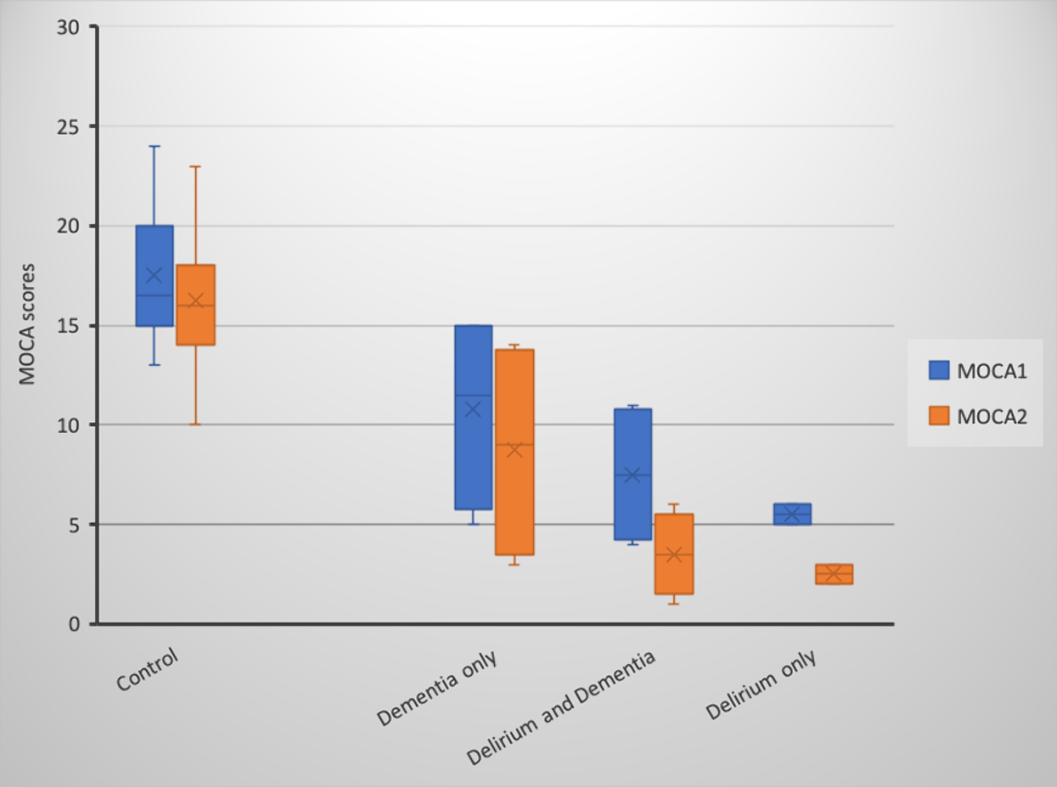
From a total of 22 patients (12 C, 4 Dem, 2 D, and 4 DD) delirium (D and DD groups) was associated with a worse score in MOCA of 3-points (p<.02) and 2.5-points (p<.03), respectively, at one year, follow up. Dementia patients without delirium had a decrease of 2-point (p=.04) while cognitively healthy patients had a decrease in 1.08 points (p=.05) (Graph1). MOCA and NPI scores during hospitalization correlated significantly with cognitive decline in the four groups (r=.658, p<.01 and r=.439, p=.02, respectively.)
Results
From a total of 22 patients (12 C, 4 Dem, 2 D and 4 DD) delirium (D and DD groups) was associated with a worse score in MOCA of 3-points (p<.02) and 2.5-points (p<.03), respectively, at one year follow up. Dementia patients without delirium had a of 2-point (p=.04) while cognitively healthy patients had a decrease in 1.08 points (p=.05) (Graph1). MOCA and NPI scores during hospitalization correlated significantly with cognitive decline in the four groups (r=.658, p<.01 and r=.439, p=.02, respectively.)
Conclusions
Individuals developing delirium while recovering from infection have higher rates of cognitive decline after one year, but the cognitive decline is also present to a lower extent for individuals with infections that did not develop delirium.
Williams syndrome (WS) is a rare genetic disorder caused by a deletion at chromosome 7q1123. WS is associated with high empathy, relatively good face memory and low social anxiety. Despite these strengths, WS individuals typically have an intellectual disability, difficulties with visuospatial perception, non-social anxiety and complex social cognition. Attention to other’s eyes is crucial for adaptive social understanding. Consequently, eyes trigger quick and automatic gaze shifts in typically developing individuals. It is not known whether this process is atypical in WS.
Objectives
To examine visual attention to other’s eyes in Williams syndrome.
Methods
Individuals with WS (n = 35; mean age 23.5 years) were compared to controls (n = 167) in stratified age groups (7 month, 8-12 years, 13-17 years, adults). Participants were primed to look at either the eyes or the mouth of human faces. The latency and likelihood of a first gaze shift from, or to the eyes, was measured with eye tracking.
Results
WS individuals were less likely, and slower to orient to the eyes than typically developing controls in all age groups from eight years of age (all p <.001), but did not differ from 7 months old infants. In contrast to healthy individuals from eight years and above, WS individuals did not show a preference to orient towards the eyes relative to the mouth.
Conclusions
Despite the hyper-social behavioral phenotype, WS is associated with reduced attention to other’s eyes during early stages of processing. This could contribute to the difficulties with complex social cognition observed in this group.
The 2019 coronavirus epidemic (CoViD-19) in Italy originated in Lombardy, on February 21, 2020. The Fondazione IRCCS Policlinico San Matteo di Pavia has been involved in the management of the outbreak since its beginning
Objectives
We evaluated all the population who went to the ED for intossication and substance abuse to assess the severity of cases evaluated as exit code and rate of hospitalization.
Methods
We enrolled all patients accessing our ED for intossication and substance abuse form February 22 to May 1, 2020 and during the same period of the previous year.
Results
We enrolled 142 patients. 41 in the CoViD period and 101 in 2019. The vital parameters, and sex were overlapping. patients during the pandemic were younger (38 vs 46) The priority codes for the medical examination were not different. CoViD pandemic patients have higher codes (yellow and red) for the medical examination (66% vs 59%); discharge severity codes (red) more frequently than in the reference period (2.4% vs 0.9%) and more frequently need hospitalization (26.8% vs 16.8%).
Conclusions
The epidemic has led to a reduction of accesses for intossication and substance abuse. Patients had more frequent hospitalization needs and more severe exit codes. the data may be due to the fact that during the pandemic only the most serious patients access the E.D., but also to the fact that a pandemic has contributed to destabilizing this class of fragile patients.
Some attempts are being made to describe the mental health and well-being of the population in relation with the regional specifics in a particular area of the Russia, however, they are rare and local (limited to one region).
Objectives
The current study aims to identify sociocultural mediation of mental well-being based on its measures in Russia’s regions with different ethno-cultural composition of population.
Methods
The study involved 210 men and 403 women aged 14 to 76 years (M = 26.9; SD = 13.7) from six regions of the Russian Federation: Moscow, St. Petersburg, Udmurtia, Sakha, Sverdlovsk and Kemerovo. The mental well-being of participants was assessed using the Warwick-Edinburgh Mental Wellbeing Scale (Tennant et al., 2006; Tennant et al., 2007).
Results
The measures of mental well-being were different in the regions: Moscow (M=51.04; SD=8.03), St.-Petersburg (M=50.05; SD=5.78), Udmurtia (M=47.57; SD=9.50), Sakha (M=50.99; SD=8.47), Sverdlovsk (M=54.86; SD=8.43), Kemerovo (M=51.84; SD=7.51). Using one-way analysis of variance (ANOVA), it was found that there are significant differences in the assessment of psychological well-being between study participants from different regions (F = 6.692; p <0.001). Residents from the Sverdlovsk evaluate their mental well-being as significantly better than the ones from Moscow (MD=3.821; p=0.012), St.Petersburg (MD=4.812; p=0.023), the Udmurtia (MD=7.284; p <0.001) and the Sakha (MD=3.869; p=0.003).
Conclusions
Residents from Russia’s regions with different ethno-cultural composition of population demonstrate some difference in mental well-being measures that may be caused by sociocultural factors. The reported study was funded by the Russian Foundation for Basic Research, project number 17-29-02506.
Autism spectrum disorder (ASD) is a multi-factorial disease characterized by impairments in social interaction, communication and repetitive behaviors. The necessity of developing an adequate treatment for ASD is essential. There is an increase in clinical studies assessing the positive effects of vitamins in ASD children. Vitamin C (vit. C) is implicated in biosynthesis of neurotransmitters and in protein metabolism.
Objectives
This study evaluated the possible effect of vit. C on zebrafish sociability after a single insecticide mixture administration as inductor for ASD.
Methods
A single dose of insecticide mixture (600 μg L-1 fipronil and 600 μg L-1 pyriproxyfen) was administrated to zebrafish juvenile. Vit. C (25 μg L−1) was daily administrated during 14 days. A control group simulated the administration of insecticide mixture and vitamin. Each animal was tested in the experimental tank designed for the social interaction test. The trials were recorded and analysed using EthoVision XT 11 (NOLDUS, Netherlands). The locomotor activity parameters and the time spent next to the group were measured. Each trial had 4 minutes duration.
Results
We have found no significant differences in the average levels between pre-treatment and treatment days (P< 0.05 ANOVA) regarding the locomotor activity parameters. Significant changes in sociability were observed for the group exposed to insecticide mixture and for vit. C group (P > 0.05 ANOVA). It was also found that 14 days vitamin administration can lead to sociability improvements after a single administration of mixture insecticide.
Conclusions
The results of the current study bring some positive insights for the future of ASD therapy.
Conflict of interest
This work was co-funded by the European Social Fund, through Operational Programme Human Capital 2014-2020, project number POCU/380/6/13/123623, project title
In spite of the historically consolidated psychopathological perspective, neuroscientific research applied to schizophrenia has so far almost entirely neglected the first-person experiential dimension of this syndrome, mainly focusing on higher-order cognitive functions such as executive function, working memory, theory of mind, and the like. An alternative view posits that schizophrenia is a self-disorder characterized by anomalous self-experience and awareness. This view may not only shed new light on the psychopathological features of psychosis but also inspire empirical research targeting the bodily and neurobiological changes underpinning this disorder. Recent empirical evidence on the neurobiological basis of a minimal notion of the self, the bodily self, will be presented. The relationship between the body, its motor potentialities and the notion of minimal self will be illustrated. I will posit that this approach can shed new light on the self-disturbances and social deficits characterizing schizophrenia. I will propose that cognitive neuroscience can today address classic topics of psychopathology by adding a new level of description, finally enabling the correlation between the first-person experiential aspects of psychiatric diseases and their neurobiological roots. To this purpose, I’ll describe putative neural mechanisms underpinning the blurring of self-other distinction in schizophrenic patients. I will posit that brain function anomalies of multisensory integration, differential processing of self- and other-related bodily information, mediating self-experience, might be at the basis of the imbalance in the pre-reflective relationship of the embodied self to the social world observed in schizophrenia.
Attention deficit and hyperactivity disorder (ADHD) is a common neurodevelopmental disorder in children. Its primary clinical features include symptoms of inattention and hyperactivity/impulsivity, although young people often present with emotional dysregulation, excessive mind-wandering and executive dysfunction. Symptoms of ADHD often persist into adulthood together with high rates of comorbidity and significant psychosocial impairment across the lifespan. Berry, Shaywitz and Shaywitz proposed over 30 years ago that girls with ADHD form a ‘silent minority’ with greater internalized behavior which leads them to be under-identified. Even when referred for clinical assessment, their ADHD symptoms are missed or misdiagnosed for other conditions such as anxiety, depression and personality disorder. This means they will not receive the treatment they need. Compared with controls, they may be especially vulnerable to childhood adversities and health problems and they may cope with these difficulties with dysfunctional strategies (eg. with substance misuse and/or deliberate self-harming behaviours). If we are to enhance long-term outcomes in girls and women with ADHD, healthcare practitioners need to better understand the presentation of ADHD in females, improve detection and assessment of ADHD in order that they may access appropriate treatment. This workshop will focus on the differences in presentation and outcomes between males and females with ADHD.
The current treatment goal in Major Depressive Disorder (MDD) is functional recovery (Zimmerman M et al, 2012). However, finding the “right dose for the right patient” may be challenging and the dose-response relationship for antidepressant efficacy remains controversial (Hieronymus F et al, 2016). Efficacy evaluated by MADRS increases with higher vortioxetine doses, based on meta-analysis data (Thase ME et al, 2016).
Objectives
The aim of this exploratory analysis was to assess the impact of different doses on vortioxetine effectiveness in clinical practice in Greece.
Methods
In this non-interventional study, open-label vortioxetine was administered at a flexible dosage (5-20 mg/d). Patients receiving 5/10 mg vortioxetine (group A), at the end of the study, were compared to patients receiving 15/20mg vortioxetine (group B). At baseline, 1 and 3 months, depressive symptoms and functioning were assessed by MADRS and SDS. Multiple regression was used for the statistical analyses.
Results
The study included 336 MDD patients. At the end of the study, 64.3% (n=200) of patients were receiving 15/20 mg vortioxetine. Higher vortioxetine dose at month 3 was significantly correlated with higher MADRS total score at baseline (p<0.001). SDS total score change from baseline to month 3 was significantly associated with vortioxetine dose (p<0.001), with group A and group B showing improvements of -9.2±8.2 and -12.1±6.0, respectively- whereas such association was not observed for MADRS total score.
Conclusions
In conclusion, patients with more severe depressive symptoms were treated with higher antidepressant doses. However, beyond symptom improvement, vortioxetine effectiveness on patient functioning seems to increase with higher doses.
Conflict of interest
A. Galanopoulos and E. Papalexi are full-time employees in Lundbeck Hellas. A. Ettrup is a full-time employee in H. Lundbeck A/S.
Fear of death is somehow a normal sensation. Though for those having a cancer, it could increase the burden of the disease and have negative psychological impacts. This death anxiety isn’t easily verbalized by patients, thus it’s important for caregivers to manage it to improve those patients’ quality of life.
Objectives
Assess death anxiety in cancer patients and to identify factors that may influence it
Methods
Our study was a cross-sectional descriptive study with an analytical focus on quantitative specifications. It targeted patients hospitalized at the oncology department or consultant at the day hospital of the regional hospital of Gabes, Tunisia. Participants completed a questionnaire including sociodemographic and clinical data, using HADS scale for anxious and depressive symptoms and DAS scale for death anxiety.
Results
One hundred and twenty patients were enrolled in the study. The average age of participants were 54, 9 ±11, 8 years. The majority of patients were married (68.3%) and had an average socioeconomic level (74, 2%). Our results showed that 43, 3% of patients had a high death anxiety score. Higher level of threat of death, were found in older patients(p=0.028), females (p=0.018) and for those having children (p=0,01). Death anxiety were also higher in patients having anxiety (p=0.007) and those having depression (p=0.033).
Conclusions
The degree of death anxiety among cancer patients seems important. Its assessment and resolution by the caregivers remains paramount. The identification of this death anxiety should optimize the overall care of the patient.
Greater affective inertia during the day (higher carry-over effects of prior affect to the current moment) is associated with depression and its development. However, the role of overnight affective inertia (from evening to morning) in depression, and the role of sleep therein, has been scarcely studied.
Objectives
We examined i) the difference in overnight inertia for positive (PA) and negative affect (NA) between individuals with past depression, current depression, and no depression; ii) how sleep duration and quality influence overnight affective inertia in these groups, and iii) whether overnight affective inertia predicts depression development.
Methods
We used data of 579 women from the East-Flanders Prospective Twin Survey. First, individuals with past (n=82), current (n=26), and no depression (n=471) at baseline were examined, and then individuals who did (n=58) and did not (n=319) develop depression at 12-months follow-up. Affect was assessed 10 times a day for 5 days. Sleep was assessed with sleep diaries. Affective inertia was operationalized as the influence of affectt-1 on affectt. Linear mixed-effect models were used to test the hypotheses.
Results
Overnight affective inertia was not associated with depression, neither was it differently associated with sleep characteristics in the depression groups. However, sleep characteristics were more negatively associated with morning NA in both depression groups compared to the non-depressed group. Overnight affective inertia did not predict the development of depression at follow-up.
Conclusions
Depression and sleep characteristics might be more related to mean affect levels rather than to more complex emotion dynamics measures. Replication of these findings with longer time-series is needed.
Starting with December 2019, the first cases of SARS-CoV2 virus appeared in the Wuhan region of China, which will become the COVID-19 pandemic and will have an impact on the bio-psycho-socio-cultural environment. Lockdown and social isolation measures have been imposed in an attempt to gain time and find a viable treatment and a vaccine, for this new infection. The media, in an attempt to promote these measures and information about COVID-19 symptoms, have further increased fear of the virus in population.
Objectives
This presentation tried to observe the impact of the COVID-19 pandemic on patients confirmed positive with SARS- CoV2 infection, treated in hospitals, inpatients who died by suicide.
Methods
As methods a brief review of the literature was made, based on research in scientific articles published in PubMed, APA PsychNet, The BMJ, Who.int, using as keywords the terms “pandemic covid-19”, “inpatients” and “suicide”, published between January 2020 - October 2020.
Results
Several studies conducted to assess the impact of the pandemic on mental health found a significant increase in dysphoria, unhappiness, irritability, anxiety, dominant thoughts related to the transmission of the SARS-CoV2 virus, a tendency to worry about their health and culminating with suicide in the medical unit.
Conclusions
Depending on the psychological structure of each person and the socio-cultural context, different behaviors were observed related to the impact of this pandemic on mental health. The most important is, however, the occurrence of a significant number of deaths by suicide in hospitals in the context of social isolation, patients without a psychiatric history.
The National Mental Health Survey of India 2015-16 (Gururaj et al., 2016) indicated a large treatment gap of 70-92% for mental disorders and a paucity of mental health specialists in the country. In order to address this treatment gap and develop human resources, the National Institute of Mental Health and Neuro Sciences (NIMHANS), Bengaluru, India, with impetus from the Ministry of Health and Family Welfare, Govt. of India, launched the online course of Diploma in Community Mental Health for Psychologists.
Objectives
The course was designed with the objective of training individuals with a Master’s Degree in Psychology, in providing first-level psychological care in the community.
Methods
The course is a 3-month online programme comprising of approximately 25 hours of self-paced e-learning and 11 hours of live real-time interactive discussion via video conference. The course comprises of 6 modules, with an assessment at the completion of each module. Pre- and Post-Assessment is conducted to evaluate competencies achieved.
Results
On successful completion of the course, trainees are expected to have achieved competencies to: Screen for and identify mental health problems in adults and children, and understand factors influencing them; Understand management options; Conduct interview-based functional developmental assessment for intellectual deficits; Conduct first-level brief psychosocial interventions; Make appropriate referrals to Mental Health Professionals and other health professionals.
Conclusions
This digitally-driven online course is a viable option for development of human resources on a large scale, in a resource-scarce (i.e. of mental health specialists) country such as India.