We partner with a secure submission system to handle manuscript submissions.
Please note:
You will need an account for the submission system, which is separate to your Cambridge Core account. For login and submission support, please visit the
submission and support pages.
Please review this journal's author instructions, particularly the
preparing your materials
page, before submitting your manuscript.
Click Proceed to submission system to continue to our partner's website.
To save this undefined to your undefined account, please select one or more formats and confirm that you agree to abide by our usage policies. If this is the first time you used this feature, you will be asked to authorise Cambridge Core to connect with your undefined account.
Find out more about saving content to .
To send this article to your Kindle, first ensure no-reply@cambridge.org is added to your Approved Personal Document E-mail List under your Personal Document Settings on the Manage Your Content and Devices page of your Amazon account. Then enter the ‘name’ part of your Kindle email address below. Find out more about sending to your Kindle.
Find out more about saving to your Kindle.
Note you can select to save to either the @free.kindle.com or @kindle.com variations. ‘@free.kindle.com’ emails are free but can only be saved to your device when it is connected to wi-fi. ‘@kindle.com’ emails can be delivered even when you are not connected to wi-fi, but note that service fees apply.
There is little prospective data on the risk factors for later suicide in women who experience perinatal mental disorders, particularly beyond one-year postnatal.
Objectives
Among a cohort of women who were in contact with a mental healthcare provider during the perinatal period, to: (1) Describe sociodemographic and clinical characteristics of the women who died by suicide (2) Understand when, in relation to childbirth, most suicides tended to occur.
Methods
Data-linkage of de-identified service-user electronic healthcare records, national hospital episode statistics and mortality data generated a cohort of women in contact with a mental healthcare service provider in London, UK, perinatally. Using Natural Language Processing and structured field extraction, we identified clinical, socio-demographic characteristics, self-harm exposure, and suicide.
Results
Among 5204 women, clinical and demographic characteristics of women who did and did not die by suicide were similar apart from indicators of illness severity including perinatal sedative medication prescription, clinician-rated functional impairment and smoking, which were more common in women who died by suicide. Suicide deaths occurred most frequently in the second year post-delivery. The most common method of suicide ocurring wihtin two years was by violent means, whereas after two years postnatal, the most common method was non-violent.
Conclusions
Our findings support the extension of perinatal mental healthcare service provision to two years post-delivery.
The coronavirus disease 2019 (COVID-19) pandemic and the resulting containment measures, such as “lockdown” and “social distancing”, have had important consequences on people’s mental and physical health.
Objectives
We aimed to study the effect of social isolation and subsequent re- exposure and eventual changes in general and ED-specific psychopathology in people with Eating Disorders (EDs).
Methods
Three-hundred twelve Italian people with EDs (179 Anorexia Nervosa, 83 Bulimia Nervosa, 48 Binge Eating Disorder and 22 Other Specific Feeding Eating Disorder) were asked to fill-in an online survey to explore several dimensions such as: anxiety, depression, panic, insomnia, suicide ideation, stress, post-traumatic stress and obsessive-compulsive symptoms. Differences in ED specific and general symptoms among the 3 investigated time periods (before, during and after the end of lockdown) were assessed with a one-way ANOVA with repeated measures. Subsequently, ED diagnosis was introduced as covariate in the analysis in order to investigate the possible contribution on psychopathological changes.
Results
ED core symptoms increased during the lockdown but most of them returned to pre-COVID19 levels at re-opening. The severity of general psychopathology also increased during the lockdown and persisted high in the following phase, except for depression and suicide ideation. None of this symptoms was affected by ED diagnosis, participants’age and illness duration.
Conclusions
People with EDs showed worsening of both general and specific psychopathology; moreover, changes in general psychopathology persisted in the re-opening period suggesting a higher stress vulnerability in this kind of patients.
In the perinatal period, about 15-20 % of women will present a mental health disorder. These disorders, as with all sources of psychological and physical stress in early childhood, especially the poor quality of parent-child relationships, are widely involved in predicting poor mental health in adulthood. The economic cost of perinatal mental health, corollary of this human cost, evaluated in 2014 would amount to £GBP 8.1 billion per annual birth cohort according to a UK report. This report highlights another fundamental element: 3/4 of the costs are associated with the deleterious consequences of parental psychological disorders on child development. The mechanisms involved in the relationship between parental psychiatric disorders and child development are complex. On the other hand, the influence of parental characteristics on the future of children can vary depending on social determinants such as familial income level. During the perinatal period, parental mental health represents one of the keys to the infant development. Perinatal psychiatry allows a dual approach essential to deal with the complexity of perinatal psychiatry care, combining a curative aim (care of the parent) and a preventive one (preventing the risk of dysfunction in the process of becoming parents, in parent-child relationships and of impaired child developement). This intervention wil discuss how this interactive circle must be supported by perinatal mental health policies, of which the joint care of parents and infants (from parent-child psychotherapy to joint mother-baby hospitalisation) in perinatal psychiatry is a pivotal element.
This lecture will present a therapeutic group that took place at a closed-unit in a psychiatric hospital. The members of this group were patients suffering from psychotic disorders
Objectives
Patients suffering from psychotic disorders.
Methods
The patients had difficulty in organizing their thoughts as well as with the expression of their internal-world and emotions. Moreover, they were suspected of the units’ staff members. These circumstances led us to create a theme group that combines a verbal-affective metaphoric instrument - literature. Art, such as literature, represents the mind of its creator and when incorporated into the therapeutic process, can serve as a third-voice - a symbolic language that conveys an idea indirectly and arouses the patient’s personal associations and emotions. The use of literature, while relating to content that aroused from a poem or a short story, led to a connection or an identification with the emotion expressed in the writing stimuli or in opposition to it, and from there to a projection of the internal world of the patient.
Results
Through the possibility of alternating between proximity and distance, regard the metaphoric instrument, patients could organize their associations and emotions and express them in a more beneficent way – “normalization” of the cognitive and expressive process.
Conclusions
The analysis of the different group’s sessions, points to the potential of using literature in a therapeutic group with patients in their acute state, at the closed-unit. Examples of verbal reports from different group settings, in which literature was used, will be presented.
Up to 80% of patients scheduled for surgery experience preoperative anxiety, which may implicate perioperative psychological and physical discomforts. Several studies focused on this phenomenon in neurosurgical setting, still controversial evidence exists.
Objectives
Our aim is to synthesize this evidence, investigating prevalence, implications and therapy of preoperative anxiety in brain surgery patients.
Methods
We performed a systematic review of literature by searching PubMed, Embase, and Cochrane Library databases. Data were extracted using the PICO framework. PRISMA guidelines were applied, and the risk of bias was assessed using the RoB 2 and ROBINS tools, as was the methodological quality of the included studies, following GRADE criteria; we excluded articles with serious risk of bias and/or low quality.
Results
We included 27 articles, accounting for 2558 patients of twelve different countries. Prevalence of anxiety before brain surgery was up to 89%, reaching higher levels in women. Anxiety concerned mostly anesthesia and surgical outcome. No correlation emerged between level of anxiety and laterality, histological type of tumor or survival rate. Before surgery, anxious patients performed worse in cognitive tasks and had worse subjective evaluation of their cognitive abilities. After surgery, preoperative anxiety was associated with depression, longer hospitalization, increase of physical disability and lower quality of life. Effective approaches to reduce anxiety were acupuncture, music therapy, virtual reality and pharmacological support.
Conclusions
Preoperative anxiety in brain surgery patients is a common experience that should not be underestimated to achieve a better perioperative care through early detection and adequate pharmacological or non-pharmacological management.
Depression in the elderly represents a major public health problem, due to its high prevalence and its deleterious consequences in terms of morbidity and mortality, in particular by suicide.
Objectives
1-Draw up the socio-demographic and clinical profile of elderly patients hospitalized in psychiatry for a major depressive episode 2-Determine the semiological and therapeutic characteristics of depression in the elderly.
Methods
Participants were outpatients of Psychiatry B department in Hedi chaker University Hospital Center in Tunisia, over the age of 65, hospitalized in psychiatry for a major depressive episode, recruted between 2000 and 2015. The data was collected using a pre-established sheet containing socio-demographic information, the clinical and evolutionary characteristics of the depressive episode and the therapeutic data concerning the depressive episode.
Results
30 patients were included in this study with an average age (69 Y) and sex ratio (0.66). More than half (53.3%, 16 patients) had a history of chronic somatic disease. The average length of hospitalization was 26 days. The most frequent reason for hospitalization is sadness of mood (43.3%) with cognitive impairment as the predominant clinical symptomatology (40%). 93.3% of the population received as treatment an antidepressant mainly Fluoxetine (50%).
Conclusions
Depression and its different modes of expression in the elderly is a serious condition with direct effects on quality of life. Early detection is desirable in order to set up appropriate management, and thus prevent the occurrence of complications such as suicide.
Patients diagnosed with vascular dementia often present with apathy, executive dysfunction or/and memory impairment. Some of these psychiatric domains are not responsive to antidepressants or acetylcholinesterase inhibitors. Since methylphenidate enhances frontal lobe function, it may be a valid therapeutic option.
Objectives
To report a case where methylphenidate was used as a therapeutic approach in vascular dementia.
Methods
We present a case of a patient diagnosed with vascular dementia with substantial clinical improvement after treatment with methylphenidate.
Results
A 67 year-old male was observed in a psychiatric consultation reporting memory loss, inability to retain information and inattention. According to her spouse, the patient has been mostly isolated at home and recently he has become unable to accomplish some daily living activities. There was no history of previous psychiatric disorder. Cognitive assessment was performed using MoCA test: 19/30 points (predominantly in executive, attention and delayed recall domains). After this evaluation, it was introduced bupropion 150mg od and donepezil 5mg od with insignificant clinical improvement. The patient underwent a routine workup which was unremarkable and a brain computed tomography scan that revealed ischemic leukoencephalopathy. Three months later no clinical benefit was reported. Attention and functional improvement were observed after introduction of methylphenidate with progressive dose adjusting till 30 mg/day.
Conclusions
Besides not being a consensual therapeutic approach, considering that there is a lack of efficient pharmacological strategies in vascular dementia, methylphenidate may play a significant role in this field contributing to clinical improving and ultimately to an enhanced quality of life.
The Balint group emerged at the Tavistock Clinic in London in the early 1950s. Its creator was a doctor and psychoanalyst Michael Balint. It consisted of a group process, with meetings among general practitioners, in which non-conscious aspects of the professional-patient relationship were approached. We present how a proposal for implementation of a Balint Group has emerged, specifically for physicians and nurses who care for cancer patients. Is is a consequence of results obtained from a qualitative study conducted by a student of the professional master’s degree linked to a Clinical Oncology.
Objectives
To present a technical product, as required in a Brazilian professional master’s degree, as a result of research that studied reports of doctors and nurses who deal with usual difficulties of handling patients with HNC.
Methods
The group work is triggered by the report of a case brought by a participant, presenting a problem-situation in the management of his patient. The meeting leader seeks to understand the reactions reported by the presenter in the light of a psychodynamic approach.
Results
Expected results: the holding of a Balint group, perhaps monthly, in charge of a colleague who has knowledge in applied psychoanalysis, will allow insights to the participants who will bring them conditions to perceive “neurotic elements” in the relationship with their patient.
Conclusions
Final consideration: having accumulated decades of positive experience, Balint Groups must remain as an updated proposal for the work on emotional issues of professional teams, with emphasis on clinical services with the management of so-called “difficult patients”.
The risk of mothers to develop a severe mental illness is dramatically increased in the first three months after giving birth. Childbirth has the strongest relationship with postpartum affective psychosis, a condition that is characterized by an acute onset of florid symptoms, usually within 2 weeks of delivery, and atypical features, such as rapidly fluctuating psychotic symptoms, florid motor symptoms, perplexity and high risks to the mother and her baby. Follow up data of women with a first episode suggest that some women only become ill in the context of childbirth whereas in others it is an expression of a lifelong bipolar disorder. Whether this reflects two distinct forms of the disorder or different degrees of vulnerability requires future study. The profound hormonal and metabolic as well as psychosocial changes in the perinatal period give rise to a number of hypotheses that seek to explain the pathogenesis of postpartum psychosis. Current research findings on biological and psychosocial risk factors will be discussed as well as what is currently known about responses to treatment.
Long-acting antipsychotics (e.g. 1-monthly (PP1M) / 3-monthly (PP3M) injection forms of paliperidone palmitate) have been developed to improve treatment continuation in schizophrenia patients.
Objectives
To assess risk factors of treatment discontinuation in patients on paliperidone palmitate and risperidone microsphere. Additionally, treatment continuation between patients with PP1M and PP3M was compared.
Methods
The IQVIA Longitudinal Prescription databases were used. Risk factors of treatment discontinuation were identified by a multilevel survival regression using Cox proportional hazards model. Kaplan Meier analyses were performed by identified significant risk factors.
Results
25,361 patients (France: 9,720; Germany: 14,461; Belgium: 1,180) were included. Over a one-year follow-up period, a significant higher treatment continuation was observed for patients newly initiated on paliperidone palmitate (46.2%) than those initiated on risperidone microspheres (14.6%). Additionally, a significantly higher treatment continuation was found for ‘stable’ PP3M patients (81.8%) than ‘stable’ PP1M patients (62.9%). Patients were more likely to discontinue when drugs prescribed by GP only (HR = 1.68, p < 0.001 vs. psychiatrist only) or being females (HR = 1.07, p < 0.001), whereas discontinuation rate decreased with age (31-50 years: HR = 0.95, p = 0.006 and > 50 years: HR = 0.91, p < 0.001 vs. 18-30 years).
Conclusions
Paliperidone palmitate was associated with a significantly higher treatment continuation than risperidone microspheres. Treatment continuation is likely to be improved by targeting young patients (18-30 years), empowering GPs with mental health knowledge and managing patients by a collaborative primary care-mental health model. Further research is needed to understand why females have more treatment discontinuation.
Disclosure
Rui Cai, Flore Decuypere and Pierre Chevalier are IQVIA employees and served as paid consultants to Janssen during the conduct of this study. Antonie Wimmer, Pascal Guillon, Stefan Pype, Annabelle Godet, Valeria Timtschenko are Janssen employees.
There is an increasing interest in integrative (mental) health care and a growth in centers offering such services, but a paucity of research on patient characteristics, diagnosis, treatments offered, the effects of those treatments and patient satisfaction.
Objectives
To examine the course of mental health outcomes in the context of the nature and quality of care of outpatients at a center for integrative psychiatry in the Netherlands, as well as relevant sociodemographic, clinical, and treatment-related moderators of this course.
Methods
Baseline patient demographics, clinical and treatment characteristics of 537 patients with a completed care episode between 2012 and 2019 were assessed. Satisfaction and mental health treatment outcomes were examined using routine outcome monitoring and analyzed with multilevel intention-to-treat models.
Results
Two thirds of patients were woman (median age 41 years), predominantly with a primary diagnosis of mood or anxiety disorder. Mean number of treatment sessions was 49 (SD=94) and total clinical time was 54 hours (SD=109). Mean treatment duration was 460 days (SD=407). Ninety percent of the sample filled out one or more assessment(s). Of the individuals with a baseline assessment, 50% completed a follow-up. Significant improvements in symptomatology, social functioning, interpersonal functioning, wellbeing, resilience and quality of life were found. Clinical and scientific interpretation, moderator analyses and patient satisfaction will be presented at the conference.
Conclusions
Although no definite conclusions can be drawn due to the naturalistic design and missing data, especially at follow-up, patients seem to improve on all measured domains, including psychopathology, functioning and wellbeing.
The Assertive Community Treatment (ACT) was developed by Leonard Stein and Mary Ann. The objective is the treatment of serious Mental Disorders in an integral way and in the community.
Objectives
The Assertive Community Treatment (ACT) was developed by Leonard Stein and Mary Ann. The objective is the treatment of serious Mental Disorders in an integral way and in the community.
Methods
This is a retrospective study with a total of 69 patients whose main diagnosis is Schizophrenia undergoing CT follow-up in 2018-2019. The data obtained have been analyzed by the SPSS statistical program.
Results
Our sample is mainly composed of men (60.9%) with an average age of 48 years (+ - 11.56). The main diagnosis is schizophrenia (62.3%) and the most commonly used long-term injectable treatment is paliperidone palmitate with a dose range of 150mg. Of the total number of patients, 29% of the cases did not maintain active use of any toxic, and the most commonly used toxic is tobacco (49.3% of cases).
Conclusions
The inclusion of patients in a ACT program requires a diagnosis of severe Mental Disorder and poor therapeutic adherence. After analyzing our data, we observed that most of them also have active toxic consumption and high doses of psychotropic drugs.
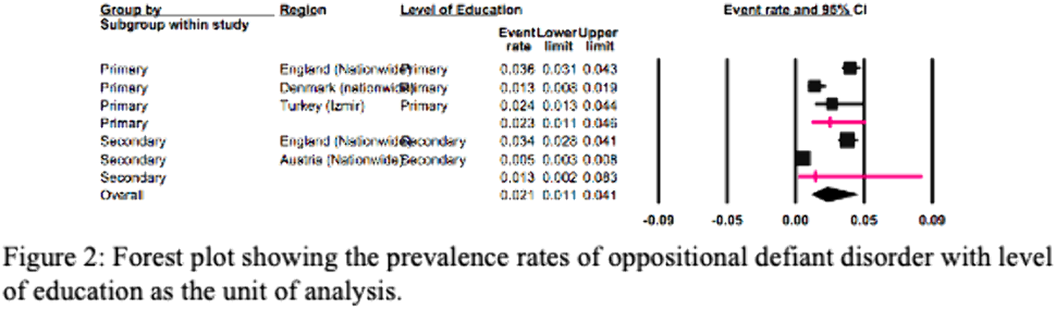
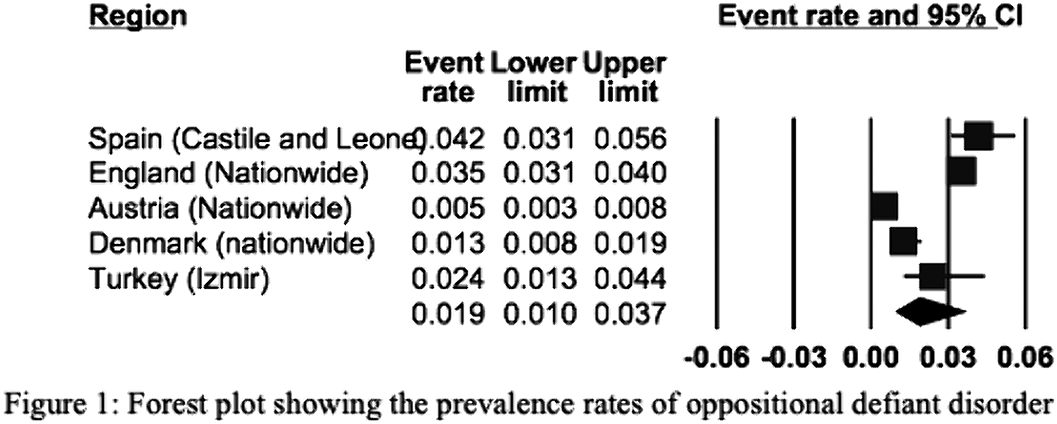
This systematic review estimates the pooled prevalence (PP) of oppositional defiant disorders (ODD) among 5-to-18-year-old YP living in Europe, based on prevalence rates established in the last five years (LFY).
Objectives
Trends of prevalence rates across countries, gender and level of education were analysed. The random effects pooled prevalence rate (REPPR) for ODD was calculated.
Methods
A search strategy was conducted on three databases. Studies were also identified from reference lists and grey literature. Eligible studies were evaluated for reliability, validity, bias, and the REPPR for ODD was calculated.
Results
The European REPPR for ODD is calculated at 1.9% (Figure 1). The REPPR among males is 4.8%, whereas the rate among females is 2.7% (95% CI: 0.7%- 1.4%). The prevalence rate of ODD among primary school children is 1.8 times higher than the prevalence of secondary school children (Figure 2).
Conclusions
Gender, culture and socioeconomic diagnostic inequality may contribute to prevalence differences across countries. Routine screening and addressing these aspects may facilitate early intervention.
On March, Tunisian government imposed lockdown measures on cities to contain the COVID19 outbreak. Media coverage, social distancing, quarantine and isolation led to a global atmosphere of anxiety and depression.
Objectives
To assess the level of anxiety and depression among citizens of southern Tunisia and theirs associated factors.
Methods
We conducted a cross-sectional, descriptive and analytical online-based survey, from April 19, 2020, to May 5, 2020 on 331 citizens living in south of Tunisia. During this period, the total confirmed cases of COVID-19 exceeded 900 in Tunisia. We used a self-administered anonymous questionnaire containing citizen’s sociodemographic and clinical data. Hospital Anxiety and Depression Scale (HAD) validated in the Tunisian dialectal version was used to assess anxiety and depression. Data were analysed using SPSS version 21.
Results
The 331 Participants were males (35%), singles (43,2%),aged between 20 and 40 years old(71%). From them, 37.5 % were suffering from anxiety and 42% of them from depression. Anxiety was correlated to the personal history of anxiety (p<10-3), the depression (p<10-3), the fear of contamination (p<10-3), the increased consumption of coffee and tea (p=0.005) and sleep disorders (p<10-3). Meanwhile, depression was associated to a past psychiatric history (p=0.001), a personal experience of psychological violence (p=0.011), increased cannabis use (p=0.011) and a broken sleep (p=0.007).
Conclusions
Our study identified a high prevalence of adverse psychological symptoms experienced by Tunisian citizens during this first wave of virus spread. Mitigating coronavirus effect on mental health is becoming an international public health priority.
Threatened preterm labor (TPL) is a traumatic event during pregnancy that involves a threat to the physical integrity of the upcoming baby. Despite biomarkers would be the strongest delivery date predictors, an assessment of chronic and acute stress response to TPL diagnosis may improve this prediction.
Objectives
The objective is to predict delivery date in women with TPL based on their response to this diagnosis and chronic stressors, along with relevant obstetric variables.
Methods
A prospective cohort study was conducted with a sample was formed by 157 pregnant women with TPL diagnosis between 24 and 31 weeks. Determination of salivary cortisol, α-amylase levels, along with anxiety and depression symptoms were measured to estimate stress response to TPL. Cumulative life stressors as traumas, social and familiar functioning were also registered. To examine the effect of the possible predictor variables of delivery date, linear regression models were used.
Results
A correlation was found between the variables of response to chronic stress and between the variables of psychological response to stress. The main predictors of preterm delivery were low family adaptation, higher BMI, higher cortisol levels, and the week of diagnosis of TPL (<29 weeks of gestation).
Conclusions
The best predictor of delivery date was the combination of the stress response to the diagnosis of TPL measured by cortisol in saliva, cumulative life stressors (mainly family adaptation) and obstetric factors (week TPL and BMI). Through psychosocial therapeutic intervention programs, it is possible to influence this modifiable predictive factors of preterm birth in symptomatic women.
We all have the innate ability to tell our story and the way we do it can determine the impact that each problem has on our lives. Storytelling can play a critical role in psychiatric practice and, from this premise, a new way of practicing psychiatry has recently emerged: narrative psychiatry.
Objectives
The objective is to offer a unified vision of narrative psychiatry, providing details on the historical and academic context of this approach.
Methods
A narrative-type literary review focused on narrative psychiatry will be presented.
Results
Narrative psychiatry is an innovative clinical approach in line within narrative medicine and with a specific subtype of postmodern psychotherapy, the narrative therapy of Michael White and David Epston. This novel way of practicing psychiatry arises from critical movements within the discipline but it is an integrative and collaborative perspective: the position of each problem in the patient’s personal narrative is discussed and different therapeutic proposals are addressed, including for instance psychotropic drugs. This integrative posture gives the narrative psychiatrist enough flexibility to equally integrate the scientific achievements of biological psychiatry and the humanizing component of narrative practice. In this literature review, the key tools proposed by the main narrative psychiatrists worldwide for the narrative clinical interview will be exposed.
Conclusions
Narrative psychiatry is a novel approach that narrows the therapeutic relationship and that puts in evidence the history of resistance of the consultant, healing through its own storytelling.
Exposure to extreme traumatic events can lead to post-traumatic stress disorder (PTSD). This disorder affects emotional, social and professional functioning. Recent studies suggest that it can lead to sexual dysfunction.
Objectives
The aim of this study is to compare the level of sexual dysfunction between men with PTSD and control subjects.
Methods
A total of 30 male PTSD patients and 30 controls were included in this study. We used the Post-Traumatic Stress Disorder Check Scale (PCLS) to assess the intensity of PTSD symptoms and the International Erectile Function Index (IIEF15) to assess sexual dysfunction of both patients and controls.
Results
The mean IIEF-15 score was 51.16 ± 6.82 in patients followed for PTSD versus 77.33 ± 2.02 in healthy controls with a non-significant difference (p = 0.26). Three patients (10%) had an alteration of desire while the control reported only dysfunction but there was no significant difference between the mean scores of IIEF-SD (p = 0.22). No patient or control had erectile dysfunction and there was no significant difference between the IIEF-EF sub-scores in the 2 groups (p = 0.20). The mean sexual intercourse satisfaction (SD) score in the patients was 5.13 ± 1.10 versus 8.86 ± 0.40 with a non-significant difference (p = 0.09). Altered satisfaction with intercourse was noted in 15% (n = 5) of subjects with PTSD versus a single control.
Conclusions
It is important that practitioners address the subject of sexuality in patients followed for PTSD and refer their patients, if necessary, to a sexology consultation.
Heart failure (HF) is a worldwide public health problem and the main cause of morbidity and mortality in older people. Previous studies have demonstrated that psychological symptoms are associated with worse cardiovascular outcomes. Nevertheless, the research regarding the association between anxiety and HF is still scarce.
Objectives
To analyse the levels of anxiety in HF patients and its association with New York Heart Association (NYHA) class in HF patients.
Methods
This study takes part of a wider project named Deus Ex-Machina project (NORTE-01-0145-FEDER-00026). HF patients were recruited from an outpatient clinic at a University Hospital. Patient with inability to communicate, with severe visual impairment or with NYHA class IV were excluded. Sociodemographic data and NYHA class were recorded. Anxiety was assessed using the Generalized Anxiety Disorder-7 (GAD-7).
Results
Overall, 136 patients were included, with a mean age of 57(±13) years old. Most of them were men (66%) and married (76%), with mean education of 8 years (±4). Regarding NYHA class, 36%, 49% and 15% were at class I, II and III, respectively. The mean GAD-7 total score was 6.4 (±5.2) and 32% of patients showed moderate to severe anxiety symptoms. No association between the NYHA functional class and anxiety was found (p=0.106).
Conclusions
The results reveal that anxiety is frequent among HF patients. However, as found in previous studies, it was not associated with more severe HF symptoms. The coexistence of HF and anxiety deserves further studies, in order to build a better understanding of this association.
Due to the COVID-19 pandemic, there is a steep rise in the acceptance of telemedicine and digital health, including increased interest in pursuing mental health treatment through telepsychiatry. Digital health helps following social distancing measures and increases the health outcomes.
Objectives
To see the role of digital health in improving physical and mental well-being during COVID-19 Pandemic
Methods
This study is a part of a large global project where 240 people inquired advice on phone app during COVID-19-Pandemic. Later on, a short study was conducted on the same population through survey to evaluate the effectiveness of digital health/tele-mental health. We also searched PubMed, Google Scholar, PsychInfo, and Medline for words “Digital Health, Tele-mental health, COVID-19-Pandemic”. Reviewed 40 articles and included 3 in this review1,4,5.
Results
We received a total of 98 responses. 65.6% people reported that online health resources are helpful in relieving pandemic-induced anxiety/stress, 66.2% reported to continue online health services after pandemic, 37.7% noted that digital health saves times in waiting areas, 46% reported lack of physical interaction with doctor as a disadvantage of digital health, and 40.3% reported comfort in using tele-mental health. Our literature review has shown barriers like privacy concerns and technological issues1. Provision of tele-psychiatry is safe and effective in continuity of mental health care.4,5
Conclusions
There has been an increased inclination towards digital health during any disaster. During COVID-19-Pandemic, digital health has increased access to mental health care and reduced risk of infection. The drawbacks include poor patient-doctor relationship, reimbursement concerns, and lack of confidentiality.
The concept of food addiction emerged recently due to the similarities between food overconsumption patterns and addictive drugs. This concept is not yet included into ICD or DSM as it still needs to be further investigated. Relationship between obesity and food consumption as well as the psychological indicators of food addiction are of particular interest.
Objectives
To examine the prevalence of food addiction and its relationship to obesity, quality of life and multiple indicators of impulsivity.
Methods
Cross-sectional in-person assessment of 1432 community adults (age 38.93+/-13.7; 58% female). Measurements: Yale Food Addiction Scale 2.0, anthropometrics, body composition, World Health Organization Quality of Life scale, and impulsivity measures including impulsive personality traits, delay discounting, and behavioral inhibition.
Results
The prevalence of food addiction was 9.3% and substantially below that of obesity (32.7%). Food addiction was more prevalent among obese individuals and also was associated with higher BMI among non-obese participants. It was associated with significantly lower quality of life in all domains, and significantly higher impulsive personality traits, particularly negative and positive urgency.
Conclusions
In this general community sample, food addiction was present in slightly fewer than 1 in 10 individuals, approximately one-third the prevalence of obesity, but notably the food addiction has been mostly represented within the subsample of obese individuals. Food addiction was robustly associated with substantively lower quality of life and elevations in impulsivity, particularly in deficits in emotional regulation. These data suggest food addiction may be thought of as a subtype of obesity and, in non-obese individuals, possibly a prodrome.