We partner with a secure submission system to handle manuscript submissions.
Please note:
You will need an account for the submission system, which is separate to your Cambridge Core account. For login and submission support, please visit the
submission and support pages.
Please review this journal's author instructions, particularly the
preparing your materials
page, before submitting your manuscript.
Click Proceed to submission system to continue to our partner's website.
To save this undefined to your undefined account, please select one or more formats and confirm that you agree to abide by our usage policies. If this is the first time you used this feature, you will be asked to authorise Cambridge Core to connect with your undefined account.
Find out more about saving content to .
To send this article to your Kindle, first ensure no-reply@cambridge.org is added to your Approved Personal Document E-mail List under your Personal Document Settings on the Manage Your Content and Devices page of your Amazon account. Then enter the ‘name’ part of your Kindle email address below. Find out more about sending to your Kindle.
Find out more about saving to your Kindle.
Note you can select to save to either the @free.kindle.com or @kindle.com variations. ‘@free.kindle.com’ emails are free but can only be saved to your device when it is connected to wi-fi. ‘@kindle.com’ emails can be delivered even when you are not connected to wi-fi, but note that service fees apply.
Despite existentialism positing that existential concerns are universal, research into the existential issues related to addiction remains scarce. An existential model of addiction is lacking.
Objectives
This research aims to develop an existential model of addiction, conceptualising the development of addiction through to authenticity.
Methods
A scoping literature review was carried out using PUBMED, reference lists and internet websites.
Results
Psychopathology, from an existential point of view, occurs as a result of the avoidance of the existential givens which are death, freedom, existential isolation and meaninglessness. In this model, addiction is positioned as a coping mechanism to deal with the existential or neurotic anxiety which arises from facing or avoiding the existential givens. Addiction is defined as being-with-drug; a state in which our inherent relation to others is replaced by a relation with a substance. This state is understood from the ontological, axiological, ethical and praxeological levels, shedding light on the phenomenological experience of addiction. The existential dilemmas around meaning, loneliness, death, freedom, guilt and control while living with addiction are discussed. Finally, existential crises, boundary situations and secondary suffering are seen as the main motivators to overcome addiction.
Conclusions
Phenomenological and existential research support the fact that existential issues are relevant to addiction. This model explains the relationships between existential concepts and addiction, while providing a framework for clinicians to explore and address these issues with patients.
Despite innovative treatments, the impairment in real-life functioning in subjects with schizophrenia (SCZ) remains an unmet need in the care of these patients. Recently, real-life functioning in SCZ was associated with abnormalities in different electrophysiological indices. It is still not clear whether this relationship is mediated by other variables, and how the combination of different EEG abnormalities influences the complex outcome of schizophrenia.
Objectives
The purpose of the study was to find EEG patterns which can predict the outcome of schizophrenia and identify recovered patients.
Methods
Illness-related and functioning-related variables were measured in 61 SCZ at baseline and after four-years follow-up. EEGs were recorded at the baseline in resting-state condition and during two auditory tasks. We performed Sparse Partial Least Square (SPLS) Regression, using EEG features, age and illness duration to predict clinical and functional features at baseline and follow up. Through a Linear Support Vector Machine (Linear SVM) we used electrophysiological and clinical scores derived from SPLS regression, in order to classify recovered patients at follow-up.
Results
We found one significant latent variable (p<0.01) capturing correlations between independent and dependent variables at follow-up (RHO=0.56). Among individual predictors, age and illness-duration showed the highest scores; however, the score for the combination of the EEG features was higher than all other predictors. Within dependent variables, negative symptoms showed the strongest correlation with predictors. Scores resulting from SPLS Regression classified recovered patients with 90.1% of accuracy.
Conclusions
A combination of electrophysiological markers, age and illness-duration might predict clinical and functional outcome of schizophrenia after 4 years of follow-up.
Studies in adults with bipolar disorder (BD), shows that in 25% of cases first affective episode occurs under the age of 13 and in 63-69% under the age of 19. The most difficult problem is the early identification of BD, which starts in adolescence as a result of polymorphism of clinical symptoms, their syndromic incompleteness.
Objectives
Study of the structure of adolescents affective disorders on primary appointment in outpatient psychiatric unit.
Methods
Content analysis, sampling method, statistical method. 120 disease histories of adolescents who first applied for outpatient psychiatric unit in 2019 were used. 93 (77.5%) of them were girls and 27 (22.5%) of them were boys. The average age was 17 years.
Results
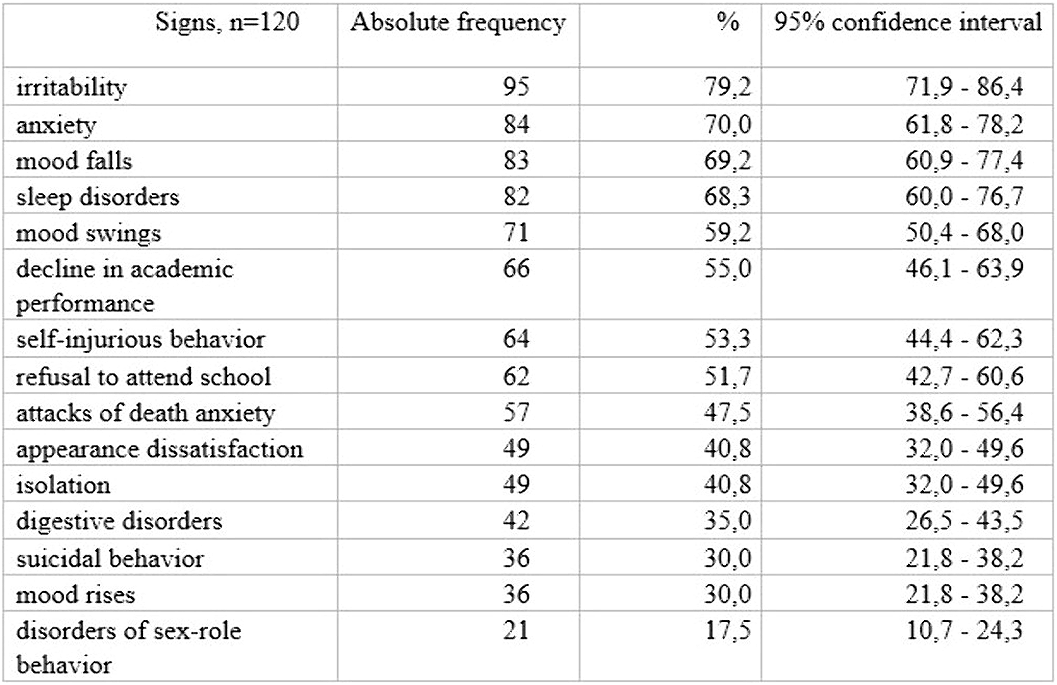
In the structure of initial diagnoses, according to ICD-10, mood disorders [F30-F39] - 56.0% prevailed. [F40-F49] - 25%, [F00-F09] - 6.6%, [F20-F29] - 6.6%, [F50-F59] – 4,2%, [F90-F99] – 1,6% were less likely. Structure of complaints of adolescents and their parents on primary appointment for specialized psychiatric care is shown in Table 1 (p<0,05).
Conclusions
Initial signs of emotional disorders in adolescence are polymorphic, nosologically nonspecific, and can lead to diagnoses that are not limited only by the affective pathology. The most common symptoms (irritability, anxiety, mood falls) can act as transdiagnostic phenomena that must be taken into consideration both in the diagnostic study and in further clinical and dynamic follow-ups and treatment.
There is a growing literature suggesting disgust plays a major role in religiosity. Asceticism is a personality trait characterized by abstinence from sensual pleasures, often for the purpose of pursuing spiritual goals. Since few studies suggested that higher disgust levels may lead to greater fear of sin, contamination disgust may serve as effective mechanisms for inflated scrupulosity.
Objectives
We aimed to investigate the role of contamination disgust on a specific religious belief in two clinical groups: eating disorders and anxiety disorders.
Methods
We enrolled 84 patients admitted in the Psychiatric Unit of Careggi with diagnosis of Anxiety Disorders (AD) and Eating Disorders (ED). We administered them: Disgust Scale Revised (DS-R) and Eating Disorders Inventory 2 (EDI-2)
Results
A t-test for independent samples between AD patients and ED patients showed no difference in DS-R contamination disgust subscale (t=1.437, p=0.153), while significantly higher EDI-2 asceticism scores were detected in ED patients (t=2.452, p=0.010). An ANCOVA model having EDI2 Asceticism subscale as dependent variable, and DS contamination disgust subscale, diagnosis, and interaction between contamination disgust and diagnosis was estimated. The overall model was significant (F(1,136)=4.854, p=0.003) and accounted for 9.7% of variance of EDI2 Asceticism subscale (R2=0.097). The effect of contamination disgust was positive and significant (β=0.302, t=2.781, p=0.006), and accounted for 5.4% of variance of EDI2 Asceticism (partial η2=0.054). No effect was detected for diagnosis (F(1,136)=0.012, p=0.912) or interaction between contamination disgust and diagnosis (F(1,136)=1.346, p=0.248).
Conclusions
Contamination disgust may have a trans-diagnostic effect on asceticism and may be a possible driver for specific religious behaviors.
Psychiatric emergencies are acute disturbances in thought, behavior or mood which require immediate medical intervention. As a substantial number of patients with mental illness present as psychiatric emergencies, the sustainability and management of psychiatric emergency services becomes significant.
Objectives
In this study we aimed to examine the factors associated with psychiatric emergency care, taking the boarding time in the emergency department as primary outcome measure.
Methods
Charts of 466 psychiatric emergency cases admitted to the Hacettepe University Emergency Department (ED) between December 2018 – September 2019 were evaluated. Boarding time (BT) in the ED, presence of self-harm, psychotic symptoms and agitation were noted.
Results
In the examined period, number of patients admitted increased with time significantly (r= 0.562, p <0.01). However, increase in the number of patients was not correlated with an increase in BT. Patients with psychotic symptoms had greater BT compared to non-psychotic patients (7.01 hours vs. 11.24 hours, T= -2.796 df = 182.717 p <0.01). Patients with self-harm also had greater BT (7.47 hours vs. 9.85 hours, T = -2.013 df = 433 p <0.05). Patients with self-harm in relation with previous suicidal ideation displayed significantly a longer BT when compared with patients admitted due to self-harm without any suicidal plan (U=2572,5 p<0.01).
Conclusions
A significant increase in BT with psychosis and self-harm due to a suicidal plan supports the need of intermediate facilities between the ED and inpatient units, as such facilities would create a positive impact in the care of psychotic and suicidal patients.
Physical and psychological health, social relationships and professional environment determine the quality of life of nurses.
Objectives
This study aims to evaluate the quality of life of Hospital nurses and to identify the factors that influenced this assessment.
Methods
We conducted a cross-sectional study concerning nurses who answered a questionnaire developed and structured in order to assess the quality of life and with the appliance of the World Health Organization Quality of Life Instrument (WHOQoL-BREF). The statistical processing was done with IBM SPSS Statistics for Windows, Version 21.0.
Results
Most of the nurses were women (78.30%), married (81.70%) and with a specialization degree (65 %). The mean age of the study population was 50.20 years (±7.20 years). Most of them considered their quality of life good or very good (46.7%) and were satisfied or very satisfied with their health (48.4%). There is a significant association between quality of life and satisfaction with life (p=0.000). The average score of Physical health was 55.76(±13.89). The average scale of Psychological health was 61.45 (±15.14). A significant correlation was observed between lack of antecedents and a better physical health (p=0.000).The psychological health was correlated with age (p=0.000) and social relationships (p=0.000).
Conclusions
Studying the quality of life of nurses is particularly important, since it can lead to the development of a policy for improving the working conditions in the public sector.
Current studies indicate the involvement of inflammation in the pathogenesis of chronic non-infectious diseases, and therefore it is of interest to study the role of inflammation markers in non-psychotic mental disorders (NPMD).
Objectives
To identify a number of inflammatory markers in serum of patients with NPMD.
Methods
73 patients with NPMD were examined (F43.2; F06.6). The comparison group consisted of 76 patients with endogenous psychosis (EGP) (F20.0; F25.0). The control group included 80 healthy people. The serum activity of leukocyte elastase (LE), α1-proteinase inhibitor (α1-PI) and the level of autoantibodies (aAb) to neuroantigens were determined.
Results
Three groups of patients with different variants of inflammatory response to the pathological process were identified. In group 1 (23.3%), all indices corresponded to the control values, which indicated the absence of the pathological process in brain. In group 2, there was a significant increase in activity both LE and α1-PI compared to control (p<0.05). This type of immune reaction characterized a balanced inflammatory response. It was found in 52% of patients with NPMD and in all patients with EGP. The aAb level also exceeded the control values (p<0.05). Group 3 (24.7%) showed an increase in α1-PI activity (p<0.05), but not in LE activity compared to control. Insufficient LE activity reflects a decrease in the functional activity of neutrophils.
Conclusions
The immune heterogeneity of NPMD according to the level of inflammatory markers was identified. 52% of patients with NPMD have a pronounced activation of inflammatory reactions accompanied by increased levels of aAb to neuroantigens.
Studied the psychological mechanisms of mental states’ self-regulation of students in the course of the educational activities: at lectures, seminars and exams.
Objectives
The main aims of the study were: 1. To identify the typical methods and techniques of mental states’ self-regulation and regulatory abilities in everyday and stressful conditions of educational activity; 2. To establish the relationships between the quality of subject training, regulatory abilities and states of students; 3. To study the influence of mental structures (semantic, reflective) on self-regulation and regulatory abilities of students.
Methods
To solve these problems used a bank of 23 techniques, including 303 indicators. 260 1-st year students took part in the research (aged 18-20).
Results
As a result of the research, identified the states typical for lectures, seminars, exams. Comparison of mental states characteristics of humanities students and students of natural sciences did not reveal any differences. Among the mental states of highly effective students, particular importance have the cognitive mental states: interest, thoughtfulness and concentration. Found that the effectiveness of students’ mental states self-regulation affects the productivity of passing the semester exam. The most commonly used methods are introspection (withdrawal), self-control, the use of logic, a positive attitude and search activity. This pattern is typical for both mathematics and psychology students.
Conclusions
Found that students with high self-regulation efficiency more often use a wide range of regulatory technics. Established the properties of personality, providing high efficiency of self-regulation, these are: adequacy, awareness, independence and assertiveness. This work was supported by the RFBR grant № 19-29-07072.
Obsessive-compulsive symptoms (OCS) are common in schizophrenia, with a prevalence ranging from 12 to 25%. They affect negatively disease outcome. Patients with comorbid OCS present more frequently resistant psychotic symptoms. Besides, the appearance and aggravation of OSC are more commonly reported with atypical antipsychotics.
Objectives
To present through a clinical case and a brief literature review the treatment challenge of obsessive-compulsive symptoms in schizophrenia.
Methods
We reported the case of Mr. M.S., treated in our department since 2008 for comorbid schizophrenia and OCS, and discussed therapeutic alternatives through a literature review.
Results
Mr. M.S. a 34-year-old male diagnosed with comorbid schizophrenia and OCS at age 20. To control psychotic symptoms, the patient received several trials of anti-psychotics with little improvement. We concluded that it was resistant schizophrenia. The introduction of clozapine reaching 300 mg daily led to significant improvement of psychotic symptoms but worsened OCS. The adjunction of fluoxetine and cognitive-behavioral therapy (CBT) was unsuccessful to manage obsessive symptoms. We opted for the association of aripiprazole 20 mg daily and clozapine, the doses of which were gradually tapered down to 150 mg daily. This association has guaranteed the improvement of both psychotic and obsessive symptoms.
Conclusions
Conclusion This clinical vignette highlights the need for clinical awareness about the possible exacerbation of OCS with atypical antipsychotics in schizophrenia.
Characterizing neuroanatomical markers of different stages of schizophrenia (SZ) to assess of how the disorder develops is extremely important for the clinical practice. It still remains uncertain how abnormalities are formed as SZ progresses.
Objectives
We reviewed and analyzed 113 voxel based morphometry studies on people at risk of or with schizophrenia to assess GM alterations at different stages of the disorder and to functionally characterize these GM variations.
Methods
We performed a meta-analysis of voxel-based morphometry studies of genetic and clinical high-risk subjects (g-/c-HR), recently diagnosed (RDSZ) and chronic SZ patients (ChSZ). We quantified gray matter (GM) changes associated with these four conditions and compared them with contrast and conjunctional data. We performed the behavioral analysis and networks decomposition of alterations to obtain their functional characterization.
Results
Compared to previous investigations, results reveal a robust cortical-subcortical, left-to-right homotopic progression of GM loss. The right anterior cingulate is the only altered region in all conditions. Contrast analyses show left-lateralized insular, amygdalar and parahippocampal GM reduction in RDSZ, which appears bilateral in ChSZ. An overlap between RDSZ and ChSZ is observed in the left insula, amygdala, precentral and inferior frontal gyri. Functional decomposition shows involvement of the salience network, with an enlargement of the sensorimotor network in RDSZ and the thalamus-basal nuclei network in ChSZ.
Conclusions
These results can help the research on diagnostic and neuroimaging biomarkers of SZ staging, as well as on the identification of new therapeutics neuroanotomic targets that could be addressed with focused magnetic or non-invasive electric stimulation.
Anorexia nervosa (AN) is a complex condition with high comorbidity.
Objectives
This study aims to verify whether patients with AN are more aggressive towards themselves than towards others; namely, we measure the levels of autoaggressive/aggressive ideation, negative emotions regarding self/others, as well as self-harm behavior.
Methods
10 female patients with AN (2 of them also had bulimia nervosa) and 20 female participants of the control group were presented with Structured Interview, Rosenzweig Picture-Frustration Test (P‐F), Thomas-Kilmann Conflict Mode Instrument, Buss-Durkee Hostility Inventory, I-structural Test of Ammon, Boyko Communication Aggression Inventory, Boyko Self-directed Emotion Accumulation Inventory (BSEAI). Mann-Whitney U-test and Pearson’s correlation coefficient were used.
Results
Table 1
Structured interview indicator
Control group
AN patients
Suicide attempts
10%
60%
Self-harm behavior
35%
60%
Piercing/tattoos
20%
50%
Depression (self-report)
40%
90%
There were no significant differences in aggression levels between groups. However, patients with AN showed less extrapunitive reactions: blaming others, requiring others to resolve the situation (P-F, р=0.013) and more intropunitive reactions: self-blame, feeling responsible/guilty for the situation (P-F, р=0.031). AN patients had more self-directed negative emotions and impulses (BSEAI, р=0.01), more self-harm behavior (see table 1). There were no correlations between autoaggression and aggression scales in the control group, but there were 9 correlations between them in the AN group (p<0.05, r>0.76).
Conclusions
Patients with AN are more inclined to self-blame, negative ideas about themselves, self-harm behavior, but have the same aggression level as the control group. The interconnection of aggression and autoaggression is different in patients with anorexia nervosa compared to the control group.
Triple Network Model (TNM), which considers the dynamic interaction between Default Mode (DMN), Salience (SN), and Central Executive (CEN) networks, explains clinical features in mental disorders from a neurophysiological perspective. Some studies highlight the increased connectivity in TNM in adults with Borderline Personality Disorder (BPD), but little is known about adolescents.
Objectives
The aim of our preliminary study was to investigate TN functional connectivity (FC) in BPD adolescents with a history of traumatic experiences, and its correlation with dissociative symptoms.
Methods
15 BPD adolescents (DSM-5 criteria) with early traumatic experiences were compared to 15 healthy controls, matched for sex and age. Dissociation Questionnaire (DIS-Q) was administered. Eyes-closed resting-state (RS) EEG recordings were performed (19 electrodes; 10- 20 system) and analyzed using Exact Low-Resolution Electromagnetic Tomography software (eLORETA). FC was computed for all frequency bands and 9 Regions of Interest for TNM.
Results
BPD adolescents showed a hyper-connection between CEN and DMN [dorso-lateral prefrontal cortex (dlPFC) and posterior cingulate cortex (PCC); PCC and left posterior parietal cortex (PPC)] and within the CEN (left and right PPC). The strength of PCC-dlPFC and left-right PPC connections was correlated with dissociative symptoms severity.
Conclusions
FC alterations can already be identified in BPD adolescents, supporting the need for early diagnosis. Normally DMN and CEN show opposite functioning. In our BPD adolescents, the absence of this “anti-correlation” reflects the typical confusion between internal and external mental states, which clarify their difficulties in metacognition or mentalization. Moreover, in dissociative symptoms, two CEN nodes are also involved, not only DMN as previously described.
Multiple epidemiologic and clinical studies have explored the relationship between physical pain and suicidal thoughts and behaviours.
Objectives
The aim of this meta-analysis was to provide an update of the data already present in literature about this specific association in adults.
Methods
Starting from a meta-analysis published by Calati and colleagues in 2015, 28 studies were included in this work. After searching on Pubmed (until March 2020), data were extracted from articles comparing the rates of current and lifetime suicidal thoughts and behaviours (death wish, suicidal ideation, suicidal planning, suicide attempt and suicide death: DW, SI, SP, SA, and SD) in adults with any type of physical pain and in individuals who did not report this condition. Data were analysed using Cochrane Collaboration Review Manager software (RevMan, version 5.4).
Results
Although high between-study heterogeneity was detected in most analyses, results suggested that adults with physical pain are more likely to report any form of suicidal outcome, except for death by suicide, compared to individuals not affected by pain. No evidence of publication bias was reported in the main analysis (lifetime SA).
Conclusions
Collected data are therefore in line with previous literature on this topic, which considered physical pain an extremely relevant risk factor for suicidal thoughts and behaviours. Future studies should specifically focus on alternative types of physical pain (such as medically unexplained pain or psychogenic pain) or explore the different impact of acute versus chronic pain in terms of increased suicide risk.
Esketamine nasal spray has been developed for patients with treatment resistant depression.
Objectives
A cohort Temporary Authorization for Use (ATUc) allowed to collect for a 6-month period the first data in real life
Methods
On 02/08/2019 the French National Agency for Medicines and Health Product Safety granted an early access program for Esketamine nasal spray framed by a specific protocol for patients without therapeutic alternatives. Each treatment request was approved based on inclusion and exclusion criteria. Clinical evolution, treatment management and safety were then spontaneously reported by psychiatrists.
Results
From 09/23/2019 to 03/25/2020, 66 patients were treated. The median age was 53 years and 41 (62.1%) were females. At treatment request, 52 patients (79%), presented a severe current depressive episode based on clinical judgment. The median duration of the disease was 12.2 years and the current episode was 2.6 years. Since the beginning of the current depressive episode, all patients (66) were prescribed ≥2 antidepressants (mean 4.2). Esketamine was initiated in a complete hospitalization setting in 27 patients (55.1%) and in day hospitalization in 22 patients (44.9%).Safety profile was consistent with the one described during clinical study. The most frequently adverse events reported (>10%) were dizziness, sedation, sleepiness, anxiety and dissociation. Most of them appeared after treatment administration and were transient.
Conclusions
ATUc ended on 12/18/2019 after Marketing Authorization granted by European Medicines Agency. Data reported by French psychiatrists are the first collected in this specific population and provide descriptive information on patient characteristics, burden of disease; Esketamine management and practical use at hospital level
Disclosure
Data analysis performed by RCTs and poster conception coordinated by Medergy and funded by Janssen
The COVID19 outbreak has disrupted the mental health of resident doctors who had to care for patients. Eating disorders were among these reported mental health problems.
Objectives
To screen binge eating disorder among young Tunisian doctors and its associated factors.
Methods
We conducted a cross-sectional, descriptive and analytical online-based survey, from April 19, 2020, to May 5, 2020 on 180 medical residents in training. We sent the survey via a google form link. We used a self-administered anonymous questionnaire containing sociodemographic and clinical data of young doctors. The Diagnostic and Statistical Manual of Mental Disorders (DSM-5) criteria were used to assess Binge-Eating Disorder.
Results
Among 180 young doctors who enrolled the survey, 70,2% were female, 16% were married. The mean age was 29 years. 51,1% were frontline caregivers, working directly in diagnosing, treating or caring for patients with coronavirus disease. Among our participants, 5% presented anxiety disorder, another 5 % presented depression disorder and 1,7% had eating disorder. Binge eating disorder were present among 8,9 % of participants and it was associated to personal history of eating disorder (7,7% vs 1,1%, p<10-3), past history of depression disorder (7,2% vs 3,3%, p=0.008), exposure to media or news about coronavirus outbreak (0.5% vs 8,3%, p=0.04).
Conclusions
Our study indicated the evolving proportion of binge eating disorder among young doctors. Screening eating disorder is important in order to prevent related physical health problems.
Disulfiram is an alcohol detox drug that has been approved by the FDA for over 50 years. Among the various side effects that can cause there is encephalopathy. Its incidence is currently unknown, according to some authors it is estimated between 1 and 20%.
Objectives
In this article we report the case of a 48-year-old woman diagnosed with borderline personality disorder and alcohol use disorder, presenting with encephalopathy.
Methods
We discuss about our diagnostic and therapeutic approach.
Results
Fortunately, the rapid identification of this rare condition led to a favorable outcome in our patient.
Conclusions
Early detection of any acute change in mental state, especially in early stage of therapy, is important. Cessation of disulfiram is recommended in case of suspicion about disulfiram encephalopathy. This case underscores the importance of awareness of this serious complication during disulfiram treatment. If suspected early, appropriate diagnosis and treatment can prevent rapid progression.
The covid-19 virus pandemic is another risk factor not only for the lives of older people, but also for their mental health, as the threat is immediate and intense.
Objectives
The aim of the study was to investigate depression during the pandemic in a population of elderly people over 65 years of age living in the Greek countryside.
Methods
The research was synchronous and was conducted in the autumn of 2020 in Crete. The sample of the study was random and consisted of 200 elderly users of services of the Health Center of the Municipality of Phaistos, Crete. The Geriatric Depression Scale (GDS-15) was used to conduct the study in combination with 24 questions related to pandemic perceptions.
Results
40.5% of the sample were men and 59.5% were women. The mean age was 75.70 years (SD ± 6.29). The mean value of GDS-15 was found to be 5.97 (SD, 3.07), while the comparison of depressive symptoms showed that women, lonely people and the elderly with chronic health problems are more vulnerable to the development of depressive symptoms. In relation to covid-19 and depressive symptoms, there was a positive correlation with twelve factors (p <, 05) with the most important being the fear for their family health, sleep disorder, loneliness and inability to deal with the virus.
Conclusions
The research showed moderate depressive symptoms, while a clear effect of the pandemic due to Covid-19 was found on the emotional mood of the elderly, a fact that makes their psychosocial support necessary.
Generalized problematic internet use/GPIU has recently been associated with the impulsive-compulsive spectrum/ICS, but its mapping onto these behaviour dimensions is relatively unexplored.
Objectives
To compare patterns of internet use and scores of BIG-5 personality traits, perfectionism and psychological distress between groups with low/high levels of GPIU.
Methods
475 university students (78.9% girls; mean age 20.22±1.695) answered the Portuguese versions of: GPIU Scale, Multidimensional Perfectionism Scale-13, NEO-FFI-20, Depression, Anxiety and Stress Scales and other questions about internet use. Chi-square and Mann-Whitney tests were performed using SPSS.
Results
Individuals with high levels of GPIU (median+2SD; n=18; 3.8%) spent significantly more time/day in online activities, exceeding what they have planned; had no other hobbies and used social networks to meet friends; reported that GPIU interfered with affective/work relationships and academic performance (all p<.05). There were no significant differences in the purposes of the internet use (e-mail, social networks, shopping, videogames, multimedia, sexual, work…), unless for general information searching and betting games (both p<.05). High-PGIU group also presented significant higher levels of neuroticism, negative (but not positive) perfectionism, depression, anxiety, and stress (all p<.001).
Conclusions
Our results indicate that unlike the purposes of internet use, personality, perceived interference and the associated cognitive-emotional processes and symptoms (psychological distress) may help distinguishing between functional vs. dysfunctional internet use. Considering the preponderance of processes over contents and the presence of certain dimensions, such as perception of uncontrollability, interference and social isolation we add more evidence to consider PGIU as falling within the spectrum of impulsive-compulsive disorders.
In the assessment of suicidal behavior, recent studies describe the great influence of an environmental component with adverse life events and stressors that can influence self-harm ideation and gesture.
Objectives
1. To analyze the reasons for consultation of adolescents between 11 and 17 years of age who consult for suicidal behavior. 2. To estimate the frequency of the different socio-family life events.
Methods
A retrospective review of the emergency room visits in the last 3 months was carried out. Sociodemographic data, vital events, reason for consultation and evolution are collected in the following 30 days after consultation in the emergency room.
Results
Data were collected from 16 adolescents who consulted in the emergency room for suicidal ideation / gesture in a period of 3 months, of which 43% (7) were women and 56% (9) were men between 11 and 18 years old. The reasons recorded as stressful life events were: 22% unstructured family environment, 10% death of a close relative, 43% little parental supervision, 26% end of a romantic relationship, 5% legal problems, 2% sexual or physical abuse, 70 % academic problems, 3% bullying. It was observed that in 63% of the cases they presented more than one adverse experience.
Conclusions
Suicidal ideation and behavior are frequently preceded by different adverse life events that can be minimized or go unnoticed and undervalued. A meticulous medical history can clarify some of the reasons that influence the hopelessness and clinical anguish that the suicidal patient presents. Its early detection provides the opportunity for an early and specialized approach.
Compared with adult onset, early onset schizophrenia is typically characterized by greater illness severity and less favorable prognosis.
Objectives
To evaluate the proportion of adolescent patients with schizophrenia who achieved sustained remission and recovery during 2 years of treatment with lurasidone.
Methods
Patients aged 13-17 years with a DSM-IV-TR diagnosis of schizophrenia, and a Positive and Negative Symptom Scale (PANSS) total score ≥70 and <120, were randomized to 6 weeks of double-blind (DB), fixed-dose treatment with lurasidone (37 or 74 mg/d) or placebo. Patients who completed 6 weeks of DB treatment were eligible to enroll in a 2-year, open-label (OL), flexible dose extension study of lurasidone (18.5-74 mg/d). Criteria for sustained remission, were the 6-month consensus criteria summarized by Andreasen (Am J Psych 2005;162:441-9). Criteria for sustained recovery consisted of meeting sustained remission criteria with a Children’s Global Assessment Scale (CGAS) score ≥70 for at least 6-months indicating no clinically significant functional impairment.
Results
A total of 271 patients completed the 6-week DB study and entered the extension study, and 186 (68.6%) and 156 (57.6%) completed 52 weeks and 104 weeks of treatment, respectively. During OL treatment with lurasidone, 52.8% met sustained remission criteria, with a Kaplan-Meier (KM) estimate of 64.1 weeks for median time to sustained remission; and 28.8% met sustained recovery criteria, KM estimate of 104.6 weeks for median time to sustained recovery.
Conclusions
For adolescents with schizophrenia, treatment with lurasidone was associated with high rates of sustained remission and sustained recovery over a two-year period.
Disclosure
Employee of Sunovion Pharmaceuticals Inc. The study summarized in this Abstract was supported by funding from Sunovion Pharmaceuticals Inc