We partner with a secure submission system to handle manuscript submissions.
Please note:
You will need an account for the submission system, which is separate to your Cambridge Core account. For login and submission support, please visit the
submission and support pages.
Please review this journal's author instructions, particularly the
preparing your materials
page, before submitting your manuscript.
Click Proceed to submission system to continue to our partner's website.
To save this undefined to your undefined account, please select one or more formats and confirm that you agree to abide by our usage policies. If this is the first time you used this feature, you will be asked to authorise Cambridge Core to connect with your undefined account.
Find out more about saving content to .
To send this article to your Kindle, first ensure no-reply@cambridge.org is added to your Approved Personal Document E-mail List under your Personal Document Settings on the Manage Your Content and Devices page of your Amazon account. Then enter the ‘name’ part of your Kindle email address below. Find out more about sending to your Kindle.
Find out more about saving to your Kindle.
Note you can select to save to either the @free.kindle.com or @kindle.com variations. ‘@free.kindle.com’ emails are free but can only be saved to your device when it is connected to wi-fi. ‘@kindle.com’ emails can be delivered even when you are not connected to wi-fi, but note that service fees apply.
We conducted a national longitudinal survey among healthcare workers in the context of the Covid-19 pandemic, (1) to assess mental health and (2) to describe the results of an intervention to improve capacity of resilience. Non-participation is rarely studied despite being an important methodological matter when performing studies on mental health.
Objectives
The study aims to describe and identify the factors associated with non-participation of healthcare workers to the intervention part of a national longitudinal study on the psychological impact of the COVID-19 pandemic.
Methods
Participants were recruited from April to October 2021 via an Internet link widely disseminated. Data collected include participant’ socio-demographic, occupational and working conditions, general health, professional burnout and mental health. The intervention proposed the use of tools for self-management of stress and resilience (PsySTART-Responder® and Anticipate.Plan.Deter™ program). A robust Poisson regression was used to identify factors associated with non-participation.
Results
Among 724 participants, 41% participated to the intervention part. Factors associated to non-participation to the intervention were to work with few or no COVID-19 patients, and low scores in the anxiety scale. Social determinants, occupational characteristics or general health were not associated with non-participation.
Conclusions
Our study provides a better understanding of the participation of healthcare workers that was not frequently studied. The results logically suggest lower participation among those with better mental health and not directly concerned with management of COVID-19 patients. Non-participation to the intervention was not associated with social factors, which is an argument in favour of using such a design/intervention in a socially heterogeneous population.
Alzheimer’s disease (AD) is the leading cause of dementia worldwide. About 40-50% of AD patients are also affected by depression, with mounting evidence suggesting its association with worse disease prognosis and negative outcomes, such as lower quality of life, higher mortality and more hospitalizations. However, few studies have specifically measured the association of depression with AD hospitalization outcomes.
Objectives
To characterize depression among all hospitalizations with a registered diagnosis of AD and to explore its association with hospitalization outcomes, including in-hospital mortality, length of stay and discharge destination.
Methods
A retrospective observational study will be conducted following the RECORD statement. A Portuguese nationwide hospitalization database from all mainland public hospitals will be used. Episodes of inpatients ≥65 years old with a primary or secondary diagnosis of AD (ICD-9-CM code 331.0), discharged between 2008-2015, will be selected. Codes 296.2X, 296.3X, 300.4 and 311 will be used to identify episodes with a concomitant registry of depression at any diagnostic position. Descriptive, univariate and multivariate approaches will be used.
Results
A total of 61 361 episodes complying with the fixed criteria will be assigned to one of two groups (with vs without depression). Groups will be compared regarding sociodemographic characteristics, comorbidity profile, type of admission (planned vs urgent) and hospitalization outcomes. Results regarding the association of depression and outcomes will be presented as crude and adjusted odds ratios (OR).
Conclusions
With this nationwide analysis, we expect to contribute to the clarification of depression impact on AD hospitalizations, so that best-practice care may be provided to these patients.
Tranylcypromine (TCP), an irreversible monoamine oxidase inhibitor (MAOI), is recommended for difficult-to-treat depression. Besides the requirement of a low-tyramine diet, there are concerns about the safety of TCP treatment during anaesthesia and electroconvulsive therapy (ECT). For safety reasons, many psychiatrists prefer to terminate TCP before ECT.
Objectives
To assess the safety of tranylcypromine treatment during ECT series in patients with difficult-to-treat depression (DTD).
Methods
In this retrospective study we report on n=19 patients, who were treated with tranylcypromine during the ECT series. ECT parameters, clinical and safety data were obtained from our clinical database.
Results
Mean age of patients was 51 years (range 29-77) at time of the first ECT sessions. 58 % (n=11) of patients were female. In total, 198 ECT sessions were analysed (mean 11, median 9,5 per patient). Mean TCP dose was 44 mg at time of first ECT (median 43). Concomitant TCP and ECT treatments were well tolerated during the entire ECT series. In one case TCP treatment was discontinued due to self-limiting bigeminus during the ECT session. In another case TCP and other drugs as well as the ECT series were stopped after the patient developed delirium. At the end of ECT series the mean TCP dosage was 37 mg.
Conclusions
Tranylcypromine appears to be safe during ECT series and does not necessarily have to be terminated prior to electroconvulsive therapy.
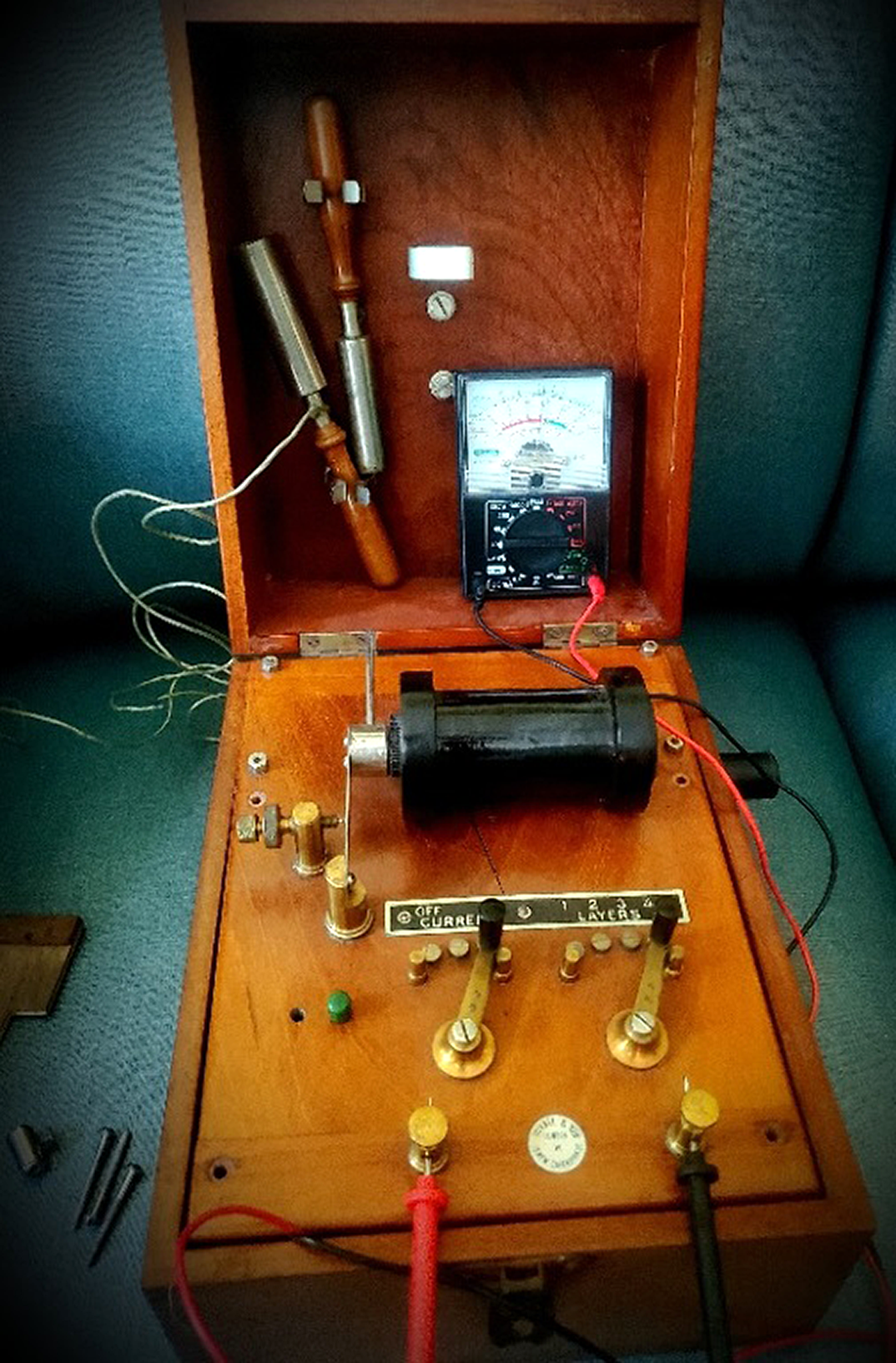
Desperation for cure led to 19th century invention-- electrotherapeutic devices; replete with hyperbolic claims of cure-all, perceived ineffectiveness, and potential harm rendered the modality as quackery but were used in early brain stimulation, melancholia treatment, and cortex mapping. Here, antique devices are restored, and their electrophysiological qualities ascertained.
Objectives
Determine the comparative capabilities of these devices in delivering electrostimulation and compare with modern standards to understand possible electrophysiological sequelae.
Methods
Devices known as “medical batteries” were analyzed. Power delivery utilized a “voltaic battery”, simple circuit, and a conductor wrapped around an iron core. When the circuit is energized, the core is magnetized by direct current of the battery which induces an alternating current that electrifies probes used on the body. Due to their marked age, a common 9-volt battery was exchanged for the corrosive dry cell paste batteries. Electrical parameters were then measured.

Results
Table 1
Device
Frequency (Hz)
Resistance (Ohms)
Max Output (Amps)
Min Output (Amps)
Max Output (Volts)
Min Output (Volts)
Voltampa
2k – 12K
60
0.66
0.33
60V
20V
J.H. Bunnell & Co.’s No. 4 D.D.
7k-10k
50
6
0.4
300V
20V
Schall & Son (London)b
300-1200
40
10.5
2.75
420V
110V
Conclusions
Devices for electrotherapeutics ranged from anemic vibrations to dangerous tetany inducing shocks. Measuring the capabilities of these devices shows the robust yields possible if the original higher capacity batteries were utilized. The reality is, cure or not, the devices were surprisingly potent. It is interesting that, albeit unrefined, efficacious doses were available before modern electrification.
Structured clinical interviews are the gold standard for assessing mental health. However limited resources may allow the use of only self-report questionnaires. In the context of emergency, such as terrorist attacks, the performance and thresholds of such tools still unclear.
Objectives
We investigated the performance of the Posttraumatic stress disorder CheckList Scale (PCL-S) and of the Hospital Anxiety and Depression scale (HADS), both compared to the MINI Interview, among civilians and first responders involved in terrorist attacks.
Methods
The data came from the IMPACTS survey which was conducted from 6-10 months among civilians (N=190) and first responders (N=232) after the January 2015 terrorist attacks in the Paris Region, France. Sensitivity and specificity of the PCL-S and HADS were estimated by the ROC curve, and the optimal threshold was defined using the Youden index.
Results
Regarding the PCL-S: for civilians and first responders respectively, the overall AUC was 0.947 and 0.899, and the optimal threshold were 38.5 and 39.5. Regarding the HADS-D: for civilians and first responders respectively, the overall AUC was 0.908 and 0.617 and the optimal thresholds were 7.5 and 1.5. For the HADS-A for civilians and first responders respectively, the overall AUC was 0.823 and 0.717, the optimal threshold were 9.5 and 6.5.
Conclusions
In the context of a terrorist attack, compared to the MINI, our study underlined satisfactory performance of the PCL-S and the HADS-D in screening for PTSD and depression respectively, while the screening of anxiety using the HADS-A was unsatisfactory.
Clozapine, a unique antipsychotics, is well known for its adverse effects. Myocarditis is a rare but life-threatening complication, however not monitored at a global scale.
Objectives
This work aims to review the literature on clozapine-induced myocarditis.
Methods
Pubmed and Google Scholar search using Mesh terms clozapine, myocarditis, clozapine-induced myocarditis.
Results
Clozapine-induced Myocarditis (CIM) is potentially fatal, with mortality rates environ 21%. According to the World Health Organization Monitoring Program, notification rate is 0,93%, nonetheless incidence found in literature varies dramatically. Highest rates are reported in Australia, where this relationship was first established and a complete monitoring protocol is compulsory in all patients starting clozapine, which causes some authors to defend this condition is generally undernotified. Underlying mechanisms are not fully understood, but an imunomediated hypersensitive reaction occurring in the first 3-4 weeks after treatment is suggested. CIM is rare after 6 weeks. Risk factors include age, cardiac disease, initial high dose, rapid titration and simultaneous valproate or other antipsychotics use. The most common symptoms, fever, tachycardia, dyspnea and malaise, are non-specific and can be indistinguishable from other clozapine benign adverse effects. Analytically, C-reactive protein and Troponine elevation are the most specific diagnostic markers, therefore the most suitable for monitoring. Prompt cardiological observation for further evaluation should be seeked whenever CIM is suspected.
Conclusions
Diagnosis of CIM can be challenging. Systematic monitoring is not consensual but may increase detection, prevent severe outcomes and help clinicians decide whether to keep or suspend therapy. Clozapine is beneficial and shouldn’t be avoided or unjustifiably discontinued.
Common side effects are agranulocytosis and myocardiopathy. There are reports of myocardite related to m-rna vaccine for covid-19 (Pfizer-Bionteck), while the interactions with clozapine has not been yet studied.
Objectives
The object of the study is to explore the safety of COVID-19 vaccination at patients treated with clozapine.
Methods
We report a group of 27 patients from the psychiatric rehabilitation unit of the General Hospital of Corfu who were treated with clozapine and another group of 27 patients on different antipsychotic. Levels of clozapine were measured before the 1st vaccination and one month after the individuals were fully vaccinated, as well their COVID antibodies. For myocarditis detection we used CRP >1mg/dl and quadruplication of the troponin of reference.
Results
No significant difference has been observed among the 2 groups in relation to antibody production, No difference has been detected between clozapine and nor-clozapine serum levels before and after vaccination. While there was no case of myocarditis or vein embolism noticed.
Conclusions
It seems that patients treated with clozapine develop immune response to COVID-19 as individuals in any other anti-psychotic. No major side effects were reported at the two groups leading as to the conclusion that treatment with clozapine sould not be an obstacle for COVID-19 vaccination. Thus to the small number of patients in this study further research is needed.
The COVID-19 pandemic has positioned health professionals around the world in an unprecedented situation, having to work in extreme conditions.
The reactions of healthcare personnel that concern us most are the negative psychological effects of the pandemic, such as exhaustion, moral injury, acute stress reactions, anxiety, depression or post- traumatic stress disorder.
Objectives
To assess the impact of the COVID19 crisis on mental health of Spanish health professionals during the start of the pandemic.
Methods
A descriptive, cross-sectional study is carried out, in which the population sample to be studied was the health professionals who responded to the online questionnaire designed to assess the emotional impact caused by the COVID-19 health crisis.
The questionnaire collects sociodemographic and labor data, which correspond to the independent variables of the study. The dependent variables correspond to the two scales used in the questionnaire (SAS and SASRQ scales)
Results
The population sample was 473 people.
Analyzing the results of the SAS scale, 26.5% of the sample had anxiety symptoms in a normal range, 44.3% had mild-moderate anxiety levels, 24.4% marked-severe anxiety and 4, 9% had extreme anxiety levels.
The SARQ questionnaire assesses the presence of an acute stress disorder. In our study, 31.6% of those surveyed had this type of disorder.
Conclusions
Immediate interventions and support for health professionals are essential to improve psychological resilience and avoid the appearance of mental health problems.
The COVID19 pandemic came with unprecedented measures that impacted every aspect of the student’s life making them vulnerable to psychological distress.
Objectives
The aim of this study was to assess anxiety and depressive symptoms in relation to the coping strategies during the COVID19 pandemic among medical students.
Methods
We conducted a web-based cross-sectional study among Tunisian medical students. We used an anonymous survey comprising sociodemographic characteristics, the Hospital Anxiety and Depression scale and the brief COPE.
Results
A total of 216 students participated in the study; 78% were female and most respondents were enrolled in first and second year of medical studies (53%). The frequency of depressive and anxiety symptoms were respectively 28% and 40%; females experienced significantly higher depression and anxiety scores (p<10¯³ and p=0.02 respectively). Most used coping strategies were self-blame, planning, acceptance, distraction, positive reframing, active coping and religion (99%-96%). The least used coping strategies were substance use (13%) and denial (52%). We found that gender was associated with a significant difference in the coping styles where females scored higher on religious coping and denial whereas males used more humor coping. Depression and anxiety were significantly associated with denial coping. Humor, acceptance, positive reframing and active coping were significantly associated with lower depression rates. Humor coping and active coping were associated with lower anxiety rates.
Conclusions
Our study shows alarming rates of depression and anxiety among Tunisian medical students during the COVID19 pandemic. A targeted intervention to promote mental health using the coping styles might be useful in this population.
Almost 5 million people worldwide have lost their lives due to SARS-CoV-2 (source: WHO coronavirus (COVID-19) dashboard, data of 1.10.2021; https://covid19.who.int/) and therefore, globally, there is an increase of people in grief due to the death of a significant other.
Objectives
To study psychological correlates of grief during the COVID-19 pandemic.
Methods
591 university students, with a mean age of 23.84±7.95 years (range 18-65 years; 76.8% women; 91.2% Portuguese) completed an online questionnaire during the second COVID-19 confinement (from 15.02 to 13.03.2021), with sociodemographic questions, the Pandemic Stress Index, the Mental Health Inventory, Insomnia Scale, questions on physical/ psychological health, and social isolation.
Results
Students bereaving the death of a significant other (n=93, 15.7%; n=25, 26.9% reported cause was SARS-CoV-2; time since death: < 3 months to 1-year), compared to those who did not (n= 498; 84.3%), described poorer psychological health, higher psychological distress (depression, anxiety, lack of control) and sleep difficulties, higher levels of stress (higher impact of COVID pandemic in daily life, and higher behavior changes in response to COVID-19) and more social isolation.
Conclusions
COVID-19 pandemic-related stress is a source of additional stress for bereaved students. Grief is also associated with social isolation, poor mental health (depression, anxiety, lack of control) and sleep difficulties. Screening efforts, guidance, and counseling from professionals of mental health care, primary health care, and universities health care services during and after the COVID-19 pandemic could be extremely beneficial for bereaved students, particularly for those at higher risk of developing prolonged grief disorder.
The COVID-19 crisis has generated an increasing stress throughout the population.
Objectives
To develop and validate the Adherence Scale to the Recommendations for Mental Health during the COVID-19 pandemic from the Portuguese General Directorate of Health (GDH) (ASR-MH-COVID19).
Methods
The items content was based on the GDH guides for the prevention of mental health and psychosocial well-being of the general population during the COVID-19 outbreak. After content and facial validity analysis, the preliminary version of the ASR-MH-COVID19 (8 items to be answered on a Likert scale) was completed by 413 individuals (69.2% female; mean age=31.02±14,272), in September-December 2020 (Sample1) and then by 967 (70.9% female; mean age=34.02±14,272), in February-May 2021 (Sample2). Sample1 was randomly divided in two sub-samples. Sample1A was used for exploratory factor analysis/EFA and Sample1B for confirmatory factor analysis/CFA; CFA was then replicated with Sample2. The online surveys also included the Adherence Scale to the Recommendations of Portuguese GDH to minimize the impact of COVID-19 (ASR-COVID-19; Pereira et al. 2020).
Results
CFAs were informed by EFA and showed that the unidimensional model presented acceptable-good fit indexes (Sample1B: χ2/df=2.747; RMSEA=.0980, p<.001; CFI=.973; TLI=.918, GFI=.972; Sample2: χ2/df=3.327; RMSEA=.0490, p<.001; CFI=.993; TLI=.983, GFI=.990). Cronbach’s alfas were α<.850. Pearson correlations between ASR-MH-COVID19 and ASR-COVID19 were significant (p<.01) and moderate-high for the total (r=.753) and dimensional scores (Distance and respiratory hygiene, r=.739; House and personal hygiene, r=.584; Use of remote services and isolation r=.425).
Conclusions
The new ASR-MH-COVID19 has shown validity and reliability, allowing the investigation of this (mental) health behaviour.
Public health authorities around the world have been disseminating messages to support mental health and psychosocial well-being during the COVID-19 pandemic. Based on the Portuguese guidelines, we have developed the Adherence Scale to the Recommendations for Mental Health during the COVID-19 Pandemic (ASR-MH-COVID19) to better understand this health behaviour.
Objectives
To analyse the relationship between sociodemographics, personality traits, Adherence (to the Recommendations for Mental Health during the COVID-19 Pandemic) and psychological distress.
Methods
413 individuals (69.2% female; mean age=31.02±14,272) completed an on-line survey, in September-December 2020, including sociodemographic questions, ASR-MH-COVID19, NEO-FFI-20 and Depression Anxiety Stress Scale (DASS-21) and Health Perception Scale.
Results
Adherence scores did not significantly differ by gender, age and years of education. Women presented higher DASS and Neuroticism scores (p<.01). Adherence were negatively correlated with Neuroticism (r=-.247) and with Depression/Anxiety/Stress (all r».-200), positively with Openness to Experience (r=.174), Conscientiousness (r=.194) and Perceived Health (Physical, r=.173 and Psychological, r=.215) (all p<.01). Mediation analysis (Hays’ Macro Process - Model 4) revealed that Adherence is a partial mediator between Openness and DASS and Conscientiousness and DASS; when considering Neuroticism, only the direct effect was significant. The effect of Perceived Health (both Physical and Psychological) on DASS was also mediated by Adherence.
Conclusions
The Health Behaviour Model proposes a pathway linking personality and health that applies to these results about adherence and psychological distress during the COVID-19 pandemic. Personality and perceived health (also a trait) influence both adherence to mental health behaviours and psychological distress. Understanding personality is vital for health care providers.
Perceived vulnerability to disease/PVD may influence psychological reactions to COVID-19 pandemic.
Objectives
To analyse the role of PVD in psychological distress/PD during the COVID-19 pandemic, testing whether it is mediated by perceived risk of COVID-19, fear of COVID-19 and repetitive negative thinking/RNT.
Methods
Participants (N=413 adults; 69.2% women) were recruited from September until December 2020, via social networks. They completed the following self-report validated questionnaires: Perceived Vulnerability to Disease Questionnaire/PVDQ; Perceived Risk of COVID-19 Scale, Fear of COVID-19 Scale; Perseverative Thinking Questionnaire and Depression Anxiety and Stress Scale. As women had significantly higher levels of PVD, COVID-19 perceived risk and fear, RNT, and psychological distress/PD, gender was controlled in mediation analysis (using PROCESS macro for SPSS; Hayes 2018).
Results
All the variables significantly (p<.01), moderately (r>.20) and positively correlated. The serial mediation model 6 with the three sequential mediators resulted in significant total effect (c=.326, se=.0791, p<.001, CI:.1702-.4814), non-significant direct effect (c’=.111, se=.065, p=.087, CI:-.0162 to .2380), significant total indirect effect (.2149, se=.065, CI:.1079-.3278); most indirect effects were significant, including the indirect 7 (.0144, se=.0077, CI=.0017-.0320), that goes through all mediators (PVD->COVID19 perceived risk->COVID19 fear->RNT->PD), meaning full mediation.
Conclusions
The effect of PVD on psychological distress operates by increasing the perception of risk and the fear of COVID-19, which intensify related worries and ruminations in times of pandemic. People with high perceived threat, aversion and discomfort in situations associated with increased risk of infection should be helped to decrease dysfunctional cognitive contents and processes in times of pandemic.
Loneliness and social isolation condition the health of those over 65 years of age, increasing morbidity and mortality. The pandemic caused by Covid-19 has been a health emergency in which the negative effects have been increased by loneliness. We can define several types of loneliness: physical loneliness, moral loneliness and social isolation.
Objectives
The objective was to analyze the impact of Covid-19 on the feeling of loneliness in those over 65 years of age during the last year of the pandemic.
Methods
A bibliographic search was carried out in Pubmed with the terms “loneliness in elderly in the covid-19 pandemic” with the filters “abstract” and “in the last 1 year”, selecting the studies whose title included the terms “loneliness”, “elderly” or “older people” and “Covid-19 ” or “SARS-Cov-2”. The search gave rise to 13 results, of which the content of the abstracts was qualitatively analyzed.
Results
All studies found an increase in loneliness in the elderly, and more than 50% reported a decrease in this feeling in the elderly trained in new technologies. Other aspects that stood out to influence were comorbidity, resilience, economic situation, social support and subjective feeling of vulnerability.
Conclusions
Older adults avoid direct social contact to protect themselves. This may result in loneliness, that can have serious consequences in terms of morbidity and mortality. To mitigate loneliness they can use online social media, but older adults need to be trained. Institutions and public powers have the obligation to ensure individual and collective security, and protect the integrity of people from dangers.
The COVID-19 related restrictions such as social distancing forced the search for feasible alternatives to the provision of care for patients with severe mental illness (SMI), with services opting for teletherapy as an substitute of face-to-face treatment.
Objectives
To examine the implementation of teletherapy (telephone, videoconference) with patients with SMI during the COVID-19 first wave, and explore its associations with reduced hospitalisations after the first wave was over.
Methods
We performed a retrospective assessment of 270 records of patients visiting fifteen outpatient mental health services across Spain during 2020. We retrieved sociodemographic and clinical data, including modality of received therapy (in-person, telephone, videoconference) in three time points (before, during and after the first COVID-19 wave) and hospitalisation rates two, four and six months later.
Results
During the first wave, services implemented teletherapy (telephone and videoconference) extensively, whilst they reduced face-to-face therapy, though this returned to previous levels after the first wave. Hospitalisations two months later did not differ between patients who received teletherapy, and those who did not (p=.068). However, hospitalisations were lower for the first group of patients four (p =.004) and six months later (p <.001). Multilevel analyses suggested that receiving teletherapy by videoconference during the first wave was the factor that protected patients most against hospitalisations six months later (OR=0.25; p=.012).
Conclusions
Our findings suggest that teletherapy plays a protective role against hospitalisations, especially when face-to-face therapy is not feasible. Therefore, it can be considered a valid alternative to ensure continuity of care to patients with SMI.
As of August 27th, 2021, the diagnosed cases of COVID 19 in Spain are 4 758 003 with a prevalence of 10.03%. 68.4% of the Spanish population is fully vaccinated
Objectives
Primary: To compare the prevalence of COVID infection in a cohort of patients with schizophrenia to patients with a dual diagnosis of schizophrenia and substance use disorder Secondary: To compare the rate of fully vaccinated patients diagnosed with schizophrenia with and without a coexisting substance use disorder.
Methods
Retrospective descriptive study. The population in study is made up of patients with schizophrenia (46) and dual diagnosis schizophrenia (28) (following DSM 5 criteria) Confirmed cases were those cases with positive PCR
Results
There was not a stadistically significant difference in the prevalence of COVID 19 infection between both groups of patients. The prevalence of COVID infection among the dual diagnosis schizophrenia was 3.57% compared to 6.5% in those without coexisting substance abuse disorder. Relative to vaccination rate, we didn’t find a stadistically significant difference between both groups. However, there was a higher vaccination rate in the dual diagnosis schizophrenia group (82.12%) compared to the non-dual diagnosis schizophrenia group (69.56%)
Conclusions
The prevalence of COVID 19 infection in the dual diagnosis schizophrenia cohort is 3.57% and in the group of patients with schizophrenia without substance abuse disorder is 6,5%. In those with dual diagnosis schizophrenia the vaccination rate was un 82.12%. It was 69.56% in those without coexisting substance abuse disorder.
Due to its relatively high prevalence and recurrent nature, depression causes a major burden on healthcare systems and societies.
Objectives
To investigate healthcare resource utilization and costs associated with treatment-resistant depression (TRD) compared with non-TRD depression in Finland.
Methods
Of all patients aged 16-65 years and diagnosed with depression in Finland during 2004-2016, persons with TRD (N=15 405) were identified from nationwide registers and matched 1:1 with comparison persons with depression but no TRD. TRD was defined as initiation of a third treatment trial after having failed two pharmacological treatment trials. Follow-up period covered five years after TRD or corresponding matching data (until end of 2018). Healthcare resource utilization was studied with negative binomial regression and average excess costs of TRD with generalized estimating equations, by adjusting for baseline costs, comorbidity and baseline severity of depression.
Results
Persons with TRD (mean age 38.7, SD 13.1, 60.0% women) had more healthcare utilization and work disability (sick leaves and disability pensions), adjusted incidence rate ratio for work disability days was 1.72 (95% CI 1.64-1.80). This resulted in higher total costs for persons with TRD, adjusted mean difference 7572 (95% CI 7215-7929) EUR per patient per year, higher productivity losses (due to sick leaves and disability pensions, mean difference 5296, 95% CI 5042-5550) and direct healthcare costs (2002, 95% CI 1853-2151) compared with non-TRD patients. Mean difference was highest during the first year after TRD (total costs difference 11760, 95% CI 11314-12206).
Conclusions
Treatment-resistant depression is associated with a significant cost burden.
Disclosure
This study was funded by Janssen-Cilag Finland and the Finnish Ministry of Social Affairs and Health through the developmental fund for Niuvanniemi Hospital. ML was partly funded by personal grants from the Finnish Medical Foundation and Emil Aaltonen fou
Previous Electronic Health Records (EHR) based studies adopted various definitions in identifying Treatment-Resistant Depression (TRD) patients. There is a lack of similar attempts among Chinese population which limits the understanding of TRD in China.
Objectives
Assess TRD identification using EHR from a major psychiatric hospital in China.
Methods
This study utilized a retrospective Major Depressive Disorder (MDD) cohort of patients who newly initiated pharmaceutical treatment (2010-2018); follow-up was ended upon 1-year or treatment discontinuation (≥120d without treatment). TRD was first identified based on common clinical definition of two prior regimen failures (change of regimen) with 4-week as regimen adequacy threshold (Def1). Alternative adequacy thresholds of 2-week and 6-week were applied. Based on Def1 (4-week), at least 3 distinctive regimens were additionally required in TRD identification (Def2). Further, a data-driven definition (Def3) based on drug count as having ≥3 antidepressants or ≥1 antipsychotic within 1 year was considered (Cepeda et al., 2018).
Results
From 12257 MDD patients included in the cohort, Def1 identified 633 (5.2%) TRD cases, whereas regimen adequacy thresholds of 2-week and 6-week identified 1772 (14.5%) and 61 (0.5%) cases, respectively. Further, Def2 identified 261 (2.4%) TRD cases. Finally, Def3 yielded 2449 (20.0%) TRD cases, including 1966 exclusive cases that were not identified by Def1.
Conclusions
This study showed different definitions for TRD identification had considerable impact on the number of patients identified among Chinese population, obscuring the comparability among EHR-based TRD studies. As first step, we found the criteria of regimen adequacy as major contributor to the observed variability in China.
The tools used to evaluate mental health during pregnancy matter. Their efficacy in identifying symptom severity enables better predictions of postpartum mental health. The Mother & Youth: Research on Neurodevelopment & behaviour (MYRNA) cohort is an NIH funded longitudinal cohort from Sherbrooke, Canada studying the effects of pregnant women’s mental health.
Objectives
We examine which mental health tools will better gauge depression and anxiety during pregnancy based on predicting postpartum outcomes. Our hypothesis is that an approach combining a clinical interview with self-report questionnaires may predict mental health in postpartum women.
Methods
Participants’ mental health is evaluated by the SCID-5-RV, a lifetime interview administered at 30 weeks and monthly questionnaires including PHQ-9 and GAD-7. Participants are in the depression/anxiety group if they either pass all the criteria in the SCID during pregnancy or have an average PHQ-9 or GAD-7 score greater than 7. The Edinburgh Postnatal Depression Scale (EPDS) and the Perceived Stress Scale (PSS) are the outcome variables.
Results
PHQ-9 was correlated with EPDS, r(220)= .38, p< .01, and GAD-7 was correlated with PSS, r(213)= .56, p< .01. SCID results only had a significant effect on PSS, F(3,220)= 3.77, p= .01 and not with EPDS, F(3,219)= 1.08, p= .36. When the self-report measures and interview were combined significant effects were seen for both the EPDS, F(1,222)= 18.71, p< .01 and the PSS, F(1,223)= 34.94, p<.01.
Conclusions
Preliminary results show significant associations between measures administered during pregnancy and postpartum measures. Prediction models based on classification will be analyzed once more data is collected.