We partner with a secure submission system to handle manuscript submissions.
Please note:
You will need an account for the submission system, which is separate to your Cambridge Core account. For login and submission support, please visit the
submission and support pages.
Please review this journal's author instructions, particularly the
preparing your materials
page, before submitting your manuscript.
Click Proceed to submission system to continue to our partner's website.
To save this undefined to your undefined account, please select one or more formats and confirm that you agree to abide by our usage policies. If this is the first time you used this feature, you will be asked to authorise Cambridge Core to connect with your undefined account.
Find out more about saving content to .
To send this article to your Kindle, first ensure no-reply@cambridge.org is added to your Approved Personal Document E-mail List under your Personal Document Settings on the Manage Your Content and Devices page of your Amazon account. Then enter the ‘name’ part of your Kindle email address below. Find out more about sending to your Kindle.
Find out more about saving to your Kindle.
Note you can select to save to either the @free.kindle.com or @kindle.com variations. ‘@free.kindle.com’ emails are free but can only be saved to your device when it is connected to wi-fi. ‘@kindle.com’ emails can be delivered even when you are not connected to wi-fi, but note that service fees apply.
Anti-N-methyl-D-aspartate receptor (anti-NMDAR) encephalitis is an autoimmune limbic encephalitis, where psychiatric symptoms are often the initial presentation dominant initially. These patients are mainly admitted to psychiatric wards, due to first episode psychosis (FEP).
Objectives
Multiple studies analysed whether anti-NMDAR antibodies were present in the sera of schizophrenic patients, but results have not verified this hypothesis. It is possible, however, that unknown autoimmune antibodies play a role in FEP, similarly to anti-NMDAR antibodies.
Methods
40 patients with FEP and 30 healthy controls have been recruited to the study. Patients with affective psychosis, drug-related psychosis and patients with diagnosed encephalitis were excluded. The sera were tested with immune fluorescent assays for anti-NMDAR antibodies. A non-specific method was used to test anti-brain antibody activity on monkey-cerebellum and rat-hippocampus slices.
Results
Neither the samples from the 40 patients, nor the samples of healthy controls contained anti-NMDAR antibodies. 14 of the patients’ and only 6 of the healthy controls’ serum showed positive reaction of the neuroendothelium. These results suggest that there is a difference between the groups, although the results are not significant.
Conclusions
None of the 40 patients proved positive for anti-NMDAR antibodies in agreement with previous studies. However, a higher proportion of samples from the FEP group showed activity in the neuroendothelium of non-specific immune fluorescent assays compared to healthy controls. Based on literature and on our experience, it is possible, that unknown autoimmune antibodies play role in FEP.
In schizophrenia, abnormal synaptic pruning during adolescence may be due to an altered Complement system activity. While this hypothesis is supported by C4 overexpression in various brain regions of individuals with schizophrenia, such alterations should be replicated and extended to other brain regions relevant to schizophrenia. Moreover, transcriptional studies of genes coding for proteins regulating the Complement system activity are lacking. Furthermore, it remains unknown whether cerebral and peripheral expression of C4 and Complement control proteins (CCP) are related.
Objectives
To identify altered expression of C4 and CCP (CSMD1, CSMD2, CD46) coding genes at the cerebral and peripheral levels in schizophrenic individuals.
Methods
We explored C4 and CCP coding genes expression at the cerebral and peripheral levels. Using shinyGEO application we analyzed gene expression from eight Gene Expression Omnibus datasets obtained from 196 schizophrenic individuals and 182 control subjects. First, we compared gene expression between schizophrenic patients and controls in postmortem cerebral samples from 7 different brain regions. Then, we compared gene expression between schizophrenic patients and controls in 4 peripheral tissues.
Results
We observed C4 overexpression in the DLPFC, parietal, temporal cortex and associative striatum of schizophrenic individuals. We report altered transcriptional patterns of CCP genes in the DLPFC, hippocampus and cerebellum of schizophrenic individuals. CD46 expression was altered in opposite directions between brain and blood of schizophrenic individuals. No significant alteration of C4 expression was observed in peripheral tissues.
Conclusions
Our results support the hypothesis of an altered Complement system activity in various brain regions of schizophrenic individuals which may disrupt the synaptic pruning process during adolescence.
Research in recent decades focuses on understanding the role of the immune system in First-Episode Psychosis (FEP) at a young age. Our studies indicate that different stages of schizophrenia differ in the spectrum of inflammation markers. These indicators reflect the activity of the pathological process, using them as markers of the clinical state of patients at different stages of the disease.
Objectives
To assess the relationship of immune markers with the clinical features of remission in patients after FEP.
Methods
Fifty patients aged 15-25 years with post-psychotic depression (PD) after FEP (F20, F25) and 30 healthy men were included in the study. The follow-up period was two years. PD typological variants with positive affectivity (PA) (n=30) and negative affectivity (NA) (n=20) were distinguished. Leukocyte elastase (LE), a1-proteinase inhibitor (a1-PI) activity, and S-100B autoantibodies in plasma samples were measured.
Results
The increase of LE and a1-PI activity in plasma of both types of PD patients compared to controls was detected (p<0.01). There was the highest LE activity and S-100B autoantibodies in PD with NA (p<0.05). The different dynamics of immune markers in both groups were correlated to the clinical features of remission. PD with PA was associated with a decrease in inflammatory markers (p<0.05) and a favorable prognosis. PD patients with NA had a further increase in LE activity and S-100B autoantibodies (p<0.01), and an unfavorable prognosis.
Conclusions
The results confirm using the immune indicators as markers to assess the quality of remission after FEP in young adult age and the risk of recurrent psychotic attacks.
The mild encephalitis hypothesis(ME) ( Bechter 2001, NPBR; updated Bechter 2013,Progr NP&BP) proposed that mild neuroinflammation triggered by infections, autoimmunity, trauma or toxicity (including from stress) might causally underly a spectrum of severe mental disorders (SMDs), especially disorders of the schizophrenic and affective spectrum.
Objectives
The development from ME hypothesis to the new diagnoses of Autoimmune Psychosis (AP) and a subgroup of Autoimmune Encephalitis (AE) and beyond into future research is reviewed and discussed.
Methods
Expert review
Results
The subgroup of AE with exclusive or predominant psychiatric symptoms ( compare Graus et al 2016) and all cases of AP ( Pollak et al,Lancet Psychiatry 2020) match the previous poposed ME criteria. AE and AP can now successfully be treated in majority of cases by immune modulatory treatments. These new insights challenge both, the implementation of diagnosis and treatment into clinical reality and forthcoming research on the causality underlying severe mental disorders (SMDs). CSF studies showed in 50-70% of therapy resistant cases of affective and schizophrenic spectrum disorders some abnormalities compatible with mild neuroinflammation ( Bechter et al 2010, J Psych Res), recently confirmed in large patient samples from various university hospitals in Germany ( Endres et al 2018 aso., Rattay et al 2021, aso.).Also post mortem findings are compatible with ME hypothesis in a larger subgroup of SMDs. Open questions of new clinical categorization by refined grading of mild neuroinfalmmation by improved diagnostic methods appear increasingly required, which will be discussed ( Bechter Frontiers Psychiatry 2020).
Conclusions
Mild neuroinflammation appears causally involved in SMD
Methamphetamine associated psychosis has increased globally because of the increased usage of the substance. The use of risperidone is noted to reduce the cravings of methamphetamine in patients who have methamphetamine use disorder. This becomes relevant because the number of patients who are being treated with MAP tends to have high relapse rates. MAP is being treated with different antipsychotics and the treatment protocol is made usually for alleviating the symptoms, a formal treatment regimen for patients with MAP is yet to be developed (Chiang et al 2018; Srisurapanont 2021; Edwards and Mooney 2014)
Objectives
The purpose of this review is to highlight the use of risperidone in reducing the cravings of methamphetamine in patients who have methamphetamine use disorder
Methods
PubMed, SCOPUS and Web of Science literature databases were screened and filtered.With established Inclusion and exclusion criteria, obtained a total of 15578 hits which was refined to 133articles. A total of 10papers were reviewed in detail
Results
Multiple clinical trials have shown that risperidone was effective in lowering drug cravings in methamphetamine use disorder. Along with the effects on craving, risperidone has also been studied for its effect on positive symptoms in patients with MAP (Samei 2016). Risperidone was noted to be effective in reducing positive symptoms.
Conclusions
Risperidone can be effectively used in the acute setting for psychosis and future cravings in the patients. Considering the limited clinical trials and research on risperidone and the cravings of methamphetamine use disorder, studies are needed with longer follow-ups and more samples in the future.
With the advancement of technology over the last years, gaming is no longer reserved to adolescents. It has become a growing phenomenon within young adults which should,’t be overlooked as it is accompanied with the risk of addiction.
Objectives
To study the factors involved in video games addiction behaviors in adults
Methods
We conducted a cross-sectional, descriptive and analytical study. Data were collected using a self-administered questionnaire on social networks. We solicited adults between 18–40 years. We used the gaming addiction scale (GAS) in its validated Arabic short version.
Results
A hundred and nine participants were included. The mean age was 29.6 ±10.3 with a sex ratio of 1.5.The mean age of the beginning of regular gaming was 16.3± 8.64. we found that40.4% of our participants preferred the mode Massively Multiplayer Online Role Playing Games (MMORPG) while others played casual single player games. A play time of over 20 hours per week was reported by 11.9%of participants. According to the GAS, 25.7%were addicted gamers. Our participants spent an average of 7.94±6.71 hours before they play their first game of the day. We found that the score of Gas was significantly correlated to the male gender of the participants (p<0.000), a higher number of weekly gaming hours (p<0.000),a lower number of hours before gaming (P<0.000) and the mode of games (p<0.000).
Conclusions
Our study showed that contextual factors play an important role in understanding gaming addiction in young adults as a holistic phenomenon,embedding the problematic behavior within the context of the individual the game and gaming practices.
Gambling disorder (GD) is characterized by repeated problematic gambling behavior associated with unsuccessful and uncontrollable urges to keep gambling, which leads to considerable distress and impairment. Several types of interventions exist to treat GD, with cognitive behavior therapy (CBT) being one of the most widely used approaches.
Objectives
To estimate trajectories of the gambling disorder (GD) severity for 12 months following a manualized cognitive-behavior-therapy (CBT) program, and to identify the main variables associated with each trajectory.
Methods
Latent Class Growth Analysis examined the longitudinal changes of n = 603 treatment-seeking patients with GD.
Results
Five separate empirical trajectories were identified: T1 (n = 383, 63.5%) was characterized by the most highest baseline gambling severity levels and positive progress to recovery during the follow-up period; T2 (n = 154, 25.5%) featured participants with high baseline gambling severity and good progress to recovery; T3 (n = 30, 5.0%) was made up of patients with high gambling baseline severity and slow progress to recovery; T4 (n = 13, 2.2%) and T5 (n = 23, 3.8%) contained participants with high baseline gambling severity and moderate (T4) and poor (T5) progress in GD severity during the follow-up. Psychopathology, personality traits, poor compliance and relapses discriminated between trajectories.
Conclusions
These results show that treatment seeking patients with GD are heterogeneous. In addition, the obtained findings could be useful in the design of more efficient interventions for this behavioral addiction. Funding oftained from RTI2018-101837B-I00
Although smoking prevalence has been decreasing worldwide, sustained tobacco cessation remains a challenging goal for many smokers. Nicotine replacement therapy (NRT) products remain among the most widespread type of cessation tobacco aids, along with the more recently introduced electronic cigarette, the efficiency of which is still a matter of debate in the public health community.
Objectives
This study aims to contribute to the ongoing discussion about effective ways of encouraging tobacco cessation and in particular evaluating the role of the two aforementioned tobacco cessation aids with regard to lasting smoking abstinence in real-life settings.
Methods
The study is based on the French 2017 Health Barometer, a cross-sectional survey conducted by Santé Publique France. Two distinct outcomes related to tobacco cessation were used: smoking status at 6 months follow-up (yes vs. no) and the duration of smoking abstinence. These two study outcomes were examined respectively among N1 = 2783 and N2 = 1824 participants. All results were weighted based on inclusion probability weights and controlled for propensity scores via overlap weighting (OW), which is appropriate when exposure groups are disparate.
Results
After adjusting on potential confounders, tobacco cessation at 6 months remains significantly associated with e-cigarette use (OR: 1.50 (1.12-1.99)) and e-cigarette use combined with NRT (OR:1.88 (1.15-3.07)). This association did not reach statistical significance in the long-term analysis, nor did the results of NRT use alone in both analyses.
Conclusions
Overall, while electronic cigarette use alone and combined with NRT is associated with an increase in the likelihood of smoking cessation, the long-term effects are probably limited.
Depression is a common psychiatric disorder and chronic stress is considered its main environmental risk factor. Recently, immune processes including adenosine triphosphate mediated P2X7 receptor (P2X7R) signalling via microglia and macrophages (M/Ms) were found to play a critical role in depression genesis, by linking environmental stress to depression biology and symptoms.
Objectives
To characterize the role of human P2X7R (hP2X7R) in psychosocial and immune stress conditions, both in vitro and in vivo.
Methods
Several, custom designed mouse lines expressing the loxP-flanked, hP2X7R-sequence in the murine P2X7R locus were established. In addition, these mice possess a Cre-sensitive reporter and express a Cre recombinase fused to a mutant estrogen receptor ligand-binding domain in M/Ms. This enables conditional, tamoxifen-inducible hP2X7R inactivation and simultaneous tdTomato expression. First, we established primary microglia cell cultures and characterized them at baseline and following immune stimulation. Next, we performed behavioural assessment of hP2X7Rwt and microglia-specific hP2X7RKO mice following chronic psychosocial stress. Last, we developed a novel in vivo two-photon microscopy (TPM) approach by use of frontolimbic cranial windows.
Results
Primary hP2X7RKO microglia displayed significantly lower IL-1β production, increased survival and decreased morphological activation upon immune stimulation. Although hP2X7RKO mice showed a significant increase of locomotor activity at baseline, there was no impact on anxiety- and depressive-like phenotypes. Longitudinal in vivo TPM enabled morphometric characterization of cortical M/Ms over several weeks.
Conclusions
Our results illustrate the great potential of this humanized mouse line for translational psychiatry. In the future, this system could proof useful to evaluate immunomodulatory approaches in chronic stress and depression.
Drug poisonings is a continuous public health problem in Russia and worldwide.
Objectives
The objective of the study was to provide characteristics of lethal drug poisonings in a northern Russian region.
Methods
The data on deaths from drug poisoning that occurred between 2018 and September 2021, systematically collected by the Regional Center on the Organization of the Narcological and Psychiatric service of the Khanty-Mansi Autonomous Okrug of Russia, was analyzed.
Results
Among 220 cases of fatal drug poisoning the overwhelming majority (90.4%) occurred among males. The number of cases increased annually from 27 in 2018 to 71 in 2020. The average age of death increased from 33.6 years in 2018 to 38.2 years in 2021. Over two thirds of deceased (70.9%) had complete secondary or vocational secondary level of education, almost one third (30.0%) were skilled workers, and slightly less than half (44.1%) were unemployed. The most common causes of death were methadone poisoning (34.5%), poisoning with other opioids (21.8%), other synthetic drugs (17.3%), other unspecified drugs (11.8%), and psychostimulants (10.0%). Alcohol intoxication was identified as a concomitant cause of death in every fourth case (26.0%), of which 98% were among males. Most often, alcohol was present in the blood at a concentration of 120 mg/ml and above. Every fourth deceased (23.6%) was registered with narcology health service for drug addiction.
Conclusions
Fatal poisonings with narcotic drugs and psychotropic substances is a growing public health problem in a northern industrial region of Russia, which affects predominantly working-age males and requires comprehensive multisectoral response.
Recent studies in the word found an increase of substance use among medical students.
Objectives
To determine the prevalence of substance use and associated factors among medical residents in Tunisia.
Methods
It was a descriptive and analytical cross-sectional study among medical residents from the 4 medical faculties of Tunisia. A questionnaire was created from Google Forms and was published on the social network Facebook. We asked about the current consumption of different psychoactive substances. We used the Patient Health Questionnaire (PHQ-9) to identify depressive symptoms.
Results
The sample included 241 residents. The female sex was predominant (83.4%, n = 201). The average age was 28.18 (± 2.13) years. Among these residents, 27.8% (n = 67) currently consume at least one psychoactive substance and 71% (n = 171) had depressive symptoms. The substances consumed by residents were: tobacco 18.7% (n = 45), alcohol 18.7% (n = 45), cannabis 6.2% (n = 15) , amphetamine 3.3% (n = 8), sleeping pills (without medical prescription) 2.9% (n = 7), hallucinogens 2.9% (n = 7), cocaine 2.1 % (n = 5) and inhaled solvents 0.4% (n = 1).
The use of at least one psychoactive substance was significantly associated with male sex (p = 0.01), the presence of financial problems (p = 0.08), lack of religiosity (p <0.001), feeling of life dissatisfaction (p = 0.01), uncertainty about life events (p = 0.05) and the presence of depression (p = 0.018).
Conclusions
Psychoactive substance use has become a growing problem among residents in Tunisia. The associated factors should attract attention to identify these subjects.
Youth ontogenesis contributes significantly to depressive disorders, causing pronounced atypia, a high level of comorbid pathology. A long-term depressive state lead can to persistent, adverse consequences.
Objectives
To study the clinical, psychopathological and psychometric features of youth chronic endogenous depression (UCED).
Methods
62 patients of the age 16-25 were examined clinically and psychopathologically; the patients were first hospitalized from 2017 to 2020 for a chronic depressive state with non-psychotic mental disorders (ICD-10: F31, F32, F33, F34, F21 keys) lasting more than two years. Psychometric assessment was done by HDRS, SOPS, and SANS.
Results
UCED are characterized by a pronounced atypia with a predominance of symptoms for negative affectivity with apathy, anhedonia, physical and mental asthenia, depressive devitalization. In contrast with non-chronic youth depressions, cognitive disorders, motor inhibition, a large proportion of comorbid pathology are presented in the chronic ones. Depending on the prevalence of additional psychopathological disorders, 2 types were distinguished: Type I – depression with a clear-cut affective psychopathological structure (54.8%, 34 patients); Type II - depression with the symptoms of other than affective registers (45.2%, 28 patients). Psychometric assessment on the HDRS scale, in the sub-scale “negative symptoms” of the SOPS scale, in the sub-scale “anhedonia-associality” of the SANS scale showed a greater severity of psychopathological symptoms in type II depression (p<0.05).
Conclusions
The obtained data confirm the differences between UCED and non-chronic youth depressions and demonstrate the aggravating effect of symptoms of the non-affective spectrum on the severity of UCED and the level of negative affectivity.
Treatment-Resistant Depression continues to represent a great challenge for clinicians.
Objectives
We investigated patients with history of resistance, assessing prognostic factors, response to treatments, and remission over time.
Methods
We recruited 202 unipolar and bipolar depressed inpatients. According to anamnestic backgrounds, patients were assigned to: A) Non-resistant: responders, with no characteristics of resistance in the current episode. B) Resistant: resistant to two antidepressant trials of adequate doses and duration. C) Pseudo-resistant: non-responders, not classifiable as Resistant because of inadequate trials. During hospitalization, patients were treated by clinical judgment, following a rehabilitation program.
Results
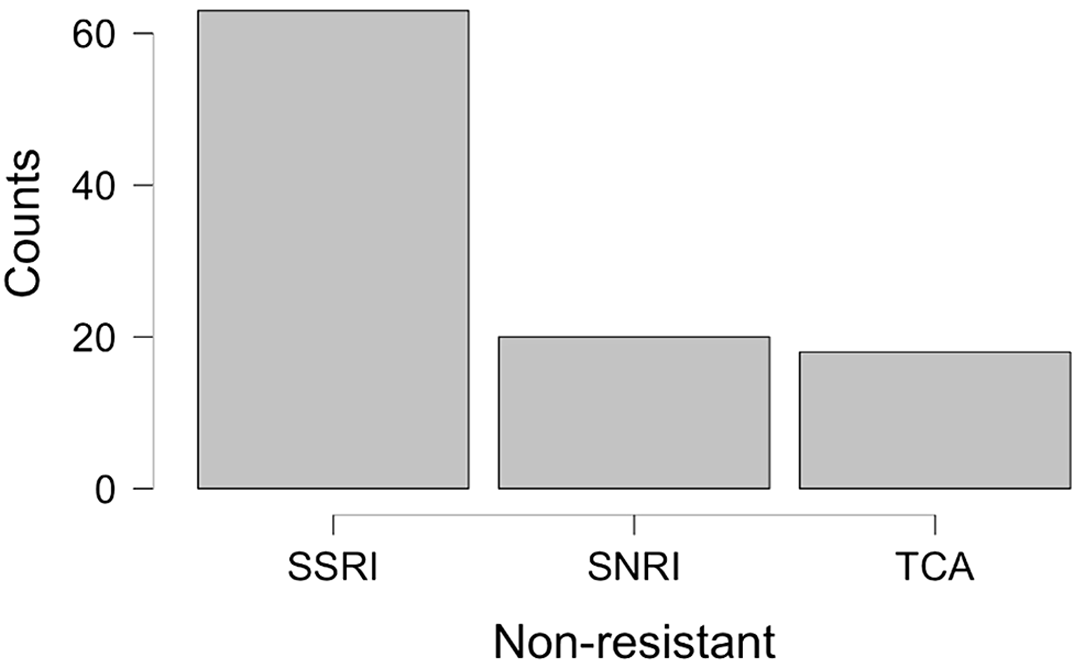
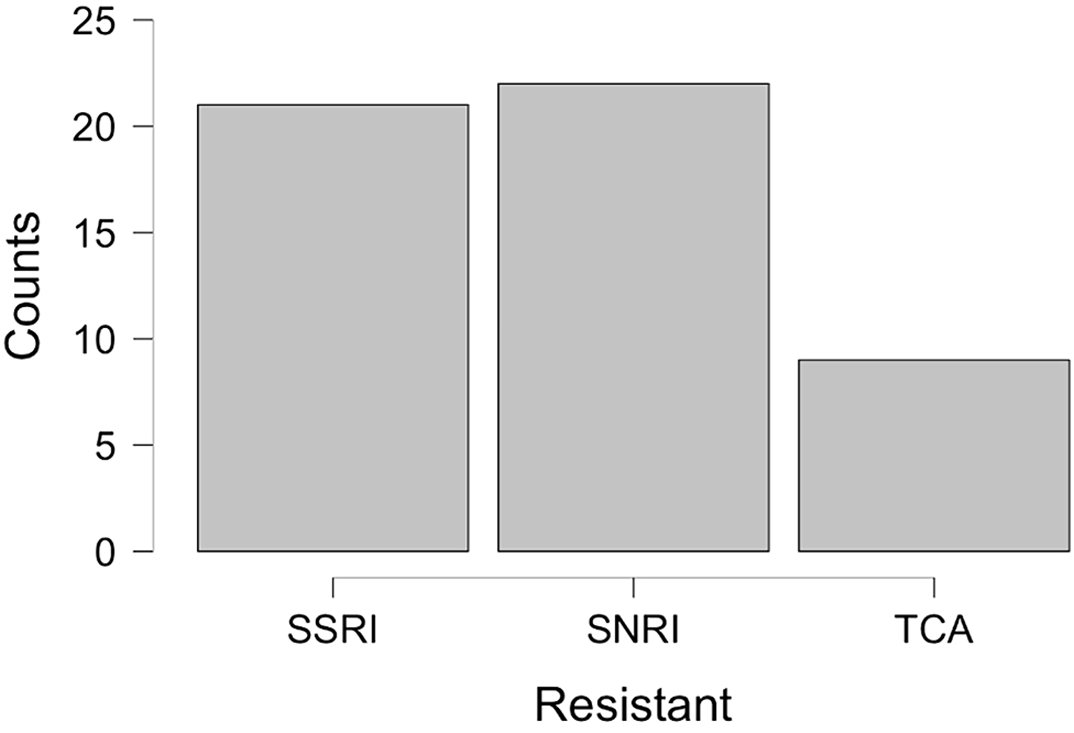
Table 1
Non-resistant (111)
Resistant (54)
Pseudo-resistant (35)
p-value
Age
59.1±11.9
63.0±12.6
57.0±11.3
0.036*
Episodes of illness
3.8±2.1
4.0±1.9
3.0±1.8
0.036*
Personality disorders
27.0%
18.9%
48.6%
0.009**
Therapies:
0.014**
SSRI
62.4%
40.4%
69.7%
SNRI
19.8%
42.3%
15.1%
TCA
17.8%
17.3%
15.1%
Augmentation
24.3%
38.9%
17.1%
0.05**
Remission
76.5%
59.5%
81.2%
CvsB:0.045** CvsA:0.587**
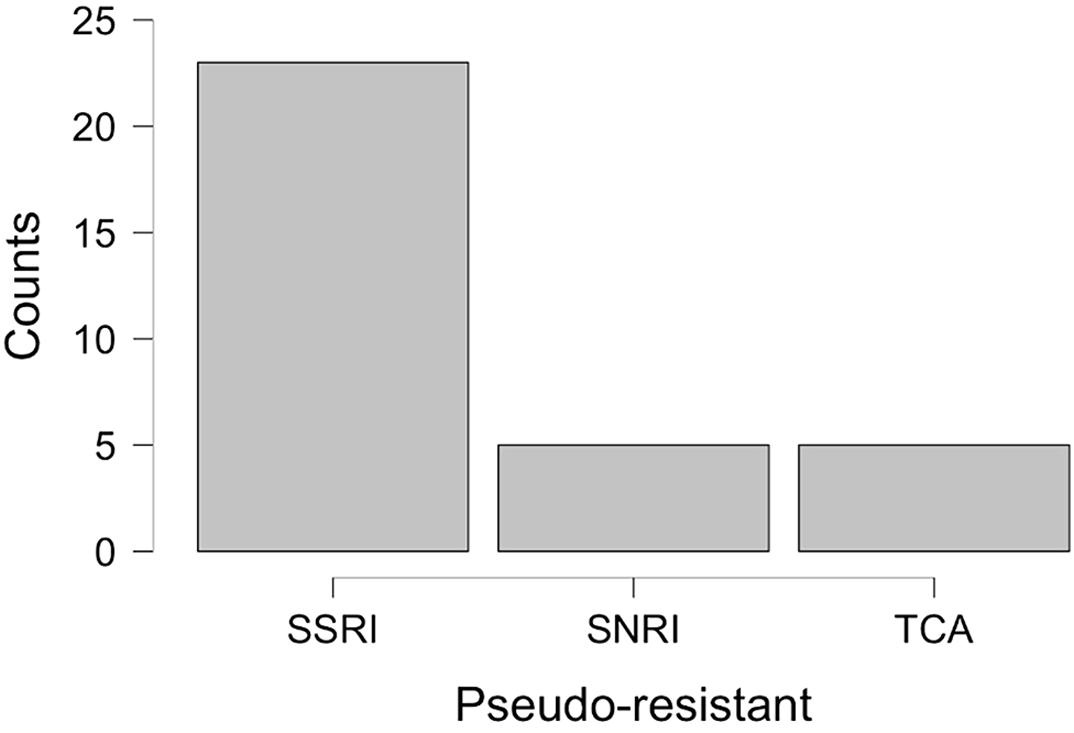
On the day of admission, non-responders were 44.5% of the sample, but 39.3% of them did not meet the Resistant criteria, defining the Pseudo-resistant group. Pseudo-resistant differed from others by younger age, fewer illness episodes, higher rate of personality disorders, and different therapies during hospitalization [Fig.1,2,3]. Pseudo-resistant remission rate, significantly greater than Resistant one, was comparable to Non-resistant [Tab.1]. *Kruskal-Wallis Test **Chi-Squared Test
Conclusions
This study outlines a new group of depressed patients that, apparently drug-resistant, displays the same outcome as responders when treated with first-line drugs during hospitalization, certainly taking benefit from the psychoeducational program. Quick recognition of these patients could be crucial to giving optimal care.
The period after delivery is characterised by physical, hormonal and psychological changes. Up to 20% of women can present depressive and anxiety symptoms and difficulties in the interaction with the newborn, emotional lability. This condition is also called “Maternity Blues (MB)”.
Objectives
To: 1) assess the frequency of MB presentation of depressive symptoms immediately after the delivery; 2) identify those characteristics more frequently associated to the onset of depressive symptoms after the delivery; and 3) verify the hypothesis that the presence of maternity blues is a risk factor for the onset of a depressive episode in the 12 months after the delivery.
Methods
From December 2019 to February 2021 all women who gave birth at the University of Campania “Vanvitelli” were enrolled. Upon acceptance, they filled in the EPDS Scale. Sociodemographic, gynaecological, peripartum and psychiatric anamnesis was collected at baseline. Women have been reassessed after 1, 3, 6 and 12 months.
Results
359 women were recruited, with a mean EPDS score of 5.51. Among these, 83 reported the presence of MB (EPDS score≥10; 23.12%). Anxiety disorders with onset prior to pregnancy (p<.000), preeclampsia (p<.01), increased foetal health rate (p<.01), conflicts with relatives (p<.001) and anxiety disorders the partner (p<.01) emerged as predictors of Mb. The presence of MB increase 7 time the risk to have higher EPDS score at follow-up assessments (p<.000).
Conclusions
The presence of MB should always be assessed in the immediate post-partum and psychosocial interventions should be provided to women with MB to reduce its potential negative effect on mental health.
Despite the huge progression in depression treatment, many individuals do not achieve full recovery. Studies demonstrated alternatives from neurotransmitter targets which are promising to predict and manage illness.
Objectives
This study aimed to select metabolic factors linked to the severity of depression symptoms.
Methods
66 patients (36% males) with episode of depression from part of SANGUT study were assessed for laboratory biomarkers (insulin, glucose, ALT, AST, lipid profile, cortisol, hs-CRP), anthropometric measurements (BMI, body composition, WHR ratio) and severity of subjective depressive (BDI scale) and stress (PSS-10 scale) symptoms.
Results
Maximum accuracy for differentiating mood symptoms was achieved by the combination of triglycerides (cut-off point > 101 mg/dl) and HDL cholesterol (cut-off point <=48 mg/dl). For differentiating stress symptoms the combination of cholesterol LDL (cut-off point > 108.35 mg/dl) and hs-CRP (cut-off point <=1.55 mg/dl) were most accurate. In the regression analysis model, total; LDL and HDL cholesterol, adjusting for HOMA-ir, cortisol, hs-CRP, triglycerides, age and body fat content were independently related to mood symptoms severity and explain 23.4% variability. Stress symptoms were related to cortisol, hs-CRP levels and WHR ratio adjusted for age, duration of illness, LDL cholesterol, and body fat content. The following model explains 19% variability of symptoms severity.
Conclusions
In patients with mood disorders, more attention should be paid to metabolic changes, predicting intensified depression traits. The results indicate lifestyle changes as an available to all patients tool for depression management.
The study of psychopathic traits has increased in recent years, given the impact that these traits have on our society.
Objectives
This study aimed to evaluate the relationship between psychopathy traits and ability emotional intelligence by examining the sub-dimensions of both constructs in a sample of incarcerated males.
Methods
A total of sixty-three incarcerated adult males (Mage = 37.51) were assessed for psychopathy traits and emotional intelligence levels through the 34-item Self-Report Psychopathy Scale-III (SRP-III) and the Mayer-Salovey-Caruso Emotional Intelligence Test (MSCEIT) respectively.
Results
The results revealed that the incarcerated population is characterized by low EI and high psychopathic traits (explained by the scores obtained on the criminal tendencies sub-dimension). Moreover, participants scoring lower in ability EI were more likely to score higher on the callous affect sub-dimension of psychopathy. We also observed an indirect negative effect of ability EI on erratic lifestyle, criminal tendencies and interpersonal manipulation sub-dimensions through the mediating role of callous affect.
Conclusions
These findings offer a better understanding of the relationship between psychopathy traits and ability emotional intelligence and provide empirical support for the need to implement intervention programs in penitentiary centers based on EI training, which could help to reduce antisocial and disruptive behaviours and facilitate future reintegration into society.
Findings from previous studies have implicated various forms of emotion dysregulation (EDys), including difficulties in emotion regulation, as important for the development and maintenance of borderline personality disorder (BPD). In addition, comorbid anxiety and depressive psychopathology has been found to contribute to the severity of BPD symptoms in this disorder.
Objectives
This study aimed at extending extant research on the above issues by testing the mediational role of comorbid psychopathology (i.e., trait anxiety and depressive symptoms) in the relationship between EDys (specifically, difficulties in emotion regulation) and BPD symptoms in BPD patients.
Methods
64 BPD female inpatients completed the Emotion Dysregulation Scale, STAI, CESD–R, and BPD Checklist.
Results
BPD symptoms were statistically significantly and strongly positively associated to EDys (rs = .55, p < .001) and to trait anxiety (rs = .52, p < .001). EDys and trait anxiety predicted the severity of BPD symptoms, R2 = 0.41, F(2, 61) = 20.90, p < .001. The examination of the indirect effect revealed a significant mediation, in which the association between EDys and BPD symptoms was mediated by trait-anxiety, B = 0.37, SE = 0.18, 95% CI = [0.10, 0.78]. However, the direct effect of EDys on BPD symptoms remained significant, B = 0.81, SE = 0.24, 95% CI = [0.32, 1.30].
Conclusions
The severity of BPD symptoms is associated with EDys and with trait anxiety. Moreover, our findings show that the latter partially mediates the link between EDys and BPD symptoms, which suggests that trait anxiety may contribute to the severity of BPD symptoms.
Personality disorders (PD) in adolescence are widespread. It creates problems of social adaptation of patients and represents significant risk factors for auto-aggressive behavior, including suicidal one. The neurobiological basis and EEG markers of PD in adolescence have not been adequately studied.
Objectives
The aim of the study was to reveal the EEG features and their correlations with clinical parameters in male adolescents with borderline personality disorder (BPD) and narcissistic personality disorder (NPD), possibly mediating some aspects of their clinical traits.
Methods
28 BPD patients (301.83, by DSM-5) and 24 NPD patients (301.81, by DSM-5), as well as 24 healthy controls (HC) aged 16-25 years were enrolled in the study. HDRS-21 and HAM-A scales were used for quantitative assessment of patient’s conditions. Pre-treatment resting EEG was recorded, and EEG spectral analysis was carried out in 8 narrow frequency sub-bands. Descriptive statistics and correlation analysis of EEG and clinical data were performed.
Results
EEG spectral parameters in BPD group did not differ significantly from those of HC. NPD group shows the EEG signs of more activated brain cortex than in both BPD and norm groups caused by decreased functional state of the anterior cortical regions. The structure of correlations between EEG parameters and clinical scores also differed between BPD and NPD groups.
Conclusions
The data obtained suggests that these features of the brain activity may contribute to the disturbance of emotion regulation and of behavior control in adolescent patients with BPD and NPD, more pronounced in NPD group.
Mental health professionals’ derogatory attitudes towards patients diagnosed with borderline personality disorder (BPD) may negatively affect treatment outcomes.
Objectives
We aimed to identify a) negative attitudes exhibited by mental health professionals towards BPD patients and b) the effects of disgust propensity and disgust sensitivity on theses negative attitudes.
Methods
Mental health professionals (N = 136) completed questionnaires on attitudes towards BPD patients, disgust propensity/sensitivity, and sociodemographic variables.
Results
Significant differences in negative attitudes toward BPD patients based on gender, marital status, occupational subgroup, educational level, psychotherapy training, level of exposure to BPD patients, and political ideology were found. Results suggested BPD patients are viewed by mental health professionals as ineffective, incomprehensible, dangerous, unworthy, immoral, undesirable to be with, and dissimilar to the mental health professionals. Moreover, disgust propensity and the pathogen component of disgust sensitivity were associated with stronger negative attitudes towards BPD patients.
Conclusions
The findings emphasize the importance of mental health professionals’ awareness of the emotion of disgust as a relevant factor to their negative attitudes towards BPD patients.
Traditional categorical classifications of personality disorders (PD) have been criticized for insufficient structural and cross-cultural validity. In the DSM-5 Section III, alternative model of the PDs (AMPD), the maladaptive personality traits are divided into five domains: negative affect, detachment, antagonism, disinhibition and psychoticism. The Personality Inventory for DSM-5 Brief Form (PID-5-BF) is a 25-item self-report questionnaire that measures the severity of each of these five domains. To date, no questionnaires assessing pathological personality traits following the AMPD have been validated in Russia.
Objectives
This study aimed to investigate the factor structure of the Russian version of PID-5-BF.
Methods
Five hundred and 86 (female - 505 (86,2%), age - 18–77 years (M - 28.2, SD - 11.5)) consecutive inpatients with non-psychotic mental disorders were assessed with the Russian language version of the PID-5-BF. Exploratory structural equation modelling (ESEM) with Robust Diagonally Weighted Least Squares method of extraction and Robust Equamax rotation was performed in Factor v 11.04.02.
Results
The results of the ESEM analysis showed good fit of the five-factor model (CFI - 0.982; TLI - 0.971; RMSEA (95% CI) - 0.036 (0.01-0.05). Most of the items had the highest factor loadings on their mother domains. However, two items showed weak loadings on their designated factors (<0.4), and attention seeking item had a primary load to (low) detachment instead of antagonism.
Conclusions
The PID-5-BF was found to be a valid and reliable tool for the evaluation of the AMPD trait domain