We partner with a secure submission system to handle manuscript submissions.
Please note:
You will need an account for the submission system, which is separate to your Cambridge Core account. For login and submission support, please visit the
submission and support pages.
Please review this journal's author instructions, particularly the
preparing your materials
page, before submitting your manuscript.
Click Proceed to submission system to continue to our partner's website.
To save this undefined to your undefined account, please select one or more formats and confirm that you agree to abide by our usage policies. If this is the first time you used this feature, you will be asked to authorise Cambridge Core to connect with your undefined account.
Find out more about saving content to .
To send this article to your Kindle, first ensure no-reply@cambridge.org is added to your Approved Personal Document E-mail List under your Personal Document Settings on the Manage Your Content and Devices page of your Amazon account. Then enter the ‘name’ part of your Kindle email address below. Find out more about sending to your Kindle.
Find out more about saving to your Kindle.
Note you can select to save to either the @free.kindle.com or @kindle.com variations. ‘@free.kindle.com’ emails are free but can only be saved to your device when it is connected to wi-fi. ‘@kindle.com’ emails can be delivered even when you are not connected to wi-fi, but note that service fees apply.
Topic: EPW26 – e-Poster Walk Session 26: Depression part 2
Article: 0723
Introduction
Subanesthetic dose of ketamine was repeatedly shown to improve depressive symptoms with a short latency of 24 hours.
Objective
We aimed to test if clinical time course of improvement is indeed mirrored by increased glutamine/glutamate ratio and if such effects would show a regional and temporal specificity in two anatomically and functionally distinct subdivisions of ACC.
Method
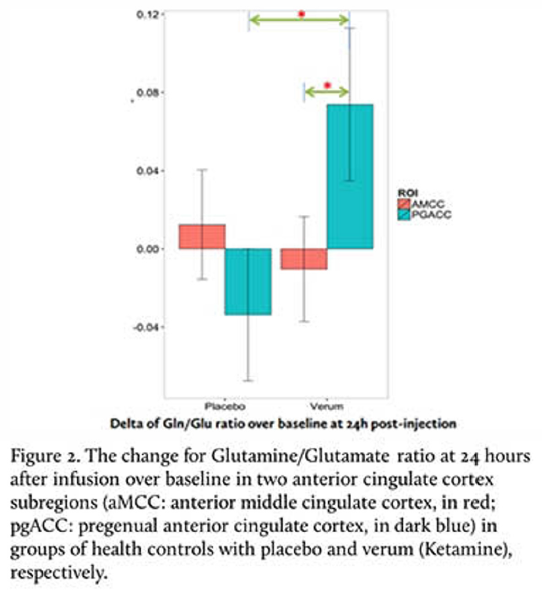
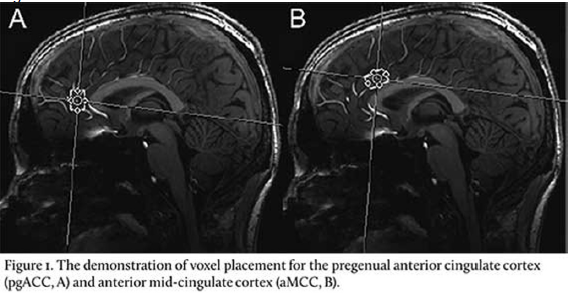
We used a glutamine sensitive magnetic resonance spectroscopy protocol at 7 Tesla to compare the longitudinal changes of glutamine/glutamate after 1 hour and 24 hours in pregenual ACC (pgACC, Figure 1A) and anterior mid-cingulate cortex (aMCC, Figure 1B) in 59 healthy controls which underwent a double-blind, placebo-controlled ketamine infusion.
Result
A significant interaction of time, region, and treatment was found (F = 3.881, p<0.028). Follow up analysis revealed that, only in pgACC and only after 24 hours, we found significantly increased glutamine/glutamate ratios in ketamine group compared with placebo (T = 2.331, p < 0.042) (Figure 2). We also found that the changes in pgACC over baseline are significant larger than changes in aMCC (T = 2.710, p<0.022) at 24 hours after ketamine infusion. Changes of glutamine/glutamate ratios were mainly driven by glutamine but not glutamate levels.
Conclusion
We found that elevated glutamine/glutamate after a single subanesthetic dose of ketamine infusion was specific to pgACC, a region previously reported glutamategic deficit in MDD. This change of glutamine/glutamate in the pgACC also showed a temporal specificity at 24 hours after infusion.
Diabetes and depression remain among the major problems of public health in the world. These diseases complicate each other. Several factors contribute to the occurrence of depression in diabetic. Thus, it would be necessary to determine them in order to prevent its occurrence.
Aims
To assess the prevalence of depression in a population of diabetics and to identify factors contributing to the occurrence of depression in diabetics.
Methods
A cross case-control study among 100 hospitalized diabetics in the department of endocrinology, Hedi Chaker hospital in Sfax Tunisia. We compared them to 100 witnesses. Then, we compared the two subgroups of depressed and non-depressed diabetics. We used the Hospital Anxiety and Depression Scale to screen for depression, the Beck Depression Inventory scale to determine the degree of its severity and the MINI to identify patients with a current major depressive episode (MDE) among depressed subjects.
Results
The prevalence of depression was higher in diabetics (35% versus 14%). The prevalence of MDE was 71.43%. Depression was severe in 40% of cases. Comparing to the non-depressed diabetics, depressed diabetics were predominantly female and older. The duration of diabetes, mostly type 2, was longer. These subjects had more acute and chronic complications. Correlation factors of depression in diabetics were: advanced age, low socio economic level, low physical activity, stressful life event, lower limb arteritis, gastroparesis, android obesity, disturbance of lipid profile and anxiety.
Conclusion
Factors involved in the onset of depression in diabetic subjects should be taken into account to improve management of diabetes
Recent studies suggested that immune activation and cytokines might be involved in depression. The proinflammatory cytokine interleukin-18 (IL-18) is less reported in depression but is still relevant since it is expressed in the brain and serum levels of IL-18 have been found to be increased in patients with moderate to severe depression. Therefore, it seems reasonable that IL-18 promoter SNPs may have an effect in antidepressant response phenotypes.
Objectives
We aim to evaluate the role of IL18-607C>A and IL18-137G>Cpromoter polymorphisms in antidepressant treatment phenotypes, specifically remission, relapse and treatment resistant depression (TRD).
Methods
We genotyped the referredpolymorphisms in a subset of 80 MDD patients followed at Hospital Magalhães Lemos, Portugal, within a period of 27 months.
Results
We found that patients carrying IL18-607CA or AA genotypes are more prone to relapse after AD treatment (OR=4.145; 95%CI: [1.038-16.555]; p=0.043) and present a lower time to relapse than patients carrying CC genotype (69 vs 115 weeks, p=0.019, Log-rank test). We also observed that patients carrying IL18-137GC or CC genotypes have a higher risk of relapse (OR=3.988; 95%CI: [1.176-13.516]; p=0.022) and display relapse earlier than the ones carrying GG genotype (64 vs 112 weeks, p=0.006, Log-rank test). No association was found between the evaluated genetic polymorphisms and remission or TRD.
Conclusions
The IL18-607A>C and IL18-137G>Cpolymorphisms seems to influence relapse after antidepressant treatment in our subset of depressed patients. These polymorphisms may possibly contribute to the elevated IL-18 levels found in patients with moderate to severe depression.
In earlier studies, loneliness strongly correlates with depression and depressive symptoms. Longitudinal studies are rare.
Objectives
The aim of the study was to investigate in a longitudinal setting the prevalence and risk factors of maternal loneliness as well as the associations between maternal loneliness, depressive symptoms and child's subsequent psychosocial adjustment.
Methods
Mothers’ reports of loneliness were explored in a sample of 133 mothers during pregnancy (T1) and when the firstborns were 8-9 years old (T2). Maternal depressive symptoms were screened with the Edinburgh Postnatal Depression Scale (EPDS) at three time points: T1, T2 and at 16-17 years of child's age (T3). Child psychosocial adjustment was assessed with the Child Behavior Checklists (CBCLs) at T2 and T3 and with the Youth Self Reports (YSRs) completed by the adolescents at T3.
Results
The prevalence of loneliness (sometimes, often or always) was 36% at T1 and 32% at T2. Loneliness during pregnancy was associated with physical illness or disability, weaker life satisfaction and change in the pair relationship. Lonely mothers reported higher levels of depressive symptoms simultaneously and longitudinally. Mothers reporting loneliness at T1 and/or T2 showed higher depressive symptom levels at T1, T2 and T3 and reported more emotional and behavioural problems in their child at T2 and T3. The adolescents also reported more problems if the mother had reported loneliness at T1 and/or T2.
Conclusions
Loneliness is common among mothers and co-occurs, predicts and is predicted by depressive symptoms. It may expose the children to poorer psychosocial outcomes.
Narcissistic Personality Disorder (NPD) has a prevalence of 6,2% on general population, with greater rates for men (7,7%) than women (4,8%). It has been frequently associated with substance misuse, Bipolar Disorder (type I and II), anxiety and other personality disorders, but seldom it has been associated with Major Depressive Disorder.
Objectives
The emphasis put on sex by elder people with NPD hasn't been widely studied in Literature. Frustration on the maintenance of a fixed rate of weekly sexual intercourse with their partners has led to a MDD in two outpatients that, for this reason, came to our Community Mental Health Center (CMHC).
Aims
Find if the supposed relation between certain Life Events for people with a well-controlled NPD can lead to a MDD can be detected.
Methods
Both completed the Minnesota Multiphasic Personality Inventory (MMPI-II) that confirmed the co-existence.
Results
Diagnostically, these patients presented an exaggerated self-appraisal even during the depressive phases, attempts to gain others’ approval and attention, very little interest on others’ thoughts and efforts to gain personal advantages in a depressive frame.
Conclusions
This report suggest the necessity of further studies on the relation between NPD and MDD when a kind of frustration in important fields of patients’ life occurs.
Topic: EPW28 – e-Poster Walk Session 28: Epidemiology and Social Psychiatry
Japanese universities are required to improve both international and Japanese students' mental health, because the number of international students increases annually. Moreover, mental health data for graduate school students in Japan are lacking. Therefore, the present study attempted to examine differences in graduate school students' mental health according to major, grade, and nationality.
Methods
A total of 587 students from a Japanese university, which only offers graduate school education, completed the Japanese version of Kessler 6 (K6) as part of their regular health assessments; 542 students agreed to the use of their data for research purposes.
Results
The K6 scores were analyzed using a 3-way (major × grade × nationality) between-subjects ANOVA, and a significant second-order interaction (F(6, 518) = 2.68, p < .05) was observed. As a subsequent 2-way (major × nationality) ANOVA, performed according to grade, only showed an interaction for first-grade master's degree students (M1; F(2, 167) = 7.88, p < .01), comparisons between Japanese and international students were made according to major. For one major, Japanese students' K6 scores tended to be higher relative to those observed in international students (t(36) = 1.98, p < .10). In contrast, international students' K6 scores for another major were significantly higher than were those of Japanese students (t(86) = 3.31, p < .01).
Conclusions
Japanese and international M1 students' K6 scores differed significantly. University staff should take these differences into account and examine ways to support students.
To study the influence of vital exhaustion (VE) on risk of an arterial hypertension (AH) in female population of 25-64 years in Russia over 16 years.
Methods
Within the WHO MONICA-psychosocial program (MOPSY) random representative sample of women aged 25-64 years (n=870) were surveyed in 1994 in Novosibirsk. VE were measured at the baseline by questionnaire 'MOPSY”. From 1995 to 2010 women were followed for incidence of AH.
Results
High level of VE in studied cohort was revealed in 31.3 % of women. Hazard ratio (HR) of AH in women with VE during the first 5 years of study was higher in 2 time, compared women which had no VE (HR=1.99, 95.0%CI:1,03-3,87; p<0,05). There was a tendency of increasing risk of AH from younger to older age groups. HR of incident AH in persons with VE within 10 years after the baseline examination was 1.47 (p>0,05), but was significant in such age categories as 35-44 (HR=2.32, 95.0%CI:1,73-7,30; p<0,05) and 45-54 years (HR=2.34; 95%CI:1,94-5,84; p<0,05). We did not have significant risk of AH over 16 years of follow up in women with VE (HR=1.02; 95.0%CI: 0,23-4,62; p>0,05). AH more likely developed in physical workers with VE (p<0,05), and as tendency in married women with VE.
Conclusion
Our finding show high prevalence of HVE (33.4%) in female cohort of 25-64 years as a significant predictor of higher risk of AH over the long-term period, especially in married women occupied in manual work.
The aim of the present study was to estimate aetiology and risk factors for psychoactive substances among adolescent students in Assiut Governorate,Egypt
Methods
This study was cross sectional community survey conducted during academic year (2010-2011). The sample size was 5476 students from preparatory and secondary schools were subjected to a standardized questionnaire of substance misuse questionnaire of Egypt in an Arabic version and modified Arabic version of socioeconomic scale .
Results
22.9 % of sample stated that they used psychoactive substance. Peak age of onset was among students between 11-15 (61%), followed by 16-19 (31%) and lastly less than 10 (8%). Students raised in Nuclear families reported higher prevalence (83.92%) than those in Extended families (16.08%). Substance use disorder was prevalent in students with first Order of birth (38.85%) and then last (30.90%). Substance use was prevalent in students with moderate socioeconomic status (67.12%),then with low (16.64 %) and with high (16.24 %). According to beliefs of substance users toward substance, 30.18 % believed it makes person euphoric, 23.25% it make person lives in world of dreams, 23.81% it makes person works for long time.
Conclusion
Risk factors for adolescent substance use disorders represent psychosocial continuum begin from representing levels of exposure to anything like a ‘drug atmosphere’
Cardiovascular disease (CVD) and depressive disorders are the most two harmful problems for human health in the 21st century. The relationships between the two diseases are complicated, yet the mechanisms are not clear so far. This study addressed this issue by clarifying shared and unique factors between metabolic syndrome (MS) and mild psychiatric disorder (MPD) using the 8-year follow-up Landseed cohort.
Methods
A total of 5712 community residents were followed-up and analyzed. The point prevalence rates of MS and MPD and their comorbidity rate were estimated by each wave. Three multiple logistic regression models, with each treating MS, MPD, and comorbid condition as dependent variable, were compared to identify the shared and unique factors. Variables specifically correlate with MS or MPD are defined as unique factors; whilst those correlated with both MS and MPD or with comorbid condition as shared factors.
Results
The point prevalence rates of MS ranged 13.83-14.26%, MPD ranged 17.17-19.60%, and comorbidity rates 2.75-3.07% in three waves. Educational level and weekly exercise frequency are shared factors of MS and MPD. Moderate personal income is a unique protective factor for MS; and male and abstaining from alcohol use are unique protective factors for MPD.
Conclusions
A balanced life style is beneficial for both physical and psychological health. Specifically, there are no dose-response effects between weekly exercise frequency and MS or MPD. It is important for clinicians and health educators to educate community people to engage in exercise in a proper way to improve public health.
The comorbidity of neurological disorders and physical (biomedical/somatic) disorders was examined. Diagnosed ICD disorders (independent variable) were grouped into 17 categories based on ICD 9 codes 001-319 and 360-999. Neurological disorders (dependent variable) were classified as ICD-9 codes 320-359.
Materials and Methods
We used direct physician billing data for the city of Calgary, Alberta from 1994-2009 for treatment of any presenting concern in the Calgary health zone (n = 763449). The counts of individuals with and without other disorders were tallied and grouped on the basis of the presence or absence of any neurological disorder. Odds ratios (OR) and 95% confidence intervals of the association were calculated and compared.
Results
Diagnosed disorders were ranked by OR with the ICD categories: Symptoms, signs, and ill-defined conditions (OR 7.42), musculoskeletal system and connective tissue (OR 4.22), and mental disorders (OR 3.81) were the highest respectively. Thirteen categories had OR above 2.00.
Conclusions
Neurological disorders have a strong relationship with a range of disorders, which indicates the need for a more detailed analysis of the temporal relationship between these disorders, in order to illuminate the etiology and sequelae of neurological and other disorders.
The temporal order of comorbidity between psychiatric disorder and other biomedical disorders (e.g., ulcerative colitis, cancer) was examined.
Materials and Methods
Direct physician billing data for the Calgary, Alberta from 1994-2009 for treatment of any presenting concern resulting in an International International Classification of Disease (ICD) diagnosis in the Calgary health zone (n = 763449) were used to identify individuals with ulcerative colitis (UC) or neoplasms. The counts of individuals with and without these disorders were tallied and grouped on the basis of the order of the psychiatric disorder and UC or neoplasm. Odds ratios and 95% confidence intervals were calculated and compared along with the annual and cumulative prevalences within each grouping.
Results
In all age groups, neuroses/depression grouping diagnoses were significantly most likely to arise before UC for males (Odds Ratio 1.87) and females (Odds Ratio 2.24). Among children, psychoses were between 3 and 11 times more likely to arise prior to pedicatric neoplasm.
Conclusions
The temporal association between psychiatric disorder and the examined bimedical disorders provides novel insight into the etiology of these disorders and has implications related to their respective treatments.
While many people with mental illness endorse and internalize cultural stereotypes of mental illness at some point, they may have different degrees of habitual recurrence of such self-stigmatizing thoughts, which could exacerbate the experience of self-stigma and perpetuate its adverse effects on mental well-being and help-seeking. To date, studies have shown the adverse effects of the cognitive content of self-stigma (a.k.a. stereotype self-concurrence) on self-esteem and recovery among people with mental illness. However, no study has taken into account the effects of the habitual process of self-stigma (a.k.a. habitual self-stigma). The present study aims to investigate whether habitual self-stigma incrementally predicts self-esteem and recovery above and beyond stereotype self-concurrence.
Methods
Ninety seven people with mental illness completed measures of stereotype self-concurrence, habitual self-stigma, self-esteem, and recovery. The Self-Stigma Scale—Short Form (SSS-SF) was used to assess stereotype self-concurrence. The Self-stigmatizing Thinking's Automaticity and Repetition (STAR) scale was used to assess habitual self-stigma. The Rosenberg Self-Esteem Scale (RSES) was used to assess self-esteem. The Maryland Assessment of Recovery in People with Serious Mental Illness (MARS) was used to assess recovery.
Results
Multivariate linear regressions showed that habitual self-stigma had an incremental value over and above stereotype self-concurrence in predicting self-esteem and recovery.
Conclusions
Future research on self-stigma should simultaneously consider both its cognitive content and habitual process so that the effects of self-stigma on people with mental illness can be more fully captured.
Atopic disorders, including asthma, dermatitis and rhinoconjunctivitis are the most common chronic diseases of childhood. Numerous studies have investigated the relationship between immune dysregulation and prenatal factors, including psychological stress. The association between prenatal maternal stress and atopy, however, has never been systematically reviewed.
Aims
To systematically review all observational studies on the association between prenatal maternal stress and atopic disorders or predisposition in childhood.
Objectives
To identify all observational studies in humans that compared the prevalence of one or more atopic disorders or predispositions in children of exposed and unexposed mothers. To critically evaluate the quality and validity of the published literature.
Methods
PubMed, EMBASE, PSYCInfo and Scopus databases were searched and relevant studies were identified and assessed accordingly to the PRISMA-criteria.
Results
Fifteen studies met the inclusion criteria, many of which examined the association between prenatal stress and multiple disorders. Preliminary results suggest that children of mothers who experienced stress during pregnancy have a higher risk of developing asthma, dermatitis and rhinoconjunctivitis than children of unexposed mothers.
Conclusion
The impact of psychological stress on immune function appears consistent regardless of stress-definition. The varying stress- and outcomes measures make it difficult to compare results from the studies. Future research should focus on whether certain disorders are more susceptible than others, as well as if certain stressor-types or times during pregnancy are more critical.
Migration of mental health professionals is an important phenomenon influencing mental health services of host and donor countries. Data on medical migration in Europe is very limited, particularly in the field of young doctors and psychiatry. To research this hot topic, the European Federation of Psychiatric Trainees (EFPT) conducted the EFPT Brain Drain Survey.
Objectives
To identify the impact of previous short-term mobility on international migration and to understand characteristics, patterns and reasons of migration.
Methods
In this cross-sectional European multicentre study, data were collected from 2281 psychiatric trainees across 33 countries. All participants answered to the EFPT Brain Drain Survey reporting their attitudes and experiences on migration.
Results
Two-thirds of the trainees had not had a short-mobility experience in their lifetime, but those that went abroad were satisfied with their experiences, reporting that these influenced their attitude towards migration positively. However, the majority of the trainees had not had a migratory experience of more than 1 year. Flows showed that Switzerland and United Kingdom have the greatest number of immigrant trainees, whereas Germany and Greece have the greatest number of trainees leaving. ‘'Pull factors'’ were mostly academic and personal reasons, whereas ‘'push factors'’ were mainly: academic and financial reasons. Trainees that wanted to leave the country were significantly more dissatisfied with their income.
Conclusions
The majority of the trainees has considered leaving the country they currently lived in, but a lower percentage has taken steps towards migration.
Adverse childhood experiences (ACEs; e.g. violence, divorce) are associated with numerous negative health outcomes. Children with autism spectrum disorder (ASD) may be at risk for ACEs due to behavioral issues and financial/social/emotional stressors associated with their care. Yet, research on ACEs in children with ASD is limited.
Aims
Assess ACEs in youth with and without ASD.
Objectives
To assess rates and associated characteristics of ACEs in children with and without ASD in the general population.
Methods
Data on 84,352 children (ages 2-17 years; 1,608 with ASD) were drawn from the 2011-2012 National Survey of Children's Health, a nationally representative CDC survey of households with children. The survey included questions about child emotional, developmental, and behavioral problems, socio-demographics and nine ACEs (neighborhood violence, discrimination, financial stress, domestic violence and parent separation, mental illness, substance abuse, death, or incarceration).
Results
A history of multiple ACEs was reported by 34.4% of children with ASD compared with 24.4% of children without ASD. In survey-weighted logistic regression models controlling for age, sex, race, family structure and poverty, youth with ASD were 1.66 times (95% CI 1.18-2.34) more likely to have multiple ACEs compared with youth without ASD. Mediation analyses suggested that the increased rate of ACEs in ASD is driven by the greater co-occurrence of behavioral and emotional problems, but not ID, in ASD.
Conclusions
Although children with ASD experience ACEs at a higher frequency than children without ASD, this is explained by the increased co-occurrence of emotional and behavioral problems in ASD.
Article: 0738
Background
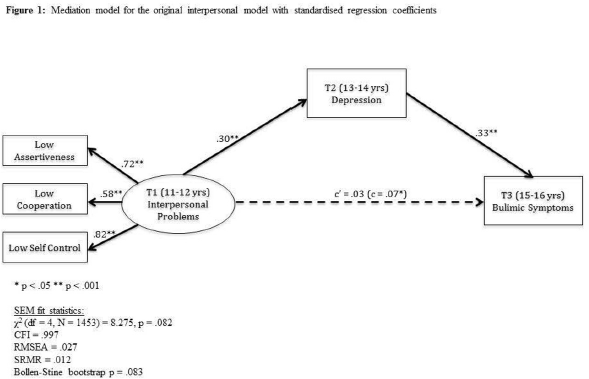
The interpersonal model of binge eating proposes that interpersonal problems lead to depression, which in turn results in bulimic behaviour. Few studies, however, have examined the model empirically.
Objective
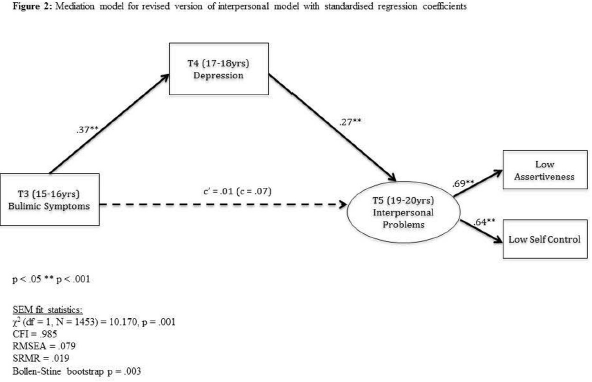
To test the original interpersonal model of binge eating longitudinally and a revised version of the model in which depression mediates the relationship between bulimic behaviour and interpersonal problems.
Method
1453 (702 females) participants from the Australian Temperament Project (ATP) were assessed across five time points (T1-T5). Interpersonal problems were drawn from parent and self-reported questionnaires at T1 and T5. Data on depression was taken from self-reports at T2 and T4 and data on bulimic behaviour was taken from self-report at T3.
Results
An acceptable fit for both models was obtained through Structural equation modelling (SEM). Depression mediated the relationship between interpersonal problems and bulimic behaviour in both models. [See Figure 1 (original model) and Figure 2 (revised model].
Conclusions
The results provide longitudinal support for the interpersonal model of binge eating and initial evidence for a new version of the model, offering important insights into the role of interpersonal problems in the development and maintenance of bulimic pathology.
Research has shown that people with mental illness (PMI) who have greater self-stigma exhibit greater avoidance of participation in psychiatric services, because they are more eager to avoid the label of mental illness, to escape from the damage of the ‘patient” identity on their self-esteem, and to suppress the reactivation of their self-stigmatizing thoughts. This kind of label avoidance reflects a coping strategy called experiential avoidance.
The paradox of experiential avoidance is that attempts to avoid or suppress a thought can cause a rebound increase in thought frequency, leading to prolonged preoccupation with it. When self-stigmatizing thinking occurs repetitively and persistently, it may acquire a certain degree of automaticity and become a mental habit.
One way to prevent or mitigate habitual self-stigma may be through the cultivation of mindfulness. By cultivating mindfulness, people can learn how to allow unwanted thoughts to come and go without judgment or reaction (thereby reducing experiential avoidance of self-stigma).
Objectives
This study aims to examine whether habitual self-stigma is predicted by maladaptive coping with self-stigma.
Methods
Ninety seven PMI completed measures of the cognitive content and the habitual strength of self-stigma, experiential avoidance, and mindfulness.
Results
Hierarchical linear regression showed that greater experiential avoidance and lower mindfulness significantly predicted stronger habitual self-stigma, beyond the effect of the content of self-stigma.
Conclusions
Aside from the content of self-stigma, maladaptive coping strategies may also determine the habit strength. The reduction of habitual self-stigma may be approached by modifying the affected individuals’ relationship with their self-stigmatizing thoughts.
Tobacco dependence is the most common substance use disorder in people with mental illness. Smoking and depression are firmly associated and both represent major health problems.
Aim
The aim of the study was to assess association between smoking status and 12-months depression in representative sample of the general Latvian population.
Methods
The study was a part of health monitoring survey, a collaborative project between Baltic States and Finland, which monitors health related behaviours; the questionnaire included structured interview and depressive module of the Mini International Neuropsychiatric Interview. Descriptive statistics and binary regression model were applied.
Results
A total of 3003 15-64 years old persons were interviewed by using face-to-face data collection tool. The 12-month prevalence of depression in the general population of Latvia was 7.3% (95% CI 6.4–8.3). Of those who were current smokers the 12-months prevalence of depression comprised 9.8% (95% CI 8.0–11.8), in occasional smokers 12.7% (95% CI 8.1–19.5), in quitters and non-smokers population – 6.6% (95% CI 4.6–9.4) and 6.4% (95% CI 5.3–7.8), accordingly. Current smokers had 2.0 times (95% CI 1.4-2.8; p<0.00) and occasional smokers had 2.6 times (95% CI1.5-4.6; p=0.001) higher risk of having depression in the past 12 months. The odds of having depression were 1.8 times (95% CI 1.4–2.5; p<0.00) higher in women who smoke compare to men.
Conclusions
Clinical evaluationson presence of depression for all patients who smoke are needed. Further population-based studies are necessary to determine the causal effects between smoking and depression.
The aim ofthis study was to assess the prevalence, size and burden of commonestpsychiatric disorders at Primary Health Care (PHC) Centres using the WHO Composite International DiagnosticInterview (WHO-CIDI) and co-morbidity.
Methods
A total of2,000 Qatari subjects aged 18 to 65 years were approached at PHC and 1,475 (73.3%) gaveconsent. Prevalence and severityof ICD-10 disorders were assessed with the WHO Composite InternationalDiagnostic Interview (CIDI, Version 3.0).
Results
The three most common disorders weremajor depression disorders (18.31%), any anxiety disorders (17.29%), any mooddisorders (16.95%), followed by separation anxiety disorders (15.25%),personality disorder (14.1%). Most of the respondentswere in the age group 35-49 years (37.8%), followed by 18-34 years (34%), then50-64 years (19.6%) and above aged 65 years old (8.5%). In the present study, prevalence in women was significantly higher thanmen for the most common psychiatric disorders, specifically generalised anxietydisorder, panic disorder, social phobia, specific phobias, obsessive compulsivedisorders, post traumatic disorder, somatisation, major depressive disorder, bipolar disorder, dysthymia, and oppositional defiant disorder. Of the total 20% had only one psychiatric diagnosisand 12% had two disorders, 9.7% respondents with three diagnoses, and finally4.3% of respondents had four or more diagnoses.
Conclusion
One-fifth of all adults who attended the PHC Centre 20% had at least one psychiatric diagnosis. The prevalence of thegeneralized anxiety disorders; socialphobia, specific phobia, major depression, and personality disorders werethe significantly higher in women than inmen.
Prevention, identification, and treatment of maternal psychopathology may be favourable for both mother and child. Both a low socio-economic position (SEP) and adverse life events are considered risk factors for symptoms of anxiety and depression during pregnancy. It is unknown whether the effect of adverse life events is modified by SEP.
Objective
To investigate the relationship between symptoms of anxiety and depression in pregnancy and adverse life events, and how this relationship is modified by SEP.
Methods
The population based Pregnancy, Anxiety and Depression (PAD) Study is a prospective study in Dutch obstetric care. We assessed symptoms of anxiety and depression in pregnant women, SEP (educational level of mother and partner, work status of mother and partner and family income), and the number of adverse life events, categorised by period in life. The association of the number of adverse life events with anxiety and depression, as well as effect modification by SEP was tested using linear regression analyses.
Results
We included 4272 participants. The number of life events and low SEP were independantly associated with symptoms of both anxiety and depression during pregnancy. Additionally, we found that aspects of SEP: low maternal educational level, maternal unemployment, and low family income may increase the adverse effect of adverse life events.
Conclusion
A low SEP increases the adverse impact of adverse life events. In an early screening for anxiety and depression, the number of adverse life events and more important the above-mentioned aspects of SEP should play a key role.