

Hostname: page-component-7b7567c8c-wxvwp Total loading time: 0 Render date: 2026-11-15T18:21:11.018Z Has data issue: false hasContentIssue false

FRACTIONAL SCHRÖDINGER–POISSON SYSTEM WITH SINGULARITY: EXISTENCE, UNIQUENESS, AND ASYMPTOTIC BEHAVIOR

Published online by Cambridge University Press:  12 March 2020

SHENGBIN YU
Affiliation:
College of Mathematics and Informatics & FJKLMAA, Fujian Normal University, Qishan Campus, Fuzhou, Fujian 350117, ChinaDepartment of Basic Teaching and Research, Yango University, Fuzhou, Fujian 350015, China, e-mail: yushengbin.8@163.com
JIANQING CHEN
Affiliation:
College of Mathematics and Informatics & FJKLMAA, Fujian Normal University, Qishan Campus, Fuzhou, Fujian 350117, China, e-mail: jqchen@fjnu.edu.cn
Rights & Permissions [Opens in a new window]

Abstract

Core share and HTML view are not available for this content. However, as you have access to this content, a full PDF is available via the 'Save PDF' action button.

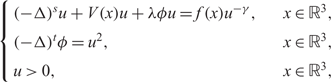
In this paper, we consider the following fractional Schrödinger–Poisson system with singularity

\begin{equation*}\left \{\begin{array}{lcl} ({-}\Delta)^s u+V(x)u+\lambda \phi u = f(x)u^{-\gamma}, &&\quad x\in\mathbb{R}^3,\\ ({-}\Delta)^t \phi = u^2, &&\quad x\in\mathbb{R}^3,\\ u>0,&&\quad x\in\mathbb{R}^3,\end{array}\right.\end{equation*}

where 0 < γ < 1, λ > 0 and 0 < s ≤ t < 1 with 4s + 2t > 3. Under certain assumptions on V and f, we show the existence, uniqueness, and monotonicity of positive solution uλ using the variational method. We also give a convergence property of uλ as λ → 0, when λ is regarded as a positive parameter.

Information

Type
Research Article
Copyright
© The Author(s) 2020. Published by Cambridge University Press on behalf of Glasgow Mathematical Journal Trust