We partner with a secure submission system to handle manuscript submissions.
Please note:
You will need an account for the submission system, which is separate to your Cambridge Core account. For login and submission support, please visit the
submission and support pages.
Please review this journal's author instructions, particularly the
preparing your materials
page, before submitting your manuscript.
Click Proceed to submission system to continue to our partner's website.
To save this undefined to your undefined account, please select one or more formats and confirm that you agree to abide by our usage policies. If this is the first time you used this feature, you will be asked to authorise Cambridge Core to connect with your undefined account.
Find out more about saving content to .
To send this article to your Kindle, first ensure no-reply@cambridge.org is added to your Approved Personal Document E-mail List under your Personal Document Settings on the Manage Your Content and Devices page of your Amazon account. Then enter the ‘name’ part of your Kindle email address below. Find out more about sending to your Kindle.
Find out more about saving to your Kindle.
Note you can select to save to either the @free.kindle.com or @kindle.com variations. ‘@free.kindle.com’ emails are free but can only be saved to your device when it is connected to wi-fi. ‘@kindle.com’ emails can be delivered even when you are not connected to wi-fi, but note that service fees apply.
We address two shortcomings in the article by Liu, Park & Cowen (J. Fluid Mech., vol. 574, 2007, pp. 449–463), which gave a theoretical and experimental treatise of the bottom boundary-layer under a solitary wave.
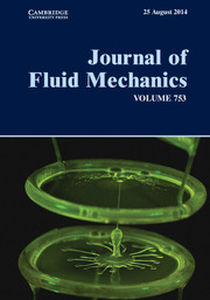
One of the simplest geometries in which to study fluid flow between two soap films connected by a Plateau border is provided by a catenoid with a secondary film at its narrowest point. Dynamic variations in the spacing between the two rings supporting the catenoid lead to fluid flow between the primary and secondary films. When the rings are moved apart, while keeping their spacing within the overall stability regime of the films, after a rapid thickening of the secondary film the excess fluid in it starts to drain into the sloped primary film through the Plateau border at which they meet. This influx of fluid is accommodated by a local thickening of the primary film. Experiments described here show that after this drainage begins the leading edge of the gravity current becomes linearly unstable to a finite-wavelength fingering instability. A theoretical model based on lubrication theory is used to explain the mechanism of this instability. The predicted characteristic wavelength of the instability is shown to be in good agreement with experimental results. Since the gravity current advances into a film of finite, albeit microscopic, thickness this situation is one in which the regularization often invoked to address singularities at the nose of a thin film is physically justified.