





No CrossRef data available.
Article contents
A caution (or two) regarding mathematical expectation
Published online by Cambridge University Press: 20 June 2025
Extract
Core share and HTML view are not available for this content. However, as you have access to this content, a full PDF is available via the 'Save PDF' action button.
Computing mathematical expectation for an experiment involving a finite number of numerical outcomes is straightforward. Let X denote the random variable having n possible values x1, x2, x3,…, xn. Letting pk denote the probability of xk, the expected value of X is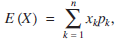 $$E\,(X)\, = \,\sum\limits_{k\, = \,1}^n {{x_k}{p_k}} ,$$
which can be interpreted as a weighted average of all xk, where the weight of each outcome is represented by its probability. But caution is required when interpreting the sum if there are infinitely many outcomes and the series fails to converge absolutely.
Information
- Type
- Articles
- Information
- Copyright
- © The Authors, 2025 Published by Cambridge University Press on behalf of The Mathematical Association
References
Gale, D., Tracking the automatic ant and other mathematical explorations, Springer-Verlag (1998).CrossRefGoogle Scholar
Hacking, I., Strange expectations, Philosophy of Science, 47(4) (1980) pp. 562-567.CrossRefGoogle Scholar
Nathan, A., False expectations, Philosophy of Science, 51(1) (1984) pp. 128-136.CrossRefGoogle Scholar
Gardner, M., Aha! gotcha: paradoxes to puzzle and delight, W. H. Freeman and Company (1982).Google Scholar
Wapner, L., Unexpected expectations: the curiosities of a mathematical crystal ball, CRC Press (2012).CrossRefGoogle Scholar
Wagner, C. H., Simpson’s paradox in real life, The American Statistician, 36 (1982) pp. 46–48.CrossRefGoogle Scholar
Taleb, N. N., The black swan: the impact of the highly improbable (2nd edn.), Random House (2010).Google Scholar
 You have Access