




No CrossRef data available.
Absolute summability functions for Hausdorff methods
Published online by Cambridge University Press: 24 October 2008
Extract
Core share and HTML view are not available for this content. However, as you have access to this content, a full PDF is available via the 'Save PDF' action button.
1. Following Lorentz, we suppose throughout that Ω(n) is a non-negati ve non-decreasing function of the non-negative integer n such that Ω(n)→ ∞ as n → ∞. Consider the summability method given by the sequence-to-sequence transformation corresponding to the matrix A = (ank). We say that Ω(n) is a summability function for A (or absolute summability function for A) if the following holds: Any bounded sequence {sn} such that the number of values of ν with ν ≤ n, sν ≠ 0 does not exceed Ω(n) is summable A (or is absolutely summable A, respectively). These definitions are due to Lorentz (4), (6). We shall be concerned with the case in which A is a regular Hausdorff method, say A = H = (H, μn). Then H is given by the matrix (hnk) with
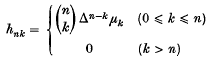
with

X(0) = X(0 + ) = 0, X(1) = 1;(see e.g.(1), chapter XI). We shall suppose throughout that these conditions are satisfied. It is known that H is then necessarily also absolutely regular.
Information
- Type
- Research Article
- Information
- Mathematical Proceedings of the Cambridge Philosophical Society , Volume 91 , Issue 1 , January 1982, pp. 51 - 56
- Copyright
- Copyright © Cambridge Philosophical Society 1982
References
REFERENCES
(2)Kuttner, B. and Parameswaran, M. R. The converse of a Tauberian theorem for Hausdorff methods. (To appear.)Google Scholar
(3)Kuttner, B. and Parameswaran, M. R. Summability functions for Hausdorff methods. (To appear.)Google Scholar
(4)Lorentz, G. G.A contribution to the theory of divergent series. Acta Math. 80 (1948), 157–190.Google Scholar
(5)Lorentz, G. G.Direct theorems on methods of summability. Canadian J. Math. 1 (1949), 305–319.CrossRefGoogle Scholar
(6)Lorentz, G. G.Direct theorems on methods of summability: II. Canadian J. Math. 3 (1951), 236–256.Google Scholar
(7)Lorentz, G. G. and Macphail, M. S.Direct theorems on methods of summability. III. Absolute summability functions. Math. Zeitschrift 59 (1953), 231–246.CrossRefGoogle Scholar
 You have Access