







Hostname: page-component-7b7567c8c-z4zkx Total loading time: 0 Render date: 2026-11-17T06:35:19.153Z Has data issue: false hasContentIssue false

Complex homogeneous linear forms

Published online by Cambridge University Press:  24 October 2008

K. Rogers
Affiliation:
Princeton University
Rights & Permissions [Opens in a new window]

Extract

Core share and HTML view are not available for this content. However, as you have access to this content, a full PDF is available via the 'Save PDF' action button.

Let Z, Q, C denote respectively the ring of rational integers, the field of rational numbers and the field of complex numbers. Minkowski (4) solved the problem of minimizing

for x, y ∈ Z(i) or Z(ρ), where a, b, c, d ∈ C have fixed determinant Δ ≠ 0. Here ρ = exp 2/3πi, and Z(i) and Z(p) are the rings of integers in Q(i) and Q(ρ) respectively. In fact he found the best possible results

for Z(i), and

for Z(ρ), where

while Buchner (1) used Minkowski's method to show that

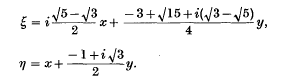
for Z(i√2). Hlawka(3) has also proved (1·2), and Cassels, Ledermann and Mahler (2) have proved both (1·2) and (1·3). In a paper being prepared jointly by H. P. F. Swinnerton-Dyer and the author, general problems of the geometry of numbers in complex space are discussed and a systematic method given for solving the above problem for all complex quadratic fields Q(ϑ). Here, ϑ is a non-real number satisfying. an irreduc7ible quadratic equation with rational coefficients. The above problem is solved in detail for Q(i√5), for which

and the ‘critical forms’ can be reduced to

Information

Type
Research Article
Copyright
Copyright © Cambridge Philosophical Society 1956