

 For the purposes of the above discussion such series should be classed with the ‘positive’ cases.
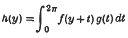 has the Fourier coefficients π(αn αn + b nβn), π(αnb n − a n βn). We have then only to consider the convergence of the Fourier series of h at the origin; in the present case, this is ensured by the Dirichlet-Jordan test, since the methods used above show that h is a continuous function of bounded variation. We could thus have omitted the working down to (4) by quoting Young's result; but we have preferred to follow the lines of the transform proof.
 for
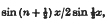 with a similar substitution for
 and then integrate from 0 to 2π.


Crossref Citations

This article has been cited by the following publications. This list is generated based on data provided by Crossref.
Edmonds, Sheila M.
1950.
The Parseval formulae for monotonic functions. III.
Mathematical Proceedings of the Cambridge Philosophical Society,
Vol. 46,
Issue. 2,
p.
249.
Edmonds, Sheila M.
1953.
The Parseval formulae for monotonic functions. IV.
Mathematical Proceedings of the Cambridge Philosophical Society,
Vol. 49,
Issue. 2,
p.
218.
Yung-Ming, Chen
1958.
Some further asymptotic properties of Fourier constants.
Mathematische Zeitschrift,
Vol. 69,
Issue. 1,
p.
105.
Peyerimhoff, Alexander
1958.
Über trigonometrische Reihen mit monoton fallenden Koeffizienten.
Archiv der Mathematik,
Vol. 9,
Issue. 1,
p.
75.
Zygmund, A.
and
Fefferman, Robert
2003.
Trigonometric Series.