Hostname: page-component-7b7567c8c-7pwfn Total loading time: 0 Render date: 2026-11-17T02:08:54.598Z Has data issue: false hasContentIssue false

Summability fields which span the bounded sequences

Published online by Cambridge University Press:  24 October 2008

J. W. Baker
Affiliation:
University College of Swansea
G. M. Petersen
Affiliation:
University of Canterbury, New Zealand
Rights & Permissions [Opens in a new window]

Extract

Core share and HTML view are not available for this content. However, as you have access to this content, a full PDF is available via the 'Save PDF' action button.

If A = (am, n) is a regular matrix, then for any sequence x = {xn}, Am(x) will denote the transform and A-lim x denotes if that limit exists. We shall denote by the set of bounded sequences which are summed by A. If B is another regular matrix with then we say that B is b-stronger than A. In that case B must be b-consistent with A (see (4) and (6)), i.e. if then

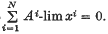
If {μn} is a sequence of positive real numbers with we say that A and B are (μn)-consistent if every sequencer x = {xn} satisfying xn = 0(μn) which is summed by both A and B is summed to the same value by both matrices. A finite set of matrices A1, A2, …, AN is said to be simultaneously (μn)-inconsistent (b-consistent) if whenever is summed by Ai with (i = l, 2, …, N) then implies that The set of sequences, is denoted by

Information

Type
Research Article
Copyright
Copyright © Cambridge Philosophical Society 1967