Contents
Research Article
On (
 h(n)) summability methods
-
- Published online by Cambridge University Press:
- 24 October 2008, pp. 189-193
-
- Article
-
- You have access
- Export citation
-
In 1967 Segal introduced the Dirichlet convolution (
, h(n)), generalizing a method of Ingham developed in studies on the Prime Number Theorem. In this paper we establish necessary and sufficient conditions on the sequence h(n) in order that the convolution method (, h(n)) be conservative. Further conditions are established for the method to be absolutely conservative.
 h(n)) summability methods
Diophantine approximation and Dirichlet series
-
- Published online by Cambridge University Press:
- 24 October 2008, pp. 195-210
-
- Article
-
- You have access
- Export citation
-
1. Given a sequence an of positive integers, one expects to obtain information on the distribution of these numbers by examining the Dirichlet series

In this paper we are going to show how such a series arises from Fröhlich's Galoismodule theory and the use the Thue–Siegel–Roth–Schmidt Theorem as one of the tools in the study of its singularities.

On the structure of certain arithmetic subgroups of SL2(
 )
-
- Published online by Cambridge University Press:
- 24 October 2008, pp. 211-217
-
- Article
-
- You have access
- Export citation
 )
Finite Bol loops: III
-
- Published online by Cambridge University Press:
- 24 October 2008, pp. 219-223
-
- Article
-
- You have access
- Export citation
Residual finiteness of certain 1-relator groups: extensions of results of Gilbert Baumslag
-
- Published online by Cambridge University Press:
- 24 October 2008, pp. 225-230
-
- Article
-
- You have access
- Export citation
-
Let
 be the class of groups which can be presented in the form

where u, v are positive words on the generators g, h, …, k and where each generator appears in uv−1 with zero exponent sum. Let
 be the class of groups which can be presented in the form

where u, v are words (not necessarily positive) on the disjoint sets of generators c1, …, cm and d1, …, dn and where [u, v] = u−1v−1uv.
 be the class of groups which can be presented in the form
 be the class of groups which can be presented in the form
Fibre products of Noetherian rings and their applications
-
- Published online by Cambridge University Press:
- 24 October 2008, pp. 231-241
-
- Article
-
- You have access
- Export citation
Cohomology and finite subgroups of small cancellation quotients of free products
-
- Published online by Cambridge University Press:
- 24 October 2008, pp. 243-259
-
- Article
-
- You have access
- Export citation
Graphs in the plane invariant under an area preserving linear map and general continuous solutions of certain quadratic functional equations
-
- Published online by Cambridge University Press:
- 24 October 2008, pp. 261-278
-
- Article
-
- You have access
- Export citation
-
The requirement that the graph
 of a function
 be invariant under a linear map
 is equivalent to a functional equation of f. For area preserving maps M(det (M) = 1), the functional equation is equivalent to an (easily solved) linear one, or to a quadratic one of the form

for all
 Here 2C = Trace (M). It is shown that (Q) admits continuous solutions ⇔ M has real eigenvalues ⇔ (Q) has linear solutions f(x) = λx ⇔ |C| ≥ 1. For |c| = 1 or C < – 1, (Q) only admits a few simple solutions. For C > 1, (Q) admits a rich supply of continuous solutions. These are parametrised by an arbitrary function, and described in the sense that a construction is given for the graphs
 of the functions which solve (Q).
 of a function
 be invariant under a linear map
 is equivalent to a functional equation of f. For area preserving maps M(det (M) = 1), the functional equation is equivalent to an (easily solved) linear one, or to a quadratic one of the form

 Here 2C = Trace (M). It is shown that (Q) admits continuous solutions ⇔ M has real eigenvalues ⇔ (Q) has linear solutions f(x) = λx ⇔ |C| ≥ 1. For |c| = 1 or C < – 1, (Q) only admits a few simple solutions. For C > 1, (Q) admits a rich supply of continuous solutions. These are parametrised by an arbitrary function, and described in the sense that a construction is given for the graphs
 of the functions which solve (Q).
On complex vector bundles on rational threefolds
-
- Published online by Cambridge University Press:
- 24 October 2008, pp. 279-288
-
- Article
-
- You have access
- Export citation
-
It is known [14] that every topological complex vector bundle on a smooth rational surface admits an algebraic structure. In [10] one constructs algebraic vector bundles of rank 2 on
 with arbitrary Chern classes c1, c2 subject to the necessary topological condition c1 c2 = 0 (mod 2). However, in dimensions greater than 2 the Chern classes don't determine the topological type of a vector bundle. In [2] one classifies the topological complex vector bundles of rank 2 on and one proves that any such bundle admits an algebraic structure.
 with arbitrary Chern classes c
On Toda's fibrations
-
- Published online by Cambridge University Press:
- 24 October 2008, pp. 289-298
-
- Article
-
- You have access
- Export citation
-
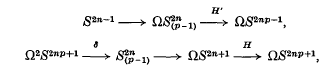
In 1956 Toda [5] introduced two fibrations localized at p > 2:
where
 is a subcomplex of the James construction
 . The construction of H′ was somewhat difficult and was discussed by Moore (see [3]). Moore's definition however is not natural (in the sense of Theorem 1 (b) below). It is our purpose to give another definition, closer to Toda's original definition, which is natural, is an H map* and behaves well with respect to the Dyer-Lashof map λ: BΣp → Q(So). We use this to settle an unanswered question in [2].
 is a subcomplex of the James construction
 . The construction of H′ was somewhat difficult and was discussed by Moore (see [3]). Moore's definition however is not natural (in the sense of Theorem 1 (b) below). It is our purpose to give another definition, closer to Toda's original definition, which is natural, is an H map* and behaves well with respect to the Dyer-Lashof map λ: BΣ
Brownian motion can see a knot
-
- Published online by Cambridge University Press:
- 24 October 2008, pp. 299-309
-
- Article
-
- You have access
- Export citation
-
Let
 be the 3-dimensional sphere and let
 be a smooth knot, i.e. K is the image of a regular diffeomorphism
 . We say that K is unknotted if there exists a diffeomorphism of
 onto the unit sphere of
 , that brings K to the equatorial circle
 otherwise we say that K is knotted.
 be the 3-dimensional sphere and let
 be a smooth knot, i.e. K is the image of a regular diffeomorphism
 . We say that K is unknotted if there exists a diffeomorphism of
 onto the unit sphere of
 , that brings K to the equatorial circle
 otherwise we say that K is knotted.
The dimension of Euclidean subspaces of quasi-normed spaces
-
- Published online by Cambridge University Press:
- 24 October 2008, pp. 311-320
-
- Article
-
- You have access
- Export citation
Growth conditions on subharmonic functions and resolvents of operators
-
- Published online by Cambridge University Press:
- 24 October 2008, pp. 321-324
-
- Article
-
- You have access
- Export citation
-
Let X be a complex Banach space and T a bounded operator on X. The numerical range of T is defined by


A Hausdorff measure classification of polar sets for the heat equation
-
- Published online by Cambridge University Press:
- 24 October 2008, pp. 325-344
-
- Article
-
- You have access
- Export citation
-
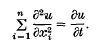
Our main purpose is to give criteria for determining which subsets of Rn+1 are polar relative to the heat equation
A High–Low search game on the unit interval
-
- Published online by Cambridge University Press:
- 24 October 2008, pp. 345-348
-
- Article
-
- You have access
- Export citation
-
We consider the following two-person zero-sum game on the closed interval [0,1]. The hider chooses any real number h in [0,1]. The searcher successively chooses real numbers ξ1ξ2… in [0,1], where at each choice ξi he is told whether h = ξih < ξ1 or h > ξi and he may choose ξi+1 in the light of this information. The payoff (to the hider) is the sum of the distances of the searcher from the hider at each of the moves, that is
 .
 .
Characterizations of invariant distributions
-
- Published online by Cambridge University Press:
- 24 October 2008, pp. 349-355
-
- Article
-
- You have access
- Export citation
Asymptotic shapes of inflated noncircular elastic rings
-
- Published online by Cambridge University Press:
- 24 October 2008, pp. 357-379
-
- Article
-
- You have access
- Export citation
Front matter
PSP volume 97 issue 2 Cover and Front matter
-
- Published online by Cambridge University Press:
- 24 October 2008, pp. f1-f2
-
- Article
-
- You have access
- Export citation
Back matter
PSP volume 97 issue 2 Cover and Back matter
-
- Published online by Cambridge University Press:
- 24 October 2008, pp. b1-b2
-
- Article
-
- You have access
- Export citation