Contents
Research Article
An integral equation
-
- Published online by Cambridge University Press:
- 24 October 2008, pp. 165-173
-
- Article
-
- You have access
- Export citation
-
1. The integral equation

where x, f (x), and λ are real and α positive, may be regarded as a differential equation of order α. Suppose for example that α is a positive integer p, that f (x) tends to 0, when x → ∞, with sufficient rapidity, and that

Then, if we integrate repeatedly by parts, and write z for fp (x), (1·1) becomes

The only solutions are finite combinations of exponentials.

On the canonical curve of genus five
-
- Published online by Cambridge University Press:
- 24 October 2008, pp. 174-189
-
- Article
-
- You have access
- Export citation
On some series of functions, (3)
-
- Published online by Cambridge University Press:
- 24 October 2008, pp. 190-205
-
- Article
-
- You have access
- Export citation
Note on the trisecants and quadrisecants of a space curve
-
- Published online by Cambridge University Press:
- 24 October 2008, pp. 206-208
-
- Article
-
- You have access
- Export citation
-
1. Formulae obtained by enumerative methods are always liable to break down owing to the appearance of an infinity of degenerate solutions, and when this happens it is usually necessary to make a fresh start. Enumerative arguments have been used to prove the two following results for a curve
 of order n and genus p in space of three dimensions:
(i) The order of the ruled surface formed by trisecant lines of the curve is
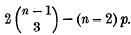
(ii) The number of quadrisecant lines is

 of order n and genus p in space of three dimensions:
Photo-electric absorption in hydrogen-like atoms
-
- Published online by Cambridge University Press:
- 24 October 2008, pp. 209-218
-
- Article
-
- You have access
- Export citation
On the theory of the recombination of ions in gases at high pressures
-
- Published online by Cambridge University Press:
- 24 October 2008, pp. 219-233
-
- Article
-
- You have access
- Export citation
On the non-linear difference equation Δxn = kΦ (xn)
-
- Published online by Cambridge University Press:
- 24 October 2008, pp. 234-243
-
- Article
-
- You have access
- Export citation
-
1. Among the equations arising in the theory of natural selection is the finite difference equation
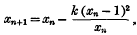
where k is a constant which may have any value between 1 and − ∞ inclusive, but is often small. Its solution is discussed in the accompanying paper(1). It is a particular case of the equation

where Φ(x) is a known one-valued function of x. When k is small this may obviously be solved approximately by treating it as a differential equation

whence


A mathematical theory of natural and artificial selection. Part IX. Rapid selection
-
- Published online by Cambridge University Press:
- 24 October 2008, pp. 244-248
-
- Article
-
- You have access
- Export citation
The energy exchanges between molecules
-
- Published online by Cambridge University Press:
- 24 October 2008, pp. 249-255
-
- Article
-
- You have access
- Export citation
Front Matter
PSP volume 28 issue 2 Cover, Front matter and Corrigenda
-
- Published online by Cambridge University Press:
- 24 October 2008, pp. f1-f3
-
- Article
-
- You have access
- Export citation
Back Matter
PSP volume 28 issue 2 Cover and Back matter
-
- Published online by Cambridge University Press:
- 24 October 2008, pp. b1-b2
-
- Article
-
- You have access
- Export citation