Contents
Research Article
Fourier-Laplace transforms decaying exponentially
-
- Published online by Cambridge University Press:
- 24 October 2008, pp. 321-322
-
- Article
-
- You have access
- Export citation
-
Let ƒ(x) be a C-valued function which is integrable with respect to a positive measure m on the Borel σ-field of R = (– ∞, ∞). We shall give necessary and sufficient conditions under which the following Fourier-Laplace transform f(λ) of ƒ(x) decays exponentially as λ → ∞:

where θ is a constant with –π/2 ≤ θ ≤ π/2.
On shrinking bases in p-Banach spaces
-
- Published online by Cambridge University Press:
- 24 October 2008, pp. 127-132
-
- Article
-
- You have access
- Export citation
The dual J* of the James space has cotype 2 and the Gordon-Lewis property
-
- Published online by Cambridge University Press:
- 24 October 2008, pp. 323-331
-
- Article
-
- You have access
- Export citation
-
We prove the result in the title. More generally we consider the Banach space υp, of all sequences (xn) of scalars such that

where the supremum runs over all increasing sequences n1 ≤ n2 ≤ …. We show that
 is of cotype 2 if p ≽ 2 and of cotype p′, where 1/p′ + 1/p = 1, if p ≤ 2. Similar results are obtained for the analogous function spaces.
 is of cotype 2 if p ≽ 2 and of cotype p′, where 1/p′ + 1/p = 1, if p ≤ 2. Similar results are obtained for the analogous function spaces.
Packing regularity of sets in n-space
-
- Published online by Cambridge University Press:
- 24 October 2008, pp. 133-145
-
- Article
-
- You have access
- Export citation
Sprays, universality and stability
-
- Published online by Cambridge University Press:
- 24 October 2008, pp. 515-534
-
- Article
-
- You have access
- Export citation
Large correlated families of positive random variables
-
- Published online by Cambridge University Press:
- 24 October 2008, pp. 147-162
-
- Article
-
- You have access
- Export citation
-
S. Argyros and N. Kalamidas([l], repeated in [2], Theorem 6·15) proved the following. If κ is a cardinal of uncountable cofinality, and 〈Eξ〉ξ<κ is a family of measurable sets in a probability space (X, μ) such that infξ<κμEξ = δ, and if n ≥ 1,
 , then there is a set Γ ⊆ κ such that #(Γ) = κ and μ(∩ξ∈IEξ) ≥ γ whenever I ⊆ ξ has n members. In Proposition 7 below I refine this result by (i) taking any γ < δn (which is best possible) and (ii) extending the result to infinite cardinals of countable cofinality, thereby removing what turns out to be an irrelevant restriction. The proof makes it natural to perform a further extension to general uniformly bounded families of non-negative measurable functions in place of characteristic functions.
 , then there is a set Γ ⊆ κ such that #(Γ) = κ and μ(∩
Improved estimates for continuous data dependence in linear elastodynamics
-
- Published online by Cambridge University Press:
- 24 October 2008, pp. 535-559
-
- Article
-
- You have access
- Export citation
The quasi-centre of a Banach algebra
-
- Published online by Cambridge University Press:
- 24 October 2008, pp. 333-337
-
- Article
-
- You have access
- Export citation
-
An element a of a Banach algebra A over ࠶ will be called quasi-central if, for some K ≥ 1,

The set Q(A) of all quasi-central elements of A will be called the quasi-centre of A and the set of elements a which satisfy (1) for a particular value of K will be denoted by Q(K, A). The motivation for these definitions is the result of Le Page ([1], proposition 3) that Q(1, A) coincides with the centre Z(A) of A. The reader is referred to [2] and [3] for a study of the properties of quasi-central elements.
The Hausdorff dimension of self-affine fractals
-
- Published online by Cambridge University Press:
- 24 October 2008, pp. 339-350
-
- Article
-
- You have access
- Export citation
-
If T is a linear transformation on ℝn with singular values α1 ≥ α2 ≥ … ≥ αn, the singular value function øs is defined by
 where m is the smallest integer greater than or equal to s. Let T1, …, Tk be contractive linear transformations on ℝn. Let
 where the sum is over all finite sequences (i1, …, ir) with 1 ≤ ij ≤ k. Then for almost all (a1, …, ak) ∈ ℝnk, the unique non-empty compact set F satisfying
 has Hausdorff dimension min{d, n}. Moreover the ‘box counting’ dimension of F is almost surely equal to this number.
 where m is the smallest integer greater than or equal to s. Let T
 where the sum is over all finite sequences (i
 has Hausdorff dimension min{d, n}. Moreover the ‘box counting’ dimension of F is almost surely equal to this number.
Additive arithmetic functions on intervals
-
- Published online by Cambridge University Press:
- 24 October 2008, pp. 163-179
-
- Article
-
- You have access
- Export citation
Far field patterns and the inverse scattering problem for electromagnetic waves in an inhomogeneous medium
-
- Published online by Cambridge University Press:
- 24 October 2008, pp. 561-575
-
- Article
-
- You have access
- Export citation
Which sets contain multiple points of Brownian motion?
-
- Published online by Cambridge University Press:
- 24 October 2008, pp. 181-187
-
- Article
-
- You have access
- Export citation
Front matter
PSP volume 103 issue 3 Cover and Front matter
-
- Published online by Cambridge University Press:
- 24 October 2008, pp. f1-f2
-
- Article
-
- You have access
- Export citation
Research Article
The Markov branching process with density-independent catastrophes I. Behaviour of extinction probabilities
-
- Published online by Cambridge University Press:
- 24 October 2008, pp. 351-366
-
- Article
-
- You have access
- Export citation
-
Let (Xt: t ≥ 0) be the Markov branching process (MBP) with a density independent catastrophe component. It is denned to be the Feller process on the non-negative integers having the generator
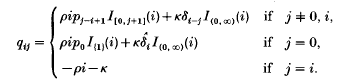
Here {pj} is the offspring distribution which satisfies p1 = 0 and p0 < 1, ρ is the per capita birth rate, κ is the rate of occurrence of catastrophe events, {δj: j ≥ 0} is the decrement distribution and
 . Thus Xt can be interpreted as the size of a population in which individuals reproduce according to the rules of a MBP – see Athreya and Ney[1], chap, III – and where there is an external and independent Poisson process of catastrophe events, κ per unit time, and if j < i each such event reduces the population size by j with probability δj. Usually we assume that δ0 = 0 on the basis that a catastrophe always reduces the population size. Let f(s) = Σpjsj and assume that
 . This ensures that the MBP obtained by setting κ = 0 is regular ([1], p. 105) and hence (Xt) is the unique Markov process corresponding to the above generator when κ > 0.
 . Thus X
 . This ensures that the MBP obtained by setting κ = 0 is regular ([1], p. 105) and hence (X
Back matter
PSP volume 103 issue 3 Cover and Back matter
-
- Published online by Cambridge University Press:
- 24 October 2008, pp. b1-b4
-
- Article
-
- You have access
- Export citation
Research Article
Structurally stable heteroclinic cycles
-
- Published online by Cambridge University Press:
- 24 October 2008, pp. 189-192
-
- Article
-
- You have access
- Export citation
A computation of the Littlewood exponent of stochastic processes
-
- Published online by Cambridge University Press:
- 24 October 2008, pp. 367-370
-
- Article
-
- You have access
- Export citation
-
A stochastic process X = {X(t): t ∈ [0, 1]} on a probability space (Ω,
 , ℙ) is said to have finite expectation if the function defined on the measureable rectangles in Ω × [0, 1] by

for A ∈
and (s, t) ⊂ [0, 1] gives rise to a complex measure in each of its two coordinates (see [1], definition 1·1). Equivalently, X has finite expectation if
is finite. The function defined by (1), effectively a generalization of the Doléans measure (see e.g. [4] pp. 33–35), is extendible to a bona fide complex measure on Ω × [0, 1] if and only if its ‘total variation’
 , ℙ) is said to have finite expectation if the function defined on the measureable rectangles in Ω × [0, 1] by
Front matter
PSP volume 103 issue 1 Cover and Front matter
-
- Published online by Cambridge University Press:
- 24 October 2008, pp. f1-f2
-
- Article
-
- You have access
- Export citation
Research Article
Path sensitivity of material response at intrinsic eigenstates in classical plasticity
-
- Published online by Cambridge University Press:
- 24 October 2008, pp. 371-381
-
- Article
-
- You have access
- Export citation
Corrigendum
Corrigendum
-
- Published online by Cambridge University Press:
- 24 October 2008, p. 383
-
- Article
-
- You have access
- Export citation