




No CrossRef data available.
Article contents
OPPOSITE-SIGN KLOOSTERMAN SUM ZETA FUNCTION
Part of:
Exponential sums and character sums
Discontinuous groups and automorphic forms
Zeta and $L$-functions: analytic theory
Published online by Cambridge University Press: 28 January 2016
Abstract
Core share and HTML view are not available for this content. However, as you have access to this content, a full PDF is available via the 'Save PDF' action button.
We study the meromorphic continuation and the spectral expansion of the opposite-sign Kloosterman sum zeta function for 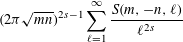 $$\begin{eqnarray}\displaystyle (2{\it\pi}\sqrt{mn})^{2s-1}\mathop{\sum }_{\ell =1}^{\infty }\frac{S(m,-n,\ell )}{\ell ^{2s}} & & \displaystyle \nonumber\end{eqnarray}$$
 $m,n$ positive integers, to all
 $s\in \mathbb{C}$ . There are poles of the function corresponding to zeros of the Riemann zeta function and the spectral parameters of Maass forms. The analytic properties of this function are rather delicate. It turns out that the spectral expansion of the zeta function converges only in a left half-plane, disjoint from the region of absolute convergence of the Dirichlet series, even though they both are analytic expressions of the same meromorphic function on the entire complex plane.
MSC classification
Primary:
11F66: Langlands $L$-functions; one variable Dirichlet series and functional equations
11F72: Spectral theory; Selberg trace formula
11L05: Gauss and Kloosterman sums; generalizations
11M36: Selberg zeta functions and regularized determinants; applications to spectral theory, Dirichlet series, Eisenstein series, etc. Explicit formulas
Information
- Type
- Research Article
- Information
- Copyright
- Copyright © University College London 2016
References
Davenport, H., Multiplicative Number Theory, 3rd edn., (Graduate Texts in Mathematics 74
), Springer (New York, 2000).Google Scholar
Goldfeld, D. and Sarnak, P., Sums of Kloosterman sums. Invent. Math.
71(2) 1983, 243–250.Google Scholar
Gradshteyn, I. S. and Ryzhik, I. M., Table of Integrals, Series, and Products, 8th edn., Elsevier/Academic Press (Amsterdam, 2015).Google Scholar
Hoffstein, J., Hulse, T. A. and Reznikov, A., Multiple Dirichlet series and shifted convolutions. J. Number Theory
161
2016, 457–533.CrossRefGoogle Scholar
Motohashi, Y., On the Kloosterman-sum zeta-function. Proc. Japan Acad. Ser. A Math. Sci.
71(4) 1995, 69–71.Google Scholar
Motohashi, Y., Spectral Theory of the Riemann Zeta-function
(Cambridge Tracts in Mathematics 127
), Cambridge University Press (Cambridge, 1997), doi:10.1017/CBO9780511983399.Google Scholar
Sarnak, P. and Tsimerman, J., On Linnik and Selberg’s conjecture about sums of Kloosterman sums. In Algebra, Arithmetic, and Geometry: in Honor of Yu. I. Manin, Vol. II
(Progress in Mathematics 270
), Birkhäuser (Boston, MA, 2009), 619–635.CrossRefGoogle Scholar
Selberg, A., On the estimation of Fourier coefficients of modular forms. In Theory of Numbers
(Proceedings of Symposia in Pure Mathematics VIII
), American Mathematical Society (Providence, RI, 1965), 1–15.Google Scholar
Titchmarsh, E. C., The Theory of the Riemann Zeta-function, Vol. 196, Oxford University Press (1951).Google Scholar
 You have
Access
- 3
- Cited by