Contents
Research Article
Coherent Pairs of Extensions of Associative Algebras
-
- Published online by Cambridge University Press:
- 22 January 2016, pp. 1-12
-
- Article
-
- You have access
- Export citation
On a Theory Objects Based on a Single Axiom Scheme
-
- Published online by Cambridge University Press:
- 22 January 2016, pp. 13-30
-
- Article
-
- You have access
- Export citation
An Operational Calculus for Meromorphic Functions
-
- Published online by Cambridge University Press:
- 22 January 2016, pp. 31-38
-
- Article
-
- You have access
- Export citation
The Order of Certain Classes of Functions Defined in the Unit Disk
-
- Published online by Cambridge University Press:
- 22 January 2016, pp. 39-52
-
- Article
-
- You have access
- Export citation
Homology of Non-Commutative Polynomial Rings
-
- Published online by Cambridge University Press:
- 22 January 2016, pp. 53-59
-
- Article
-
- You have access
- Export citation
Über den Quasinormalteiler der regulären p-Gruppe von der Klasse 2
-
- Published online by Cambridge University Press:
- 22 January 2016, pp. 61-67
-
- Article
-
- You have access
- Export citation
-
In der vorliegenden Arbeit wird untersucht, was für eine Struktur eine Untergruppe
 von endlicher p-Gruppe
 habe, wenn mit jeder Untergruppe von als ganzes vertauschbar ist. In diesen tritt natürlich ein nicht nur aus E bestehender Normalteiler von auf und er enthält ein Zentrumselement von der Ordnung p. Wir fragen: Gilt das Ähnliche auch, falls kein Normalteiler ist? Die gestellte Frage läßt sich für regülare beantworten, deren Klasse 2 ist, aber für andere bleibt sie noch offen. Bevor wir diese Frage untersuchen, stellen wir einige Definitionen und nötige Sätze und Hilfssätze zusammen.
 von endlicher p-Gruppe
 habe, wenn
Une Generalisation des Lignes de Green
-
- Published online by Cambridge University Press:
- 22 January 2016, pp. 69-87
-
- Article
-
- You have access
- Export citation
-
L’objet du présent travail est d’étudier, dans un espace de Green Ω, une généralisation des lignes de Green, à savoir les trajectoires orthogonales des surfaces de niveau de
 où G désigne la fonction de Green de pôle fixé y0 ∈ Ω, et h une fonction harmonique > 0 fixée dans Ω. Le cas h = 1, qui est celui des lignes de Green ordinaires, a été étudié en détail par M. Brelot et G. Choquet dans [4]. On montrera ici, moyennant l’introduction de notions convenablement appropriées, que les propriétés de ce cas initial s’étendent.
 où G désigne la fonction de Green de pôle fixé y
Relative Cohomology of Algebraic Linear Groups, II
-
- Published online by Cambridge University Press:
- 22 January 2016, pp. 89-99
-
- Article
-
- You have access
- Export citation
-
Let G be an algebraic linear group over a field F of characteristic 0, and let H be an algebraic subgroup of G. Let A, M be rational G-modules. In [4], we defined
 (A, M), and, in particular, relative cohomology groups Hn(G, H, M) were defined as (F, M).
 (A, M), and, in particular, relative cohomology groups H
On the Grothendieck Ring of an Abelian p-Group
-
- Published online by Cambridge University Press:
- 22 January 2016, pp. 101-113
-
- Article
-
- You have access
- Export citation
-
The Grothendieck ring of a finite group has been studied by Swan ([5], [6]). At the end of [6] he determined completely the structure of the Grothendieck ring G(Z
 ) of a cyclic p-group over the ring of rational integers Z.
 ) of a cyclic p-group
Unique Continuation for Parabolic Equations of Higher Order
-
- Published online by Cambridge University Press:
- 22 January 2016, pp. 115-120
-
- Article
-
- You have access
- Export citation
-
Let x = (xl,…xn) be a point in the n-dimensional Euclidean space and let
 be the unit sphere
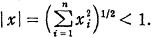 In the (n + 1)-dimensional Euclidean space with coordinate (x, t), we put

and

where
 denotes the boundary of . We also use the following notation:

 be the unit sphere
 In the (n + 1)-dimensional Euclidean space with coordinate (x, t), we put
 denotes the boundary of
On Metric Properties of Sets of Angular Limits of Meromorphic Functions
-
- Published online by Cambridge University Press:
- 22 January 2016, pp. 121-126
-
- Article
-
- You have access
- Export citation
-
Let f be a nonconstant function meromorphic in the unit disc
 , with circumference C, and let Ez be a subset of C with positive (linear) measure. Suppose that at each ζ ∈ Ez f has an angular limit aζ and let
 It is known that Ew contains a closed set with positive harmonic measure (see Priwalow [6, p. 210] or Tsuji [7, p. 339]).
 , with circumference C, and let E
 It is known that E
Singular Sets of Some Kleinian Groups
-
- Published online by Cambridge University Press:
- 22 January 2016, pp. 127-143
-
- Article
-
- You have access
- Export citation
A New Definition of the n-Dimensional Quasiconformal Mappings
-
- Published online by Cambridge University Press:
- 22 January 2016, pp. 145-165
-
- Article
-
- You have access
- Export citation
A Remark on the Intersection of Tow Logics
-
- Published online by Cambridge University Press:
- 22 January 2016, pp. 167-171
-
- Article
-
- You have access
- Export citation
Sur l’allure des Fonctions Meromorphes
-
- Published online by Cambridge University Press:
- 22 January 2016, pp. 173-181
-
- Article
-
- You have access
- Export citation
Eleven Nonequivalent Conditions on a Commutative Ring
-
- Published online by Cambridge University Press:
- 22 January 2016, pp. 183-194
-
- Article
-
- You have access
- Export citation
A Formalism for Primitive Logic and Mechanical Proof-Checking
-
- Published online by Cambridge University Press:
- 22 January 2016, pp. 195-203
-
- Article
-
- You have access
- Export citation
On α-Harmonic Functions
-
- Published online by Cambridge University Press:
- 22 January 2016, pp. 205-221
-
- Article
-
- You have access
- Export citation
Front Matter
NMJ volume 26 Cover and Front matter
-
- Published online by Cambridge University Press:
- 22 January 2016, pp. f1-f3
-
- Article
-
- You have access
- Export citation
Back Matter
NMJ volume 26 Cover and Back matter
-
- Published online by Cambridge University Press:
- 22 January 2016, pp. b1-b2
-
- Article
-
- You have access
- Export citation