Open access
Contents
Research Article
Massey products in the homology of the loop space of a p-completed classifying space: finite groups with cyclic Sylow p-subgroups
- Part of:
-
- Published online by Cambridge University Press:
- 30 September 2021, pp. 908-915
-
- Article
-
- You have access
- Open access
- HTML
- Export citation
-
Let $G$
 be a finite group with cyclic Sylow $p$
 -subgroups, and let $k$
 be a field of characteristic $p$
 . Then $H^{*}(BG;k)$
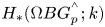
 and $H_*(\Omega BG{{}^{{}^{\wedge }}_p};k)$
 are $A_\infty$
 algebras whose structure we determine up to quasi-isomorphism.


Algebras with representable representations
- Part of:
-
- Published online by Cambridge University Press:
- 24 June 2021, pp. 555-573
-
- Article
-
- You have access
- Open access
- HTML
- Export citation
-
Just like group actions are represented by group automorphisms, Lie algebra actions are represented by derivations: up to isomorphism, a split extension of a Lie algebra $B$
 by a Lie algebra $X$
 corresponds to a Lie algebra morphism $B\to {\mathit {Der}}(X)$
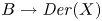 from $B$
 to the Lie algebra ${\mathit {Der}}(X)$
 of derivations on $X$
 . In this article, we study the question whether the concept of a derivation can be extended to other types of non-associative algebras over a field ${\mathbb {K}}$
 , in such a way that these generalized derivations characterize the ${\mathbb {K}}$
 -algebra actions. We prove that the answer is no, as soon as the field ${\mathbb {K}}$
 is infinite. In fact, we prove a stronger result: already the representability of all abelian actions – which are usually called representations or Beck modules – suffices for this to be true. Thus, we characterize the variety of Lie algebras over an infinite field of characteristic different from $2$
 as the only variety of non-associative algebras which is a non-abelian category with representable representations. This emphasizes the unique role played by the Lie algebra of linear endomorphisms $\mathfrak {gl}(V)$
 as a representing object for the representations on a vector space $V$
 .


Homotopy nilpotency of localized spheres and projective spaces
- Part of:
-
- Published online by Cambridge University Press:
- 04 June 2021, pp. 501-512
-
- Article
-
- You have access
- Open access
- HTML
- Export citation
-
For the $p$
 -localized sphere $\mathbb {S}^{2m-1}_{(p)}$
 with $p >3$
 a prime, we prove that the homotopy nilpotency satisfies $\mbox {nil}\ \mathbb {S}^{2m-1}_{(p)}<\infty$
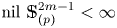 , with respect to any homotopy associative $H$
 -structure on $\mathbb {S}^{2m-1}_{(p)}$
 . We also prove that $\mbox {nil}\ \mathbb {S}^{2m-1}_{(p)}= 1$
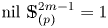 for all but a finite number of primes $p >3$
 . Then, for the loop space of the associated $\mathbb {S}^{2m-1}_{(p)}$
 -projective space $\mathbb {S}^{2m-1}_{(p)}P(n-1)$
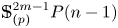 , with $m,n\ge 2$
 and $m\mid p-1$
 , we derive that $\mbox {nil}\ \Omega (\mathbb {S}^{2m-1}_{(p)}P (n-1))\le 3$
 .


On the low-dimensional cohomology groups of the IA-automorphism group of the free group of rank three
- Part of:
-
- Published online by Cambridge University Press:
- 05 May 2021, pp. 338-363
-
- Article
-
- You have access
- Open access
- Export citation
-
In this paper, we study the structure of the rational cohomology groups of the IA-automorphism group $\mathrm {IA}_3$
 of the free group of rank three by using combinatorial group theory and representation theory. In particular, we detect a nontrivial irreducible component in the second cohomology group of $\mathrm {IA}_3$
 , which is not contained in the image of the cup product map of the first cohomology groups. We also show that the triple cup product of the first cohomology groups is trivial. As a corollary, we obtain that the fourth term of the lower central series of $\mathrm {IA}_3$
 has finite index in that of the Andreadakis–Johnson filtration of $\mathrm {IA}_3$
 .


Hypergeometric rational approximations to ζ(4)
- Part of:
-
- Published online by Cambridge University Press:
- 03 February 2020, pp. 374-397
-
- Article
-
- You have access
- Open access
- Export citation
Real closed valued fields with analytic structure
- Part of:
-
- Published online by Cambridge University Press:
- 05 December 2019, pp. 249-261
-
- Article
-
- You have access
- Open access
- Export citation
A multiplier inclusion theorem on product domains
- Part of:
-
- Published online by Cambridge University Press:
- 20 June 2019, pp. 1073-1088
-
- Article
-
- You have access
- Open access
- Export citation
-
In this note it is shown that the class of all multipliers from the d-parameter Hardy space
 $H_{{\rm prod}}^1 ({\open T}^d)$ to L2 (𝕋d) is properly contained in the class of all multipliers from L logd/2L (𝕋d) to L2(𝕋d).

On the Quantitative Metric Theory of Continued Fractions in Positive Characteristic
- Part of:
-
- Published online by Cambridge University Press:
- 07 February 2018, pp. 283-293
-
- Article
-
- You have access
- Open access
- Export citation
-
Let 𝔽q be the finite field of q elements. An analogue of the regular continued fraction expansion for an element α in the field of formal Laurent series over 𝔽q is given uniquely by
where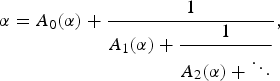 $$\alpha = A_0(\alpha ) + \displaystyle{1 \over {A_1(\alpha ) + \displaystyle{1 \over {A_2(\alpha ) + \ddots }}}},$$
 $(A_{n}(\alpha))_{n=0}^{\infty}$ is a sequence of polynomials with coefficients in 𝔽q such that deg(A n (α)) ⩾1 for all n ⩾ 1. In this paper, we provide quantitative versions of metrical results regarding averages of partial quotients. A sample result we prove is that, given any ϵ > 0, we havefor almost everywhere α with respect to Haar measure.
 $$\vert A_1(\alpha ) \ldots A_N(\alpha )\vert ^{1/N} = q^{q/(q - 1)} + o(N^{ - 1/2}(\log N)^{3/2 + {\rm \epsilon }})$$

