Contents
Research Article
On the methods of extending Dirac's equation of the electron to general relativity
-
- Published online by Cambridge University Press:
- 20 January 2009, pp. 39-50
-
- Article
-
- You have access
- Export citation
Index to Papers
Index of Papers Published in this Volume Arranged According to Names of Authors
-
- Published online by Cambridge University Press:
- 20 January 2009, p. 205
-
- Article
-
- You have access
- Export citation
Front matter
PEM volume 7 issue 2 Cover and Front matter
-
- Published online by Cambridge University Press:
- 20 January 2009, pp. f1-f2
-
- Article
-
- You have access
- Export citation
Research Article
On the limits of oscillation of a function and its Cesàro means
-
- Published online by Cambridge University Press:
- 20 January 2009, pp. 162-167
-
- Article
-
- You have access
- Export citation
A note on inverse central factorial series
-
- Published online by Cambridge University Press:
- 20 January 2009, pp. 168-170
-
- Article
-
- You have access
- Export citation
-
The purpose of this brief note is to draw attention to a type of inverse factorial series which, so far as the writer can judge, has not been intensively studied. The central difference formulae of interpolation and the corresponding infinite series in central factorial polynomials have in the past received much attention, and so also has the ordinary inverse factorial series

which from the time of Stirling (Methodus Differentialis, 1730) has been known to be of value in transforming slowly convergent series into series of more rapid convergence.
Back matter
PEM volume 7 issue 2 Cover and Back matter
-
- Published online by Cambridge University Press:
- 20 January 2009, pp. b1-b2
-
- Article
-
- You have access
- Export citation
Index According to Subjects
Index According to Subjects
-
- Published online by Cambridge University Press:
- 20 January 2009, p. 206
-
- Article
-
- You have access
- Export citation
Research Article
On the relations between the numbers of standard tableaux
-
- Published online by Cambridge University Press:
- 20 January 2009, pp. 51-54
-
- Article
-
- You have access
- Export citation
-
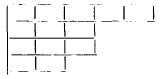
§ 1. Corresponding to any partition

which we denote by [a1, . …, ak] or briefly by [a], of the integer n, we can construct a shape which has a1 spaces in the first row, a2 in the second row, . …, ak in the kth and last row. Thus the shape corresponding to the partition [5, 3, 3, 2] of 13 has the form:
Front matter
PEM volume 7 issue 3 Cover and Front matter
-
- Published online by Cambridge University Press:
- 20 January 2009, pp. f1-f2
-
- Article
-
- You have access
- Export citation
Research Article
The projective invariants of four mediale
-
- Published online by Cambridge University Press:
- 20 January 2009, pp. 55-72
-
- Article
-
- You have access
- Export citation
Other
Edinburgh Mathematical Society
-
- Published online by Cambridge University Press:
- 20 January 2009, pp. 207-214
-
- Article
-
- You have access
- Export citation
Research Article
A type of periodicity of certain quartic surfaces
-
- Published online by Cambridge University Press:
- 20 January 2009, pp. 73-80
-
- Article
-
- You have access
- Export citation
Front matter
PEM volume 7 issue 4 Cover and Front matter
-
- Published online by Cambridge University Press:
- 20 January 2009, pp. f1-f2
-
- Article
-
- You have access
- Export citation
Back matter
PEM volume 7 issue 3 Cover and Back matter
-
- Published online by Cambridge University Press:
- 20 January 2009, pp. b1-b2
-
- Article
-
- You have access
- Export citation
PEM volume 7 issue 4 Cover and Back matter
-
- Published online by Cambridge University Press:
- 20 January 2009, pp. b1-b5
-
- Article
-
- You have access
- Export citation
Fornt matter
PEM volume 7 issue 1 Cover and Fornt matter
-
- Published online by Cambridge University Press:
- 20 January 2009, pp. f1-f2
-
- Article
-
- You have access
- Export citation
Back matter
PEM volume 7 issue 1 Cover and Back matter
-
- Published online by Cambridge University Press:
- 20 January 2009, pp. b1-b2
-
- Article
-
- You have access
- Export citation