We partner with a secure submission system to handle manuscript submissions.
Please note:
You will need an account for the submission system, which is separate to your Cambridge Core account. For login and submission support, please visit the
submission and support pages.
Please review this journal's author instructions, particularly the
preparing your materials
page, before submitting your manuscript.
Click Proceed to submission system to continue to our partner's website.
To save this undefined to your undefined account, please select one or more formats and confirm that you agree to abide by our usage policies. If this is the first time you used this feature, you will be asked to authorise Cambridge Core to connect with your undefined account.
Find out more about saving content to .
To send this article to your Kindle, first ensure no-reply@cambridge.org is added to your Approved Personal Document E-mail List under your Personal Document Settings on the Manage Your Content and Devices page of your Amazon account. Then enter the ‘name’ part of your Kindle email address below. Find out more about sending to your Kindle.
Find out more about saving to your Kindle.
Note you can select to save to either the @free.kindle.com or @kindle.com variations. ‘@free.kindle.com’ emails are free but can only be saved to your device when it is connected to wi-fi. ‘@kindle.com’ emails can be delivered even when you are not connected to wi-fi, but note that service fees apply.
To examine the effect of an intervention combining user fees removal with community-based management of undernutrition on the nutrition status in children under 5 years of age in Burkina Faso.
Design:
The study was a non-equivalent control group post-test-only design based on household survey data collected 4 years after the intervention onset in the intervention and comparison districts. Additionally, we used propensity score weighting to achieve balance on covariates between the two districts, followed by logistic multilevel modelling.
Setting:
Two health districts in the Sahel region.
Participants:
Totally, 1116 children under 5 years of age residing in 41 intervention communities and 1305 from 51 control communities.
Results:
When comparing children living in the intervention district to children living in a non-intervention district, we determined no differences in terms of stunting (OR = 1·13; 95 % CI 0·83, 1·54) and wasting (OR = 1·21; 95 % CI 0·90, 1·64), nor in severely wasted (OR = 1·27; 95 % CI 0·79, 2·04) and severely stunted (OR = 0·99; 95 % CI 0·76, 1·26). However, we determined that 3 % of the variance of wasting (95 % CI 1·25, 10·42) and 9·4 % of the variance of stunting (95 % CI 6·45, 13·38) were due to systematic differences between communities of residence. The presence of the intervention in the communities explained 2 % of the community-level variance of stunting and 3 % of the community-level variance of wasting.
Conclusions:
With the scaling-up of the national free health policy in Africa, we stress the need for rigorous evaluations and the means to measure expected changes in order to better inform health interventions.
To collect context-specific insights into maternal and child health and nutrition issues, and to explore potential solutions in Nanoro, Burkina Faso.
Design:
Eleven focus groups with men and women from eleven communities, facilitated by local researchers.
Setting:
The study took place in the Nanoro Health district, in the West-Central part of Burkina Faso.
Participants:
Eighty-six men (18–55 years) and women by age group: 18–25; 26–34 and 35–55 years, participated in the group discussions.
Results:
Participants described barriers to optimal nutrition of mothers and children related to a range of community factors, with gender inequality as central. Major themes in the discussions are related to poverty and challenges generated by socially and culturally determined gender roles. Sub-themes are women lacking access to food whilst pregnant and having limited access to health care and opportunities to generate income. Although communities believe that food donations should be implemented to overcome this, they also pointed out the need for enhancing their own food production, requiring improved agricultural technologies. Given the important role that women could play in reducing malnutrition, these communities felt they needed to be empowered to do so and supported by men. They also felt that this had to be carried out in the context of an enhanced health care system.
Conclusions:
Findings reported here highlight the importance of nutrition-sensitive interventions and women’s empowerment in improving maternal and child nutrition. There is a need to integrate a sustainable multi-sectorial approach which goes beyond food support.
Population reductions in Na intake could prevent hypertension, and current guidelines recommend that clinicians advise patients to reduce intake. This study aimed to estimate the prevalence of taking action and receiving advice from a health professional to reduce Na intake in ten US jurisdictions, including the first-ever data in New York state and Guam.
Design:
Weighted prevalence and 95 % CI overall and by location, demographic group, health status and receipt of provider advice using self-reported data from the 2017 Behavioral Risk Factor Surveillance System optional Na module.
Setting:
Seven states, the District of Columbia, Puerto Rico and Guam.
Participants:
Adults aged ≥ 18 years.
Results:
Overall, 53·6 % (95 % CI 52·7, 54·5) of adults reported taking action to reduce Na intake, including 54·8 % (95 % CI 52·8, 56·7) in New York and 61·2 % (95 % CI 57·6, 64·7) in Guam. Prevalence varied by demographic and health characteristic and was higher among adults who reported having hypertension (72·5 %; 95 % CI 71·2, 73·7) v. those who did not report having hypertension (43·9 %; 95 % CI 42·7, 45·0). Among those who reported receiving Na reduction advice from a health professional, 82·6 % (95 % CI 81·3, 83·9) reported action v. 44·4 % (95 % CI 43·4, 45·5) among those who did not receive advice. However, only 24·0 % (95 % CI 23·3, 24·7) of adults reported receiving advice from a health professional to reduce Na intake.
Conclusions:
The majority of adults report taking action to reduce Na intake. Results highlight an opportunity to increase Na reduction advice from health professionals during clinical visits to better align with existing guidelines.
To systematically audit the extent of unhealthy sponsorship within junior community sporting clubs and ascertain whether differences exist across geographical areas and sport types.
Design:
Club sponsorship data were assessed to determine the extent of unhealthy food/beverage, alcohol and gambling sponsorship using a cross-sectional design. Differences across geographical areas were assessed using logistic regressions.
Setting:
A stratified random sampling procedure was used to select thirty communities across the state of Victoria, Australia. Within each community, local clubs across the top eight participating junior sports were selected for audit.
Participants:
Sponsorship data were collected from 191 club websites and Facebook pages in September–November 2019.
Results:
Unhealthy sponsorships represented 8·9 % of all identified sponsorship arrangements. A quarter of all clubs accepted alcohol (25·6 %) and unhealthy food sponsors (25·9 %), and one-fifth of all clubs accepted high-risk food (unhealthy brands with large market share) (18·1 %) and gambling sponsors (20·4 %). Acceptance of unhealthy sponsorship differed across sport types with football, netball, cricket and soccer clubs having the greatest numbers. Compared with metro areas, a significantly greater proportion of sporting clubs in regional areas were affiliated with unhealthy food (32·7 % v. 19·6 %) and high-risk food sponsors (26·9 % v. 9·8 %). A higher proportion of clubs in low socio-economic status (SES), compared with the high SES areas, were affiliated with alcohol (33·9 % v. 16·5 %) and gambling sponsors (27·4 % v. 12·6 %).
Conclusion:
Victorian children participating in community junior sports are being exposed to marketing of unhealthy brands and products. Public health intervention is necessary to protect children from this exposure.
Food insecurity is a structural barrier to HIV care in peri-urban areas in South Africa (SA), where approximately 80 % of households are moderately or severely food insecure. For people with HIV (PWH), food insecurity is associated with poor antiretroviral therapy adherence and survival rates. Yet, measurement of food insecurity among PWH remains a challenge.
Design:
The current study examines the factor structure of the nine-item Household Food Insecurity Access Scale (HFIAS, isiXhosa-translated) among PWH in SA using a restrictive bifactor model.
Setting:
Primary care clinics in Khayelitsha, a peri-urban settlement in Cape Town, SA.
Participants:
Participants (n 440) were PWH who received HIV care in Khayelitsha screening for a clinical trial. Most were categorised as severely (n 250, 56·82 %) or moderately (n 107, 24·32 %) food insecure in the past 30 d.
Results:
Revised parallel analysis suggested a three-factor structure, which was inadmissible. A two-factor structure was examined but did not adequately fit the data. A two-factor restrictive bifactor model was examined, such that all items loaded on a general factor (food insecurity) and all but two items loaded on one of two specific additional factors, which adequately fit the data (comparative fit index = 0·995, standardised root mean square residual = 0·019). The two specific factors identified were: anxiety/insufficient quality and no food intake. Reliability was adequate (ω = 0·82).
Conclusions:
Results supported the use of a total score, and identified two specific factors of the HFIAS, which may be utilised in future research and intervention development. These findings help identify aspects of food insecurity that may drive relationships between the construct and important HIV-related variables.
Polyphenols are antioxidant compounds with an impact on different health factors. Thus, it is important to have precise tools to estimate the intake of polyphenols. This study focuses on the development of an intuitive tool to estimating the intake of dietary total polyphenols.
Design:
The tool was developed in a spreadsheet to improve accessibility and use. It is divided into six different meals for each of the 7 d with a similar format to 24-h diet recalls. The total polyphenol values of 302 foods were included and the possibility of own values.
Setting:
Framework of the European project Stance4Health, Granada, Spain.
Participants:
This tool was tested on 90 participants in different stages of life (girls, women and pregnant women). Ages ranged from 10 to 35 years.
Results:
The total polyphenol intake obtained was of 1790 ± 629 mg polyphenols/d. The highest consumption of polyphenols was observed in pregnant women (2064 mg/d). Polyphenols intake during the weekend was lower for the three groups compared to the days of the week. The results were comparable with those of other studies.
Conclusions:
The current tool allows the estimation of the total intake of polyphenols in the diet in a fast and easy way. The tool will be used as a basis for a future mobile application.
This article analyses the relationship between socio-economic status and the prevalence of overweight and obesity in the primary school population in Costa Rica.
Design:
A National School Weight/Height Census was disseminated across Costa Rica in 2016. The percentage of children who were overweight or obese was calculated by sex, age and socio-economic indicators (type of institution: private, public, mix; type of geographic location: rural, urban and the level of development of the district of residence: quartiles). A mixed-effects multinomial logistic regression model and mixed-effects logistic regression model were used to analyse the association between the prevalence of being overweight or obese and district socio-economic status.
Setting:
The survey was carried out in public and private primary schools across Costa Rica in 2016.
Participants:
In total, 347 366 students from 6 to 12 years were enrolled in public and private primary schools.
Results:
The prevalence of overweight and obesity among children was 34·0 %. Children in private schools were more likely to be overweight or obese than students in public schools (OR = 1·10 [1·07, 1·13]). Additionally, children were less likely to be overweight or obese if attending a school in a district of the lowest socio-economic quartile compared with the highest socio-economic quartile (OR = 0·79 [0·75, 0·83]) and in a rural area compared with the urban area (OR = 0·92 [0·87, 0·97]).
Conclusions:
Childhood obesity in Costa Rica continues to be a public health problem. Prevalence of overweight and obesity in children was associated with indicators of higher socio-economic status.
To assess the level, pattern and determinants of minimum acceptable diet (MAD) feeding in Odisha, India.
Design:
Utilising cross-sectional data, the MAD was estimated through a dietary assessment method wherein the child’s mother was asked to recall all the food intake of the youngest child the previous day and night of the surveyed date.
Setting:
National Family Health Survey 2015–2016.
Participants:
Children aged 6–23 months, living with mother and for whom complete information on MAD was available (n 3073).
Results:
Only 8·4 % of the children aged 6–23 months were fed MAD, and the MAD feeding varies considerably by socio-demographic characteristics. Children aged 12–17 months had two times (OR: 2·51, 95 % CI (1·48, 4·26)) and those aged 18–23 months had three times (OR: 3·77, 95 % CI (2·25, 6·30)) higher odds of having a MAD than their counterparts aged 6–8 months. Children whose mother was exposed to any mass media had a higher chance of MAD feeding (OR: 1·46, 95 % CI (1·01, 2·11)).
Conclusions:
The children of higher age, second or higher-order births, with mother exposed to mass media are significantly more likely to be fed with a MAD. At the same time, children from scheduled caste (SC) households have a lower probability of MAD feeding. The lower MAD feeding among the SC households suggests strengthening the ongoing programmes with a higher emphasis on the inclusion of this disadvantaged and marginalised group. Findings from the current study would assist policymakers, and public health managers improve MAD feeding practices in Odisha, India, in a targeted manner.
The objective was to explore mothers’ perceptions on educational videos on infant and young child-feeding practices, and to assess whether viewing frequencies would influence maternal knowledge, attitudes and feeding practices (KAP).
Design:
A set of forty-seven videos were displayed in health centres for 6 months. At 3 months, we conducted focus group discussions (FGD) with mothers and, at 6 months, administered KAP-questionnaire-based interviews to mothers. Using a quasi-experimental design, we compared groups according to video viewing frequencies.
Setting:
The study was conducted in a slum in Nairobi and a rural area in Machakos, Kenya. We installed TV screens in waiting rooms of six Mother and Child Health Centers, where mothers could choose to watch them.
Participants:
Forty-three mothers with children aged 0–48 months participated in six FGD and 547 mothers of children aged 0–23 months in KAP interviews.
Results:
The mothers from the FGD found the videos acceptable and beneficial. Videos enhanced mothers’ learning and empowered them to support others in learning. The KAP data showed that after adjustments, breast-feeding (P = 0·06), complementary feeding knowledge (P = 0·01), complementary feeding attitudes (P = 0·08) and hygiene knowledge and practices (P = 0·003) were better among mothers who had seen videos three to four times, or five or more times, compared with mothers who had seen the videos once or twice.
Conclusions:
Videos were an accepted form of education and were beneficial when watched repeatedly. The videos could be a good addition to current infant and young child-feeding education efforts in Kenya.
Adequate and appropriate nutrition education is expected to contribute towards preventing risk of child stunting and maternal overweight/obesity. Understanding women’s information-seeking behaviours is an important key step for health professionals and departments of health in order to improve the development of optimal and targeted nutrition education during pregnancy. This study investigated the experience of Indonesian women in seeking and receiving nutritional information during pregnancy and its relationship to women’s socio-demographic and pregnancy characteristics.
Design:
An online cross-sectional study.
Setting:
Malang City, Indonesia.
Participants:
Women who had given birth within the past 2 years (n 335).
Results:
All women in this study sought or received food and nutrition information from multiple sources, including social and health professional contacts and media sources. The women frequently discussed nutrition issues with their family, particularly their husband (98·2 %) and mother or mother-in-law (91·6 %). This study identified four groups of sources based on women’s search habits. Women from high socio-economic strata were more likely to discuss food and nutrition issues or received nutrition information from obstetricians, their family or online sources (adjusted R2 = 26·3 %). Women from low socio-economic strata were more likely to receive nutrition information from midwives, health volunteers or Maternal and Child Health books (adjusted R2 = 14·5 %).
Conclusions:
A variety of nutrition information sources needs to be provided for women from different socio-economic strata. Involvement of family members in antenatal nutrition education may improve the communication and effectiveness of young mothers’ dietary and nutrition education.
To determine the status of nutritional literacy and its affecting factors among the adolescents who are in the 9th grade in Çivril, in Denizli province, in Turkey.
Design:
This is a cross-sectional study that determines the sociodemographic characteristics, nutritional habits, nutritional behaviour, nutritional literacy status of adolescents and affecting factors.
Setting:
Denizli, Turkey.
Participants:
We included 523 adolescents in ninth grade in this study.
Results:
Half (49·7 %) of the participants were female; 47 %, in normal BMI; and 68·1 %, non-smokers. The mean (sd) Adolescent Nutrition Literacy Scale score was 67·6 (sd 7·9). Nutrition literacy status was related to mothers’ education level (P 0·021); health perceptions (P 0·008); positive body perception (P 0·032); unhealthy food consumption status (P 0·017); information barriers (undecided about effort for information gathering (P 0·026), undecided about the difficulty of understanding information (P 0·042) and thinking it is difficult to understand (P 0·003)), trust in nutrition, diet information sources (nutrition and diet expert, dietitian trusting (according to others) (P 0·001), nutrition and diet expert, dietitian neutral to trust (compared with others) (P 0·011) and trust in textbooks (P 0·023)).
Conclusions:
The level of nutrition literacy status of participants was moderate. It is important to carry out interventions to increase the education level of women, positive body perceptions and general health perceptions of adolescents and to remove information barriers related to nutrition.
As Mexico continues to develop, an epidemiological and nutritional transition has led to an increase in infant formula use in its rural and indigenous communities. Our objective was to determine the social and cultural factors that influence the use of formula in such populations in Central Mexico.
Design:
Qualitative study using a data collection instrument based on the socio-ecological framework.
Setting:
Two rural and indigenous communities in Central Mexico.
Participants:
Mothers, fathers, grandparents and healthcare providers.
Results:
Breast-feeding was favoured in both communities; however, several cultural traditions hindered exclusive breast-feeding. As these communities became more developed, emerging ideas of modernity led to negative connotations about breast-feeding and many mothers began to view formula as a complement for breast-feeding. Formula was seen as a convenient solution for breast pain, insufficient milk and body image. Healthcare providers promoted the use of formula through their own beliefs, information, communication and conflicts of interest with formula industry representatives. The recent social and economic changes in these communities combined with the increased advertising and availability of breast milk substitutes have facilitated the preference for formula.
Conclusions:
Women in rural, indigenous communities in Central Mexico are increasingly using formula. Efforts at the policy and institutional levels are needed to protect mothers and their children from the detrimental consequences of unregulated formula promotion and the formula culture that it brings with it.
The associations between sugar-sweetened beverage (SSB) and artificially sweetened beverage (ASB) consumption and the risk of metabolic syndrome (MetS) remain controversial. A quantitative assessment of dose–response associations has not been reported. This study aims to assess the associations between the risk of MetS and SSB, ASB, and total sweetened beverage (TSB, the combination of SSB and ASB) consumption by reviewing population-based epidemiological studies.
Design:
Meta-analysis.
Setting:
We searched PubMed, Embase and Web of Science databases prior to 4 November 2019, for relevant studies investigating the SSB–MetS and ASB–MetS associations. A random effects model was used to estimate pooled relative risks (RR) and 95 % CI. Dose–response association was assessed using a restricted cubic splines model.
Participants:
We identified seventeen articles (twenty-four studies, including 93 095 participants and 20 749 MetS patients).
Results:
The pooled RR for the risk of MetS were 1·51 (95 % CI 1·34, 1·69), 1·56 (1·32, 1·83) and 1·44 (1·19, 1·75) in high consumption group of TSB, SSB and ASB, respectively; and 1·20 (1·13, 1·28), 1·19 (1·11, 1·28) and 1·31 (1·05, 1·65) per 250 ml/d increase in TSB, SSB and ASB consumption, respectively. Additionally, we found evidence of non-linear, TSB–MetS and SSB–MetS dose–response associations and a linear ASB–MetS dose–response association.
Conclusions:
TSB, SSB and ASB consumption was associated with the risk of MetS. The present findings provide evidence that supports reducing intake of these beverages to lower the TSB-, SSB- and ASB-related risk of MetS.
To evaluate changes in ultra-processed food (UPF) intake and its major correlates during the first Italian lockdown (9 March–3 May 2020).
Design:
Retrospective observational study.
Setting:
Italy.
Participants:
We analysed 2992 subjects (mean age 57·9 ± 15·3 years, 40·4 % men). Individual participant data were pooled from two retrospective cohorts: (1) The Moli-LOCK cohort consists of 1501 adults, a portion of the larger Moli-sani study (n 24 325; 2005–2010) who were administered a phone-based questionnaire to assess lifestyles and psychological factors during confinement and (2) the Analysis of Long Term Risk of Covid-19 Emergency is a web-based survey of 1491 individuals distributed throughout Italy who self-responded to the same questionnaire by using Google forms.
UPF was defined according to NOVA classification based on degree of food processing. An UPF score was created by assigning 1 point to increased consumption, −1 to decreased and 0 point for unchanged intakes of nineteen food items, with higher values indicating an increase in UPF during confinement.
Results:
Overall, 37·5 % of the population reported some increase in UPF (UPF score ≥1). Adults were more likely to decrease UPF (multivariable regression coefficient β = −1·94; 95 % CI −2·72, −1·17 for individuals aged >75 years as compared with 18–39 years) as did individuals from southern Italian regions as compared with Northern inhabitants (β = −1·32; 95 % CI −1·80, −0·84), while UPF lowering associated with increased exercise (β = −0·90; 95 % CI −1·46, −0·35) and weight loss (β = −1·05; 95 % CI −1·51, −0·59) during confinement.
Conclusions:
During the first Italian lockdown, about 40 % of our population switched to unfavourable eating as reflected by increased UPF intake and this may have long-term effects for health.
This study examines secular changes in diet-related greenhouse gas emissions (GHGE) in younger and older Swedish adults, since the turn of this century.
Design:
Two cross-sectional health examination surveys were conducted in 2001–2004 (T1) and 2014–2018 (T2). At both times, an eighty-six-item FFQ was embedded in the survey. From the food frequencies and age-standardised portion sizes, GHGE estimates (kg CO2e/year) were calculated. GHGE was modelled as a function of time period and covariates, for five distinct age groups.
Setting:
The municipality of Gothenburg, in western Sweden.
Participants:
Women and men aged 25–34, 35–44, 45–54, 55–64 and 65–75 years were randomly selected from the population registry and recruited for examinations. After exclusion of participants with incomplete dietary data, the analytic sample consisted of 2569 individuals at T1 and 2119 at T2.
Results:
Lower dietary GHGE scores were observed at T2 compared with T1, in each age group, adjusting for sex, BMI and education. The largest differences in GHGE were observed in the youngest age group (approximately 30 % reduction). Decreasing trends in GHGE from animal-based foods were observed at all ages and were accompanied by smaller increases from plant-based sources in younger groups only. At all ages, GHGE from discretionary foods decreased, and prevalence of overweight remained stable.
Conclusions:
Optimal dietary trends should support both human health and planetary health. Our results suggest that Swedish adults have moved in this direction, e.g. through less intake of red meat products and stable weight status.
To evaluate the cost and cost-effectiveness of a farm-to-Special Supplemental Nutrition Programme for Women, Infants and Children (WIC) intervention to promote vegetable intake and the redemption of WIC vouchers for produce purchases at farmers’ markets.
Design:
An economic analysis was undertaken using data from a pilot of the intervention. Vegetable intake was assessed with a reflection spectroscopy device (the Veggie Meter® [VM]) and via self-report. Voucher redemption was reported by WIC. Total and per participant intervention costs and cost-effectiveness ratios (expressed as cost per intervention effect) were estimated in 2019 US dollars over a 6-month period from the perspective of the agency implementing the intervention.
Setting:
A large, urban WIC agency.
Participants:
Participants were 297 WIC-enrolled adults.
Results:
Post-intervention, VM scores, self-reported vegetable intake and voucher redemption were higher in the intervention as compared with the control study group. Over the 6-month period, intervention costs were $31 092 ($194 unit cost per participant). Relative to the control group, the intervention cost $8·10 per increased VM score per participant, $3·85 per increased cup/d of vegetables consumed per participant and $3·29 per increased percentage point in voucher redemption per participant.
Conclusions:
Intervention costs and cost-effectiveness ratios compared favourably with those reported for other interventions targeting vegetable intake in low-income groups, suggesting that the programme may be cost effective in promoting vegetable purchases and consumption. As there is no benchmark against which to compare cost-effectiveness ratios expressed as cost per unit of effectiveness, conclusions regarding whether this is the case must await further research.
To examine associations between sociodemographic and mental health characteristics with household risk for food insecurity during the COVID-19 outbreak.
Design:
Cross-sectional online survey analysed using univariable tests and a multivariable logistic regression model.
Setting:
The United States during the week of 30 March 2020.
Participants:
A convenience sample of 1965 American adults using Amazon’s Mechanical Turk platform. Participants reporting household food insecurity prior to the pandemic were excluded from analyses.
Results:
One thousand two hundred and fifty participants reported household food security before the COVID-19 outbreak. Among this subset, 41 % were identified as at risk for food insecurity after COVID-19, 55 % were women and 73 % were white. On a multivariable analysis, race, income, relationship status, living situation, anxiety and depression were significantly associated with an incident risk for food insecurity. Black, Asian and Hispanic/Latino respondents, respondents with an annual income <$100 000 and those living with children or others were significantly more likely to be newly at risk for food insecurity. Individuals at risk for food insecurity were 2·60 (95 % CI 1·91, 3·55) times more likely to screen positively for anxiety and 1·71 (95 % CI 1·21, 2·42) times more likely to screen positively for depression.
Conclusions:
An increased risk for food insecurity during the COVID-19 pandemic is common, and certain populations are particularly vulnerable. There are strong associations between being at risk for food insecurity and anxiety/depression. Interventions to increase access to healthful foods, especially among minority and low-income individuals, and ease the socioemotional effects of the outbreak are crucial to relieving the economic stress of this pandemic.
To scale-out an experiential teaching kitchen in Parks and Recreation centres’ after-school programming in a large urban setting among predominantly low-income, minority children.
Design:
We evaluated the implementation of a skills-based, experiential teaching kitchen to gauge programme success. Effectiveness outcomes included pre–post measures of child-reported cooking self-efficacy, attitudes towards cooking, fruit and vegetable preference, intention to eat fruits and vegetables and willingness to try new fruits and vegetables. Process outcomes included attendance (i.e., intervention dose delivered), cost, fidelity and adaptations to the intervention.
Setting:
After-school programming in Parks and Recreation Community centres in Nashville, TN.
Participants:
Predominantly low-income minority children aged 6–14 years.
Results:
Of the twenty-five city community centres, twenty-one successfully implemented the programme, and nineteen of twenty-five implemented seven or more of the eight planned sessions. Among children with pre–post data (n 369), mean age was 8·8 (sd 1·9) years, and 53·7 % were female. All five effectiveness measures significantly improved (P < 0·001). Attendance at sessions ranged from 36·3 % of children not attending any sessions to 36·6 % of children attending at least four sessions. Across all centres, fidelity was 97·5 %. The average food cost per serving was $1·37.
Conclusions:
This type of nutritional education and skills building experiential teaching kitchen can be successfully implemented in a community setting with high fidelity, effectiveness and organisational alignment, while also expanding reach to low-income, underserved children.
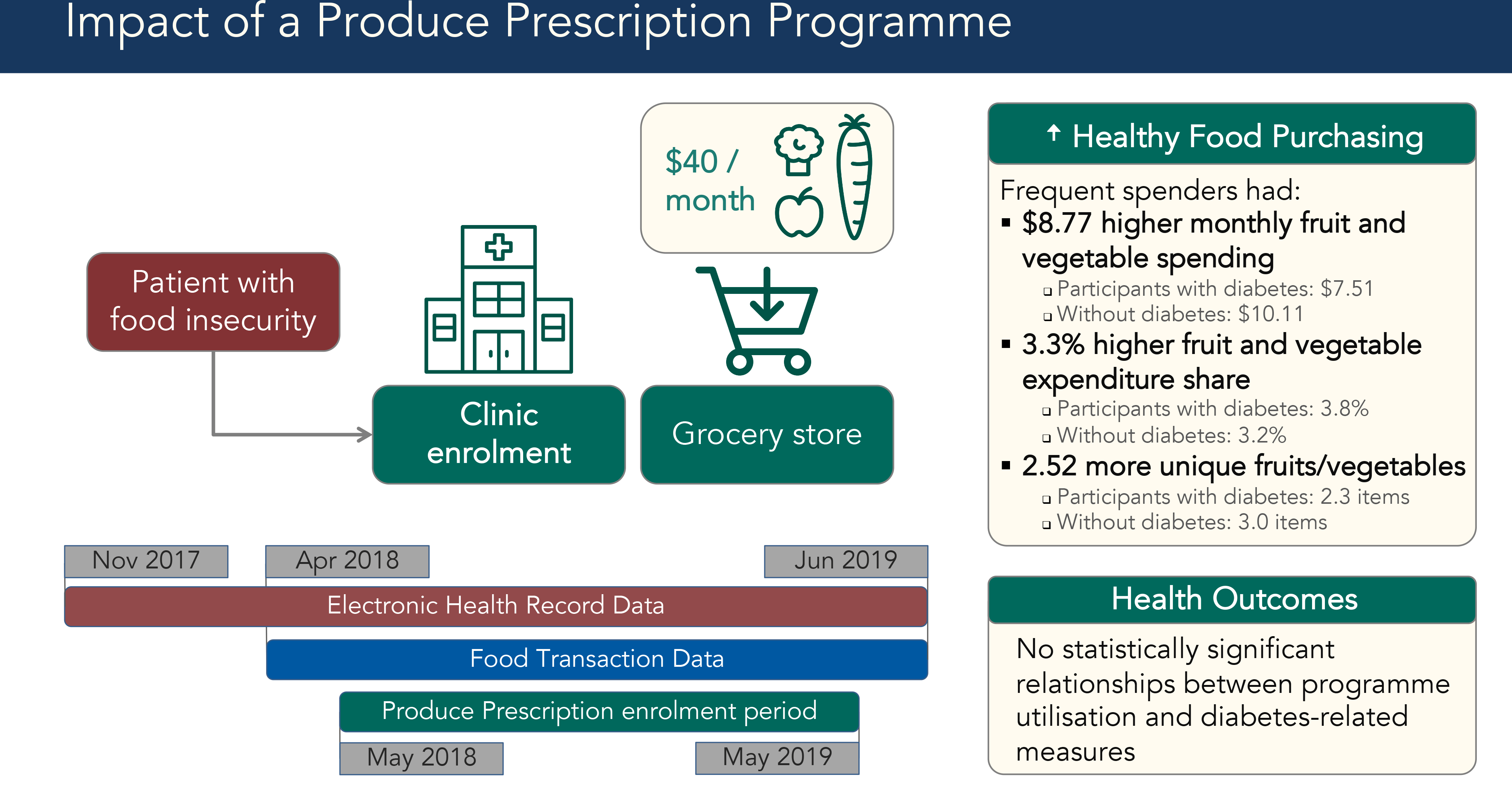
To evaluate a Produce Prescription Programme’s utilisation and its effects on healthy food purchasing and diabetes control among participants with type 2 diabetes.
Design:
Prospective cohort study using participants’ electronic health records and food transaction data. Participants were categorised as ‘Frequent Spenders’ and ‘Sometimes Spenders’ based on utilisation frequency. Multivariate regressions assessed utilisation predictors and programme effects on fruit/vegetable purchasing (spending, expenditure share and variety) and on diabetes-related outcomes (HbA1c, BMI and blood pressure).
Setting:
Patients enrolled by clinics in Durham, North Carolina, USA. Participants received $40 monthly for fruits and vegetables at a grocery store chain.
Participants:
A total of 699 food-insecure participants (353 with diabetes).
Results:
Being female and older was associated with higher programme utilisation; hospitalisations were negatively associated with programme utilisation. Frequent Spender status was associated with $8·77 more in fruit/vegetable spending (P < 0·001), 3·3 % increase in expenditure share (P = 0·007) and variety increase of 2·52 fruits and vegetables (P < 0·001). For $10 of Produce Prescription Dollars spent, there was an $8·00 increase in fruit/vegetable spending (P < 0·001), 4·1 % increase in expenditure share and variety increase of 2·3 fruits/vegetables (P < 0·001). For the 353 participants with diabetes, there were no statistically significant relationships between programme utilisation and diabetes control.
Conclusions:
Programme utilisation was associated with healthier food purchasing, but the relatively short study period and modest intervention prevent making conclusions about health outcomes. Produce Prescription Programmes can increase healthy food purchasing among food-insecure people, which may improve chronic disease care.
The objective is to analyse Danish consumers’ attitudes to buying food with reduced salt content.
Design:
The study is based on a comprehensive store intervention that included 114 stores belonging to the same supermarket chain. Three different salt claims were tested for 8 weeks on six test products within the categories bread, cornflakes and frozen pizzas. Scanner data were supplemented with 134 brief interviews with consumers in nine selected stores.
Setting:
Stores spread across Denmark.
Participants:
Consumers who buy food in the stores.
Results:
Statistical regression analyses of the scanner data indicated that none of the three claims significantly affected demand for any of the test products. The interviews confirmed that many consumers were more focused on other elements of the official dietary advice than reduced salt consumption, such as eating plenty of vegetables, choosing products with whole grains and reducing their intake of sugar and fat.
Conclusions:
Overall, both the scanner data and the interviews pointed in the same direction, towards the conclusion that salt content is often a secondary factor when Danish consumers make dietary choices.