We partner with a secure submission system to handle manuscript submissions.
Please note:
You will need an account for the submission system, which is separate to your Cambridge Core account. For login and submission support, please visit the
submission and support pages.
Please review this journal's author instructions, particularly the
preparing your materials
page, before submitting your manuscript.
Click Proceed to submission system to continue to our partner's website.
To save this undefined to your undefined account, please select one or more formats and confirm that you agree to abide by our usage policies. If this is the first time you used this feature, you will be asked to authorise Cambridge Core to connect with your undefined account.
Find out more about saving content to .
To send this article to your Kindle, first ensure no-reply@cambridge.org is added to your Approved Personal Document E-mail List under your Personal Document Settings on the Manage Your Content and Devices page of your Amazon account. Then enter the ‘name’ part of your Kindle email address below. Find out more about sending to your Kindle.
Find out more about saving to your Kindle.
Note you can select to save to either the @free.kindle.com or @kindle.com variations. ‘@free.kindle.com’ emails are free but can only be saved to your device when it is connected to wi-fi. ‘@kindle.com’ emails can be delivered even when you are not connected to wi-fi, but note that service fees apply.
Screen use at mealtimes is associated with poor dietary and psychosocial outcomes in children and is disproportionately prevalent among families of low socio-economic position (SEP). This study aimed to explore experiences of reducing mealtime screen use in mothers of low SEP with young children.
Design:
Motivational interviews, conducted via Zoom or telephone, addressed barriers and facilitators to reducing mealtime screen use. Following motivational interviews, participants co-designed mealtime screen use reduction strategies and trialled these for 3–4 weeks. Follow-up semi-structured interviews then explored maternal experiences of implementing strategies, including successes and difficulties. Transcripts were analysed thematically.
Setting:
Australia.
Participants:
Fourteen mothers who had no university education and a child between six months and six years old.
Results:
A range of strategies aimed to reduce mealtime screen use were co-designed. The most widely used strategies included changing mealtime location and parental modelling of expected behaviours. Experiences were influenced by mothers’ levels of parenting self-efficacy and mealtime consistency, included changes to mealtime foods and an increased value of mealtimes. Experiences were reportedly easier, more beneficial and offered more opportunities for family communication, than anticipated. Change required considerable effort. However, effort decreased with consistency.
Conclusions:
The diverse strategies co-designed by mothers highlight the importance of understanding why families engage in mealtime screen use and providing tailored advice for reduction. Although promising themes were identified, in this motivated sample, changing established mealtime screen use habits still required substantial effort. Embedding screen-free mealtime messaging into nutrition promotion from the inception of eating will be important.
To assess annual household purchases of sugar-sweetened beverages (SSBs), artificially sweetened beverages (AFSBs), and unsweetened beverages (USBs) by household composition and income, and over time.
Design:
Observational cohort study using beverage purchasing data linked to a supermarket database. ANOVA was used to compare total household purchase volumes (L) and the contribution of beverages purchased by category, household composition (size), household income (four categories from New Zealand (NZ) < $30 000 to > $90 000), and over time (trend from 2015 to 2019).
Setting:
Aotearoa NZ.
Participants:
∼1800 households in the NielsenIQ Homescan® market research panel.
Results:
In 2019, the mean (sd) annual household purchase volume and relative contribution to total beverage volume of SSBs were 72·3 (93·0) L and 33 %, respectively. Corresponding values for AFSBs were 32·5 (79·3) L (15 %), and USBs were 112·5 (100·9) L (52 %). Larger households purchased more of all beverage types except AFSBs. Total purchases were similar by income, but households earning < $NZ 30 000 purchased fewer AFSBs and USBs (but not SSBs) than households earning > $NZ 90 000. Total and USB purchases were unchanged over time, but SSBs dropped by 5·9 L (P-trend = 0·04), and AFSBs increased by 5·3 L (P-trend = 0·00).
Conclusions:
USBs contributed the most to household beverage purchases. Total purchases were higher for larger households and similar by income, including for SSBs. The reduction over time was too small for health benefits. Findings support policies and interventions to reduce SSB consumption and highlight the importance of focusing on equitable outcomes.
This study presents the development and evaluation of food preservation lessons for gardeners.
Design:
Lessons were developed using the DESIGN process, a nutrition education program planning framework. This study examines the effectiveness of this curriculum at increasing knowledge of proper food preservation practices and increasing participants’ confidence in home food preservation, identifies challenges participants experienced with home food preservation and assesses the perceived influence of home food preservation on vegetable intake and aspects of food security. We used the DESIGN process developed by Contento and Koch to develop the curricula and used social cognitive theory to guide the lesson development. Lessons on three types of food preservation (freezing, water bath canning and pressure canning) were developed and presented to adult gardeners. The evaluation consisted of post-lesson surveys and a follow-up survey several months after the lessons.
Setting:
Mid-Michigan, USA.
Participants:
Adult gardeners.
Results:
Food preservation confidence increased following the lessons. At follow-up, 64 % of participants agreed or strongly agreed that they ate more fruit and vegetables because of preserving food, 57 % of respondents agreed or strongly agreed that they spend less money on food due to preserving, while 71 % reported being better able to provide food for themselves and their family. Lastly, 93 % reported feeling better about where their food comes from and wasting less food due to preserving.
Conclusions:
This study provides evidence that home food preservation may be beneficial in promoting fruit and vegetable intake and food security among gardeners.
To evaluate sex- and age-stratified body composition (BC) parameters in subjects with wide age range of 20–79 years.
Design:
Cross-sectional.
Setting:
Participants of Tehran Lipid and Glucose Study (TLGS).
Participants:
Two thousand nine hundred seventy participants met our inclusion criteria. They were divided into five age groups, and BC parameters were analysed based on sex and age using a bioelectrical impedance analyser (BIA).
Result:
The mean age of the participants was 42·1 ± 12·5 years, and 54 % of them were males. The mean BMI was 26·7 ± 3·7 kg/m2. Obesity indices were significantly higher in females (P < 0·001); however, skeletal muscle mass (SMM) and fat-free mass (FFM) were significantly higher in males (P < 0·001). Both SMM and FFM decreased significantly after the age of 50 years. Obesity indices significantly increased from the age group of 20–29 to 30–39 years in males and the age groups of 30–39 to 40–49 years and 40–49 to 50–59 years in females. The fat mass ratio (fat mass/SMM) showed two peaks in both sexes (after the ages of 30 and 50 years in males and 40 and 50 years in females). A strong correlation was found between BMI and percentage of body fat (r = 0·823 in females v. r = 0·768 in males).
Conclusion:
This is the first community-based study in the MENA region identifying sex- and age-stratified BC values using BIA. Our findings can be used as a reference for comparison in appropriate settings.
Implementation of school meal guidelines is often inadequate, and evidence for effective implementation strategies for school-based nutrition interventions is limited. The aim of the present study was to examine the implementation and effectiveness of a multi-strategy implementation intervention to increase adherence to the Norwegian national school meal guideline.
Design:
The study was a school-based hybrid implementation effectiveness trial with a pre–post non-equivalent control group design, testing three implementation strategies: internal facilitation, training and an educational meeting.
Setting:
Primary schools and after-school services in two counties in south-east Norway.
Participants:
School principals, after-school leaders and class teachers from thirty-three schools in the intervention county and principals and after-school leaders from thirty-four schools in a comparison county.
Results:
There was a significant difference of 4 percentage points in change scores between the intervention and the comparison groups at follow-up, after adjusting for baseline adherence (B = 0·04, seB = 0·01, t = 3·10, P = 0·003). The intervention effect was not associated with the school’s socio-economic profile. School-level fidelity was the implementation dimension that was most strongly correlated (rs = 0·48) with the change scores in the intervention group, indicating that principals’ support is important for gaining the largest intervention effects.
Conclusions:
A school-based intervention with low intensity, based on trained teachers as internal facilitators, can increase adherence to the national school meal guideline among Norwegian primary schools, irrespective of local socio-economic conditions. Implementation fidelity, at an organisational level, may be a useful predictor for intervention outcomes in schools.
Sugar-sweetened beverages (SSB) are heavily advertised globally, and SSB consumption is linked to increased health risk. To reduce unhealthy food marketing, Chile implemented a regulation for products classified as high in energies, sugar, saturated fat or sodium, starting with a 2016 ban on child-targeted advertising of these products and adding a 06.00–22.00 daytime advertising ban in 2019. This study assesses changes in television advertising prevalence of ready-to-drink beverages, including and beyond SSB, to analyse how the beverage industry shifted its marketing strategies across Chile’s implementation phases.
Design:
Beverage advertisements were recorded during two randomly constructed weeks in April-May of 2016 (pre-implementation) through 2019 (daytime ban). Ad products were classified as ‘high-in’ or ‘non-high-in’ according to regulation nutrient thresholds. Ads were analysed for their programme placement and marketing content.
Setting:
Chile.
Results:
From pre-regulation to daytime ban, child-targeted, daytime and total ads decreased by 51·8 percentage points (p.p.), 51·5 p.p. and 61·8 p.p. for high-in products and increased by 62·9 p.p., 54·9 p.p. and 61·8 p.p. for non-high-in products (Ps < 0·001). Additionally, total ready-to-drink beverage ads increased by 5·4 p.p. and brand-only ads (no product shown) by 7 p.p.
Conclusions:
After the regulation implementation, ‘high-in’ ads fell significantly, but ‘non-high-in’ ads rose and continued using strategies targeting children and being aired during daytime. Given research showing that advertising one product can increase preferences for a different product from that same brand and product categories, broader food marketing regulation approaches may be needed to protect children from the harmful effects of food marketing.
To explore dietary patterns in relation to periodontitis and number of teeth.
Design:
A cross-sectional study.
Setting:
We used data from the seventh survey of the Tromsø Study in Norway, 2015–2016. Three periodontitis groups were compared: (i) no periodontitis/slow bone loss; (ii) moderate bone loss; and (iii) rapid bone loss. Number of teeth was categorised as 25–28, 20–24 and ≤ 19. Dietary patterns were identified by principal component analysis. Multiple logistic regression was applied to examine associations between tertiles of dietary pattern scores and periodontitis, and between these same tertiles and number of teeth.
Participants:
1487 participants (55·5 % women) aged 40–79 years who were free of major chronic diseases, attended an oral health examination and completed a FFQ.
Results:
Four dietary patterns were identified, which explained 24 % of the total variability in food intake: fruit and vegetables, Westernised, meat/fish and potatoes, and refined grain and dessert. The fruit and vegetables pattern was inversely associated with periodontitis characterised by rapid bone loss when compared with no periodontitis/slow bone loss (OR tertile 3 v. 1 0·49, 95 % CI: 0·25, 0·98). Participants who were in the highest tertile of the refined grain and dessert pattern (tertile 3 v. 1) had 2·38- and 3·52-fold increased odds of having ≤ 19 than 20–24 and 25–28 teeth, respectively.
Conclusion:
Out of four identified dietary patterns, only the fruit and vegetables pattern was negatively associated with advanced periodontitis. A more apparent positive association was observed between the refined grain and dessert pattern and having fewer teeth (≤ nineteen teeth).
To describe and discuss a 2-step methodology developed to select a reference society that provides Dietary Reference Values (DRV) for national implementation and to illustrate its application in Switzerland with one macronutrient and one micronutrient.
Design:
During Step 1, we searched and compared DRV and methodologies used to define DRV from eight European societies for seven selected nutrients. We repeated this procedure during Step 2 for DRV from two preselected societies for forty-four nutrients.
Setting:
The 2-step methodology applied here for Switzerland may be used in other countries.
Participants:
The research team commissioned six external experts from three linguistic regions of Switzerland, who provided their opinions through two online surveys, individual interviews and a focus group.
Results:
After Step 1, we excluded five societies because of old publication dates, irrelevant publication languages for Switzerland, difficulty in accessing documents, or because their DRV were mainly based on another society. After Step 2, the two societies were qualified based on the analysis of the values and methodologies used. The need for free and easily accessible scientific background information favoured the European Food Safety Authority (EFSA). We chose alternative societies for nine nutrients for the overall population or subgroups and for the elderly.
Conclusions:
To manage heterogeneous and complex data from several societies, adopting a 2-step methodology including fewer nutrients and more societies during Step 1, and fewer societies but all nutrients in Step 2, was very helpful. With some exceptions, we selected EFSA as the main society to provide DRV for Switzerland.
This study investigated the trend of effect estimates of the key risk factors of childhood stunting and anaemia between 2003 and 2017.
Design:
A secondary analysis of the Demographic Health Survey (DHS) and Multiple Indicator Cluster Survey (MICS) data for the Ghanaian population between 2003 and 2017. Associations of selected socio-demographic (child age and gender; maternal age and education), economic (household wealth), environmental, dietary (minimum dietary diversity and iodine use) and health system (place of delivery and vaccination) factors were explored using the Poisson regression model. Trend analysis was explored using a fitted linear regression line on a time series plot.
Setting:
Ghana
Participants:
Children under 5 years
Results:
The results showed a reduction in the prevalence of stunting and anaemia over the 15-year duration. These health outcomes were found to be negatively associated with a wide array of socio-demographic (child age and gender, maternal age and education, residency), economic (household wealth), dietary (iodised salt use) and health service (place of delivery and vaccination) factors; however, the most consistent statistically significant association was observed between child’s age and belonging to the poor wealth quintile.
Conclusion:
In order to prevent these indicators of child malnutrition, key consideration must be given to the early developmental stages of life. Child health policies must focus on addressing the key contextual factors of child malnutrition.
Anaemia affects more than half of Indian women and children, but the contribution of its causes remains unquantified. We examined interrelationships between Hb and nutritional, environmental, infectious and genetic determinants of anaemia in non-pregnant mothers and children in Uttar Pradesh (UP).
Design:
We conducted a cross-sectional survey of households in twenty-five districts of UP between October and December 2016. We collected socio-demographic data, anthropometry and venous blood in 1238 non-pregnant mothers and their children. We analysed venous blood samples for malaria, Hb, ferritin, retinol, folate, Zn, vitamin B12, C-reactive protein, α1-acid glycoprotein (AGP) and β-thalassaemia. We used path analysis to examine pathways through which predictors of anaemia were associated with Hb concentration.
Setting:
Rural and urban households in twenty-five districts of UP.
Participants:
Mothers 18–49 years and children 6–59 months in UP.
Results:
A total of 36·4 % of mothers and 56·0 % of children were anaemic, and 26·7 % of women and 44·6 % of children had Fe deficiency anaemia. Ferritin was the strongest predictor of Hb (β (95 % CI) = 1·03 (0·80, 1·27) g/dL in women and 0·90 (0·68, 1·12) g/dL in children). In children only, red blood cell folate and AGP were negatively associated with Hb and retinol was positively associated with Hb.
Conclusions:
Over 70 % of mothers and children with anaemia had Fe deficiency, needing urgent attention. However, several simultaneous predictors of Hb exist, including nutrient deficiencies and inflammation. The potential of Fe interventions to address anaemia may be constrained unless coexisting determinants are jointly addressed.
We investigated the missed treatment opportunities affecting programmes using mid-upper arm circumference (MUAC) as the sole anthropometric criterion for identification and monitoring of children suffering from severe acute malnutrition (SAM).
Design:
Alongside MUAC, we assessed weight-for-height Z-score (WHZ) in children screened and treated according to the national MUAC only protocol in Pakistan. Besides, we collected parents’ perceptions regarding the treatment received by their children through qualitative interviews.
Setting:
Data were collected from October to December 2021 in Tando Allah Yar District, Sindh.
Subjects:
All children screened in the health facilities (n 8818) and all those discharged as recovered (n 686), throughout the district, contributed to the study. All children screened in the community in the catchment areas of five selected health facilities also contributed (n 8459). Parents of forty-one children randomly selected from these same facilities participated in the interviews.
Results:
Overall, 80·3 % of the SAM cases identified during community screening and 64·1 % of those identified in the health facilities presented a ‘WHZ-only’ diagnosis. These figures reached 93·9 % and 84·5 %, respectively, in children aged over 24 months. Among children treated for SAM and discharged as recovered, 25·3 % were still severely wasted according to WHZ. While parents positively appraised the treatment received by their children, they also recommended to extend eligibility to other malnourished children in their neighbourhood.
Conclusion:
In this context, using MUAC as the sole anthropometric criterion for treatment decisions (referral, admission and discharge) resulted in a large number of missed opportunities for children in need of timely and adequate care.
To evaluate the acceptability of traditional Zambian dishes fortified with Complementary Food for Africa+Dried Fish Powder (ComFA+Fish), a locally sourced protein/micronutrient blend designed to impact nutrient deficiencies among infants and young children (IYC) and improve pregnancy and birth outcomes among women of reproductive age (WRA).
Design:
During two sensory panels, caregivers evaluated: (1) the acceptability of four ComFA+Fish dishes for household consumption, including fortified chibwabwa fisashi, savory Kapenta chutney, fortified complementary maize porridge and fortified bean-vegetable soup and (2) whether their IYC found the fortified complementary maize porridge acceptable.
Setting:
Lake Kariba, Southern Province, Zambia.
Participants:
Women of reproductive age (n 42) and their IYC aged 6–11 months (n 16) and 12–23 months (n 26) were recruited from fishing villages in Gwembe, Siavonga and Sinazongwe District.
Results:
A majority of caregivers extremely liked/liked the: (1) fortified chibwabwa fisashi’s sensory attributes (94·7 %), convenience (92·8 %) and overall acceptability (100 %); (2) savory Kapenta chutney’s sensory attributes (81·8 %), convenience (92·8 %) and overall acceptability (100 %); (3) fortified complementary porridge’s sensory attributes (83·5 %), convenience (90·5 %) and overall acceptability (88·1 %) and (4) fortified bean-vegetable soup’s sensory attributes (66·8 %), convenience (87·5 %) and overall acceptability (87·5 %). Further, a majority of caregivers evaluated the fortified complementary porridge as highly acceptable to their IYC.
Conclusions:
Results suggest that ComFA+Fish is strategically well placed to fill nutritional gaps among IYC and WRA in Zambia and has the potential to be scaled across sub-Saharan Africa.
In South Asia, while women make substantial economic contributions through their participation in agricultural sector, these contributions are undercounted as most of their work is underpaid or unpaid. This paper examines how mothers allocate their time to productive and reproductive activities and its association with a household’s ability to achieve high household diet diversity score.
Design:
The analysis uses data on household consumption and expenditure including food during the kharif (June to October) season (seeds are sown) and a modular time-use survey.
Setting:
Two districts of rural Bihar, India.
Participants:
Mothers with children less than 5 years of age and supported by the head of the household from 2026 households.
Results:
The estimates indicate that the high household diet diversity (High HDDS ≥ 10) is associated with greater time spent in reproductive activities by all women (OR = 1·12, 95 % CI: 1·06, 1·18). However, with increasing time spent in productive activities by the women the odds of achieving ‘High HDDS’ reduced (OR = 0·83, 95 % CI: 0·77, 0·89) in adjusted logistic regression analysis.
Conclusion:
The findings highlight propensity to achieve ‘High HDDS’ in Bihar increased with mothers allocating time towards reproductive activities, while it had an opposing effect with mothers allocating time on productive activities. Our study highlights that the policies that encourage women’s participation in agriculture or livestock should acknowledge the unpaid nature of some of the productive activities and design programs to improve economic agency of women to actuate the true potential of agriculture-nutrition pathways.
This study evaluated the independent and combined environmental impacts of the consumption of beef and ultra-processed foods in Brazil.
Design:
Cross-sectional study.
Setting:
Brazil.
Participants:
We used food purchases data from a national household budget survey conducted between July 2017 and July 2018, representing all Brazilian households. Food purchases were converted into energy, carbon footprints and water footprints. Multiple linear regression models were used to assess the association between quintiles of beef and ultra-processed foods in total energy purchases and the environmental footprints, controlling for sociodemographic variables.
Results:
Both beef and ultra-processed foods had a significant linear association with carbon and water footprints (P < 0·01) in crude and adjusted models. In the crude upper quintile of beef purchases, carbon and water footprints were 47·7 % and 30·8 % higher, respectively, compared to the lower quintile. The upper quintile of ultra-processed food purchases showed carbon and water footprints 14·4 % and 22·8 % higher, respectively, than the lower quintile. The greatest reduction in environmental footprints would occur when both beef and ultra-processed food purchases are decreased, resulting in a 21·1 % reduction in carbon footprint and a 20·0 % reduction in water footprint.
Conclusions:
Although the environmental footprints associated with beef consumption are higher, dietary patterns with lower consumption of beef and ultra-processed foods combined showed the greatest reduction in carbon and water footprints in Brazil. The high consumption of beef and ultra-processed foods is harmful to human health, as well as to the environment; thus, their reduction is beneficial to both.
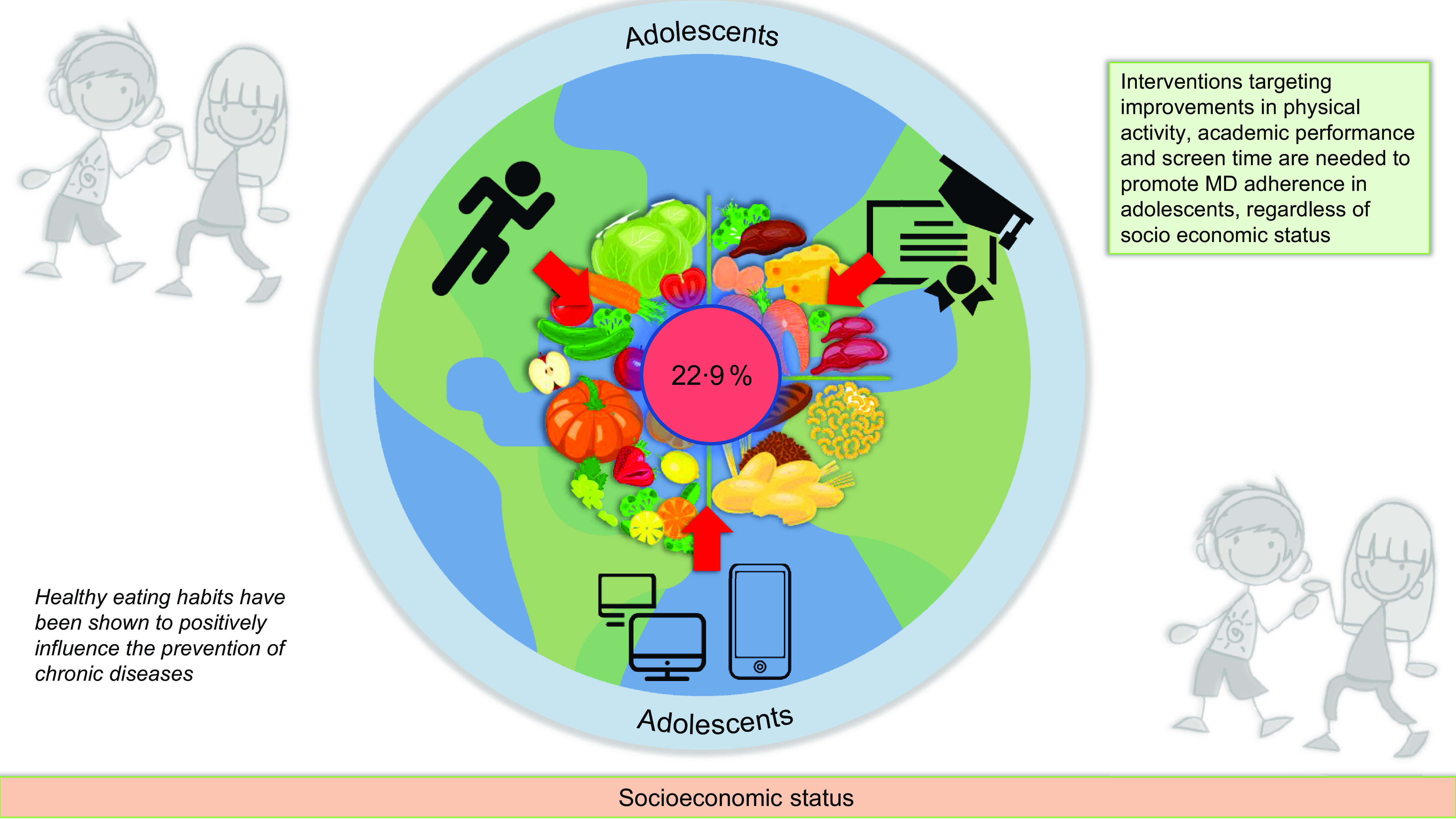
The present study examined the association of BMI, fat mass, physical activity engagement (PA), maximal oxygen consumption (VO2max), screen time and academic performance (AP) with Mediterranean diet (MD) adherence in a sample of high socio-economic status (SES) children.
Design:
A non-randomised design was used. A multilinear regression model was developed using backward elimination. Analysis included variables pertaining to age, BMI, VO2max, fat percentage, AP, PA engagement and screen time. All participants had a high SES and so this variable was not included as a predictor. Data met the assumptions required for multiple regressions in terms of linearity, homoscedasticity, normality, independence and non-multicollinearity.
Setting:
Two state and three mixed funding schools in Granada, Spain.
Participants:
Data were collected from 244 children aged between 10 and 12 years.
Results:
Better AP, higher PA engagement and lower screen time were found to be predictive of MD adherence. These variables explained 22·9 % of the variance in data measuring adolescent MD adherence.
Conclusions:
The present study suggests that, in addition to SES, PA, AP and screen time are important components to consider when targeting improvements in MD adherence in children. It is, therefore, concluded that interventions targeting improvements in PA, AP and screen time are needed to promote MD adherence in children, regardless of SES.
Diet quality is significantly impacted by social and environmental factors. People experiencing socio-economic disadvantage face inequitable barriers to accessing nutritious foods and health services, resulting in significant health disparities. This study aimed to explore the barriers faced by organisations that provide food support to people experiencing disadvantage as well as to identify potential strategies to enhance this support for improved well-being of clients.
Design:
Semi-structured interviews using an exploratory approach and inductive thematic analysis.
Setting:
Australia.
Participants:
Individuals from organisations involved in the provision of food support for people experiencing disadvantage aged ≥16 years.
Results:
Two major themes were identified from thirteen interviews. ‘Dignity and respect for clients’ serves as a guiding principle for food-related services across all organisations, while ‘food’ was a point of connection and a potential gateway to additional support pathways. Five additional subthemes included ‘food as a platform to reduce social isolation, foster connection and promote participation’, challenges with ‘servicing clients with diverse experiences and needs’, ‘dependence on staff and volunteers with varying knowledge and skillsets’, ensuring ‘adequate access to services, resources and facilities’ and ‘necessity of community collaboration’.
Conclusions:
This study highlights the unique position of organisations involved in food support to identify client-specific needs and implement broader holistic health support. Future interventions should prioritise dignity, respect and social connection in design. Organisations require an adequately trained, sustainable workforce, with shared or enhanced services, resources and facilities, and greater community coordination with other services to maximise effectiveness.
To measure the effects of health-related food taxes on the environmental impact of consumer food purchases in a virtual supermarket.
Design:
This is a secondary analysis of data from a randomised controlled trial in which participants were randomly assigned to a control condition with regular food prices (n 152), an experimental condition with a sugar-sweetened beverage (SSB) tax (n 131) or an experimental condition with a nutrient profiling tax based on Nutri-Score (n 112). Participants were instructed to undertake their typical weekly grocery shopping for their households. Primary outcome measures were three environmental impact indicators: greenhouse gas (GHG) emissions, land use and blue water use per household per week. Data were analysed using linear regression analyses.
Setting:
Three-dimensional virtual supermarket.
Participants:
Dutch adults (≥ 18 years) who were responsible for grocery shopping in their household (n 395).
Results:
GHG emissions (–7·6 kg CO2-eq; 95 % CI –12·7, –2·5) and land use (–3·9 m2/year; 95 % CI –7·7, –0·2) were lower for the food purchases of participants in the nutrient profiling tax condition than for those in the control condition. Blue water use was not affected by the nutrient profiling tax. Moreover, the SSB tax had no significant effect on any of the environmental impact indicators.
Conclusions:
A nutrient profiling tax based on Nutri-Score reduced the environmental impact of consumer food purchases. An SSB tax did not affect the environmental impact in this study.
To investigate whether financial constraint and perceived stress modify the effects of food-related taxes on the healthiness of food purchases.
Design:
Moderation analyses were conducted with data from a trial where participants were randomly exposed to: a control condition with regular food prices, an sugar-sweetened beverage (SSB) tax condition with a two-tiered levy on the sugar content in SSB (5–8 g/100 ml: €0·21 per l and ≥8 g/100 ml: €0·28 per l) or a nutrient profiling tax condition where products with Nutri-Score D or E were taxed at a 20 percent level. Outcome measures were overall healthiness of food purchases (%), energy content (kcal) and SSB purchases (litres). Effect modification was analysed by adding interaction terms between conditions and self-reported financial constraint or perceived stress in regression models. Outcomes for each combination of condition and level of effect modifier were visualised.
Setting:
Virtual supermarket.
Participants:
Dutch adults (n 386).
Results:
Financial constraint or perceived stress did not significantly modify the effects of food-related taxes on the outcomes. Descriptive analyses suggest that in the control condition, the overall healthiness of food purchases was lowest, and SSB purchases were highest among those with moderate/high levels of financial constraint. Compared with the control condition, in a nutrient profiling tax condition, the overall healthiness of food purchases was higher and SSB purchases were lower, especially among those with moderate/high levels of financial constraint. Such patterns were not observed for perceived stress.
Conclusion:
Further studies with larger samples are recommended to assess whether food-related taxes differentially affect food purchases of subgroups.
To investigate adolescents’ experiences with the food selection at the sport arena.
Design:
Four focus group interviews were conducted with 4–6 participants each. Interviews were recorded and transcribed verbatim. The transcripts were coded in NVivo and the analysis was guided by thematic analysis.
Setting:
Adolescents from handball and football clubs in Oslo and Viken, Norway, participated in the study.
Participants:
A total of nine boys (11–14 years old) and ten girls (11–14 years old) participated in the study.
Results:
We identified four main themes: interest for healthy food; experiences with the food selection at the sports arena; factors influencing participants’ food choices at the sports arena and expectations related to a healthy food selection at the sports arena. Adolescents across the focus groups experienced the food selection at the sports arena as unhealthy. Price, marketing and availability of unhealthy food were important factors that influenced their food choices at the sports arena. The trainer appeared to motivate the participants to eat healthy.
Conclusions:
Participants wished for a healthier food selection at the sports arena. Cost of food emerged as a factor that influenced their food choices. Our study also indicates that marketing of unhealthy food and beverages should be restricted, to influence adolescence food choice towards healthier alternatives.
This study assesses the relationship between adverse childhood experiences (ACE) occurring before the age of 18 years and patterns of fast-food consumption and sugary beverage consumption in adulthood. The study also examines how perceived stress and socio-economic status (SES) (college educational attainment and income) in adulthood mediate this relationship.
Design:
Using data from the National Longitudinal Study of Adolescent to Adulthood Health (N 8599), multinomial logistic regression analyses were carried out to assess the association between ACE and unhealthy dietary behaviours in adulthood. Karlson–Holm–Breen mediation analysis is used to determine the mediating effects of SES and perceived stress.
Setting:
Persons living in the USA in 2016–2018.
Participants:
Adults (n 8599) aged 33–44 years.
Results:
The findings show an association between four or more ACE and high fast-food (relative risk ratio (RRR) = 1·436, 95 % CI = 1·040, 1·983) and high sugary beverage consumption (RRR = 1·435, 95 % CI = 1·002, 2·055). The association between ACE and high fast-food consumption is partially mediated by college educational attainment, and the association between ACE and high sugary beverage consumption is partially mediated by perceived stress and college educational attainment.
Conclusions:
ACE can have long-term consequences for unhealthy dietary behaviours in adulthood, and this relationship is partially due to a lower likelihood of higher perceived stress and college educational attainment among ACE-exposed persons. Future research is needed to understand further the influence of ACE on dietary patterns over the life course.