We partner with a secure submission system to handle manuscript submissions.
Please note:
You will need an account for the submission system, which is separate to your Cambridge Core account. For login and submission support, please visit the
submission and support pages.
Please review this journal's author instructions, particularly the
preparing your materials
page, before submitting your manuscript.
Click Proceed to submission system to continue to our partner's website.
To save this undefined to your undefined account, please select one or more formats and confirm that you agree to abide by our usage policies. If this is the first time you used this feature, you will be asked to authorise Cambridge Core to connect with your undefined account.
Find out more about saving content to .
To send this article to your Kindle, first ensure no-reply@cambridge.org is added to your Approved Personal Document E-mail List under your Personal Document Settings on the Manage Your Content and Devices page of your Amazon account. Then enter the ‘name’ part of your Kindle email address below. Find out more about sending to your Kindle.
Find out more about saving to your Kindle.
Note you can select to save to either the @free.kindle.com or @kindle.com variations. ‘@free.kindle.com’ emails are free but can only be saved to your device when it is connected to wi-fi. ‘@kindle.com’ emails can be delivered even when you are not connected to wi-fi, but note that service fees apply.
To understand which anthropometric diagnostic criteria best discriminate higher from lower risk of death in children and explore programme implications.
Design:
A multiple cohort individual data meta-analysis of mortality risk (within 6 months of measurement) by anthropometric case definitions. Sensitivity, specificity, informedness and inclusivity in predicting mortality, face validity and compatibility with current standards and practice were assessed and operational consequences were modelled.
Setting:
Community-based cohort studies in twelve low-income countries between 1977 and 2013 in settings where treatment of wasting was not widespread.
Participants:
Children aged 6 to 59 months.
Results:
Of the twelve anthropometric case definitions examined, four (weight-for-age Z-score (WAZ) <−2), (mid-upper arm circumference (MUAC) <125 mm), (MUAC < 115 mm or WAZ < −3) and (WAZ < −3) had the highest informedness in predicting mortality. A combined case definition (MUAC < 115 mm or WAZ < −3) was better at predicting deaths associated with weight-for-height Z-score <−3 and concurrent wasting and stunting (WaSt) than the single WAZ < −3 case definition. After the assessment of all criteria, the combined case definition performed best. The simulated workload for programmes admitting based on MUAC < 115 mm or WAZ < −3, when adjusted with a proxy for required intensity and/or duration of treatment, was 1·87 times larger than programmes admitting on MUAC < 115 mm alone.
Conclusions:
A combined case definition detects nearly all deaths associated with severe anthropometric deficits suggesting that therapeutic feeding programmes may achieve higher impact (prevent mortality and improve coverage) by using it. There remain operational questions to examine further before wide-scale adoption can be recommended.
Excess salt consumption is causally linked with stomach cancer, and salt intake among adults in Vietnam is about twice the recommended levels. The aim of this study was to quantify the future burden of stomach cancer that could be avoided from population-wide salt reduction in Vietnam.
Design:
A dynamic simulation model was developed to quantify the impacts of achieving the 2018 National Vietnam Health Program (8 g/d by 2025 and 7 g/d by 2030) and the WHO (5 g/d) salt reduction policy targets. Data on salt consumption were obtained from the Vietnam 2015 WHO STEPS survey. Health outcomes were estimated over 6-year (2019–2025), 11-year (2019–2030) and lifetime horizons. We conducted one-way and probabilistic sensitivity analyses.
Setting:
Vietnam.
Participants:
All adults aged ≥ 25 years (61 million people, 48·4 % men) alive in 2019.
Results:
Achieving the 2025 and 2030 national salt targets could result in 3400 and 7200 fewer incident cases of stomach cancer, respectively, and avert 1900 and 4800 stomach cancer deaths, respectively. Achieving the WHO target by 2030 could prevent 8400 incident cases and 5900 deaths from stomach cancer. Over the lifespan, this translated to 344 660 (8 g/d), 411 060 (7 g/d) and 493 633 (5 g/d) health-adjusted life years gained, respectively.
Conclusions:
A sizeable burden of stomach cancer could be avoided, with gains in healthy life years if national and WHO salt targets were attained. Our findings provide impetus for policy makers in Vietnam and Asia to intensify salt reduction strategies to combat stomach cancer and mitigate pressure on the health systems.
To compare the prognostic value of mid-upper arm circumference (MUAC), weight-for-height Z-score (WHZ) and weight-for-age Z-score (WAZ) for predicting death over periods of 1, 3 and 6 months follow-up in children.
Design:
Pooled analysis of twelve prospective studies examining survival after anthropometric assessment. Sensitivity and false-positive ratios to predict death within 1, 3 and 6 months were compared for three individual anthropometric indices and their combinations.
Setting:
Community-based, prospective studies from twelve countries in Africa and Asia.
Participants:
Children aged 6–59 months living in the study areas.
Results:
For all anthropometric indices, the receiver operating characteristic curves were higher for shorter than for longer durations of follow-up. Sensitivity was higher for death with 1-month follow-up compared with 6 months by 49 % (95 % CI (30, 69)) for MUAC < 115 mm (P < 0·001), 48 % (95 % CI (9·4, 87)) for WHZ < -3 (P < 0·01) and 28 % (95 % CI (7·6, 42)) for WAZ < -3 (P < 0·005). This was accompanied by an increase in false positives of only 3 % or less. For all durations of follow-up, WAZ < -3 identified more children who died and were not identified by WHZ < -3 or by MUAC < 115 mm, 120 mm or 125 mm, but the use of WAZ < -3 led to an increased false-positive ratio up to 16·4 % (95 % CI (12·0, 20·9)) compared with 3·5 % (95 % CI (0·4, 6·5)) for MUAC < 115 mm alone.
Conclusions:
Frequent anthropometric measurements significantly improve the identification of malnourished children with a high risk of death without markedly increasing false positives. Combining two indices increases sensitivity but also increases false positives among children meeting case definitions.
School lunches represent a key opportunity to improve diets and health of schoolchildren. No recent nationally representative studies have examined the nutritional differences between school meals and packed lunches in the UK. This study aimed to characterise and compare the nutritional quality of school meals and packed lunches among primary and secondary school-age children.
Design:
A pooled cross-sectional analysis of the UK’s National Diet and Nutrition Survey (2008–2017).
Setting:
United Kingdom.
Participants:
3001 children (aged 4–16 years) who completed a 3/4-d food diary which recorded meal type (school meal/packed lunch). Multivariable logistic regression models assessed associations of meeting food and nutrient recommendations by meal type. Analyses were stratified by academic key stages (KS).
Results:
KS-1 (4–7 years) and 2 (8–11 years) children consuming school meals were more likely to meet minimum recommendations for vegetables, protein-rich foods and fibre, and not exceed maximum recommendations for salt, savoury and sweet snacks compared with pupils consuming packed lunches. However, in KS-3 (12–14 years) and 4 (14–16 years), these effects were reduced. As children aged, the median weight of fruits, vegetables, protein-rich foods and dairy products consumed typically decreased for both school meals and packed lunches, and generally an increasing proportion of school meals contained sweet and savoury snacks.
Conclusion:
These findings suggest school meals are nutritionally superior to packed lunches but are not yet optimal. Quality declined at higher KS. Actions to improve lunches of primary and secondary schoolchildren across the UK are needed, with attention to KS-3 and 4 in secondary schools.
Misreporting of energy intake (EI) in nutritional epidemiology is common and even severe among adolescents. Thus, the current study aims to examine the presence, bias and impact introduced by implausible reporters.
Design:
Cross-sectional.
Setting:
Central and eastern regions of Peninsular Malaysia.
Participants:
A stratified random sampling was employed to select 917 secondary school-going adolescents (aged 15–17 years).
Results:
The prevalence of under-reporters was 17·4 %, while no over-reporters were identified. Under-reporters had higher body composition and lower dietary intakes (except for vitamin C, Cr and Fl) compared with plausible reporters (P < 0·05). Adolescents with overweight and obesity had a higher odds of under-reporting compared with under-/normal weight adolescents (P < 0·001). In model 3, the highest regression coefficient (R2 = 0·404, P < 0·001) was obtained after adjusting for reporting status.
Conclusions:
Overweight and obese adolescents were more likely to under-report their food intake and consequently affect nutrient intakes estimates. Future analyses that include nutrient intake data should adjust for reporting status so that the impact of misreporting on study outcomes can be conceded and consequently improve the accuracy of dietary-related results.
Behavioural patterns are important in understanding the synergistic effect of multiple health behaviours on childhood adiposity. Most previous evidence assessing associations between patterns and adiposity were cross-sectional and investigated two or three behaviour domains within patterns. This study aimed to identify behavioural patterns comprising four behaviour domains and investigate associations with adiposity risk in children.
Design:
Parent-report and accelerometry data were used to capture daily dietary, physical activity, sedentary behaviour and sleep data. Variables were standardised and included in the latent profile analysis to derive behavioural patterns. Trained researchers measured children’s height, weight and waist circumference using standardised protocols. Associations of patterns and adiposity measures were tested using multiple linear regression.
Setting:
Melbourne, Australia.
Participants:
A total of 337 children followed up at 6–8 years (T2) and 9–11 years (T3).
Results:
Three patterns derived at 6–8 years were broadly identified to be healthy, unhealthy and mixed patterns. Patterns at 9–11 years were dissimilar except for the unhealthy pattern. Individual behaviours characterising the patterns varied over time. No significant cross-sectional or prospective associations were observed with adiposity at both time points; however, children displaying the unhealthy pattern had higher adiposity measures than other patterns.
Conclusion:
Three non-identical patterns were identified at 6–8 and 9–11 years. The individual behaviours that characterised patterns (dominant behaviours) at both ages are possible drivers of the patterns obtained and could explain the lack of associations with adiposity. Identifying individual behaviour pattern drivers and strategic intervention are key to maintain and prevent the decline of healthy patterns.
The association between high sugar-sweetened beverages (SSB) intake during pregnancy and offspring overweight/obesity has been reported only from Western countries. The objective of this study was to examine the association between SSB intake before and during pregnancy and offspring overweight/obesity among Japanese women.
Design:
Japanese prospective birth cohort study.
Setting:
We analysed mother–offspring pairs who participated in the Tohoku Medical Megabank Project Birth and Three-Generation Cohort Study from 2013 to 2017. SSB intake during pregnancy was evaluated using the FFQ and classified into three groups: none (0 g/d), medium (<195 g/d) and high (>195 g/d). Overweight or obesity at 1 year of age in offspring was defined as having a BMI Z-score greater than 2 sd, calculated based on the BMI reference data for Japanese children. Multiple logistic regression analyses were performed to examine the associations between SSB intake before and during pregnancy and offspring overweight/obesity, after adjusting for covariates.
Participants:
Japanese mother–offspring pairs (n 7114).
Results:
The overweight/obesity rate of the offspring was 8·8 %. Pregnant women with a high intake of SSB in early to mid-pregnancy had a higher risk of overweight/obesity in their offspring compared with those who did not; the OR was 1·52 (95 % CI (1·09, 2·12)).
Conclusions:
High SSB intake in early to mid-pregnancy was associated with an increased risk of offspring overweight/obesity at 1 year of age.
To examine food and beverage purchasing patterns across formal and informal outlets among Mexican households’ and explore differences by urbanicity and income.
Design:
Cross-sectional study of a nationally representative sample of households. We calculated the proportion of total food and beverage expenditure in each household by food outlet type overall and by urbanicity and income. We defined informal outlets as those which are not registered or regulated by tax and fiscal laws. Since some of the outlets within community food environments do not fall in clear categories, we defined a continuum from formal to informal outlets, adding mixed outlets as a category.
Setting:
Mexico.
Participants:
Mexican households (n 74 203) from the 2018 National Income and Expenditure Survey.
Results:
Of the total food and beverage purchases, outlets within the formal food sector (i.e. supermarkets and convenience stores) accounted for 15 % of the purchases, 13 % of purchases occurred in outlets within the informal food sector (i.e. street markets, street vendors and acquaintances) and 70 % in fiscally mixed outlets (i.e. small neighbourhood stores, specialty stores and public markets). Across levels of urbanicity and income, most food and beverage purchases occurred in mixed outlets. Also, purchases in informal and mixed outlets decreased as levels of urbanicity and income increased. In contrast to informal outlets, purchases in formal outlets were most likely from richer households and living in larger sized cities.
Conclusions:
Understanding where Mexican households shop for food is relevant to create tailored interventions according to food outlet type, accounting for regulatory and governance structures.
Stunted children have an increased risk of diminished cognitive development, diabetes, degenerative and CVD later in life. Numerous modifiable factors decrease the risk of stunting in children. This study aimed to assess the role of the individual, household and social factors on stunting in Zimbabwean children.
Design:
A 1:2 unmatched case–control study.
Setting:
This study was conducted in two predominantly rural provinces (one with the highest national prevalence of stunting and one with the lowest prevalence) in Zimbabwe.
Participants:
Data were obtained from the caregivers of 150 children aged between 6 and 59 months with stunting and from the caregivers of 300 children without stunting.
Results:
Multiple (39) correlates of stunting were identified. Child’s age, birth length, birth weight, and weight-for-age outcome (child-related factors), caregiver’s age, maternal HIV status, occupation, and education (parental factors), breast-feeding status, number of meals, and dietary quality (dietary factors), child’s appetite, diarrhoeal and worm infection (childhood illnesses), income status, access to safe water, access to a toilet, health clubs and maternal support in infant feeding (household, socio-cultural factors) were all found to be significant predictors of childhood stunting.
Conclusion:
Nearly all aspects under review from the individual-, household- to social-level factors were significantly associated with childhood stunting. These findings add to the growing body of evidence supporting the WHO stunting framework and strengthen the need to focus interventions on a multi-sectoral approach to effectively address stunting in high prevalence countries.
Ultra-processed food (UPF) consumption is increasing exponentially, becoming a matter of concern for Public Health, given its adverse health effects.
Objective:
To identify individual and faGmily factors predicting UPF consumption in childhood.
Design:
The SENDO project is an ongoing prospective dynamic cohort of Spanish children. In this study, we used baseline information of participants recruited between January 2015 and June 2021. Dietary information was collected with a validated semi-quantitative FFQ, and food items were classified using the NOVA classification. Individual and family factors associated with UPF consumption (P < 0·20) in univariate analyses were introduced in a model of generalised estimating equations which accounted for intra-cluster correlations between siblings.
Setting:
The SENDO project (Spain), 2015–2021.
Participants:
Spanish children are recruited at the age of 4–5 years and followed yearly through online questionnaires completed by parents.
Results:
In this sample of 806 participants (49 % girls; mean age 5 years (sd: 0·90)), the mean UPF consumption was 37·64 % of total energy intake (sd: 9·59). Large family size and longer exposure to screens predicted higher consumption of UPF. On the other hand, better knowledge of children’s dietary recommendations, healthy dietary attitudes towards child’s eating habits and longer breastfeeding were associated with lower consumption of UPF. All these factors accounted for approximately 16 % of the variability on the consumption of UPF in childhood.
Conclusion:
Since most of the factors identified in this study are modifiable, they should be considered in public health strategies aimed at promoting healthy dietary habits in early life.
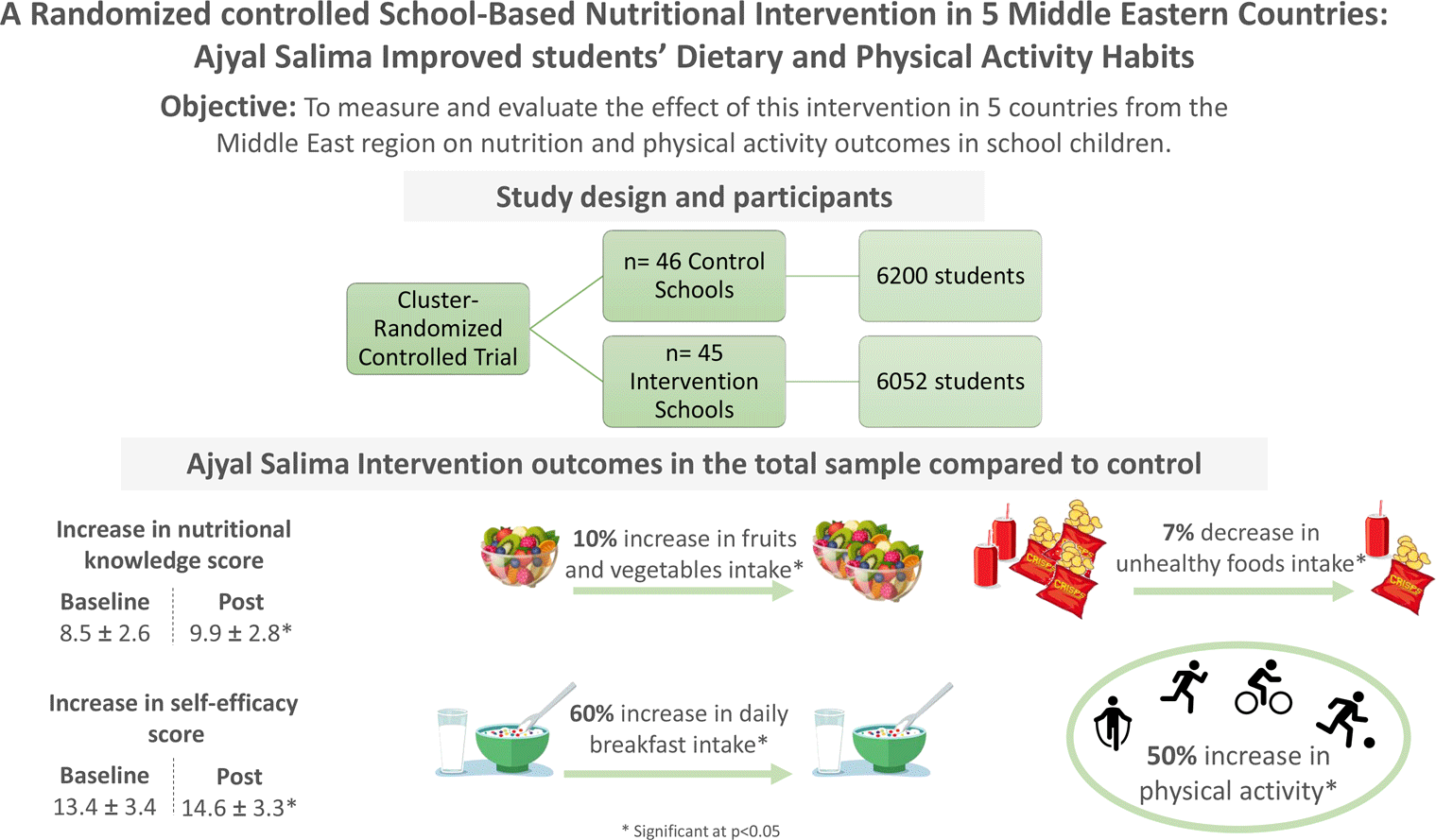
The purpose of this study was to measure the impact of the Ajyal Salima school intervention on nutrition and physical activity outcomes in children aged 9–11 years.
Design:
The study was a 1-year cluster-randomised controlled trial. Ajyal Salima used a multi-component approach including classroom activities, family programme and food service adaptation. Outcomes included daily intake of breakfast, frequency of healthy and unhealthy food consumption, frequency of physical activity, knowledge score and self-efficacy score. Intervention and control groups were compared for all main outcomes and a post-intervention qualitative evaluation assessed strengths and limitations of the intervention components.
Setting:
Schools in five countries – Lebanon, Jordan, Palestine, Saudi Arabia and Bahrain.
Participants:
Schools were selected by Ministries of Health and Education within their jurisdictions. Forty-five intervention schools (6052 students) and forty-six control schools (6200 students) were included in the analysis.
Results:
The intervention group had a significantly higher odds of consuming breakfast daily (OR 95 % CI = 1·60, 1·35, 1·90), consuming healthy foods (OR 95 % CI = 1·60, 1·39, 1·84) and a decreased odds of consuming unhealthy foods and sweetened beverages (OR, 95 % CI = 0·70, 0·60, 0·81). Additionally, school children in the intervention group, as compared with the control group, were 47 % more likely to exercise outside school hours (OR 95 % CI = 1·47, 1·23, 1·76). Lastly, children in the intervention group had a significantly improved nutritional knowledge score and improved self-efficacy by 1·3 score unit and 1·1 score unit, respectively.
Conclusions:
The Ajyal Salima intervention led to significant improvements in dietary and physical activity habits among school children and increased nutritional knowledge scores.
To determine the prevalence and associated factors of the coexistence of overweight or obesity (OWOB) and anaemia among non-pregnant Guinean women aged 15–49 years.
Design:
The analysis was performed using data from the 2018 Guinean Demographic and Health Survey. Multivariate logistic regression was used to identify factors associated with the coexistence of OWOB and anaemia (OWOB + anaemia) among non-pregnant Guinean women.
Setting:
Guinea
Participants:
A total of 4783 non-pregnant women aged 15–49 years with valid data on the nutritional status (BMI and Hb level) were included in the analysis.
Results:
The prevalence of coexistence of OWOB and anaemia among non-pregnant women was 11·16 % (95% CI: 10·05, 12·37). The following variables were associated with OWOB + anaemia in multivariate models (adjusted OR (AOR) 95% CI): higher wealth index (AOR = 4·69; 95% CI: 2·62, 8·39), middle wealth index (AOR = 1·96; 95% CI: 1·31, 2·93), four or more antenatal visits (AOR = 1·62; CI: 1·16, 2·28), having four or more children (AOR = 2·47; 95% CI: 1·37, 4·43) and the rural areas (AOR = 0·59; 95% CI: 0·37, 0·95).
Conclusion:
The current study’s findings reveal that OWOB + anaemia concerned one-tenth of non-pregnant women. Associated factors were household wealth index, multiparity, antenatal visits and rural areas. Thus, there is a need to design specific interventions to prevent the double burden of malnutrition among women of reproductive age. Interventions should include promoting physical exercise, family planning, healthy eating and raising awareness of behavioural change.
To estimate the prevalence of vitamin A deficiency (VAD) in children and associated risk factors.
Design:
Analysis of data from a cross-sectional multicentre study performed in the primary care units of the municipalities from January to June 2015. The children’s legal guardians answered a socio-economic questionnaire, and the children’s blood samples were obtained by venipuncture. Plasma retinol was determined by HPLC. Plasma retinol values of <0·70 μmol/l were considered VDA. Poisson multiple regression with robust variance was used. Values of P < 0·05 were considered significant. The data were analysed in the SPSS software, 21.0.
Setting:
Forty-eight poorest municipalities in the South Region of Brazil.
Participants:
Children (n 1503) aged 12–59 months.
Results:
The prevalence of VAD in the sample was 1·9 % (95 % CI (0·5, 6·8)). The following risk factors were associated with the outcome in the final explanatory model: family received Bolsa Familia program benefits (PR = 3·19; 95 % CI (1·69, 6·02)), child was not being breastfed (PR = 5·22; 95 % CI (1·68, 16·18)) and stunting (PR = 4·75; 95 % CI (2·10, 10·73)).
Conclusions:
VAD did not represent a public health problem for children living in socio-economically vulnerable municipalities in the South Region of Brazil, suggesting a new panorama of this nutritional deficiency even in regions of low socio-economic conditions in these three states. Thus, in view of the current nutritional transition scenario, it is necessary to continuously monitor and improve public policies related to vitamin A supplementation in the country.
This paper assesses trends in food environment and market concentration and racial and ethnic inequities in food environment exposure and food retail market concentration at the US census tract level from 2000 to 2019.
Design:
Establishment-level data from the National Establishment Time Series were used to measure food environment exposure and food retail market concentration. We linked that dataset to race, ethnicity and social vulnerability information from the American Community Survey and the Agency for Toxic Substances and Disease Registry. A geospatial hot-spot analysis was conducted to identify relatively low and high healthy food access clusters based on the modified Retail Food Environment Index (mRFEI). The associations were assessed using two-way fixed effects regression models.
Setting:
Census tracts spanning all US states.
Participants:
69 904 US census tracts.
Results:
The geospatial analysis revealed clear patterns of areas with high and low mRFEI values. Our empirical findings point to disparities in food environment exposure and market concentration by race. The analysis shows that Asian Americans are likelier to live in neighbourhoods with a low food environment exposure and low retail market concentration. These adverse effects are more pronounced in metro areas. The robustness analysis for the social vulnerability index confirms these results.
Conclusion:
US food policies must address disparities in neighbourhood food environments and foster a healthy, profitable, equitable and sustainable food system. Our findings may inform equity-oriented neighbourhood, land use and food systems planning. Identifying priority areas for investment and policy interventions is essential for equity-oriented neighbourhood planning.
To examine the cross-sectional and longitudinal (2-year follow-up) associations between dietary diversity (DD) and depressive symptoms.
Design:
An energy-adjusted dietary diversity score (DDS) was assessed using a validated FFQ and was categorised into quartiles (Q). The variety in each food group was classified into four categories of diversity (C). Depressive symptoms were assessed with Beck Depression Inventory-II (Beck II) questionnaire and depression cases defined as physician-diagnosed or Beck II >= 18. Linear and logistic regression models were used.
Setting:
Spanish older adults with metabolic syndrome (MetS).
Participants:
A total of 6625 adults aged 55–75 years from the PREDIMED-Plus study with overweight or obesity and MetS.
Results:
Total DDS was inversely and statistically significantly associated with depression in the cross-sectional analysis conducted; OR Q4 v. Q1 = 0·76 (95 % CI (0·64, 0·90)). This was driven by high diversity compared to low diversity (C3 v. C1) of vegetables (OR = 0·75, 95 % CI (0·57, 0·93)), cereals (OR = 0·72 (95 % CI (0·56, 0·94)) and proteins (OR = 0·27, 95 % CI (0·11, 0·62)). In the longitudinal analysis, there was no significant association between the baseline DDS and changes in depressive symptoms after 2 years of follow-up, except for DD in vegetables C4 v. C1 = (β = 0·70, 95 % CI (0·05, 1·35)).
Conclusions:
According to our results, DD is inversely associated with depressive symptoms, but eating more diverse does not seem to reduce the risk of future depression. Additional longitudinal studies (with longer follow-up) are needed to confirm these findings.
The goal of the present study was to evaluate the association between depression and ultra-processed food (UPF) consumption as risk factors for developing type 2 diabetes (T2D).
Design:
A prospective community study.
Setting:
Baseline data (2009–2010) from CARTaGENE community health study from Quebec, Canada, were used. Food and drink consumption was assessed using the Canadian-Diet History Questionnaire II and grouped according to their degree of processing by the NOVA classification, and participants were categorised into tertiles of UPF (g/d). Depression was defined using either a validated cut-off score on the Patient Health Questionnaire-9 or antidepressant use. The outcome was the incidence of T2D, examined in 3880 participants by linking survey data with administrative health insurance data. Cox regression models estimated the associations between UPF, depression and incident T2D.
Participants:
40–69-year-old individuals at baseline.
Results:
In total, 263 (6·8 %) individuals developed T2D. Participants with high depressive symptoms and high UPF consumption showed the highest risk for T2D (adjusted hazard ratios (aHR) = 1·58, 95 % CI (0·98, 2·68)), compared to those with low depressive symptoms and low UPF consumption. The risk for T2D was similar when high depressive symptoms and antidepressant use were combined with high UPF (aHR 1·62, 95 % CI (1·02, 2·57)).
Conclusions:
This study shows that co-occurring depression and high UPF consumption were associated with a higher risk for T2D. Early management and monitoring of both risk factors might be essential for diabetes prevention.
Higher BMI, lower quality of diet and a higher percentage of breakfast-skippers have been reported among rotating shift (RS) workers compared with day shift (DS) workers. As such, this study examined the association between breakfast skipping, habitual food consumption and BMI in RS workers.
Design:
Japanese nurses were studied using a self-administered questionnaire that assessed the height, weight, breakfast consumption habits, dietary consumption, physical activity, sleep habits, chronotype and demographic characteristics of the participants.
Setting:
A cross-sectional study was conducted in a population of nurses in Japan. Dietary and health-related questionnaires were mailed to 5536 nurses aged 20–59 years, working at 346 institutions.
Participants:
A total of 3646 nurses at 274 institutions responded to the questionnaire. After removing those who met the exclusion criteria, 2450 participants were included in the statistical analysis.
Results:
The RS breakfast-skippers had lower total energy intake, diet quality and higher BMI than DS workers, whereas the RS breakfast-consumers had a higher total energy intake and BMI than the DS workers. In the RS workers, breakfast skipping on the days of DS and the end days of evening/night shift was associated with a poorer diet quality. Additionally, breakfast skipping on the days of DS was positively associated with BMI, independent of the total energy intake and diet quality.
Conclusions:
Breakfast skipping on workdays may contribute to a difference in dietary intake and BMI between RS workers and DS workers and may increase BMI in RS workers, independent of dietary intake.
The study’s objective was to investigate multiple underlying social, economic and agricultural determinants of stunting among under-five children in three distinct ecological areas in rural Myanmar.
Design:
Repeated cross-sectional surveys in three states of Myanmar.
Setting:
Rural households in Chin (mountainous), Magway (plains) and Ayeyarwady (delta).
Participants:
From two purposively selected adjacent townships in each state, we randomly selected twenty villages and, in each village, thirty households with under-five children. Households in the first survey in 2016 were revisited in late 2017 to capture seasonal variations.
Results:
Stunting increased from 40·4 % to 42·0 %, with the highest stunting prevalence in Chin state (62·4%). Univariate Poisson regression showed factors contributing to child stunting varied across the regions. Adjusted Poisson regression models showed that child’s age and short maternal stature (aRR = 1·14 for Chin, aRR = 1·89 for Magway and aRR = 1·86 for Ayeyarwady) were consistently associated with child stunting across three areas. For Chin, village-level indicators such as crop consumption (aRR = 1·18), crop diversity (aRR = 0·82) and land ownership (aRR = 0·89) were significantly associated with stunting. In Magway, the number of household members (aRR = 1·92), wealth status (aRR = 0·46), food security status (aRR = 1·14), land ownership (aRR = 0·85) and in Ayeyarwady, women’s decision-making (aRR = 0·67) and indicators related to hygiene (aRR = 1·13) and sanitation (aRR = 1·45) were associated with stunting.
Conclusions:
Area-specific factors were associated with stunting. Maternal short stature and child age were consistent determinants of stunting. A multi-sectoral local approach, including improvements in transport, is needed to address the intergenerational malnutrition problem.