We partner with a secure submission system to handle manuscript submissions.
Please note:
You will need an account for the submission system, which is separate to your Cambridge Core account. For login and submission support, please visit the
submission and support pages.
Please review this journal's author instructions, particularly the
preparing your materials
page, before submitting your manuscript.
Click Proceed to submission system to continue to our partner's website.
To save this undefined to your undefined account, please select one or more formats and confirm that you agree to abide by our usage policies. If this is the first time you used this feature, you will be asked to authorise Cambridge Core to connect with your undefined account.
Find out more about saving content to .
To send this article to your Kindle, first ensure no-reply@cambridge.org is added to your Approved Personal Document E-mail List under your Personal Document Settings on the Manage Your Content and Devices page of your Amazon account. Then enter the ‘name’ part of your Kindle email address below. Find out more about sending to your Kindle.
Find out more about saving to your Kindle.
Note you can select to save to either the @free.kindle.com or @kindle.com variations. ‘@free.kindle.com’ emails are free but can only be saved to your device when it is connected to wi-fi. ‘@kindle.com’ emails can be delivered even when you are not connected to wi-fi, but note that service fees apply.
To examine cross-sectional associations between farmers’ market shopping behaviours and objectively measured and self-reported fruit and vegetable (FV) intake among rural North Carolina (NC) and New York City (NYC) shoppers.
Design:
Cross-sectional intercept surveys were used to assess self-reported FV intake and three measures of farmers’ market shopping behaviour: (1) frequency of purchasing FV; (2) variety of FV purchased and (3) dollars spent on FV. Skin carotenoids, a non-invasive biomarker for FV intake, were objectively measured using pressure-mediated reflection spectroscopy. Associations between farmers’ market shopping behaviours and FV intake were examined using regression models that controlled for demographic variables (e.g. age, sex, race, smoking status, education, income and state).
Setting:
Farmers’ markets (n 17 markets) in rural NC and NYC.
Participants:
A convenience sample of 645 farmers’ market shoppers.
Results:
Farmers’ market shoppers in NYC purchased a greater variety of FV and had higher skin carotenoid scores compared with shoppers in rural NC. Among all shoppers, there was a positive, statistically significant association between self-reported frequency of shopping at farmers’ markets and self-reported as well as objectively assessed FV intake. The variety of FV purchased and farmers’ market spending on FV also were positively associated with self-reported FV intake, but not skin carotenoids.
Conclusion:
Those who shop for FV more frequently at a farmers’ markets, purchase a greater variety of FV and spend more money on FV have higher self-reported, and in some cases higher objectively measured FV intake. Further research is needed to understand these associations and test causality.
This study seeks to empirically investigate how the changing eating habits affect health habits within three countries with entirely different cultures and diets to understand to what extent the pandemic may be responsible for these changes.
Design:
Specifically, a questionnaire was conducted in China, Portugal and Turkey in early 2021. A series of statistical analyses were performed to identify how changes in individuals’ eating habits have influenced their diets, considering the pandemic context and the varying cultural contexts where this research was performed.
Setting:
A structured questionnaire form was developed and uploaded to an online platform with unique links for automatic distribution to respondents in each country. Data for the main survey were gathered between 3 January and 1 February 2021.
Participants:
Using snowball sampling, the authors leveraged their social networks by asking friends and colleagues to distribute the survey to potentially interested individuals. This distribution was stratified accordingly to the distribution of the population. The authors ultimately collected 319 useable surveys from China, 351 from Portugal and 449 from Turkey.
Results:
The pandemic inspired healthier food habits, mostly because people have additional time to cook, shop differently for food and spend more money on groceries.
Conclusions:
The study suggests that aside from cultural values and dietary habits, the available time and the fear of the pandemic most explained the new eating habits. Several implications are provided for researchers and overall society in these three countries.
Although there is growing evidence suggesting that eating patterns are important determinants of health status, comprehensive information on patterning of eating behaviours is almost lacking. The aim of this cross-sectional study was to describe eating patterns in Japan.
Design:
Information on actual eating behaviours was collected using 2-d dietary record in each season over a year (total 8 d). Eating occasions were defined as any discrete intake occasion (with a discrete start clock time and name) except for eating occasions consisting of water only, which were excluded.
Setting:
Japan.
Participants:
A nationwide sample of 4032 Japanese aged 1–79 years.
Results:
The mean value of eating frequency of meals (i.e. breakfast, lunch and dinner), snacks and total eating occasions was 2·94, 1·74 and 4·68 times/d, respectively. The mean clock time for the start of breakfast, lunch and dinner was 07.24, 12.29 and 19.15 h, respectively. The mean time spent consuming breakfast, lunch, dinner and snacks was 19, 25, 34 and 27 min/d, respectively. On average, variability (i.e. average of absolute difference from mean) of meal frequency was small compared with that of snack frequency and total eating frequency. Both mean variability of clock time for the start of eating (<1 h) and mean variability of time spent on meals (<10 min/d) were also small. Conversely, mean variability of time spent on snacks was large (>18 min/d).
Conclusion:
The present findings serve as both a reference and an indication for future research on patterning of eating behaviours.
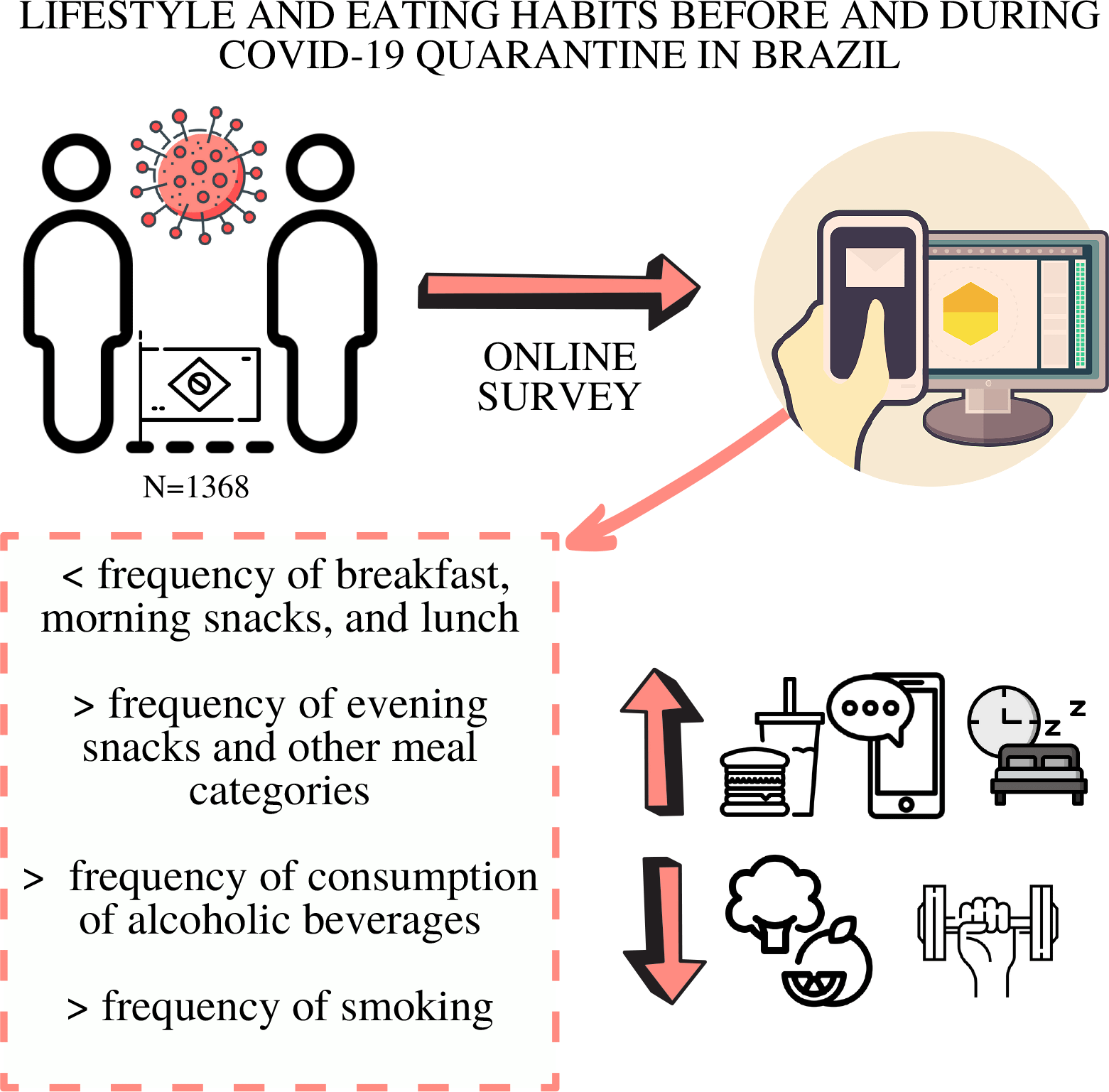
To assess changes in daily habits, food choices and lifestyle of adult Brazilians before and during the COVID-19 pandemic.
Design:
This observational study was carried out with Brazilian adults through an online questionnaire 5 months after the social distance measures implementation. The McNemar, McNemar–Bowker and Wilcoxon tests were used to investigate differences before and during the COVID pandemic period, adopting the statistical significance of P < 0·05.
Setting:
Brazil.
Participants:
Totally, 1368 volunteers aged 18+ years.
Results:
The volunteers reported a lower frequency of breakfast, morning and lunch snacks (P < 0·05) and a higher frequency of evening snacks and other meal categories during the pandemic period (P < 0·05). The results showed an increase in the consumption of bakery products, instant meals and fast food, while the consumption of vegetables and fruits decreased (P < 0·005). There was a significant increase in the frequency of consumption of alcoholic beverages (P < 0·001), but a reduction in the dose (P < 0·001), increased frequency of smoking (P = 0·007), an increase in sleep and screen time in hours and decrease in physical activity (P < 0·001).
Conclusions:
It was possible to observe an increase in screen time, hours of sleep, smoking and drinking frequency. On the other hand, there was a reduction in the dose of alcoholic beverages but also in the practice of physical activity. Eating habits also changed, reducing the performance of daytime meals and increasing the performance of nighttime meals. The frequency of consumption of instant meals and fast food has increased, while consumption of fruits and vegetables has decreased.
We wanted to identify factors related to dietary behavioural change among impoverished pregnant women in the face of nutrition education and counselling, describing what creates an enabling environment and barriers for dietary change.
Design:
We used qualitative data from a cluster-randomised maternal education trial and conducted a thematic analysis using a social ecological framework to describe the factors that influenced dietary adherence.
Setting:
Mangochi district in rural Malawi.
Participants:
We interviewed ten pregnant women and conducted four sets of focus group discussions with twenty-two significant family members (husbands and mothers-in-law) and twelve counsellors.
Results:
The participants’ experiences showed that the main barriers of adherence to the intervention were taste, affordability and poverty. The use of powders and one-pot dishes, inclusion of both women and significant family members and a harmonisation with local food practices enabled adherence to the intervention. We found it crucial to focus the dietary education and counselling intervention on locally available ingredients and food processing methods.
Conclusions:
Use of contextualised food-based solutions to combat maternal malnutrition was observed to be relatively cheap and sustainable. However, there is need for more research on local foods used as nutrition supplements. We suggest that investments need to be directed not only to nutrition education and counselling but also to the enabling factors that enhance adherence. The original cluster-randomised controlled trial was registered with Clinical trials.gov ID: NCT03136393.
Research on the consequences of breakfast skipping among students tends to focus on academic outcomes, rather than student well-being or engagement at school. This study investigated the association between breakfast skipping and cognitive and emotional aspects of school engagement.
Design:
Cross-sectional study using data from a population-level survey of children and adolescents’ well-being and engagement at school. Linear regression with adjustment for confounders was used to estimate the effect of breakfast skipping on school engagement.
Setting:
Government schools (i.e. public schools) in South Australia.
Participants:
The participants were students, Grades 4–12, who completed the Wellbeing and Engagement Collection in 2019. The analysis sample included 61 825 students.
Results:
Approximately 9·6 % of students reported always skipping breakfast, with 35·4 % sometimes skipping and 55·0 % never skipping. In the adjusted linear regression models, children and adolescents who always skipped breakfast reported lower levels of cognitive engagement (β = −0·26 (95 % CI −0·29, −0·25)), engagement with teachers (β = −0·17 (95 % CI −0·18, −0·15)) and school climate (β = −0·17 (95 % CI −0·19, −0·15)) compared with those who never skipped breakfast, after controlling for age, gender, health, sleep, sadness and worries, parental education, socio-economic status and geographical remoteness.
Conclusion:
Consistent with our hypothesis, skipping breakfast was associated with lower cognitive and emotional engagement, which could be due to mechanisms such as short-term energy supply and long-term health impacts. Therefore, decreasing the prevalence of breakfast skipping could have a positive impact on school engagement.
Most previous research on the antecedents of healthy food choice has not investigated the links between these antecedents and has focused on specific food choice rather than on an overall diet. In the present study, we tested the plausibility of an integrated theoretical model aiming to explain the role of different psychosocial factors in increasing the intention to adhere to the Mediterranean Diet (MeDiet).
Design:
An online survey measured participants’ attitude and perceived behavioural control (i.e. rational antecedents), subjective norm (i.e. social antecedent), positive and negative anticipated emotions (i.e. emotional antecedents), food choice health and mood motives (i.e. motivational antecedents), past adherence to the MeDiet (i.e. behavioural antecedent), and intention to adhere to the MeDiet.
Setting:
Italy.
Participants:
1940 adults: 1086 females; 854 males; mean age = 35·65; sd = 14·75; age range = 18–84.
Results:
Structural Equation Modelling (sem) analyses confirmed the plausibility of the proposed model. Perceived behavioural control was the strongest rational antecedent of intention, followed by the emotional (i.e. anticipated emotions) and the social (i.e. subjective norm) antecedents. Mediation analysis showed that motivational antecedents had only an indirect impact on intention via emotional antecedents. Finally, multigroup sem analysis highlighted that past adherence to the MeDiet moderated the hypothesised paths among all the study variables.
Conclusions:
The above findings advance our comprehension of which antecedents public communication might leverage to promote an increase in the adherence to the MeDiet.
Consumption is driven by children’s sensory acceptance, but little is known about the sensory characteristics of vegetables that children commonly eat. A greater understanding could help design more effective interventions to help raise intakes, thus realising beneficial health effects. This study sought to: (1) Understand the vegetable consumption patterns in children, with and without potatoes, using the Australian and WHO definitions. (2) Describe the sensory characteristics of vegetables consumed by children by age group, level of intake and variety. (3) Determine the vegetable preferences of children, by age group, level of intake and variety.
Design:
Analysis of National Nutrition Survey data, combining reported vegetable intake with sensory characteristics described by a trained panel.
Setting:
Australia
Participants:
A nationally representative sample of Australian children and adolescents aged 2–17·9 years (n 2812).
Results:
While consumption increased in older age groups, variety remained constant. Greater variety, however, was associated with higher vegetable consumption. Potato intake increased with consumption, contributing over one-third of total vegetable intake for highest vegetable consumption and for older age groups. Children favoured relatively sweet vegetables and reported lower consumption of bitter vegetables. There were no differences in the sensory properties of vegetables consumed by children in different age groups. After potatoes, carrots, sweetcorn, mixtures, fruiting and cruciferous types were preferred vegetables.
Conclusion:
Children tend to prefer vegetables with sensory characteristics consistent with innate taste preferences (sweet and low bitterness). Increasing exposure to a variety of vegetables may help increase the persistently low vegetable consumption patterns of children.
To systematically review evidence from systematic reviews of interventions to improve dietary behaviours and reduce food wastage in secondary school pupils.
Design:
CINAHL, Cochrane Reviews, EMBASE, MEDLINE, PsychINFO and Web of Science were searched for systematic reviews of school-based dietary interventions from 2000 to 2020 published in a peer-reviewed journal in English. Articles were reviewed independently by two authors. AMSTAR-2 was used for quality assessment.
Setting:
Secondary school dietary interventions.
Participants:
Adolescents (aged 11–18).
Results:
In total, thirteen systematic reviews of dietary interventions in secondary schools met the inclusion criteria. A number of key characteristics of interventions that contributed to improvements in food choices in secondary school pupils were identified. These included the combination of education and environmental restructuring, incorporation of computer-based feedback, media or messaging, peer and/or parent involvement, an increase in the availability of healthy foods and the use of behavioural theory as a basis to the intervention. Intervention components that contributed specifically to a reduction in sugar-sweetened beverage intake or an increase in fruit and vegetable consumption, which are particularly relevant to adolescents, could not be determined. Similarly, evidence for interventions that improve nutritional knowledge and attitudes was limited.
Conclusions:
This systematic review of systematic reviews has identified a number of components of dietary interventions that can be explored to improve dietary behaviours in secondary school environments and, if demonstrated to be effective, be considered for inclusion in policies and strategies to improve the school food environment and promote dietary change.
To determine the association between food insecurity and HIV infection with depression and anxiety among new tuberculosis (TB) patients.
Design:
Our cross-sectional study assessed depression, anxiety and food insecurity with Patient Health Questionnaire (PHQ-9), Zung Anxiety Self-Assessment Scale (ZUNG) and Household Food Insecurity Access Scale, respectively. Poisson regression models with robust variance were used to examine correlates of depression (PHQ-9 ≥ 10) and anxiety (ZUNG ≥ 36).
Setting:
Gaborone, Botswana.
Participants:
Patients who were newly diagnosed with TB.
Results:
Between January and December 2019, we enrolled 180 TB patients from primary health clinics in Botswana. Overall, 99 (55·0 %) were HIV positive, 47 (26·1 %), 85 (47·2 %) and 69 (38·5 %) indicated depression, anxiety and moderate to severe food insecurity, respectively. After adjusting for potential confounders, food insecurity was associated with a higher prevalence of depression (adjusted prevalence ratio (aPR) = 2·30; 95 % CI 1·40, 3·78) and anxiety (aPR = 1·41; 95 % CI 1·05, 1·91). Prevalence of depression and anxiety was similar between HIV-infected and HIV-uninfected participants. Estimates remained comparable when restricted to HIV-infected participants.
Conclusions:
Mental disorders may be affected by food insecurity among new TB patients, regardless of HIV status.
To estimate the association between food insufficiency and mental health service utilisation in the USA during the COVID-19 pandemic.
Design:
Cross-sectional study. Multiple logistic regression models were used to estimate the associations between food insufficiency and mental health service utilisation.
Setting:
US Census Household Pulse Survey data collected in October 2020.
Participants:
Nationally representative sample of 68 611 US adults.
Results:
After adjusting for sociodemographic factors, experiencing food insufficiency was associated with higher odds of unmet mental health need (adjusted OR (AOR) 2·90; 95 % CI 2·46, 3·43), receiving mental health counselling or therapy (AOR 1·51; 95 % CI 1·24, 1·83) and psychotropic medication use (AOR 1·56; 95 % CI 1·35, 1·80). Anxiety and depression symptoms mediated most of the association between food insufficiency and unmet mental health need but not the associations between food insufficiency and either receiving mental health counselling/therapy or psychotropic medication use.
Conclusions:
Clinicians should regularly screen patients for food insufficiency, especially in the wake of the COVID-19 pandemic. Expanding access to supplemental food programmes may help to mitigate the need for higher mental health service utilisation during the COVID-19 pandemic.
To prioritise and refine a set of evidence-informed statements into advice messages to promote vegetable liking in early childhood, and to determine applicability for dissemination of advice to relevant audiences.
Design:
A nominal group technique (NGT) workshop and a Delphi survey were conducted to prioritise and achieve consensus (≥70 % agreement) on thirty evidence-informed maternal (perinatal and lactation stage), infant (complementary feeding stage) and early years (family diet stage) vegetable-related advice messages. Messages were validated via triangulation analysis against the strength of evidence from an Umbrella review of strategies to increase children’s vegetable liking, and gaps in advice from a Desktop review of vegetable feeding advice.
Setting:
Australia.
Participants:
A purposeful sample of key stakeholders (NGT workshop, n 8 experts; Delphi survey, n 23 end users).
Results:
Participant consensus identified the most highly ranked priority messages associated with the strategies of: ‘in-utero exposure’ (perinatal and lactation, n 56 points) and ‘vegetable variety’ (complementary feeding, n 97 points; family diet, n 139 points). Triangulation revealed two strategies (‘repeated exposure’ and ‘variety’) and their associated advice messages suitable for policy and practice, twelve for research and four for food industry.
Conclusions:
Supported by national and state feeding guideline documents and resources, the advice messages relating to ‘repeated exposure’ and ‘variety’ to increase vegetable liking can be communicated to families and caregivers by healthcare practitioners. The food industry provides a vehicle for advice promotion and product development. Further research, where stronger evidence is needed, could further inform strategies for policy and practice, and food industry application.
To report perspectives of participants in a food benefit programme that includes foods high in added sugar (FAS) restrictions and FAS restrictions paired with fruits and vegetables (F/V) incentives.
Design:
Randomised experimental trial in which participant perspectives were an exploratory study outcome.
Setting:
Participants were randomised into one of three Supplemental Nutrition Assistance Program (SNAP)-like food benefit programme groups: (1) restriction: not allowed to buy FAS with benefits; (2) restriction paired with incentive: not allowed to buy FAS with benefits and 30 % financial incentive on eligible F/V purchased using benefits; or (3) control: same food purchasing rules as SNAP. Participants were asked questions to assess programme satisfaction.
Participants:
Adults in the Minneapolis-St. Paul, MN metropolitan area, eligible for but not currently participating in SNAP who completed baseline and follow-up study measures (n 254).
Results:
Among remaining households in each group, most found the programme helpful in buying nutritious foods (88·2 %–95·7 %) and were satisfied with the programme (89·1 %–93·0 %). Sensitivity analysis results indicate that reported helpfulness and satisfaction with the programme may in some instances be lower among the restriction and the restrictions paired with incentive groups in comparison to the control group.
Conclusions:
A food benefit programme that includes restriction on purchase of FAS or restriction paired with a financial incentive for F/V purchases may be acceptable to most SNAP-eligible households with children.
Feeding practices used by educators in Early Childhood Education and Care (ECEC) settings can influence the diet quality of young children. However, Australian data is scarce and limited to describing barriers to responsive feeding. This study describes the use of feeding practices amongst a group of Australian educators.
Design:
Direct observation of feeding practices and assessment of centre policy were conducted using the ‘Environment and Policy Assessment and Observation’ tool. Self-reported feeding practices and demographic data were collected via online survey using the Childcare Food and Activity Practices Questionnaire.
Setting:
Ten centre-based ECEC services in South East Queensland, Australia.
Participants:
Educators working in ECEC.
Results:
A total of 120 meals were observed and 88 educators provided self-report data (n 84 female). Centre policy supported the use of responsive feeding practices, and this was reflected in the high frequency with which children could decide what and how much to eat, across both observed and self-report data as well as low levels of pressure to eat and use of food as a reward (observed at 19·9 % and 0 % of meals). The only apparent discrepancy was regarding modelling. Median score for self-reported role-modelling was 5·0 (4·3–5·0) and educators were observed to sit with children at 75 % of meals, however observed occasions of enthusiastic role modelling was only 22 % (0–33·3) of meals.
Conclusions:
Research addressing how educators conceptualise feeding practices, as well under what circumstances they are used, particularly in centres with different models of food provision, may shed light on why modelling is rarely implemented in practice.
Understanding the socio-economic inequalities in dietary intake is crucial when addressing the socio-economic gradient in obesity rates and non-communicable diseases. We aimed to systematically assess the association between socio-economic position (SEP) and dietary intake in Chile.
Design:
We searched for peer-reviewed and grey literature from inception until 31 December 2019 in PubMed, Scopus, PsycINFO, Web of Sciences and LILACS databases. Observational studies published in English and Spanish, reporting the comparison of at least one dietary factor between at least two groups of different SEP in the general Chilean population, were selected. Two researchers independently conducted data searches, screening and extraction and assessed study quality using an adaptation of the Newcastle Ottawa Quality Assessment Scale.
Results:
Twenty-one articles (from eighteen studies) were included. Study quality was considered low, medium and high for 24, 52 and 24 % of articles, respectively. Moderate-to-large associations indicated lower intake of fruit and vegetables, dairy products and fish/seafood and higher pulses consumption among adults of lower SEP. Variable evidence of association was found for energy intake and macronutrients, in both children and adults.
Conclusions:
Our findings highlight some socio-economic inequalities in diets in Chile, evidencing an overall less healthy food consumption among the lower SEP groups. New policies to reduce these inequalities should tackle the unequal distribution of factors affecting healthy eating among the lower SEP groups. These findings also provide important insights for developing strategies to reduce dietary inequalities in Chile and other countries that have undergone similar nutritional transitions.
This study aimed to examine the intrapersonal, interpersonal, environmental and macrosystem influences on dietary behaviours among primary school children in Singapore.
Design:
A qualitative interpretive approach was used in this study. Focus group discussions guided by the socio-ecological model (sem), of which transcripts were analysed deductively using the sem and inductively using thematic analysis to identify themes at each sem level.
Setting:
Two co-educational public primary schools in Singapore.
Participants:
A total of 48 children (n 26 girls) took part in the semi-structured focus group discussions. Their mean age was 10·8 years (sd = 0·9, range 9–12 years), and the majority of the children were Chinese (n 36), along with some Indians (n 8) and Malays (n 4).
Results:
Children’s knowledge of healthy eating did not necessarily translate into healthy dietary practices and concern for health was a low priority. Instead, food and taste preferences were pivotal influences in their food choices. Parents had a large influence on children with regards to their accessibility to food, their attitudes and values towards food. Parental food restriction led to some children eating in secrecy. Peer influence was not frequently reported by children. Competitions in school incentivised children to consume fruits and vegetables, but reinforcements from teachers were inconsistent. The proximity of fast-food chains in the neighbourhood provided children easy access to less healthy foods. Health advertisements on social media rather than posters worked better in drawing children’s attention.
Conclusions:
Findings highlighted important factors that should be considered in future nutrition interventions targeting children.
In Brazil, national estimates of childhood malnutrition have not been updated since 2006. The use of health information systems is an important complementary data source for analysing time trends on health and nutrition. This study aimed to examine temporal trends and socio-demographic inequalities in the prevalence of malnutrition in children attending primary health care services between 2009 and 2017.
Design:
Time trends study based on data from Brazil’s Food and Nutrition Surveillance System. Malnutrition prevalence (stunting, wasting, overweight and double burden) was annually estimated by socio-demographic variables. Prais–Winsten regression models were used to analyse time trends. Annual percent change (APC) and 95 % CI were calculated.
Setting:
Primary health care services, Brazil.
Participants:
Children under 5 years old.
Results:
In total, 15,239,753 children were included. An increase in the prevalence of overweight (APC = 3·4 %; P = 0·015) and a decline in the prevalence of wasting (–6·2 %; P = 0·002) were observed. The prevalence of stunting (–3·2 %, P = 0·359) and double burden (–1·4 %, P = 0·630) had discrete and non-significant reductions. Despite the significant reduction in the prevalence of undernutrition among children in the most vulnerable subgroups (black, conditional cash transfer’s recipients and residents of poorest and less developed areas), high prevalence of stunting and wasting persist alongside a disproportionate increase in the prevalence of overweight in these groups.
Conclusions:
The observed pattern in stunting (high and persistent prevalence) and increase in overweight elucidate setbacks in advances already observed in previous periods and stresses the need for social and political strategies to address multiple forms of malnutrition.
This study aimed to synthesise the existing evidence on the performance of mid-upper arm circumference (MUAC) to identify children and adolescents with overweight and obesity.
Design:
Systematic review and meta-analysis.
Setting:
We searched PubMed, EMBASE, SCOPUS, Cochrane Library, Web of Science, CINAHL and Google scholar databases from their inception to December 10, 2021, for relevant studies. There were no restrictions regarding the language of publication. Studies reporting measures for the diagnostic performance of MUAC compared with a reference standard for diagnosing overweight and obesity in children and adolescents aged 2–19 years were included.
Participants:
A total of 54 381 children and adolescents from twenty-one studies were reviewed; ten studies contributed to meta-analyses.
Results:
In boys, MUAC showed a pooled AUC of 0·92 (95 % CI 0·89, 0·94), sensitivity of 84·4 (95 % CI 84·6, 90·8) and a specificity of 86·0 (95 % CI 79·2, 90·8), when compared against BMI z-score, defined overweight and obesity. As for girls, MUAC showed a pooled AUC of 0·93 (95 % CI 0·90, 0·95), sensitivity of 86·4 (95 % CI 79·8, 91·0), specificity of 86·6 (95 % CI 82·2, 90·1) when compared against overweight and obesity defined using BMI z-scores.
Conclusion:
In comparison with BMI, MUAC has an excellent performance to identify overweight and obesity in children and adolescents. However, no sufficient evidence on the performance of MUAC compared with gold standard measures of adiposity. Future research should compare performance of MUAC to the ‘golden standard’ measure of excess adiposity.
This study aimed to investigate the mediating role of food parenting practices (FPP), including home availability of different types of foods and drinks, parental modelling of fruit intake, permissiveness and the use of food as a reward in the relationship between parental education and dietary intake in European children.
Design:
Single mediation analyses were conducted to explore whether FPP explain associations between parents’ educational level and children’s dietary intake measured by a parent-reported FFQ.
Setting:
Six European countries.
Participants:
Parent–child dyads (n 6705, 50·7 % girls, 88·8 % mothers) from the Feel4Diabetes-study.
Results:
Children aged 8·15 ± 0·96 years were included. Parental education was associated with children’s higher intake of water, fruits and vegetables and lower intake of sugar-rich foods and savoury snacks. All FPP explained the associations between parental education and dietary intake to a greater or lesser extent. Specifically, home availability of soft drinks explained 59·3 % of the association between parental education and sugar-rich food intake. Home availability of fruits and vegetables was the strongest mediators in the association between parental education and fruit and vegetable consumption (77·3 % and 51·5 %, respectively). Regarding savoury snacks, home availability of salty snacks and soft drinks was the strongest mediators (27·6 % and 20·8 %, respectively).
Conclusions:
FPP mediate the associations between parental education and children’s dietary intake. This study highlights the importance of addressing FPP in future interventions targeting low-educated populations.
In many countries, the provision of water in the early months of a baby’s life jeopardises exclusive breast-feeding (EBF). Using a behavioural theory, this study assessed the impact of a behaviour change intervention on mothers’ intention to act and, in turn, on the water provision in addition to breast milk to their infants under 6 months of age (IU6M) in two regions of Guinea.
Design:
A quasi-experimental design. Data on individual and environmental factors of the theoretical framework, sociodemographic and outcomes were collected using validated questionnaires before and after the intervention. The outcomes examined were the intention to provide water to IU6M, the provision of water and EBF. Path analyses were performed to investigate pathways by which psychosocial and environmental factors influenced the water provision in addition to breast milk.
Setting:
Four health centres were assigned randomly to each study’s arm (one control/CG and one intervention group/IG per region).
Participants:
The sample included 300 mothers of IU6M: 150 per group.
Results:
In IG, the proportion of mothers providing water decreased from 61 % to 29 % before and after the intervention (P < 0·001), while no difference was observed in CG (P = 0·097). The EBF rate increased in IG (from 24·0 % to 53·8 %, P < 0·001) as opposed to CG (36·7 % to 45·9 %, P = 0·107). An association (P < 0·001) between the intention and the behaviour was observed in both groups.
Conclusions:
An intervention developed using a sound framework reduces the provision of water among IU6M and improves EBF.