We partner with a secure submission system to handle manuscript submissions.
Please note:
You will need an account for the submission system, which is separate to your Cambridge Core account. For login and submission support, please visit the
submission and support pages.
Please review this journal's author instructions, particularly the
preparing your materials
page, before submitting your manuscript.
Click Proceed to submission system to continue to our partner's website.
To save this undefined to your undefined account, please select one or more formats and confirm that you agree to abide by our usage policies. If this is the first time you used this feature, you will be asked to authorise Cambridge Core to connect with your undefined account.
Find out more about saving content to .
To send this article to your Kindle, first ensure no-reply@cambridge.org is added to your Approved Personal Document E-mail List under your Personal Document Settings on the Manage Your Content and Devices page of your Amazon account. Then enter the ‘name’ part of your Kindle email address below. Find out more about sending to your Kindle.
Find out more about saving to your Kindle.
Note you can select to save to either the @free.kindle.com or @kindle.com variations. ‘@free.kindle.com’ emails are free but can only be saved to your device when it is connected to wi-fi. ‘@kindle.com’ emails can be delivered even when you are not connected to wi-fi, but note that service fees apply.
It is unknown how well menu labelling schemes that enforce the display of kilojoule (kJ) labelling at point-of-sale have been implemented on online food delivery (OFD) services in Australia. This study aimed to examine the prevalence of kJ labelling on the online menus of large food outlets with more than twenty locations in the state or fifty locations nationally. A secondary aim was to evaluate the nutritional quality of menu items on OFD from mid-sized outlets that have fewer locations than what is specified in the current scheme.
Design:
Cross-sectional analysis. Prevalence of kJ labelling by large food outlets on OFD from August to September 2022 was examined. Proportion of discretionary (‘junk food’) items on menus from mid-sized outlets was assessed.
Setting:
Forty-three unique large food outlets on company (e.g. MyMacca’s) and third party OFD (Uber Eats, Menulog, Deliveroo) within Sydney, Australia. Ninety-two mid-sized food outlets were analysed.
Participants:
N/A.
Results:
On company OFD apps, 35 % (7/23) had complete kJ labelling for each menu item. In comparison, only 4·8 % (2/42), 5·3 % (2/38) and 3·6 % (1/28) of large outlets on Uber Eats, Menulog and Deliveroo had complete kJ labelling at all locations, respectively. Over three-quarters, 76·3 % (345/452) of menu items from mid-sized outlets were classified as discretionary.
Conclusions:
Kilojoule labelling was absent or incomplete on a high proportion of online menus. Mid-sized outlets have abundant discretionary choices and yet escape criteria for mandatory menu labelling laws. Our findings show the need to further monitor the implementation of nutrition policies on OFD.
The recommended level of five fruits and vegetables per day is reached by a minority of French children. No-added sugars fruit puree (NASFP) can be consumed as a complement of fresh fruit to meet the recommendation for fruits and vegetables. The objective was to simulate the nutritional impact of an increase in consumption of NASFP among French children, together with a reduction in sweetened foods.
Design:
The study was conducted on French children aged 1–17 years. The simulation consisted in introducing NASFP on four different eating occasions (breakfast, lunch, snack and dinner) to reach one serving and removing the same serving of sweetened foods. Intakes in nutrients to favour, nutrients to limit and prevalence of adequacy to nutritional requirements were compared between observed and simulated diets in the whole sample and in five different age groups.
Setting:
France.
Participants:
Children from 1 to 17 years of age in the last available French representative dietary survey (INCA3).
Results:
Simulated diets were more nutrient-dense thanks to increases in nutrients to favour from NASFP (especially fibres, iodine, Se, and vitamin A and C) associated with reductions in energy and nutrients to limit (especially free sugars) coming from sweetened foods. Prevalence of adequacy increased from 2 to 14·5 points for fibres and from 4·5 to 12 points for free sugars according to age group and eating occasion.
Conclusion:
Promoting NASFP in replacement of sweetened products is a promising strategy to improve the nutritional quality of French children’s diet through a better adherence to national guidelines.
To synthesise current evidence on knowledge, perceptions and practices towards type 2 diabetes risk in sub-Saharan Africa
Design:
Mixed-methods scoping review, which included 101 studies (seventy-three quantitative, twenty qualitative and eight mixed methods) from seven electronic databases.
Setting:
Sub-Saharan Africa, 2000–2023.
Participants:
Men and women without diabetes with mean ages ranging from 20 to 63 years.
Results:
The majority of participants in most studies knew the three main diabetes modifiable risk factors – excess weight, unhealthy diet and physical inactivity. However, most people with excess weight in almost all studies underestimated their weight. Further, the self-described ideal body weight was between midpoint of normal weight and the upper limits of overweight in most quantitative studies and was described as not too skinny but not too fat in qualitative studies. In the majority of studies, participants reported low engagement in weight control, high regular sugar intake, and low regular fruit and vegetable intake but moderate to high engagement in physical activity. Barriers to reducing diabetes risk were social (e.g. societal perceptions promoting weight gain) and environmental (e.g. limited affordability of healthy foods, high accessibility of Western diets and lack of physical activity facilities).
Conclusion:
There is a need for multicomponent type 2 diabetes prevention interventions that increase knowledge of identifying diabetes risk (e.g. what constitutes excess weight) and create social and physical environments that support healthy lifestyles (e.g. societal perceptions that promote healthy living, increased availability and affordability of healthy foods and physical activity facilities).
To assess the association between the risk of malnutrition, as estimated by the Patient-Generated Subjective Global Assessment (PG-SGA) numerical scores, and adverse outcomes in oncology patients.
Design:
Systematic review and meta-analysis.
Settings:
A comprehensive search was conducted in PubMed, Web of Science, Embase, CKNI, VIP, Sinomed and Wanfang databases. Studies that examined the association between the risk of malnutrition, as estimated by the PG-SGA numerical scores, and overall survival (OS) or postoperative complications in oncology patients were included. Patients were classified as low risk (PG-SGA ≤ 3), medium risk (PG-SGA 4–8) and high risk of malnutrition (PG-SGA > 8).
Subject:
Nineteen studies reporting on twenty articles (n 9286 patients).
Results:
The prevalence of medium and high risk of malnutrition ranged from 16·0 % to 71·6 %. A meta-analysis showed that cancer patients with medium and high risk of malnutrition had a poorer OS (adjusted hazard ratios (HR) 1·98; 95 % CI 1·77, 2·21) compared with those with a low risk of malnutrition. Stratified analysis revealed that the pooled HR was 1·55 (95 % CI 1·17, 2·06) for medium risk of malnutrition and 2·65 (95 % CI 1·90, 3·70) for high risk of malnutrition. Additionally, the pooled adjusted OR for postoperative complications was 4·65 (95 % CI 1·61, 13·44) for patients at medium and high risk of malnutrition.
Conclusions:
The presence of medium and high risk of malnutrition, as estimated by the PG-SGA numerical scores, is significantly linked to poorer OS and an increased risk of postoperative complications in oncology patients.
The National Health Service (NHS) England website provides guidance on foods/drinks to avoid or limit during pregnancy because of microbiological, toxicological or teratogenic hazards. The aims were to determine adherence and whether demographic characteristics were associated with adherence.
Design:
Cross-sectional study.
Setting:
Online survey of postpartum women resident in England during pregnancy.
Participants:
Recently, postpartum women resident in England during their pregnancy (n 598; median age 33 (IQR 30–36) years) completed an online questionnaire (April–November 2022). Questions included those on consumption of twenty-one food/drink items that the NHS advises pregnant women to avoid/limit. The study is part of the Pregnancy, the Environment And nutRition (PEAR) Study. Summary statistics were used to determine proportions adhering to the guidance. Adjusted logistic regression was used to model the associations of adherence with demographic characteristics.
Results:
Adherence was generally high (>90 % for eight of ten food/drink items to be avoided). However, among pre-pregnancy consumers, several items were not completely avoided, for example, 81 % (128/158) for game meat/gamebirds, 37 % (176/478) for cured meats and 17 % (81/467) for soft cheeses. Greater educational attainment (e.g. caffeinated soft drinks OR 2·25 (95 % CI 1·28, 3·94)), greater maternal age (e.g. oily fish 1·64 (1·05, 2·56)) and lower parity (e.g. caffeinated coffee 0.28 (0.11, 0.69)) were the most usual characteristics associated with adherence.
Conclusion:
Evidence of concerning levels of non-adherence for some food/drink items suggests a case for more education on some of the guidance, particularly for women with lower educational attainment, greater parity and greater maternal age. Further research on barriers to the implementation of the guidance is needed.
Individuals often use self-directed strategies to manage intake of tempting foods, but what these strategies are and whether they are effective is not well understood. This study assessed the frequency of use and subjective effectiveness of self-directed strategies in relation to BMI and snack intake.
Design:
A cross-sectional and prospective study with three time points (T1: baseline, T2: 3 months and T3: 3 years). At T1, demographics, frequency of use and subjective effectiveness of forty-one identified strategies were assessed. At T2 and T3, current weight was reported, and at T2 frequency of snack intake was also recorded.
Setting:
Online study in the UK.
Participants:
Data from 368 participants (Mage = 34·41 years; MBMI = 25·06 kg/m2) were used for analysis at T1, n = 170 (46·20 % of the total sample) at T2 and n = 51 (13·59 %) at T3.
Results:
Two strategy factors were identified via principal axis factoring: (1) diet, exercise, reduction of temptations, and cognitive strategies, and (2) planning, preparation and eating style. For strategy 1, frequency of use, but not subjective effectiveness, was positively related to BMI at T1. Subjective effectiveness predicted an increase in BMI from T1 and T2 to T3. No relationship to snack intake was found. For strategy 2, frequency of use was negatively related to BMI at T1. Neither frequency of use nor subjective effectiveness were related to changes in BMI over time, but subjective effectiveness was negatively correlated with unhealthy snack intake.
Conclusion:
Self-directed strategies to reduce the intake of tempting foods are not consistently related to BMI or snack intake.
Food insecurity (FI) is the lack of daily access for everyone to quality food in sufficient quantity. In many populations, it presents as a chronic and persistent condition. This study analysed the association between the length of time living with FI and socio-demographic conditions in households in a semi-arid municipality in the Brazilian Northeast between 2011 and 2019.
Design:
This is a population-based cohort study among families in the municipality in Northeast Brazil (2011, 2014 and 2019). FI was estimated through the Escala Brasileira de Insegurança Alimentar (EBIA, Brazilian Household Food Insecurity Measurement Scale), and the longitudinal category of time of living with FI was adopted to classify them according to the time they remained in FI during the cohort. The association with the socio-demographic profiles of the population was verified through multinomial logistic regression.
Setting:
Households in semi-arid, Northeast of Brazil.
Participants:
Household respondents interviewed in 2011, 2014 and 2019 (n 274).
Results:
Sixty-seven percentage (67 %) of families lived in FI in this period. Rural residence, low monthly per capita income and low schooling of the household reference person increased the chances of these families living longer in FI. These overlapping conditions increased the odds of FI in the household.
Conclusions:
Coping with FI requires intersectoral intervention that improves the socio-demographic conditions of the population.
To explore the differences in social norms around parents’ food provision in different provision contexts and by demographics.
Design:
Qualitative study using story completion methodology via an online survey in September 2021. Adults 18+ with or without children were randomised to one of three story stems focusing on food provision in different contexts; food provision at home (non-visitor), with visitors present and with the involvement of sport. Stories were coded and themed using thematic analysis. A content analysis was performed to determine count and frequency of codes in stories by participant demographics and story assumptions.
Setting:
Australia.
Participants:
Adults (n 196).
Results:
Nine themes were identified from the data resulting in four social norms around providing healthy foods and justifying non-adherence to healthy eating guidelines, evolution of family life and mealtime values, the presence of others influencing how we engage with food provision and unhealthy foods used as incentives/rewards in sport. Following content analysis, no differences of themes or norms by participant demographics or story assumptions were found.
Conclusions:
We identified pervasive social norms around family food provision and further identified how contextual factors resulted in variations or distinct norms. This highlights the impact context may have on the social norms parents face when providing food to their children and the opportunities and risks of leveraging these social norms to influence food choice in these contexts. Public health interventions and practitioners should understand the influence of context and social environments when promoting behaviour change and providing individualised advice. Future research could explore parents’ experiences of these norms and to what extent they impact food choice.
To evaluate the effectiveness of the multicomponent intervention trial ‘Are You Too Sweet?’ in reducing discretionary foods and drinks intake among young schoolchildren.
Design:
The study was a 3·5-month two-arm cluster-randomised controlled trial among primary schoolchildren and their families. School health nurses provided guidance to families regarding discretionary foods and drinks for the children. Moreover, families were given a variety of knowledge- and capability-building materials to utilise at home. Dietary intake was assessed using a web-based 7-d dietary record. Linear mixed regression models were used to estimate intervention effects as changes in child intake of discretionary foods and drinks and sugar between groups.
Setting:
Six schools from a Danish municipality were randomised to the intervention group (n 4) or the control group (n 2).
Participants:
A total of 153 children aged 5–7 years.
Results:
No significant reduction in the children’s intake of total discretionary foods and drinks or discretionary foods alone was observed between the intervention and control group, while a decreased intake of discretionary drinks of 40·9 % (P = 0·045) was observed compared with control. Secondary subgroup analysis showed that children of parents with shorter educational level significantly reduced their intake of added sugar by 2·9 E% (P = 0·002).
Conclusion:
The results of this study indicate that multicomponent interventions involving school health nurses may have some effects in reducing, especially, discretionary drinks.
This study aims to determine whether ultra-processed foods (UPFs) are being discussed in news media in Australia and whether this terminology, as described in the NOVA system, is being applied accurately.
Design:
Interpretive content analysis of online and print media articles that mentioned UPFs from 2009 to 2023 in Australia.
Setting:
Australia.
Participants:
Online and print media articles.
Results:
A total of two hundred ninety-eight Australian media articles were captured. A substantial increase in the number of UPF articles was observed between 2017–2019 and 2021–2023. The UPF concept was inaccurately explained or defined in 32 % of the articles and was frequently used interchangeably with other descriptors, such as ‘highly or heavily processed food’, ‘junk food’, ‘unhealthy food’, ‘packaged food’ and ‘discretionary food’. Most of the articles had a health focus; however, sustainability interest increased, particularly in the past 18 months.
Conclusions:
UPFs are increasingly being discussed in news media in Australia; however, the concept is still incorrectly presented in over a third of articles. This highlights the importance of improving the literacy about UPFs to ensure that messages are communicated in a way that is salient, accessible and accurate.
To test whether traffic light labels and an increased range of healthy beverages, individually and in combination, can increase healthy beverage choices from vending machines.
Design:
Two studies (n 558, 420) tested whether the provision of traffic light labels (green, amber and red) and an increased range of healthy beverages (from 20 % to 50 % green options), individually and in combination, could increase healthy beverage choices from a digital vending machine display. The studies used a between-subjects experimental design, and a hypothetical beverage choice, a limitation when considering real-world applicability.
Setting:
Both studies utilised an online Qualtrics survey that featured a digital vending machine display.
Participants:
Both studies (n 558, 420) consisted of university students from Flinders University and individuals from a survey recruitment service.
Results:
Featuring traffic lights did not significantly influence beverage choices (P = 0·074), while increasing the healthy range (P = 0·003, OR = 3·27), and the combination of both, did significantly increase healthier beverage choices (P < 0·001, OR = 4·83).
Conclusions:
The results suggest that the traffic light system and increased healthy range are not maximally effective when used on their own, and benefit greatly when combined, to increase healthy beverage choices. It was suggested that the provision of traffic light labels supplied the necessary nutritional information, and the increased healthy range offered greater opportunity to act in accordance with that information. In so doing, the present findings offer a promising pathway for reducing unhealthy beverage consumption.
Abdominal obesity (AO) is characterised by excess adipose tissue. It is a metabolic risk that affects the physical and mental health, particularly in women since they are more prone to mental health problems like depression. This study investigated the association between AO and depressive symptoms in Peruvian women of reproductive age (18–49 years).
Design:
This is a cross-sectional observational study.
Setting:
Peruvian women population of reproductive age.
Participants:
We used data from the Peruvian Demographic and Family Health Survey (DHS) for 2018 and 2019 to assess 17 067 women for the presence of depressive symptoms (using the Patient Health Questionnaire (PHQ-9): cut-off score ≥ 10) and AO (measured by abdominal circumference; cut-off score ≥88 cm).
Results:
We observed a 64·55 % prevalence of AO and 7·61 % of depressive symptoms in the study sample. Furthermore, 8·23 % of women with AO had depressive symptoms (P < 0·05). Initially, women with AO appeared to have a 26 % higher risk of depressive symptoms compared with women without AO (P = 0·028); however, after adjustment for covariates, no statistically significant association was observed.
Conclusions:
Therefore, although both conditions are common in women of this age group, no significant association was found between AO and depressive symptoms.
To assess the selection of foods and beverages in children’s sports arenas in Norway.
Design:
A cross-sectional study design with a digital questionnaire was used. Descriptive statistics were used to present the results. Moreover, Pearson’s χ2 tests examined the factors that could aid in distinguishing clubs with healthy or unhealthy consumables.
Setting:
Children’s sports clubs in Norway.
Participants:
Representatives from 301 children’s sports clubs in Norway answered the questionnaire between September and November 2021.
Results:
In total, 89·4% of the participating sports clubs (n 301) offered soda drinks with sugar. Most of the sports clubs (88 %) reported to offer batter-based cakes such as pancakes and waffles and 63·8 % offered cakes. Furthermore, 47·5% sold hot dishes with processed meat, such as hamburgers and hot dogs. More than 80% of the sports clubs offered sweets and snacks, while 44·5% did not offer fruits, vegetables and/or berries. Notably, the important factors that distinguished sports clubs with healthier food selections from those with unhealthier selections were the presence of guidelines for the food offered and purchase agreements with food suppliers.
Conclusions:
Educational, governmental guidelines for the promotion of healthy eating and establishing agreements with suppliers of healthier foods could help to overcome barriers to unhealthy food selection.
To investigate food insecurity and related coping strategies, and their associations with the risk of anxiety and depression, among South African households with children.
Design:
Nationally representative cross-sectional study. Tools for assessing food insecurity, coping strategies, risk of anxiety and depression were assessed from the Community Childhood Hunger Identification Project, Coping Strategies Index, Generalised Anxiety Disorder-7 and Patient Health Questionnaire-9, respectively. We used ordered logistic regression to test associations of food insecurity and coping strategies with the risk of anxiety and depression. Moderating effects of each coping strategy were tested in the associations of food insecurity with anxiety and depression.
Setting:
South Africa, post COVID-19 restrictions, May–June 2022.
Participants:
1,774 adults, weighted to 20,955,234 households.
Results:
Food insecurity prevalence was 23·7 % among households with children. All coping strategies were used to some extent, but relying on less preferred and less expensive foods was the most used strategy (85·5 % of food-insecure households). Moving to a higher level of food insecurity was associated with >1·6 greater odds of being in a higher risk of anxiety and depression. Sending a household member to beg for food was the strongest associated factor (OR = 1·7, P < 0·001). All coping strategies partly moderated (lessened) the associations of food insecurity with a higher risk of anxiety and depression.
Conclusions:
Food insecurity among households with children was high following the COVID-19 pandemic. Collaborative efforts between government, private sector and civil society to eradicate food insecurity should prioritise poorer households with children, as these populations are the most vulnerable.
Monitoring time trends in salt consumption is important for evaluating the impact of salt reduction initiatives on public health outcomes. There has so far not been available data to indicate if salt consumption in Norway has changed during the previous decade. We aimed to assess whether average 24-h salt intake estimated from spot urine samples in the adult population of mid-Norway changed from 2006–2008 to 2017–2019 and to describe variations by sex, age and educational level.
Design:
Repeated cross-sectional studies.
Setting:
The population-based Trøndelag Health Study (HUNT).
Participants:
In each of two consecutive waves (HUNT3: 2006–2008 and HUNT4: 2017–2019), spot urine samples were collected from 500 men and women aged 25–64 years, in addition to 250 men and women aged 70–79 years in HUNT4. Based on spot urine concentrations of Na, K and creatinine and age, sex and BMI, we estimated 24-h Na intake using the International Cooperative Study on Salt and Blood Pressure (INTERSALT) equation for the Northern European region.
Results:
Mean (95 % CI) estimated 24-h salt intakes in men were 11·1 (95 % CI 10·8, 11·3) g in HUNT3 and 10·9 (95 % CI 10·6, 11·1) g in HUNT4, P = 0·25. Corresponding values in women were 7·7 (95 % CI 7·5, 7·9) g and 7·7 (95 % CI 7·5, 7·9) g, P = 0·88. Mean estimated salt intake in HUNT4 decreased with increasing age in women, but not in men, and it did not differ significantly across educational level in either sex.
Conclusions:
Estimated 24-h salt intake in adult men and women in mid-Norway did not change from 2006–2008 to 2017–2019.
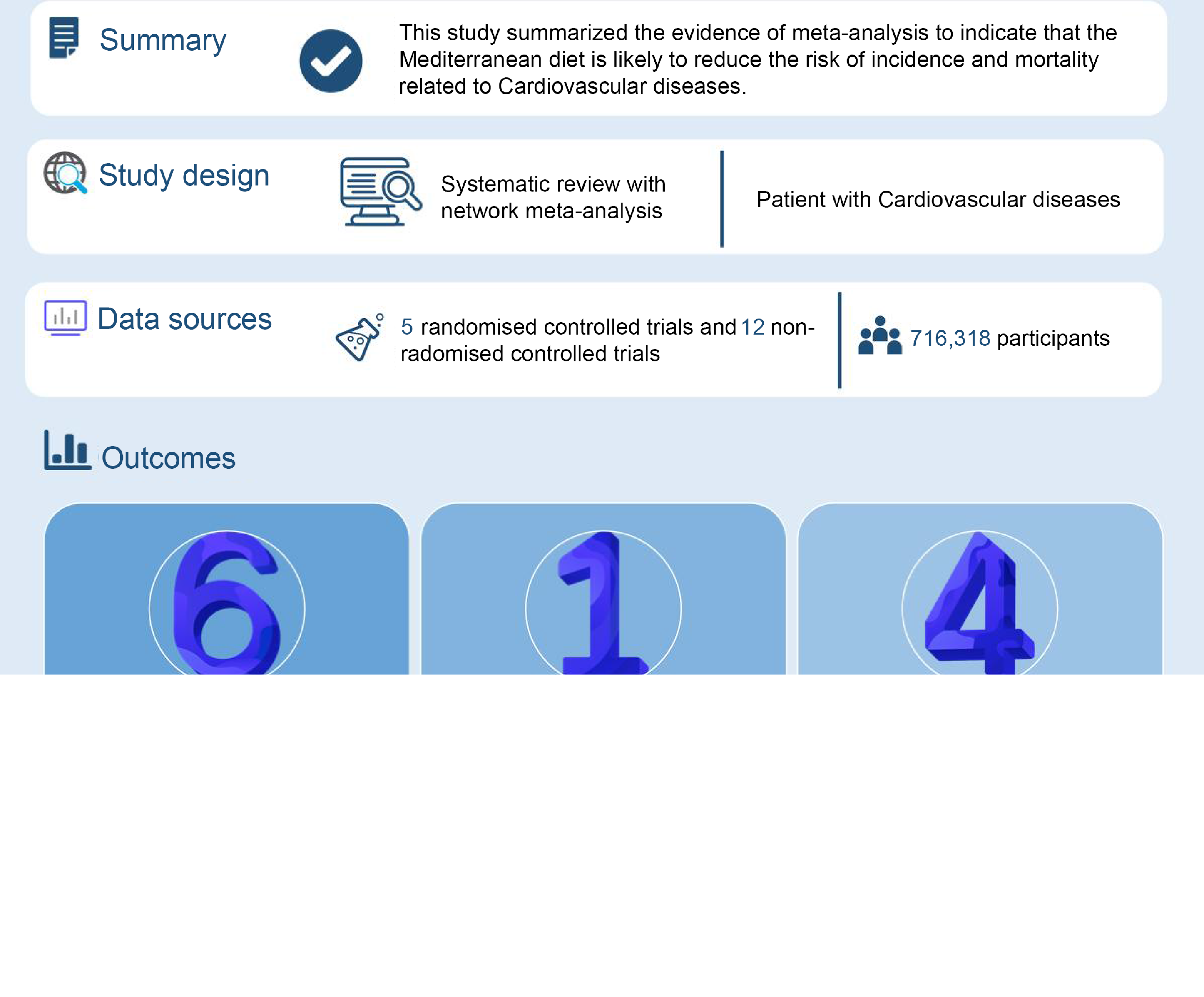
This study aimed to evaluate the methodological quality of existing meta-analyses (MA) and the quality of evidence for outcome indicators to provide an updated overview of the evidence concerning the therapeutic efficacy of the Mediterranean diet (MD) for various types of CVD.
Design:
We conducted comprehensive searches of PubMed, Cochrane Library, and Embase databases. The quality of the MA was assessed using the A Measurement Tool to Assess Systematic Reviews 2 (AMSTAR 2) checklist, while the Grading of Recommendations Assessment, Development and Evaluation (GRADE) evidence evaluation system was employed to evaluate the quality of evidence for significant outcomes.
Setting:
The CVD remains a significant contributor to global mortality. Multiple MA have consistently demonstrated the efficacy of medical interventions in managing CVD. However, due to variations in the scope, quality and outcomes of these reviews, definitive conclusions are yet to be established.
Participants:
This study included five randomized trials and twelve non-randomized studies, with a combined participant population of 716 318.
Results:
The AMSTAR 2 checklist revealed that 54·55 % of the studies demonstrated high quality, while 9·09 % exhibited low quality, and 36·36 % were deemed critically low quality. Additionally, there was moderate evidence supporting a positive correlation between MD and CHD/acute myocardial infarction, stroke, heart failure, cardiovascular events, coronary events and major adverse cardiovascular events.
Conclusions:
This study indicates that although recognizing the potential efficacy of MD in managing CVD, the quality of the methodology and the evidence for the outcome indicators remain unsatisfactory.
To better understand how the public defines ‘healthy’ foods and to determine whether the public considers sustainability, implicitly and explicitly, in the context of healthy eating.
Design:
We conducted a content analysis of public comments submitted to the US FDA in 2016 and 2017 in response to an invitation for feedback on use of the term ‘healthy’ on food labels. The analysis explored the ways in which commenters’ definitions of ‘healthy’ aligned with the 2015–2020 Dietary Guidelines for Americans and whether their definitions considered sustainability.
Setting:
The US Government’s Regulations.gov website.
Participants:
All 1125 unique comments from individuals and organisations.
Results:
Commenters’ definitions of ‘healthy’ generally mirrored the recommendations that the Dietary Guidelines for Americans put forth to promote a ‘healthy eating pattern’. Commenters emphasised the healthfulness of fruit, vegetables, whole grains, fish and other minimally processed foods and the need to limit added sugars, sodium, saturated and trans fats and other ingredients sometimes added during processing. One-third of comments (n 374) incorporated at least one dimension of sustainability, mainly the environmental dimension. Commenters who mentioned environmental considerations primarily expressed concerns about synthetic chemicals and genetic modification. Less than 20 % of comments discussed social or economic dimensions of sustainability, and less than 3 % of comments (n 30) used the word ‘sustainability’ explicitly.
Conclusions:
This novel analysis provides new information about the public’s perceptions of ‘healthy’ foods relative to nutrition and sustainability considerations. The findings can be used to advance policy discussions regarding nutrition labelling and guidance.
To assess the effect of food insecurity on perinatal depression in rural Ethiopia.
Design:
We used a prospective cohort in which food insecurity was considered as primary exposure and perinatal depression as an outcome. Food insecurity at baseline (in the period of 8–24 weeks of pregnancy) was measured using the Household Food Insecurity Access Scale (HFIAS), and perinatal depression at follow-up (in 32–36 weeks of pregnancy) was measured using a Patient Health Questionnaire (PHQ-9). We used multivariable regression to assess the effect of food insecurity on the prevalence of perinatal depression. We explored food insecurity’s direct and indirect impacts on perinatal depression using structural equation modelling (SEM).
Setting:
This paper used data from the Butajira Nutrition, Mental Health and Pregnancy (BUNMAP) cohort established under the Butajira Health and Demographic Surveillance Site (BHDSS).
Participants:
Seven hundred and fifty-five pregnant women.
Results:
Among the study participants, 50 % were food-insecure, and about one-third were depressed at 32–36 follow-up. In SEM, higher values of baseline food insecurity, depressive symptoms and state–trait anxiety (STA) were positively and significantly associated with perinatal depression. The direct impact of food insecurity on perinatal depression accounts for 42 % of the total effect, and the rest accounted for the indirect effect through baseline depression (42 %) and STA (16 %).
Conclusion:
The significant effect of food insecurity at baseline on perinatal depression and the indirect effect of baseline food insecurity through baseline anxiety and depression in the current study implies the importance of tailored interventions for pregnant women that consider food insecurity and psychosocial problems.