We partner with a secure submission system to handle manuscript submissions.
Please note:
You will need an account for the submission system, which is separate to your Cambridge Core account. For login and submission support, please visit the
submission and support pages.
Please review this journal's author instructions, particularly the
preparing your materials
page, before submitting your manuscript.
Click Proceed to submission system to continue to our partner's website.
To save this undefined to your undefined account, please select one or more formats and confirm that you agree to abide by our usage policies. If this is the first time you used this feature, you will be asked to authorise Cambridge Core to connect with your undefined account.
Find out more about saving content to .
To send this article to your Kindle, first ensure no-reply@cambridge.org is added to your Approved Personal Document E-mail List under your Personal Document Settings on the Manage Your Content and Devices page of your Amazon account. Then enter the ‘name’ part of your Kindle email address below. Find out more about sending to your Kindle.
Find out more about saving to your Kindle.
Note you can select to save to either the @free.kindle.com or @kindle.com variations. ‘@free.kindle.com’ emails are free but can only be saved to your device when it is connected to wi-fi. ‘@kindle.com’ emails can be delivered even when you are not connected to wi-fi, but note that service fees apply.
To evaluate the potential impact of sugar-sweetened beverage (SSB) taxes on overweight and obesity prevalence in countries of different income classifications.
Design:
Systematic review following Preferred Reporting Items for Systematic Reviews and Meta-Analyses (PRISMA) guidelines (PROSPERO number CRD42020161612). Five databases (Cochrane Library, Embase, LILACS (via Virtual Health Library) and MEDLINE (via PubMed), and Web of Science were searched, from January 2009 to December 2019. Articles that reported changes in purchases, sales, intake, body weight, BMI, overweight and/or obesity prevalence due to a tax on or price change in SSB were included.
Setting:
Studies conducted in countries of different income classifications.
Participants:
The search yielded 8349 articles of which 21 met inclusion criteria.
Results:
Among the sixteen studies selected, only two did not show that consumption, sales and purchase decreased as the price of SSB increased. In eight of the thirteen studies selected, a positive effect of an SSB tax on decreasing overweight and obesity prevalence was expected. It is estimated that a 20 % taxation on SSB would result in a greater decrease in the prevalence of overweight and obesity compared to a 10 % rate. Studies with no significant effect of taxing on sales, purchases, consumption and prevalence of obesity were from high-income countries, while significant effects of taxing on reducing purchase, consumption and/or obesity prevalence were found in studies from upper-middle- and middle-income countries.
Conclusion:
A high SSB tax might be an effective fiscal policy to decrease purchase and consumption of SSB and reduce overweight/obesity prevalence, especially if the tax were specific for beverage volume.
The current study was conducted to determine mothers’ knowledge, attitudes and practices regarding probiotic use during pregnancy and for infants between 6 months and 2 years old.
Design:
The study had a cross-sectional design, and the data were collected using a Socio-demographic Information Form and a Probiotic Information and Attitude Form. The data were evaluated using frequency, percentage and χ2 tests.
Setting:
Two hospitals of one province in the central Black Sea Region, Turkey.
Participants:
519 mothers with infants between 6 months and 2 years old who had been hospitalised in paediatric clinics participated in the study.
Results:
20·2 % of the mothers knew what a probiotic was, 33·1 % of them had knowledge of specific probiotic products and 49·7 % of them knew that breast milk contains probiotics. A statistically significant difference was found between mothers’ knowledge of probiotics and probiotic products, and their ages, education, employment, income, family structure and whether they were actively breast-feeding (P < 0·05). A statistically significant difference was found between the mothers’ knowledge that breast milk contains probiotics and their ages, education, employment, income, family structure, age of children and actively breast-feeding (P < 0·05).
Conclusion:
The study found that the mothers’ knowledge and practices regarding probiotics were inadequate, and that they traditionally used natural products in their daily lives. Evidence-based educational activities should be designed which include information about the definition of probiotics, and their benefits and disadvantages for mothers. Further studies are needed to determine the knowledge and attitudes of health professionals regarding the use of probiotics by mothers with infants and pregnant women.
The objective of this scoping review was to examine the research question: In the adults with or without cardiometabolic risk, what is the availability of literature examining interventions to improve or maintain nutrition and physical activity-related outcomes? Sub-topics included: (1) behaviour counseling or coaching from a dietitian/nutritionist or exercise practitioner, (2) mobile applications to improve nutrition and physical activity and (3) nutritional ergogenic aids.
Design:
The current study is a scoping review. A literature search of the Medline Complete, CINAHL Complete, Cochrane Database of Systematic Reviews and other databases was conducted to identify articles published in the English language from January 2005 until May 2020. Data were synthesised using bubble charts and heat maps.
Setting:
Out-patient, community and workplace.
Participants:
Adults with or without cardiometabolic risk factors living in economically developed countries.
Results:
Searches resulted in 19 474 unique articles and 170 articles were included in this scoping review, including one guideline, thirty systematic reviews (SR), 134 randomised controlled trials and five non-randomised trials. Mobile applications (n 37) as well as ergogenic aids (n 87) have been addressed in several recent studies, including SR. While primary research has examined the effect of individual-level nutrition and physical activity counseling or coaching from a dietitian/nutritionist and/or exercise practitioner (n 48), interventions provided by these practitioners have not been recently synthesised in SR.
Conclusion:
SR of behaviour counseling or coaching provided by a dietitian/nutritionist and/or exercise practitioner are needed and can inform practice for practitioners working with individuals who are healthy or have cardiometabolic risk.
To identify the ways in which parental involvement can be incorporated into interventions to support adolescent health behaviour change.
Design:
Data from semi-structured interviews were analysed using inductive thematic analysis.
Setting:
Southampton, Hampshire, UK.
Participants:
A convenience sample of twenty-four parents of adolescents.
Results:
Parents consider themselves to play an important role in supporting their adolescents to make healthy choices. Parents saw themselves as gatekeepers of the household and as role models to their adolescents but recognised this could be both positive and negative in terms of health behaviours. Parents described the changing dynamics of the relationships they have with their adolescents because of increased adolescent autonomy. Parents stated that these changes altered their level of influence over adolescents’ health behaviours. Parents considered it important to promote independence in their adolescents; however, many described this as challenging because they believed their adolescents were likely to make unhealthy decisions if not given guidance. Parents reported difficulty in supporting adolescents in a way that was not viewed as forceful or pressuring.
Conclusions:
When designing adolescent health interventions that include parental components, researchers need to be aware of the disconnect between public health recommendations and the everyday reality for adolescents and their parents. Parental involvement in adolescent interventions could be helpful but needs to be done in a manner that is acceptable to both adolescents and parents. The findings of this study may be useful to inform interventions which need to consider the transitions and negotiations which are common in homes containing adolescents.
The objective of the current study was to identify challenges of making and sustaining healthy lifestyle changes for families with children/adolescents affected by obesity, who were referred to a multicomponent healthy lifestyle assessment and intervention programme in Aotearoa/New Zealand (NZ).
Design:
Secondary qualitative analysis of semi-structured interviews.
Setting:
Taranaki region of Aotearoa/NZ.
Participants:
Thirty-eight interviews with parents/caregivers (n 42) of children/adolescents who had previously been referred to a family-focused multidisciplinary programme for childhood obesity intervention, who identified challenges of making healthy lifestyle changes. Participants had varying levels of engagement, including those who declined contact after their referral.
Results:
Participant-identified challenges included financial cost, impact of the food environment, time pressures, stress, maintaining consistency across households, independence in adolescence, concern for mental health and frustration when not seeing changes in weight status.
Conclusions:
Participants recognised a range of factors that contributed towards their ability to make and sustain change, including factors at the wider socio-environmental level beyond their immediate control. Even with the support of a multidisciplinary healthy lifestyle programme, participants found it difficult to make sustained changes within an obesogenic environment. Healthy lifestyle intervention programmes and families’ abilities to make and sustain changes require alignment of prevention efforts, focusing on policy changes to improve the food environment and eliminate structural inequities.
The purpose of this exploratory study was to examine the attitude towards food prescriptions (FRx) interventions among clinicians and identify potential barriers to their use in clinical practice.
Design:
The current study employed an exploratory research design using in-depth semi-structured interviews. Research participants were selected from primary care facilities, family practice offices and obesity clinics located in Mississippi and Louisiana.
Setting:
Providers selected for participation in the current study serve predominantly rural, low-income communities in the US South.
Participants:
From an original population of fifty healthcare providers that included physicians, registered dieticians and nurse practitioners, from Oxford, Tupelo, Batesville, Jackson, and Charleston, MS and New Orleans, LA. Fifteen healthcare providers agreed to participate, including three physicians, four registered dieticians, three nurses and three nurse practitioners.
Results:
The current study found that while healthcare providers expressed a desire to use FRx interventions, there was a universal lack of understanding by healthcare providers of what FRx interventions were, how they were implemented and what outcomes they were likely to influence.
Conclusions:
The current study identified key bottlenecks in the use of FRx interventions at the clinic level and data provided evidence for two key recommendations: (1) development and validation of a screening tool to be used by clinicians for enrolling patients in such interventions and (2) implementation of nutrition education in primary professional training, as well as in continuing education.
To explore the impact of inadequate sleep and associated factors on the social behaviour and food consumption of children and adolescents.
Design:
Cross-sectional study.
Setting:
Sleep information, social behaviour (Strengths and Difficulties Questionnaire), food consumption, demography, nutritional status, lifestyle, and biochemical tests were investigated.
Participants:
School children in the 4th grade of the municipal school system of a large Brazilian city.
Results:
Of a total of 797 schoolchildren, 50·9 % were female, with a median age of 9·7 (9·5–10·0) years old and an energy consumption of 7613·6 (5982·7–9766·2) kJ. It was determined that 31·6 % were overweight, and 76·8 % reported insufficient weekly practice of physical activity. A median of 9·6 (8·9–10·5) h of sleep (lower values on weekdays: 9·3 v. 10·5 h, P < 0·001) was recorded. In addition, 27 % of the individuals who experienced inadequate sleep (<9 h) engaged in longer screen time daily (≥2 h/d) (P = 0·05), had an inadequate bedtime (> 22 h) or adequate wake-up time (5–7 h), studied in the morning (P < 0·001) and never took a shower before school (P < 0·001). Of the entire sample, 9·9 % had poor or very poor sleep quality and a greater probability of sleep talking regularly, had difficulty falling asleep, and engaged in inadequate social behaviour while experiencing these conditions compared with those with positive sleep quality. There was no association between sleep and the other variables investigated.
Conclusions:
Sleep impairment contributed to changes in sleep and social behaviour in schoolchildren. The findings of this study may reinforce the importance of developing actions to promote adequate sleep and a healthy lifestyle at school age.
To explore adolescents’ views about the foods they consume and to identify their ideas about strategies to encourage healthier eating habits.
Design:
Individual questionnaires based on open-ended questions and group discussions (6–8 participants) were used to address the objectives. Data were analysed using content analysis based on deductive-inductive coding.
Setting:
Montevideo and its metropolitan area (Uruguay, Latin America).
Participants:
Totally, 102 adolescents (aged between 11 and 15 years, 52 % female) recruited at two educational institutions.
Results:
Adolescents reported frequently consuming ultra-processed products and fast food although they were perceived as bad for their health, whereas they reported an infrequent consumption of fruits and vegetables. Multifaceted strategies to promote healthy eating habits emerged from adolescents’ accounts, including public awareness campaigns, nutrition education programmes, nutrition label standards and regulations, and changes in food availability and affordability.
Conclusions:
Results from the present work suggest that co-creation with adolescents may be an effective way to inform the development of strategies to promote healthier eating habits. The strategies suggested by adolescents were mainly focused on behaviour change communication, who emphasised the importance of social media and the involvement of celebrities and influencers. The need for educational and communication strategies to raise awareness of the social and environmental drivers of eating patterns among adolescents was identified.
Online grocery shopping could improve access to healthy food, but it may not be equally accessible to all populations – especially those at higher risk for food insecurity. The current study aimed to compare the socio-demographic characteristics of families who ordered groceries online v. those who only shopped in-store.
Design:
We analysed enrollment survey and 44 weeks of individually linked grocery transaction data. We used univariate χ2 and t-tests and logistic regression to assess differences in socio-demographic characteristics between households that only shopped in-store and those that shopped online with curbside pickup (online only or online and in-store).
Setting:
Two Maine supermarkets.
Participants:
863 parents or caregivers of children under 18 years old enrolled in two fruit and vegetable incentive trials.
Results:
Participants had a total of 32 757 transactions. In univariate assessments, online shoppers had higher incomes (P < 0 0001), were less likely to participate in Special Supplemental Nutrition Program for Women, Infants, and Children or Supplemental Nutrition Assistance Program (SNAP; P < 0 0001) and were more likely to be female (P = 0·04). Most online shoppers were 30–39 years old, and few were 50 years or older (P = 0·003). After controlling for age, gender, race/ethnicity, number of children, number of adults, income and SNAP participation, female primary shoppers (OR = 2·75, P = 0·003), number of children (OR = 1·27, P = 0·04) and income (OR = 3·91 for 186–300 % federal poverty line (FPL) and OR = 6·92 for >300 % FPL, P < 0·0001) were significantly associated with likelihood of shopping online.
Conclusions:
In the current study of Maine families, low-income shoppers were significantly less likely to utilise online grocery ordering with curbside pickup. Future studies could focus on elucidating barriers and developing strategies to improve access.
The Caribbean has seen a dramatic shift in the obesity and chronic disease prevalence over the past decades, suggesting a nutrition transition. Simultaneously, Martinique has faced a demographic transition marked by significant population ageing. We aimed to differentiate the contribution of changes in health status and dietary intakes due to shifts in demographic and socio-economic characteristics (DSEC) from that due to unobserved factors.
Design:
Two cross-sectional surveys conducted in 2003 (n 743) and 2013 (n 573) on representative samples were used. Dietary intakes were estimated by 24-h recalls. The contribution of changes in health status and dietary intakes due to shifts in observed DSEC was differentiated from that due to unobserved factors over a 10-year interval, using Oaxaca–Blinder decomposition models.
Setting:
Martinique, French region in the Caribbean.
Participants:
Martinican adults (≥16 years).
Results:
Over the study period, health status deteriorated, partly owing to shifts in DSEC, explaining 62 % of the change in the prevalence of hypertension (+13 percentage points (pp)) and 48 % of waist circumference change (+3 cm). Diet quality decreased (mean adequacy ratio –2pp and mean excess ratio + 2 pp) and energy supplied by ultra-processed food increased (+4 pp). Shifts in DSEC marginally explained some changes in dietary intakes (e.g. increased diet quality), while the changes that remained unexplained were of opposite sign, with decreased diet quality, lower fruits, tubers and fish intakes and higher energy provided by ultra-processed foods.
Conclusion:
Explained dietary changes were of opposite sign to nutrition transition conceptual framework, probably because unobserved drivers are in play, such as food price trends or supermarkets spread.
This study examines secular changes in diet-related greenhouse gas emissions (GHGE) in younger and older Swedish adults, since the turn of this century.
Design:
Two cross-sectional health examination surveys were conducted in 2001–2004 (T1) and 2014–2018 (T2). At both times, an eighty-six-item FFQ was embedded in the survey. From the food frequencies and age-standardised portion sizes, GHGE estimates (kg CO2e/year) were calculated. GHGE was modelled as a function of time period and covariates, for five distinct age groups.
Setting:
The municipality of Gothenburg, in western Sweden.
Participants:
Women and men aged 25–34, 35–44, 45–54, 55–64 and 65–75 years were randomly selected from the population registry and recruited for examinations. After exclusion of participants with incomplete dietary data, the analytic sample consisted of 2569 individuals at T1 and 2119 at T2.
Results:
Lower dietary GHGE scores were observed at T2 compared with T1, in each age group, adjusting for sex, BMI and education. The largest differences in GHGE were observed in the youngest age group (approximately 30 % reduction). Decreasing trends in GHGE from animal-based foods were observed at all ages and were accompanied by smaller increases from plant-based sources in younger groups only. At all ages, GHGE from discretionary foods decreased, and prevalence of overweight remained stable.
Conclusions:
Optimal dietary trends should support both human health and planetary health. Our results suggest that Swedish adults have moved in this direction, e.g. through less intake of red meat products and stable weight status.
To investigate the level of public acceptability of a sugar-sweetened beverage (SSB) tax and its associated factors.
Design:
Participants completed an online self-administered questionnaire. Acceptability of an SSB tax was measured on a seven-point Likert scale (strongly disagree to strongly agree). Associations between acceptability and sociodemographic factors, weight status, SSB consumption and beliefs about effectiveness (e.g., ‘An SSB tax would reduce people’s SSB consumption’), appropriateness, socioeconomic and economic benefit, implementation and trust were assessed using multivariable linear regression analyses.
Setting:
The Netherlands.
Participants:
Dutch adults aged ≥18 years representative of the Dutch population for age, sex, education level and location (n 500).
Results:
Of the participants, 40 % supported and 43 % opposed an SSB tax in general. Moreover, 42 % supported (43 % opposed) an SSB tax as a strategy to reduce overweight, and 55 % supported (32 % opposed) an SSB tax if revenue is used for health initiatives. Participants with a low education level (B = –0·82, 95 % CI –1·31, –0·32), overweight (B = –0·49, 95 % CI –0·89, –0·09), moderate or high SSB consumption (B = –0·86, 95 % CI –1·30, –0·43 and B = –1·01, 95 % CI –1·47, –0·56, respectively) and households with adolescents (B = –0·57, 95 % CI –1·09, –0·05) reported a lower acceptability of an SSB tax than their counterparts. Beliefs about effectiveness, appropriateness, socioeconomic and economic benefit, implementation and trust were associated with acceptability (P < 0·001).
Conclusions:
Public acceptability of an SSB tax tends to be higher if revenue is used for health initiatives. The factors associated with acceptability should be taken into consideration.
To test the feasibility of implementing and evaluating a healthier checkout pilot study in a convenience store chain.
Design:
A quasi-experimental study was conducted comparing a 3-month ‘healthier checkouts’ intervention in ten convenience stores which stocked eight healthier items in the checkout space and ten comparison stores assigned to continue stocking their current checkout space product mix. All aspects of the intervention were implemented by the retailer. The research team conducted in-person fidelity checks to assess implementation. Sales data were collected from the retailer in order to compare mean baseline to intervention sales of the eight healthier items in intervention and comparison groups while controlling for overall store sales.
Setting:
Convenience store chain.
Participants:
Twenty convenience stores in New Hampshire.
Results:
The increases in sales of healthier items between the baseline and intervention periods among the intervention and comparison stores were not statistically significant; however, the overall pattern of the results showed promising changes that should be expanded on in future studies. Intervention fidelity checks indicated that results may have been attenuated by variability in intervention implementation.
Conclusions:
This study advances the evidence for effective promotion of healthier food purchases in the convenience store chain setting and adds to the current literature on retail checkout space interventions. Additional research is needed to confirm and expand these results.
To analyse the determinants of exclusive breast-feeding (EBF) discontinuation in southeastern Brazil between 2008 and 2013.
Design:
Secondary cross-sectional data were analysed from three waves of child feeding surveys conducted in the city of Marília, São Paulo, Brazil, in 2008, 2011 and 2013 (n 1645 children under 6 months). Multivariable Poisson regression models were used to test the association between EBF discontinuation and socio-economic, demographic and biomedical factors in a pooled sample and within each survey wave.
Setting:
Regionally representative cross-sectional survey from Brazil.
Participants:
The analytical sample included 1645 infants under 6 months old.
Results:
In the pooled sample, 40·7 % of the infants were exclusively breastfed. Between 2008 and 2013, there was a significant increase in C-section (35·1–42·7 %) and pacifier use (41·4–48·8 %). The determinants of EBF discontinuation in the pooled analysis were mothers working outside the home (adjusted prevalence ratio (APR) = 1·10; 95 % CI 1·00, 1·21), first-time mothers (APR = 1·10; 95 % CI 1·01, 1·20), pacifier use (APR = 1·48; 95 % CI 1·36, 1·61) and low birth weight (APR = 1·17; 95 % CI 1·05, 1·32).
Conclusions:
Mothers working outside the home, first-time moms, pacifier use and low birth weight were the factors associated with EBF discontinuation. Evidence-based counselling strategies during antenatal and early postpartum care in primary healthcare are needed to address the modifiable determinants of EBF discontinuation and ultimately to improve its rates in southeastern Brazil.
To investigate the influence of general parenting dimensions on adolescents’ energy balance-related behaviours (EBRB) and its interactions with behaviour-specific parenting practices based on Darling and Steinberg’s contextual model of parenting style.
Design:
Multiple linear regression analyses and the Hayes PROCESS procedure to analyse self-reported cross-sectional survey data.
Setting:
In-person survey.
Participants:
Latino early adolescents and their fathers (n 225 dyads) recruited using convenience sampling from metropolitan areas of north-central USA.
Results:
Both paternal parenting dimensions of warmth and autonomy granting were positively associated with adolescents’ fruit intake, vegetable intake and physical activity. Coercive control was positively associated with adolescents’ sugary drink intake and sweets/salty snack intake. These associations were predominantly mediated by the parenting practices of setting expectations/allowances, role modelling, and managing availability and accessibility for corresponding EBRB. After adjusting for parenting practices, paternal warmth was inversely associated with adolescents’ screen time, paternal autonomy was positively associated with sugary drink intake, and both paternal warmth and autonomy granting were positively associated with adolescents’ fast food intake. In addition, positive associations between fathers’ parenting practices and adolescents’ sugary drink intake were significantly stronger among those who perceived high v. low levels of paternal warmth and autonomy granting.
Conclusions:
Paternal warmth and autonomy granting showed mixed effects on adolescents’ EBRB, and coercive control showed undesirable relationships with adolescents’ dietary intake via interactions with behaviour-specific parenting practices. Lifestyle intervention programmes for Latino adolescents need to consider incorporating paternal parenting education components.
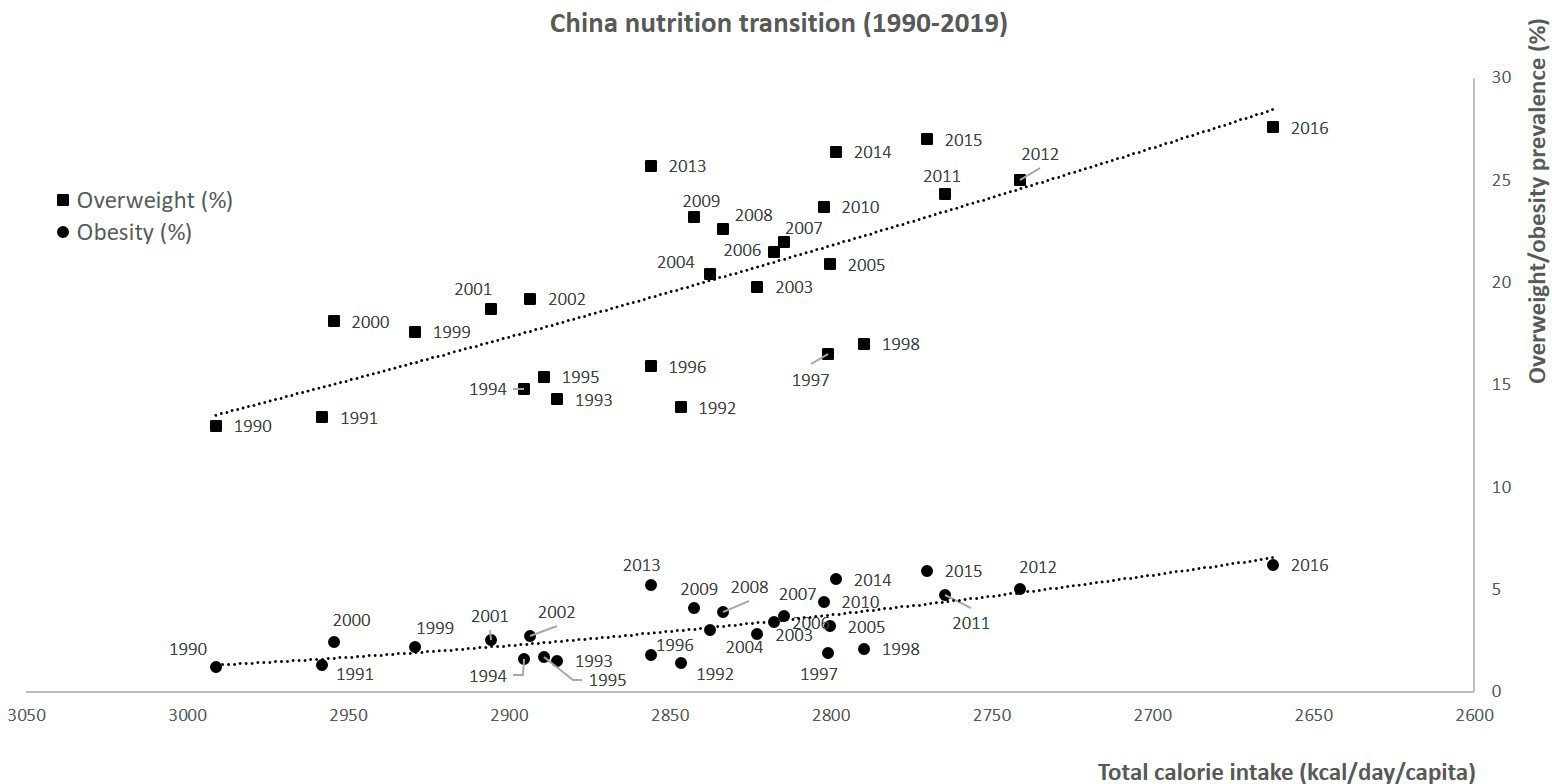
To extend analyses of nutrition transition in developed countries to China within the framework of the 3Vs rule considering degree of processing starting with plant/animal calorie ratio (Rule 1), industrially processed foods (IPFs, Rule 2), and food diversity through nutrient intakes (Rule 3).
Design:
Total and main food group (n 13) calorie intakes, percentages of animal and IPF calories, adequacy of the Dietary Reference Intake (DRI) and prevalence of chronic diseases were retrieved from scientific literature and international databases.
Setting:
China, 1990–2019.
Participants:
Overall population.
Results:
The total calorie intake decreased by 9 % over 30 years while the prevalence of chronic diseases substantially increased. Percentages of IPFs (Rule 1) and animal (Rule 2) calorie intake shifted from 9 to 30 % and 2 to 30 %, respectively. Meanwhile, the overall DRI adequacy (Rule 3) did not improve, with calcium and retinol deficiencies in 2019, and, although remaining above DRI, iron, copper, magnesium, and vitamins E, C and B1–B9 intakes regularly decreased. Notably, the prevalence of obesity increased five-fold, paralleling the exponential increase in IPF calorie intake. Both sources of calories were highly correlated with prevalence of main chronic diseases.
Conclusions:
Despite a slight decreased of total calorie consumption and small variations of adequacy with DRI, the farther the Chinese population moved away from the 3Vs rule during the 1990–2019 period, the more the prevalence of chronic diseases increased. Further analyses on foods’ transitions will be better assessed when advocating sources/quality of calories (Rules 1/2), rather than only nutrient composition (Rule 3).
To assess the relationship between food insecurity, sleep quality, and days with mental and physical health issues among college students.
Design:
An online survey was administered. Food insecurity was assessed using the ten-item Adult Food Security Survey Module. Sleep was measured using the nineteen-item Pittsburgh Sleep Quality Index (PSQI). Mental health and physical health were measured using three items from the Healthy Days Core Module. Multivariate logistic regression was conducted to assess the relationship between food insecurity, sleep quality, and days with poor mental and physical health.
Setting:
Twenty-two higher education institutions.
Participants:
College students (n 17 686) enrolled at one of twenty-two participating universities.
Results:
Compared with food-secure students, those classified as food insecure (43·4 %) had higher PSQI scores indicating poorer sleep quality (P < 0·0001) and reported more days with poor mental (P < 0·0001) and physical (P < 0·0001) health as well as days when mental and physical health prevented them from completing daily activities (P < 0·0001). Food-insecure students had higher adjusted odds of having poor sleep quality (adjusted OR (AOR): 1·13; 95 % CI 1·12, 1·14), days with poor physical health (AOR: 1·01; 95 % CI 1·01, 1·02), days with poor mental health (AOR: 1·03; 95 % CI 1·02, 1·03) and days when poor mental or physical health prevented them from completing daily activities (AOR: 1·03; 95 % CI 1·02, 1·04).
Conclusions:
College students report high food insecurity which is associated with poor mental and physical health, and sleep quality. Multi-level policy changes and campus wellness programmes are needed to prevent food insecurity and improve student health-related outcomes.
The current study aimed to address the key areas of concern for child nutrition, both during and after the COVID-19 pandemic, and proposes strategic responses to reduce child undernutrition in the short and long term.
Design:
A descriptive literature review was performed. The search of the literature was conducted through using electronic databases including PubMed, Web of Science, Google Scholar and Cochrane library.
Setting:
A wide range of published articles focused on child malnutrition were reviewed.
Participants:
The study was focused on children especially those under 5 years.
Results:
The current study proposes strategic responses to reduce child undernutrition. These responses include strengthening access to community-based nutrition services that support the early detection and treatment of undernourished children and emergency food distribution, including fortified foods with vitamins and minerals, to vulnerable households, particularly those with children under 5 years. Moreover, counseling and promotion programmes should be reinforced to revitalise community nutrition education in areas such as gestation, exclusive breast-feeding and complementary feeding, and hygienic practices involving handwashing, proper sanitation and other basic behavioural changes.
Conclusions:
The COVID-19 pandemic has affected many countries especially those in the regions of South Asia and sub-Saharan Africa in which there has been an ongoing burden of child undernutrition. However, malnutrition is preventable and can be eliminated through a multisectoral strategic approach. The effective execution of a multisectoral approach towards preventing childhood malnutrition will require not only a financial investment but also the collective efforts from different ministries of the governments, UN-affiliated agencies and non-governmental organisations.
In February 2020, San Francisco proposed mandatory health warnings for sugar-sweetened beverage (SSB) advertisements. Industry legal challenges stated that the warning would detract from advertisers’ ability to convey their intended message and mislead consumers into believing that SSB cause weight gain regardless of consumption amount, lifestyle or intake of other energy-dense foods.
Design:
Online between-group experiments tested the impact of SSB warnings on advertising outcomes and consumer perceptions. Respondents were randomised to view six SSB print advertisements with or without a health warning (‘Warning’ and ‘No Warning’ condition, respectively). Linear and binary logistic regression models tested differences between groups, including ad recall, brand perceptions and beliefs about SSB health effects.
Setting:
Panelists from the US Nielsen Global Panel.
Participants:
Sixteen to 65-year-old respondents (n 1064).
Results:
Overall, 69·2 % of participants in the ‘Warning’ condition recalled seeing warnings on SSB ads. Compared with the ‘No Warning’ condition, participants in the ‘Warning’ condition who reported noticing the warnings were equally likely to recall the brands featured in the SSB ads and to recall specific attributes of the final ad they viewed. Similarly, no differences were observed between groups in perceptions of SSB, such as perceived taste, or in the prevalence of false beliefs regarding the health effects of SSB and intake of other sugary foods on weight gain.
Conclusions:
Overall, there was no evidence that SSB health warnings detracted from attention to promotional elements in advertisements or that the warnings misled consumers into false beliefs about SSB as the exclusive cause of weight gain.
To identify and monitor food industry use of political practices during the adoption of nutrition warning labels (WL) in Colombia.
Design:
Document analysis of publicly available information triangulated with interviews.
Setting:
Colombia.
Participants:
Eighteen key informants from the government (n 2), academia (n 1), civil society (n 12), the media (n 2) and a former food industry employee (n 1).
Results:
In Colombia, the food industry used experts and groups funded by large transnationals to promote its preferred front-of-pack nutrition labelling (FOPL) and discredit the proposed warning models. The industry criticised the proposed WL, discussing the negative impacts they would have on trade, the excessive costs required to implement them and the fact that consumers were responsible for making the right choices about what to eat. Food industry actors also interacted with the government and former members of large trade associations now in decision-making positions in the public sector. The Codex Alimentarius was also a platform through which the industry got access to decision-making and could influence the FOPL policy.
Conclusions:
In Colombia, the food industry used a broad range of political strategies that could have negatively influenced the FOPL policy process. Despite this influence, the mandatory use of WL was announced in February 2020. There is an urgent need to condemn such political practices as they still could prevent the implementation of other internationally recommended measures to improve population health in the country and abroad, nutrition WL being only of them.