




No CrossRef data available.
Article contents
Remarks on Euclid’s Elements I,32 and the Parallel Postulate
Published online by Cambridge University Press: 01 September 2003
Abstract
Argument
In this paper I offer some reflections on the thirty-second proposition of Book I of Euclid’s Elements, the assertion that the three interior angles of a triangle are equal to two right angles, reflections relating to the character of the theorem and the reasoning involved in it, and especially on its historical background. I reject a common view according to which there was at some time a petitio principii in the theory of parallels and argue that certain kinds of skepticism about Proclus’ historical reports are excessive. The evidence we have makes it reasonable to suppose that the so-called common notions were made explicit in the earlier fourth century BCE and the postulates, including the parallel postulate, somewhat later than that. On the other hand, it seems clear that some proof of I,32 was available by the mid-fifth century. I attempt to describe what such a proof would have been like and reflect on its significance for our understanding of early Greek geometry.
Information
- Type
- Articles
- Information
- Copyright
- 2003 Cambridge University Press
It is well known that the proposition which we express by saying that the sum of the angles of a triangle is 180° is expressed in Euclid’s Elements (I,32)1
In this paper I use expressions like “I,32” to refer both to a specific proposition in Euclid’s Elements and to other formulations of the same truth.
In terms of figure 1 Euclid’s fifth postulate, the parallel postulate, says:
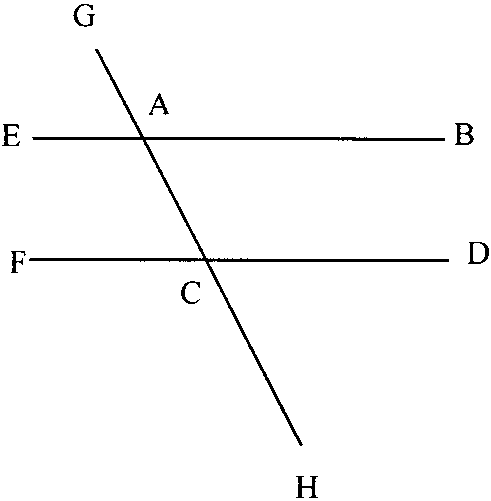
Fig. 1
If BAC and DCA are angles on the same side of the straight line AC, and they are together less than two right angles, then if AB and CD are extended past B and D, they will eventually intersect.
Thomas Heath (1949) has argued that Euclid is to be given credit for the introduction of this postulate into geometry, basing himself on a difficult passage in which Aristotle reports the existence of a petitio principii in the treatment of parallels:
A. This is what happens with those who think they draw parallels (

); for they unconsciously assume things which it is not possible to demonstrate if parallels do not exist (

) (Prior Analytics II.16.65a4-7. Heath 1949 translation).
If a general theory of parallels is here alluded to, we infer that it was on the lines of Euclid’s propositions on the subject, but that, at some point, it tacitly assumed something equivalent to the very thing to be proved. It is a fair inference that Euclid was the first to get rid of a petitio principii in some earlier text-books, by himself formulating the famous Postulate 5. (Heath 1949, 28)
The transitivity of parallelism is, of course, equivalent to the uniqueness of the parallel to a straight line through a given point. Vitrac (1990, 307-308) suggests that the petitio Aristotle has in mind is the assumption of uniqueness.
I, 32 (see fig. 2). If ACB is a triangle and BC is extended to D and CE is drawn parallel to BA, then (a)
[ang ]ACD = [ang ]ABC + [ang ]BAC
, and (b) angles ACB, ABC, BAC together are equal to two right angles.
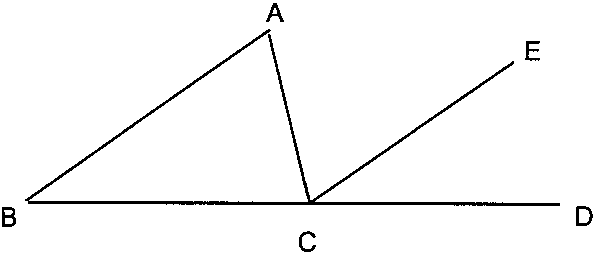
Fig. 2
What does part b of I,32 add to part a? How little it adds in content is shown by the theorem invoked to justify the move from a to b:
I,13 (see fig. 3). If BCD and AC are two straight lines, then
[ang ]ACB + [ang ]ACD = 2
right angles.
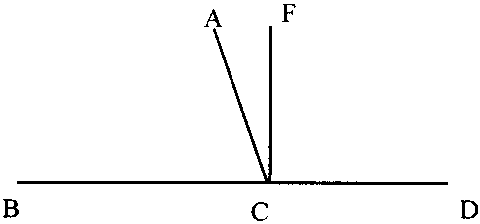
Fig. 3
Euclid’s proof is little more than the picture:
If
[ang ]ACB = [ang ]ACD
, then by the definition of a right angle (I, definition 10), each is a right angle. Suppose they are unequal and let
[ang ]ACD > [ang ]ACB
.3
It is somewhat surprising that Euclid does not worry about the relative sizes of the two angles, but simply takes for granted that they are as in the picture.
(i) Let CF be erected at right angles to BCD (I,11).
(ii)
[ang ]FCB = [ang ]ACB + [ang ]ACF
, and
[ang ]ACD = [ang ]ACF + [ang ]FCD
,
(iii)
[ang ]ACB + [ang ]ACD = [ang ]ACB + [ang ]ACF + [ang ]FCD
, and
[ang ]FCB + [ang ]FCD = [ang ]ACB + [ang ]ACF + [ang ]FCD
.
(iv)
[ang ]ACB + [ang ]ACD = [ang ]FCB + [ang ]FCD
,
The underlying reasoning here is not so much cutting and pasting as cutting and looking. But in the Elements the looking is replaced by inferences involving the common notions. Since Aristotle sometimes mentions Euclid’s third common notion (“equals subtracted from equals”) as a “common axiom” and speaks of the common axioms in a way which suggests they are a known feature of mathematics (“so-called common axioms” at Posterior Analytics I.10.76b14 and “what are called axioms in mathematics” at Metaphysics Γ.1.1005a20), it seems likely that by Aristotle’s time some mathematicians were being explicit about this sort of general quantitative assumption. But it also seems to me and, I think, most scholars likely that these assumptions were not made explicit much before Aristotle’s time. A looking argument would only require the drawing of a perpendicular from point C, and the picture would make the truth of the claim clear. And given the picture the perpendicular would seem to serve more the purpose of saying what is meant by equality to two right angles, than providing a needed presupposition of the proof.
In his commentary on Book I of Euclid’s Elements, Proclus (283.7-10) tells us that the later fifth-century figure Oinopides of Chios first investigated (

) the problem of dropping a perpendicular and that he did so because he thought it useful in astronomy; Proclus adds that Oinopides used the word “gomonwise” (

) because the

(roughly sundial) is at right angles to the horizon. Later (333.5-6) Proclus, citing Eudemus, ascribes to the same Oinopides the “discovery” of how to construct an angle equal to a given one. Euclid carries this construction out in I,23, and in I,31 he uses it to construct a line through a point parallel to a given line, the construction he uses in I,32 to draw CE (fig. 2). I do not see any reasons which would not fall under the rubric of general skepticism
4As examples of specific skepticism I would mention Dicks (1959) on Proclus’ reports on Thales and Burkert (1972, 409-412) on the description of Pythagoras in the Eudemian summary. I would classify Vitrac (1996) under the rubric of general skepticism. Vitrac concentrates on the Eudemian summary, although on page 45 he appears to generalize what he says, mentioning Thales, the Pythagoreans, and Oinopides, but he gives no specific reasons for skepticism about Oinopides, and he suggests that “la contribution d’Eudème prend toute sa valeur lorsqu’il peut disposer de sources écrites, en tout état de cause à partir d’Hippocrate de Chio.” So far as I know, no one supposes any significant chronological difference between Hippocrates and his fellow Chian Oinopides. Although Proclus refers to Hippocrates as coming after Oinopides, modern scholars (e.g., Morrow 1992, 54, n. 34) sometimes refer to them as contemporaries. The Dictionary of Scientific Biography (Gillespie 1970-1990), locates the active life of Oinopides “in the second third of the fifth century” (vol. X, 179), and that of Hippocrates “in the second half of the fifth century” (vol. VI, 410). In this paper I am not interested in any period prior to the mid-fifth century.

), a short dialogue once ascribed to Plato. But this fact hardly entitles one to dismiss the particular attributions of mathematical discoveries made by Oinopides (for which see Gillespie 1970-1990, s.v. “Oenopides”). And it seems to me particularly difficult to explain why elementary “discoveries” of the kind I have mentioned should be assigned to such a late figure as Oinopides rather than, say, to one of the great early Greek geometers, Thales or Pythagoras. I am inclined to think that what mainly Proclus, but also others, tell us allows us to locate the real beginning of axiomatization and the reduction of theorems and constructions to more elementary propositions and constructions in the later fifth century.
5I have argued for this claim in more detail in Mueller 1997.
On Hippocrates see Gillespie 1970-1990, s.v., “Hippocrates of Chios.”
The last ingredient in the proof of I,32 is the demonstration that
[ang ]ACE = [ang ]BAC
and
[ang ]ECD = [ang ]ABC
. For this Euclid invokes:
I,29 (see fig. 1) If EAB and FCD are parallel straight lines, then
- the alternate angles EAC and ACD are equal,
- the exterior angle GAB is equal to the interior and opposite angle ACD,
- the interior angles on the same side BAC, DCA together are equal to two right angles.

Fig. 4.
I shall discuss the proof of I,15 later, but now I want to bring in Proclus again. In his discussion of I,32 (379.2-16) he tells us that Eudemus credits the Pythagoreans with the discovery of the theorem that the interior angles of a triangle are equal to two right angles, and gives the Pythagorean proof, a Euclidean-style demonstration, but avoiding the preliminary assertion of the equality of the exterior angle ACD to the interior and opposite angles ABC, BAC. The proof does not differ in any interesting way from Euclid’s. In fig. 5, FAG is parallel to BC,
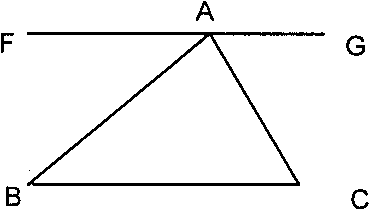
Fig. 5.
and the result is inferred from the equalities (given by I,29(a)) of the alternate angles GAC, ACB, and FAB, ABC; again I,13 would be used to get the equality to two right angles.
There will probably always be questions about the reliability of what Proclus says about the Pythagoreans, but I do not know any good, specific reason for rejecting the view that the proof he gives and hence the theorem dates from around the middle of the fifth century BCE.7
As far as I know, no one has raised skeptical objections to this passage in particular. It appears not to be mentioned by Burkert, who did so much to discredit the idea of Pythagoras the mathematician.
Aristotle provides us with quite clear evidence that I,32 was something to talk about, at least in his circles, in the mid-fourth century. It is his favorite example of a mathematical proposition,8
For a list of some twenty Aristotelian references to it, see Heiberg 1904, 19-20.
B. It is not perhaps absurd that the same false result should follow from several suppositions, e.g., that parallels meet, both on the assumption (i) that the interior angle is greater than the exterior and on the assumption (ii) that a triangle contains more than two right angles. (Posterior Analytics II.17.66a11-16; Barnes 1984 translation)
For the argument, see Mueller 1991, 66-81.
Heath’s own inference from Text A that there was a petitio principii in earlier treatments of parallels seems to me unwarranted since it relies on questionable interpretations of

and

.
10Vitrac (1990, 306, n. 15), who appears to follow Heath in this matter, proposes ‘prouver géométriquement que deux droites sont parallèles,’ and remarks that the words ‘parallels exist’ “peut aussi être diversement interprété.”

or

. It is true that in geometrical writings

is generally reserved for circles and other non-straight lines, and that the most common word for drawing a straight line is

.
11See Mugler 1958, 39-40 and 107-109, where there are passages from Aristotle conforming to this standard usage. I thank Bernard Vitrac for making this point about the words for “draw” in a discussion with me of an earlier version of this paper.

to mean something like “write about parallels.” And certainly it is true that Aristotle could use an expression like

as shorthand for a variety of things. But it seems to me preferable to start from the most direct rendering of the phrase, the kind which Heath himself offers in his translation, than to start by supposing that the phrase means something broader than what it literally says.
The only ancient Greek commentary we have on this passage, written by John Philoponus, cannot be relied on for what it suggests about the specific geometric content behind Aristotle’s remark, but there is no question that Philoponus understands the Greek constructions in the straightforward way I am proposing. He writes:
Those who draw parallel lines (

) also do the same thing: they beg the question. For they claim that it is possible to draw (

) parallel straight lines from the meridian circle, and they take a point on the plane of the circle and in this way they extend the straight lines – and they have assumed what was sought, since the person who does not concede the existence of parallels will not concede the existence of that point either. (Philoponus 454.4-9)
We cannot know what sort of situation Aristotle is envisaging, but I would suppose it is one in which a geometer says in the course of an argument, “Let the straight line CE be drawn through C parallel to BA.” Obviously this kind of reasoning has to take for granted that parallel lines exist – in some sense of exist. In the only Greek geometry we know the existence of such lines would be established by assuming or proving that such lines can be drawn. I am inclined, then, to think that Aristotle is referring to arguments like the proof of I,32, but in which the possibility of drawing parallels was not demonstrated, but simply taken for granted. We have no way of knowing whether Aristotle is explicitly thinking about I,32, but it is obviously unlikely that the possibility would be demonstrated in one case and taken for granted in another. And the idea that he is thinking about this case, the report that the Pythagoreans produced a proof of I,32, and the multiply confirmed suggestion that elementary constructions were first studied in the later fifth century all fit together nicely.12
Text A is in the present tense, but Aristotle need not be referring to anything about the geometrical practice of his contemporaries, since he frequently discusses views of his predecessors in the present tense.
I have argued that certain elementary constructions, notably I,23 or I,31 and I,11, and the first three common notions might well have been taken for granted in an earlier version of the proof of I,32. It is also reasonable to assume that the same is true of the first two Euclidean postulates, which allow one to draw the straight line connecting two points and to extend a straight line. It also appears that the parallel postulate was not enunciated as a postulate by the mid-fourth century, but any proof of I,32 would have had to in some way assume or take for granted it or one of its equivalents, I,29(a), (b), or (c). To me, for what is worth, I,29(b) is the most intuitively “obvious” of these. But I,29(b) will not suffice without I,29(a), and I am very doubtful that it is helpful to call I,29(a) obvious. Moreover, I,29(a) and (b) only get us to I,32(a). For the assertion that the angles of the triangle are equal to two right angles requires I,13, which itself seems so obvious that its very assertion seems to require the kind of sophistication one associates with the Elements. One can imagine someone pointing to fig. 2 and saying that the angles of triangle ABC are equal to those three angles at point C, but the reformulation of that claim in terms of equality to two right angles suggests the kind of general or systematic interest which we find in fully developed Greek mathematics.
A similar point can be made about I,15, which, as I indicated, is used in the proof of I,29 and would be needed in any case unless both I,29(a) and (b) were taken for granted. I would not call I,15 obvious. Euclid’s proof uses I,13, according to which (see fig. 4)
(i)
[ang ]GAB + [ang ]BAC = 2
right angles, and
[ang ]EAC + [ang ]BAC = 2
right angles.
(ii)
[ang ]GAB + [ang ]BAC = [ang ]EAC + [ang ]BAC
,
So Heath (1926, 278), but normally the common notion is applied to “things,” specific magnitudes like lines or angles or triangles, and not to more abstract quantities like “two right angles.” It seems to me possible that Euclid is simply taking for granted that if all right angles are equal then things equal to two right angles are equal to each other. But nothing I say in this essay turns on this question.
The fourth postulate is the most perplexing of the five. Proclus points out that it is provable:
Let us assume two right angles ABC and DEF. I say they are equal. For, if they are not, one of them will be greater than the other. Let this be the angle at B. Then if DE be made to coincide with AB, EF will fall within the angle as BG. Let BC be extended to H. Since ABC is a right angle, so also is ABH and they are equal to one another (for in the definitions it says that a right angle is equal to its adjacent angle). Therefore, angle ABH is greater than angle ABG. Now let BG be extended to K. Since ABG is a right angle, its adjacent angle will also be a right angle and equal to ABG. So angle ABK is equal to angle ABG, so that angle ABH is less than ABG. But it is also greater, which is impossible. (188.2-189.9; Morrow 1992 translation slightly revised)
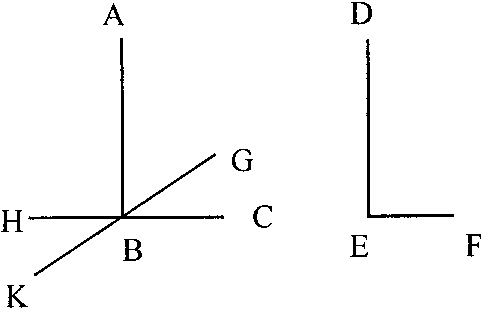
Fig. 6
We do not know why Euclid includes the fourth postulate as a postulate (see Mueller 1981, 29-30), but it does not seem unreasonable to assume that the postulate was at some time either taken for granted or justified in something like the manner of Proclus’ argument.14
For a general discussion bearing on this question, see von Fritz 1955, 76-89.
I have attempted to construct a pre-Euclidean proof of I,32 on the assumption that an earlier proof would have been more intuitive and less rigorous than the one we find in the Elements, but that the idea of the proof would not have differed radically from the idea of Euclid’s proof. I have used various evidence from Aristotle and Proclus to argue that there was a fifth-century proof and to bring out the ingredients of the Euclidean proof which might have been used earlier without proof or explicit statement. But I do not see how to deal with either the criterion of equality to two right angles brought to the forefront in I,13, or its use in the proof of I,15 (or equivalently I,29(a)), which seem to me as abstract and rigorous as anything in the Elements. Some might see this as a reason to doubt that I,32 was a part of fifth-century Greek geometry, whatever Proclus and Eudemus say to the contrary. Others might see it as a reason to think that the style of fifth-century Greek geometry was more like Euclid’s than one might otherwise suppose. I incline to side with this second group.
Acknowledgments
It is an honor and a pleasure to offer this small essay to Sabetai Unguru, who is for me the model of a courageous and forthright scholar and human being.
References
Aristotle.See Barnes 1984
Barnes, Jonathan,ed. 1984. The Complete Works of Aristotle: The Revised Oxford Translation. 2 vols. Princeton: Princeton University Press. (Pages cited after Bekker 1831.)
Bekker, Immanuel,ed. 1831. Aristotelis Opera. 2 vols. Berlin: Georg Reimer.
Burkert, Walter.1972. Lore and Science in Ancient Pythagoreanism. Translated by Edwin L. Minar Jr.Cambridge, Massachusetts: Harvard University Press.
Friedlein, Gottfried, ed. 1873. Procli Diadochi in Primum Euclidis Elementorum Librum Commentarii. Leipzig: B. G. Teubner.
Fritz, Kurt von.1955. “Die ARXAI in der griechischen Mathematik.” Archiv für Begriffsgeschichte 1:13-103.Google Scholar
Gillespie, Charles Coulston,ed. 1970-1990. Dictionary of Scientific Biography. 16 vols. New York: Charles Scribner’s Sons.
Heath, Thomas L.,trans. 1926. The Thirteen Books of Euclid’s Elements. vol. 1. 2nd ed. Cambridge, England: Cambridge University Press.
Heath, Thomas.1949. Mathematics in Aristotle. Oxford: Clarendon Press.
Heiberg, J. L.1904. “Mathematisches zu Aristoteles.” Abhandlungen zur Geschichte der Mathematischen Wissenschaften 18:1-49.Google Scholar
Morrow, Glenn,trans. 1992. Proclus. A Commentary on the First Book of Euclid’s Elements. Princeton: Princeton University Press. (Pages cited after Friedlein 1873.)
Mueller, Ian.1981. Philosophy of Mathematics and Deductive Structure in Euclid’s Elements. Cambridge, Massachusetts: MIT Press.
Mueller, Ian.1991. “On the Notion of a mathematical starting point in Plato, Aristotle, and Euclid.” In Science and Philosophy in Classical Greece. Edited by Alan C. Bowen,59-97. New York and London: Garland.
Mueller, Ian.1997. “Greek arithmetic, geometry, and harmonics: Thales to Plato.” In The Routledge History of Philosophy Volume I: From the Beginning to Plato. Edited by C. C. W. Taylor,271-322. Londonand New York: Routledge.
Mugler, Charles.1958. Dictionaire historique de la terminologie géométrique des Grecs. Paris: Librairie C. Klincksieck.
Philoponus, John.See Wallies 1905.
Proclus. See Morrow 1992.
Vitrac, Bernard,trans. 1990. Euclide d’Alexandrie. Les Eléments. vol. 1. Paris: Presses Universitaires de France.
Vitrac, Bernard.1996. “Mythes (et réalités?) dans l’histoire des mathématiques grecques anciennes.” In L’Europe mathématique. Edited by Catherine Goldstein;Jeremy Gray,and Jim Ritter,31-51. Paris: Éditions de la Maison des Sciences de l’Homme.
Wallies, Maximilian,ed. 1905. Ioannis Philoponi in Aristotelis Analytica Priora Commentaria. Berlin: Georg Reimer.
 You have
Access
- 3
- Cited by