

The Ephemeris (‘journal’) is a prose account of the Trojan War purportedly told from the perspective of ‘Diktys of Crete’, a soldier in Idomeneus' contingent. Nowadays it is a poorly known text. With good reason, some might say; yet in the Middle Ages and Renaissance, Diktys was among the most authoritative accounts of what happened at Troy, second only to Dares of Phrygia. In Byzantine historiography and literature, Diktys' importance was unmatched. Historians found Diktys better suited to their purposes than Homer because of a feature that is today perceived as Diktys' biggest fault: his plainness. That plainness is deceptive. The language is indeed bland, but Diktys is filled with richly imagined setpieces and backdrops: the garden where Paris meets Helen; the Trojan court that serves as the scene for many embassies; the temple of Helios where Odysseus and Kirke hold a summit and make a fateful pact; the precinct of the temple of Thymbraian Apollo, which provides the setting for joint festivals held by the Greeks and Trojans, for the abortive romance of Achilleus and Polyxene, and for the dastardly night-time murder of Achilleus by Paris and his brothers.
To those who do know Diktys, the Ephemeris is most familiar through a Latin translation made by Lucius Septimius in the third or fourth century.Footnote 1 Even the Latin Dictys is not well known; the Greek Diktys is badly neglected. Two new papyri of the original were published in 2009, bringing the total to four (see section 2 below), and this provides an occasion to offer some observations on the Greek original. The following comments are intended partly as a guide for the perplexed, and partly as paralegomena to an ongoing project to produce an annotated compilation of the testimony to Diktys, both the ‘Latin Dictys’ and the numerous strands of Byzantine Greek testimony. A newcomer who is acquainted only with the Latin version will find much about Diktys to be very mysterious and esoteric. Specifically, a novice who consults standard editionsFootnote 2 will not be alerted to the fact that the Latin version is very incomplete, and that Byzantine sources fill many gaps.Footnote 3 The Byzantine testimony tends to be cited only as an indicator of Diktys' influence, rather than as an indispensable witness to the original.
This is an illustrative guide, not a thorough one: it uses a few interesting or problematic parts of Diktys to demonstrate the types of problems that arise. I shall focus on just four points: (1) a general overview; (2) a comprehensive list of witnesses to Diktys (the first list of its kind for over a century, and the first ever in English); (3) some problems relating to Septimius Book 6; and (4) an overview of the so-called Sisyphosfrage.
1. Overview
The author of the original Ephemeris is unknown, but wrote probably in the late first century, possibly the first half of the second century. The Ephemeris must be later than 66 CE, the date given by the pseudo-documentary prologue when the text was supposedly discovered in Diktys' tomb.Footnote 4 For the terminus ante quem there are three dates to choose from. The most certain is the date of the recently published POxy. 4943, which all but fixes the terminus in the first half of the second century; see Hatzilambrou (2009) 83. Apart from that, there is a parody of a Diktyean episode in Lucian's True histories that can be no later than c. 190 (the approximate date of Lucian's death) and is probably rather earlier; see Gainsford (Reference Gainsford2011) 97. The earliest, but most questionable, terminus is set by Ptolemaios Chennos (late first century; see section 2 below), who mentions some distinctively Diktyean episodes; questionable because it is uncertain who copied whom, and because Chennos is even more poorly known than Diktys and survives only as an epitome. At any rate, previous datings that saw Diktys as indebted to Philostratos, in the third century,Footnote 5 are firmly disproved.
From the fifth to the fifteenth centuries CE, the Ephemeris had more impact on the Trojan War legend than almost any other text. For the Byzantines, Diktys ranked as the most authoritative account of the Troy matter, followed by Homer, Euripides and Virgil; in the west it was Dares of Phrygia, followed by Diktys, then Virgil and Ovid. Even recent adaptations have used material derived ultimately from Diktys: in the film Troy (2004), the fatal romance between Achilles and Briseis (a Trojan princess and priestess, kidnapped from a temple of Apollo) is essentially a reframing of the Diktyean romance between Achilleus and Polyxene (a Trojan princess; the romance is set around the temple of Thymbraian Apollo).
The Ephemeris lies between genres. It is a pseudo-documentary historical romance; we might call it a ‘quasi-novel’.Footnote 6 Some distinctly novelistic tropes that we see in Diktys are important early exemplars, since there is only one completely extant Greek novel that may be earlier, Chariton's Chaireas and Kallirhoe. Polyxene's and Achilleus' abortive, ill-fated love affair is a trope widely considered to be a defining feature of the Greek novel.Footnote 7 A more specific example is the importance of dreams, especially misinterpreted dreams, in the Ephemeris:Footnote 8 dreams are also important in several novels, as well as in the novel's closest poetic relative, New Comedy (though of course they also appear in the more distantly related genres of epic and tragedy).Footnote 9 The scenery is richly imagined, as noted above, and flavours the story with romance; Nilsson has compared Paris' and Helen's first meeting to garden-scenes in Achilleus Tatios and Longos.Footnote 10 Often Diktys' settings are portrayed in such terse but definite terms that it feels as though the author is not even writing a description, but rather referring to a pre-existing depiction.Footnote 11 Truce talks between Odysseus and Kirke are described as follows:
ἡ οὖν Κίρκη ἱέρɛια οὖσα Ἡλίου καὶ μυστικὰς ἠπίστατο πράξɛις … ἡ δὲ Κίρκη θαυμάσασα πῶς ɛὗρɛν αὐτὸν ɛἰδότα τὰς αὐτῆς μαγγανɛίας ὑπῆλθɛ τὸν ἄνδρα δώροις πολλοῖς καὶ ᾔτησɛν αὐτὸν μɛῖναι παρ’ αὐτῇ τὴν ὥραν τοῦ χɛιμῶνος, ὀμόσασα αὐτῷ ἐν τῷ ἱɛρῷ ὡς οὔτɛ αὐτὸν οὔτɛ τινὰ τῶν σὺν αὐτῷ βλάψɛι.
Kirke was a priestess of Helios, and had mystic powers; … Kirke was amazed to think how [Odysseus] had found out about her witchcraft, and she tried to placate him with many gifts and asked him to stay with her for the duration of the winter. And she swore to him in the temple that she would not harm him nor any of his men.Footnote 12
‘In the temple’? No temple has been mentioned; all we have to go on is the reference to Kirke as a priestess. It might be supposed that something has been elided here, but this is far from an isolated case. It might even be that the original Diktys was published with illustrations – but that is speculation.Footnote 13 The Greek Ephemeris may lack unity and have a bland prose style, but we must allow it a vivid visual imagination, at the very least. The author also had a strong sense of dramatic irony: in another Diktyean source, the Eklogē historiōn, the above moment is followed by Odysseus giving Kirke the fateful spear that, one day, will be passed on to Telegonos, and will become simultaneously the recognition token that reunites father and son and the instrument of Odysseus' death.
Perhaps the most important novelistic element in the Ephemeris is its pseudo-documentary frame-story. The Ephemeris opens with a prologueFootnote 14 that relates how an ancient text, written by ‘Diktys’, is discovered inside Diktys' own tomb in Crete during the reign of Nero. The text by the head of a dead person is a trope, one that seems to have been popular in the late first century: Chennos presents a number of anecdotes along similar lines.Footnote 15 The manuscript, written in the ‘Phoenician’ alphabet (not actually Phoenician; this is a semi-legendary term for early Greek writing, as we shall see), is taken to the emperor, who has it transcribed and published. The prologue thus frames the Ephemeris as an eyewitness account of the Trojan War.
Even in the wake of Ní Mheallaigh's (2008) excellent article on pseudo-documentarism in Diktys, Antonios Diogenes and Lucian, it is worth repeating that the story of the discovery of Diktys' manuscript is part of a fictional frame-story. Frame-stories are a common trope of both ancient and modern novels.Footnote 16 They create verisimilitude by giving the novel a back story; but there is no warrant for giving them credence beyond that. Diktys' pseudo-documentary games have led to his becoming the object of a staggering degree of credulity over the millennia. Some (not all) Byzantine chroniclers and mediaeval western writers seem to have genuinely believed that Diktys was an eyewitness account; but even in modern scholarship, otherwise level-headed scholars have been willing to take seriously the idea that the text really was discovered written ‘in Phoenician letters’ (surely rather Neo-Punic, given the period) and then translated or transliterated into Greek.Footnote 17 It is as though someone were to read a modern novel with a frame-story – say Shelley's Frankenstein, framed as a story told to an Arctic explorer – and treat it as a story told about an actual scientist creating an actual monster: faced with that extreme, it might seem sane to express doubt about the content while accepting the frame-story. That sounds like restraint. But that still means accepting the Arctic expedition as real, and even that is a drastic error. The Ephemeris may not be precisely a novel, but it is a work of fiction, and its pseudo-documentary character should never be forgotten.Footnote 18
Fortunately one of the new papyri preserves the sphragis corresponding to Septimius 5.17, where ‘Diktys’ describes linguistic issues he had to deal with in writing his account.Footnote 19 The passage builds on the prologue's frame-story by including a verbal echo of the Homeric picture of Crete's mixed culture in Odyssey 19.172–80 (Septimius seems to have missed this allusion);Footnote 20 and this makes it much clearer that the Phoenician script and/or language are all part of the frame-story, that is to say, entirely fictional. Seen in this light, references to ‘Phoenician letters’ and to the alphabet of Kadmos and DanaosFootnote 21 are nothing to do with the historical Phoenician alphabet, but about the legendary origins of the Greek alphabet. Several early writers claim that Kadmos imported the Greek alphabet from Phoenicia; in others, Danaos brought it from Egypt. Diktys simply synthesises these variants: his ‘Phoenician’ letters are in fact Greek. Many other extant aetiologies also tie the epithet ‘Phoenician’ to the early Greek alphabet.Footnote 22 When Herodotos referred to early Greek letters as ‘Phoenician’ he may possibly have been thinking of Archaic epichoric Greek alphabets; but in Diktys it must be a matter of a legendary, not a historical, script.
One may hope, then, that the optimistic tradition of taking at least something in Diktys as literal truth is now buried once and for all. It is, however, plausible that Septimius' covering letter, which replaces the prologue in the ɛ family of manuscripts, was written in good faith. That too has been doubted,Footnote 23 but that probably takes scepticism too far. The Ephemeris itself deserves no trust; but Septimius, writing two or three centuries later, is more likely to be a dupe than a stooge.
Among the Greek writers who draw on Diktys there is a curious trend, and it has to be wondered whether it is significant. In the second century we find Lucian of Samosata parodying an episode from Diktys;Footnote 24 in the sixth and seventh centuries Ioannes Malalas and (perhaps) John of Antioch use Diktys as the basis for their accounts of the Trojan War.Footnote 25 Malalas cites the lost writer Domninos, apparently an Antiochene local historian, for an episode appended to the Diktyean narrative and set in Syria; and it has been suspected (without any real evidence) that Malalas' entire Trojan War narrative may have Domninos as its immediate source.Footnote 26 The trend is that all four writers are Syrian, and three of them belong to Antioch. This could be coincidence. The geographical spread of Diktys' readership was reasonably wide: the Diktys papyri that have been found come from Egypt, so the Ephemeris was certainly read there (though the papyri could hardly have survived anywhere else). Even so, this pile-up of Syrians leads one, not to suspect, but at least to wonder whether they draw on the Ephemeris because it too was of local origin.Footnote 27 This is at least no weaker an interpretation than identifying the Ephemeris as Cretan simply because its fictional author is Cretan (though Cretan origins are of course also possible).Footnote 28
Scholars who work on Diktys often feel the need to excuse themselves. In a 1909 review of a book on Diktys, G. L. Hamilton expressed a hope for ‘the completion of critical studies on [this] worthless literary [production]’ so that scholars could move on to more worthwhile work.Footnote 29 This sentiment may stem from the character of Diktyean scholarship prior to 1908. In that era the central question was whether or not a Greek Diktys had ever existed; some held that the ‘Latin Dictys’ was the original. This question was of interest primarily for the impact it would have on the study of the Byzantine historians Ioannes Malalas and (pseudo-?)John of Antioch, who drew heavily on Diktys for their accounts of the Trojan War.
But the Diktysfrage was answered definitively in 1908 by the publication of PTeb. 268, a fragment of the original Greek text. The question was settled a little too firmly. Investigations were shut down that should not really have been shut down. For example the Sisyphosfrage, the open question of the relationship between Diktys of Crete and Sisyphos of Kos, was dropped until recently;Footnote 30 and subsequent work on Diktys has focused narrowly on the ‘Latin Dictys’, sometimes to the point of ignoring the Byzantine testimony.Footnote 31 It seems that the sense after 1908 was one of relief, that a vexatious controversy – documented by N. E. Griffin at arduous lengthFootnote 32 – had been decisively ended and could be shelved forever.
Diktys has recently earned a place in some collections of essays on ancient fiction and on the Trojan legend,Footnote 33 but some further justifications for pursuing work on Diktys may be useful. First, Diktys is of great historical importance, for reasons outlined already. Second, Diktys remains an important key (among many) to understanding the relationship between several Byzantine chronographers, especially Malalas, (pseudo-?) John of Antioch, and pseudo-Symeon/Kedrenos, all of whom base their Trojan War accounts on Diktyean material. On these witnesses see section 2 below. And third, it is likely that Diktys adapts a fair amount of material from older, lost, sources. This material – which very probably includes even the Epic Cycle – has scarcely been touched by those who work on the fragments of early epic and tragedy. Granted, the author's thorough reworking of the material makes it challenging (to say the least) to unravel old material from Diktys' own innovations.Footnote 34 But there are techniques that could be brought to bear. In places where Diktys has combined older material with his own innovations, there is a fair probability that the author is likely to compensate for the innovation by treating the older material relatively conservatively. In such cases, Cyclic epics and lost tragedies are likely sources for the older material.Footnote 35
2. Witnesses to Diktys: a comprehensive list
In the following list, names and titles in bold type are used for shorthand references. The symbol ‘ = ’ denotes a situation where a single text appears in multiple sources or in multiple modern editions; ‘ ≈ ’ indicates parallels between independent witnesses to Diktys. So for example ‘POxy. 2539 = BNJ 49 F 7c, ≈ Sept. 4.18’ means that the text of POxy. 2539 is also published in Brill's new Jacoby, and this text is parallel to Septimius 4.18.
Fürst (Reference Fürst1901) 337–44 gives a longer list of witnesses, and Dowden presents a further witness in BNJ 49 F 11. But as those authors point out, the surplus witnesses actually have nothing to do with Diktys. In Dowden's case, he has inherited a spurious fragment from Jacoby; in Fürst's case, fin de siècle Diktyean scholarship routinely cited several texts that are important for the study of John of Antioch but are unrelated to Diktys. The list below is intended for the Diktys scholar. Non-Diktyean sources are trimmed away, and a few are included that Fürst and BNJ omit. This is the first complete listing since Fürst's, so caveat lector: it is near-certain that I, too, have missed many relevant sources.
Category (A) comprises witnesses that add to our knowledge of Diktys; category (B) comprises witnesses that only replicate material in the first category and, in some cases, are based entirely on known archetypes. This categorisation is intended as a labour-saving device. When searching in older scholarship or in the Thesaurus Linguae Graecae, sources in the second category are likely to turn up frequently, but for most purposes the Diktys scholar may safely ignore them (though it is of course possible that close inspection may yet reveal new Diktyean material there). The sources in category (B) are also worth listing because several critical editions of texts in category (A) contain cross-references to texts in category (B) (these cross-references are reported below, at the end of the list); and because they are of interest in tracing the history of Diktys' influence.
It is worth stressing that these sources are not assigned to Diktys merely because they happen to be about the Trojan War; they are distinctively, and in some cases primarily, Diktyean. There are occasional contaminations from more traditional mythical material, which in this context means Homer, Euripides, Virgil, Tryphiodoros and Quintus of Smyrna (but not the Epic Cycle, unless perhaps in the original Diktys). However, it is usually easy to distinguish ‘traditional’ elements from Diktyean elements. Much Byzantine material that might at first glance look like a distorted rendering of Homer or Euripides is in fact derived from Diktys.
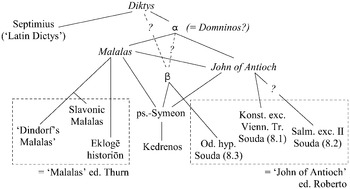
Several names here are likely to be unfamiliar to the mainstream classicist, and some sources have complex textual histories of their own. As a visual aid, Figure 1 schematically represents the relationship, as it is understood here, between the most important texts. This is not a stemma in the strict sense: lines in this diagram do not imply that one source is entirely derived or copied from the text above it in the tree. For example, Malalas' version of the Diktyean material is an imaginatively reorganised account; and the texts associated with (pseudo-?)John of Antioch are a maze of problems. The intent is primarily to give a general idea of how current critical editions envisage the relationship between the texts. On the position given to ‘(Domninos?)’ in the diagram, see n. 66 below.
A visual aid to understanding the relationship between sources 1, 3, 5, 6, 7, and 8. Italics indicate lost texts. The diagram is adapted from the critical editions of Thurn (Reference Thurn2000) and Roberto Reference Roberto(2005a), but also incorporates points raised by Bourier (Reference Bourier1900) 21–2 (on Domninos; see n. 66, below); Dowden (no date, a) on BNJ 49 F 5 (the existence of β; see on witness 5); and the present article (the division of Souda articles into groups, for which see witness 8; the Od. hyp. as non-Johannine, for which see section 3).

(A) Witnesses that add to our knowledge of Diktys
1. Lucius Septimius' translation into Latin (third or fourth century):Footnote 36 often misleadingly cited as ‘Diktys’, more accurately as ‘the Latin Dictys’. Edition: Eisenhut (21973). Books 1 to 5 of Septimius correspond closely to the original; ‘Book 6’ is an epitome of multiple books (probably four) in the original.Footnote 37 In most respects Septimius is our fullest source for Diktys.
2. Four fragmentary papyri of the original Greek text (second and third centuries): POxy. 4943 (≈ Septimius 2.29–30); PTeb. 268 (= BNJ 49 F 7a, ≈ Sept. 4.8–15); POxy. 2539 (= BNJ 49 F 7c, ≈ Sept. 4.18); POxy. 4944 (≈ Sept. 5.15–17).
3. John Malalas' Chronographia (fifth or sixth century): most of Book 5, and a few other isolated references, corresponding to the whole of Septimius' account and some more.Footnote 38 Edition: Thurn (Reference Thurn2000). Note that section numbers in Thurn do not equate to section numbers in the useful translated edition by Jeffreys et al. (Reference Jeffreys, Jeffreys and Scott1986). Malalas in turn is attested only indirectly: Dindorf's (1831) older edition was based on a manuscript that later proved to be incomplete. See Thurn (Reference Thurn2000) 11*–16* on the relationship between our three main witnesses to Malalas' Trojan War narrative (each is cited separately in scholarship prior to Thurn): ‘Dindorf's Malalas’, i.e. cod. Bodl. Barocc. 182; the Eklogē historiōn, often cited as ‘Anecdota graeca’ or ‘Cramer’ in reference to its publication by Cramer (Reference Cramer1839); and a tenth-century Slavonic translation of Malalas, first published in 1910. Malalas contains some material lacking counterparts in Septimius, most notably the ‘portraits’ of the heroes (5.9–10). Malalas expressly ascribes these to Diktys (5.10), and it is not impossible that he is telling the truth. However, Grossardt has argued compellingly that they derive from a source common with Philostratos' Heroikos.Footnote 39
4. Ptolemaios Chennos' New history (first century), as summarised by Photios, Myriobiblon cod. 190 (ninth century).Footnote 40 Edition: Henry (Reference Henry1962). There are four isolated parallels:Footnote 41 150.ii,36–151.i,3 (various incidents including Agamemnon's shooting of a goat, and Palamedes being awarded command of the Greek fleet, ≈ Sept. Book 1); 151.ii,34–7 (Helenos shoots Achilleus in the hand, ≈ Sept. 3.6); 151.ii,37–152.i,1 (Andromache present at the ransom of Hektor, ≈ Sept. 3.22); 152.ii,8–11 (the gold vine that Priam gave to Eurypylos, ≈ Sept. 4.14). Chennos' Diktyean snippets are important because they are very early. It has been debated whether Chennos read Diktys, or vice versa;Footnote 42 it is unwise to assume anything so direct as copying between these two authors only. In particular, Diktys' streamlined narrative could hardly be based on the jumble that we find in Chennos; so if Diktys were to be shown to be later, the parallels would most likely reflect older material common to both authors.Footnote 43 For example, Chennos includes Andromache in the ransom of Hektor; Septimius includes Andromache and also Polyxene. Either element could be traditional (though I suspect Diktys' treatment of the Achilleus–Polyxene romance is innovative);Footnote 44 but the combination is surely Diktys' doing. So Andromache's presence is likely to be something more traditional. She is likely to have been present at the ransom in an older account: one candidate is Aischylos' Phryges (alias Lytra);Footnote 45 another is the Aithiopis, as there are hints that that early epic included the ransom of Hektor.Footnote 46
5. Georgios Kedrenos, Synopsis historiōn (eleventh or twelfth century), 216,7–237,21 ed. Bekker (Reference Bekker1838), corresponding to the whole of Septimius' account. Kedrenos is probably multiple steps removed from Diktys, but we get many details that are not present elsewhere because his account is so full, and because it is based on multiple intermediate sources rather than only on Malalas. Roberto suspects that Kedrenos is a product of crossing Malalas with John of Antioch; but Dowden draws attention to one point elsewhere in the Diktyean material where Kedrenos reproduces an element that is found in Septimius but in neither Malalas nor (ps.-?)John of Antioch.Footnote 47 There is, therefore, at least one tradition linking Diktys to Kedrenos that is independent of both chronographers. Kedrenos' account of Greek legendary ‘history’ is reportedlyFootnote 48 a transcription of pseudo-Symeon (tenth century), a partially published chronography in cod. Paris. gr. 1712, ff. 17v–272r. The Diktyean portion of ps.-Symeon (ff. 40v–46v) is unpublished.
6. (Pseudo-?)John of Antioch (sixth or seventh century), fragments. Edition: Roberto Reference Roberto(2005a). An alternative edition, Mariev (Reference Mariev2008), omits all Diktyean material, for reasons outlined below. Diktyean material appears as F 40 to F 49.2 ed. Roberto, and corresponds to the entire Ephemeris. These fragments are compiled from texts that in most cases lack attributions, but can be linked to one another reasonably reliably. This constellation undoubtedly has Diktys as its ultimate origin, but the question of whether or not John of Antioch should be regarded as its more immediate source is close to the centre of the still-ongoing Johannesfrage. Readers are warned that piecing together the (pseudo-?)Johannine evidence is a messy business.
To complicate matters further, Roberto assigns two Diktyean sources to John that I list separately here: the so-called Odyssey hypothesis (witness 7 below), and various articles in the Souda encyclopaedia (witness 8). Four of the relevant Souda articles are indeed derived from the Johannine texts, but in other cases there is no evidence for a link. In section 3 below, I argue that the Od. hyp. does not belong to this constellation. The remaining texts are listed as 6.1 to 6.3 below.
-
6.1. Two sets of Konstantinian excerpts , De virtutibus and De insidiis, made at the order of Konstantinos VII Porphyrogennetos (tenth century).Footnote 49 The relevant sections appear most conveniently as F 23 and F 25 in Müller's (1851) edition of John of Antioch. In Roberto's edition, F 23 ed. Müller is absorbed into F 40 ed. Roberto; F 25 ed. Müller = F 49.1 Roberto. The excerpts correspond to a number of incidents throughout the Ephemeris. The fact that the Konst. exc. are transmitted under the name of John of Antioch is the basis for ascribing the entire constellation to him.
-
6.2. The Vienna Troïka (cod. Vind. hist. gr. 99, ff. 8v–14v, fourteenth century), an epitome corresponding to parts of Septimius Books 1–5. Edition: Heinrich (Reference Heinrich1892) 4–10, under the spurious name ‘Johannes Sikeliota’. An improved text appears as John of Antioch F 40, F 42.1, F 43, F 44, F 46, and F 47.2 ed. Roberto; parts also appear in BNJ 49 as F 3 and F 6. References in the present article are to Roberto's text. The Vienn. Tr. is linked to the ‘Johannine’ constellation by the fact that, where it overlaps with the Konst. exc., the two have closely parallel phrasing; see Patzig (Reference Patzig1895) 25–6.
-
6.3. A section of the Salmasian excerpts II (twelfth century or earlier), corresponding to several incidents throughout the Ephemeris. The entire Salm. exc., both I and II, appears together in Cramer (Reference Cramer1839) 383–401, with an obsolete text:Footnote 50 Salm. exc. II corresponds to 386,11 onwards, and the Diktyean section corresponds to 390,10–391,14 ed. Cramer = John of Antioch F 24 ed. Müller. Salm. exc. II is best cited using Müller's section numbers.Footnote 51 The link between Salm. exc. II and the Johannine constellation is not strong. There is one unique parallel in content with the Vienn. Tr., namely an episode where Priam appeals to king David for military aid (presumably a non-Diktyean contamination).Footnote 52 Other parallels – including parallels in phrasing with the Vienn. Tr. – are useless as evidence, because precisely the same parallels also appear in Malalas. Roberto Reference Roberto(2005a) LIII–LXXVII presents separate reasons, unrelated to Diktys, for assigning the Salm. exc. II to John of Antioch; but the matter is disputed by Mariev ((2008) 4*–8*, 26*–30*) and others.
The question of whether the entire constellation should be assigned to John of Antioch hinges on the Salm. exc. Out of its two parts, only Salm. exc. II contains Diktyean material. Roberto regards Salm exc. II as Johannine but filtered through an epitome, and Salm. exc. I as spurious;Footnote 53 Mariev regards Salm. exc. I as Johannine, and Salm. exc. II as spurious. For Mariev this outweighs even the fact that the Konst. exc. are transmitted under John's name. To evaluate the merits of either position would involve looking at the fragments of John more extensively, and that is beyond the scope of this discussion.
7. The Odyssey hypothesis (cod. Heidelb. Pal. gr. 45, ff. 230r–231r, thirteenth century), an epitome corresponding to the Odyssey and Telegony episodes (≈ Sept. 5.15–16, 6.5–6, 6.14–15). Edition: Dindorf (Reference Dindorf1855) 3–6. Patzig (Reference Patzig1893) assigned the Od. hyp. to John of Antioch, and it appears as John of Antioch F 48.2 ed. Roberto; but the reasoning is not compelling, and there is a counter-argument that Patzig did not consider. See section 3 below.
(B) Witnesses that add no new information
8. Several articles in the Souda encyclopaedia (tenth century). Edition: Adler (1928–38). As Fürst (Reference Fürst1901) 342 rightly stresses, it is unlikely that all the relevant Souda articles come from the same immediate source. Where the articles overlap with the Vienn. Tr. and Od. hyp. (see witnesses 6.2 and 7, above) the phrasing is nearly identical; but there is nothing to suggest that these articles form a single group. It is safest to divide the Diktyean articles into separate groups, listed below (8.1–8.5). The first and second groups are linked to the ‘Johannine’ constellation; the third to the Od. hyp.; the fourth and fifth groups are independent.
-
8.1. Two articles with wording very close to that of the Vienn. Tr.: π.652 Πάριον (≈ Malalas 5.2); π.34 Παλλάδιον (≈ Sept. 5.5, 5.8, 5.14–15).Footnote 54
-
8.2. Two articles that share distinctive content with the Salm. exc. II: τ.7 τάβλα (≈ Kedr. 220,8–13); ρ.146 Ῥῆσος (≈ Sept. 2.45).
-
8.3. Two articles with wording very close to that of the Od. hyp.: κ.2722 Κυνὸς σῆμα (≈ POxy. 4944, Sept. 5.16); χ.144 Χάρυβδις (≈ Sept. 6.5).
-
8.4. Two articles with Diktyean content, but where there is not enough evidence to link them to any other text: δ.1118 Δίκτυς (≈ Septimius, prologue); β.237 Βɛνɛβɛντός (≈ Sept. 6.2, Malalas 5.22, Kedr. 234,12–17; duplicated in Souda α.3791, δ.1164).Footnote 55
-
8.5. Articles that may possibly be Diktyean in origin: α.3103 ἀπέχθɛια (≈ Sept. 1.11?); σ.802 Σούσιοι (≈ Sept. 4.8? but cf. 6.10); ι.320 Ἴλιον (≈ Malalas 4.10–11?); ɛ.385 ἐκδɛές (≈ Sept. 5.8, Malalas 5.12?); α.1007 ἀκρόλιον (≈ Sept. 5.13?). This is not the moment to discuss these articles in detail, so I am content merely to label them as doubtful.
9. Isaak Komnenos Porphyrogennetos (twelfth century), Homeric omissions and portraits of the Greeks and Trojans (alias De rebus ab Homero praetermissis), covering the birth of Paris up to the sack of Troy.Footnote 56 Edition: Hinck (Reference Hinck1873) 57–88. The narrative is telescoped, and contaminated by traditional mythical material (especially Euripides) and Isaak's own exegesis. Isaak follows Malalas in ascribing his ‘portraits’ of the heroes (80,9–87,24) to Diktys (87,25–88,13); this citation does not mean that Isaak had read Diktys himself, but is identical to Tzetzes' practice (see below).
10. John Tzetzes (twelfth century) frequently reproduces Diktyean material, and in several places cites both Diktys of Crete and Sisyphos of Kos by name. Diktyean material is found, often alongside traditional mythical material, in his Iliaka, ed. Bekker (Reference Bekker1816), mainly in the ‘Antehomerica’ but also some parts of the ‘Homerica’ and ‘Posthomerica’ (especially the ‘portraits’; all the remainder of the ‘Posthomerica’ is derived from a combination of Tryphiodoros and Quintus of Smyrna); Allegories on the Iliad, prolegomena, ed. Boissonade (Reference Boissonade1851) 1–66; and Exegesis on the Iliad, introduction, ed. Bachmann (Reference Bachmann1835) 746–74. Various isolated references also appear in the Allegories on the Odyssey, ed. Hunger; scholia on Lykophron's Alexandra, ed. Scheer; Epistulae, ed. Leone; and Historiai (alias Chiliades), ed. Leone.Footnote 57 There is thus a mass of Diktyean material. Patzig (Reference Patzig1901) argues forcefully that all of it is derived from Malalas, and I can find no substantial evidence to disprove this claim. Tzetzes does occasionally provide some apparently new elements, e.g. Hist. 5.831–5, where Tzetzes has invented the ‘fact’ that Sisyphos of Kos was Teukros' scribe; but these are trivial, and best understood as supplements partly through deduction, partly through Tzetzes' imagination. As Patzig shows, Tzetzes' copy of Malalas was somewhat fuller than ‘Dindorf's Malalas’; he occasionally cites details that now survive only in the Eklogē historiōn or the Slavonic Malalas.
11. The Uffenbach Troïka (late thirteenth or fourteenth century),Footnote 58 from codex 24 in Zacharias Conrad von Uffenbach's collection. Edition: May (1720) part II cols. 655–85. See cols. 585–90 for May's description of the codex, which is now lost. The Uff. Tr. is related to Isaak, above (the opening corresponds to Isaak, Praetermissa 62,15), but leans even more heavily towards traditional mythical material. For example, in the portraits, where Isaak reproduces Malalas' physical descriptions of the heroes, the Uff. Tr. instead offers stories and attributes taken from Homer.
12. Homeric scholia (dates unknown).
-
12.1. Four Iliad scholia. Edition: Dindorf and Maass (1875–88); in Erbse's newer edition each is curtailed (for brevity) or omitted (on the grounds of being ‘allegorical’ scholia). Sch. A on 1.108 (the sacrifice of Iphigeneia; = BNJ 49 F 5; mostly traditional mythical material, but the scholion expressly cites Diktys); sch. A on 1.392 (alternate Diktyean names for Chryseis and Briseis); sch. B2 on 3.206 (also present in sch. A, there abbreviated; Antenor saves Odysseus and Menelaos in the first embassy to Troy ≈ Sept. 1.10–11; Antenor's hospitality to the Greeks ≈ Sept. 5.5); and sch. B2 on 6.311 (the story of the Palladion = Souda π.34 verbatim).Footnote 59
-
12.2. Scholia on Odyssey Book 1, ed. Pontani (Reference Pontani2007), all alluding to the Diktyean account of how Odysseus' men abducted Polyphemos' daughter, named Arene (Sept. 6.5) or Elpe (Malalas 5.18): sch. M1 on 1.69c, PY on 1.69f, PY on 1.198d, and Y on 1.234e1.Footnote 60 This focus on a single episode suggests that the story might have had an existence independent of the rest of Diktys; perhaps these scholia have drawn on Pheidalios of Korinth (BNJ 30; not ‘Phidalios’), whom Malalas cites for an allegorical interpretation of the episode.
13. Servius (fourth century) on Verg. Aen. 3.85 and 3.321: possible allusions to the Diktyean version of Achilleus' death in the precinct of Thymbraian Apollo (≈ PTeb. 268,18–51; ≈ Sept. 4.10–11). In Septimius, Paris kills Achilleus with a sword; in Servius, with the more conventional bow and arrow. Servius may therefore be following, not Diktys, but a source common with Philostratos Her. 51.1, which also sets Achilleus' death at the temple.
14. Excerpta Vaticana anonyma De incredibilibus 10, = 92,12–15 ed. Festa (date unknown). The Diktyean version of the judgment of Paris (≈ Malalas 5.2; ≈ Vienn. Tr. apud ‘John of Antioch’ F 40,10–14 ed. Roberto = Souda π.652).
15. John of Nikiu, Chronicle 45–7 (seventh or eighth century), an Ethiopic translation of a lost Arabic translation of a lost original. Edition: Zotenberg (Reference Zotenberg1883); text at 45–6, translation and notes at 266–7. Only a few names and obscure phrases are interpretible.
16. Arethas on Dio Chrysostom Or. 11.92 (tenth century; = BNJ 49 T 3). A scholion that duplicates part of the Ephemeris prologue, and does so inaccurately.Footnote 61 Arethas' scholion is derived from Malalas 5.29.
17. A late interpolation in Syrianos' scholia on Hermogenes' On issues, iv.43,2–3 ed. Walz (date unknown; omitted in the better text of ii.7,7 ed. Rabe), citing Diktys for the story that Kadmos and Danaos imported the Greek alphabet (≈ Septimius, prologue and 5.17).
18. Konstantinos Manasses, Synopsis chronikē lines 1108–1474 (twelfth century). Edition: Lampsides (Reference Lampsides1996).Footnote 62 A poetic history that draws on various sources, but is a relatively creative literary re-telling, and perhaps closer in spirit to the western Troy romances than any of the other Byzantine sources. See further Nilsson (Reference Nilsson2004) 18–22. Diktyean elements continue to appear in various later Greek poetic and romance treatments: see Nilsson (Reference Nilsson2004) 24–32.
19. Benoît de St.-Maure's Roman de Troie (mid-twelfth century) is the basis for most of the Troy matter in the western mediaeval tradition. Benoît based most of his romance on Dares of Phrygia, but drew on Septimius for the latter parts. Benoît's material rapidly made its way into texts such as Joseph of Exeter's Bellum Troianum, Alfonso el Sabio's General estoria, Guido delle Colonne's Historia destructionis Troiae, Boccaccio's Filostrato, Chaucer's Troilus and Criseyde, etc.; all Diktyean material in these texts therefore goes back to Septimius, via Benoît. See further Griffin (Reference Griffin1908); Kellogg (Reference Kellogg1972) 146–54; Solomon (Reference Solomon2007) 504–14.
20. Pseudo-Zonaras Lexicon i.507 ed. Tittmann (thirteenth century), a duplicate of Souda δ.1118.
21. Pseudo-Eudokia Violarium 221–2 and 674–9 ed. Flach. As Pulch (Reference Pulch1882) showed, the entire Violarium is a sixteenth-century forgery; the relevant material is all derived from Septimius and other known sources.
22. Allatius (Reference Allatius [Allacci]1640) 54–62 quotes several sources (all listed above) on Diktys and his use of the ‘Phoenician’ alphabet. Two are anonymous (54–5, 58–9), and have sometimes been taken for lost witnesses; but they appear to be Eklogē historiōn 221,16–21 (witness 3, above), and the Hermogenes scholia (witness 17), though Allatius' quotations are inexact.
Some editions of the above texts provide cross-references to the others. Meister's (1872) edition of Septimius includes cross-references to ‘Dindorf's Malalas’; Chennos (= ‘Hephaestio’); Kedrenos; Tzetzes' Iliaka; the Uff. Tr.; Manasses; and a couple of parallels in Dares of Phrygia (but there is no reason to think Dares has any genetic relationship to Diktys). Eisenhut's (21973) edition of Septimius includes the full text of two papyri (PTeb. 268 and POxy. 2539, at 134–40); his preface gives no hint that other witnesses exist, though his apparatus occasionally cites the Byzantine testimony. For Malalas, both Jeffreys et al. (Reference Jeffreys, Jeffreys and Scott1986) and Thurn (Reference Thurn2000) include cross-references to Septimius (= ‘Dictys’); the Eklogē historiōn (= ‘Cramer’); the Slavonic Malalas; Kedrenos; ps.-Symeon; the Konst. exc.; the Souda; Tzetzes; and, in Thurn's case, the Od. hyp. Roberto's (2005a) edition of John of Antioch includes cross-references to Septimius; Malalas; Kedrenos; ps.-Symeon; Isaak; and Manasses.
3. Problems in Septimius Book 6
Septimius and the Byzantine sources sometimes present events in a different sequence. In at least one case, it is clear that a major difference is not the result of a change made by Septimius, but by Malalas (or else a source that Malalas copied, while later writers stuck closer to the original Diktys): Malalas transposes the episodes corresponding to the end of the Iliad and the Aithiopis – the deaths of Hektor, Penthesileia, Memnon and Achilleus – to a late part of his narrative, related in flashback by Teukros to Neoptolemos after the war is over.Footnote 63
The biggest problems, however, are posed by Septimius Book 6, in large part because – as Septimius himself informs us – Book 6 is not a translation but an epitome.
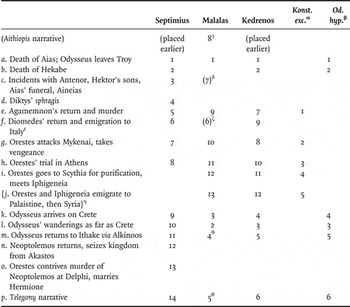
Table 1 shows the sequence used for episodes corresponding to Sept. 5.15–6.15 in Septimius, Malalas, the Konst. exc., and Od. hyp. Numbers indicate an episode's position in the account: so, for example, in Kedrenos the sequence is a b l k m e g f h i j; in the Od. hyp. it is a b l k m p.
Sequence of episodes in various Diktyean texts; numbers denote position within the sequence.

α John of Antioch F 49.1 ed. Roberto = F 25 ed. Müller.
β The overlapping Souda articles are: κ.2722 = a b; χ.144 = l k m.
γ Cf. n. 63 above.
δ Aias' funeral only; the funeral is the setting for the flashback to the Aithiopis narrative (number 8 in Malalas' sequence).
ɛ For this episode Diktys seems to stick close to the traditional legend (Aigialeia leads a rebellion, Diomedes goes into exile, travels to Aitolia, and emigrates to Italy). The full Diktyean account is obtained by piecing together Sept. 6.2, Kedr. 234,12–17, and Souda β.237.
ζ Malalas mentions only Diomedes' departure from Troy.
η Episode j is not Diktyean: see below.
θ Present only in the Eklogē historiōn; see section 2, above, on our three main sources for Malalas' account of the Trojan War.
1. The Odyssey and Telegony
Malalas, Kedrenos, and the Od. hyp. present the Odyssey and Telegony narratives as a single continuous sequence, with the episodes in chronological order: a (b) l k m p. By contrast Septimius divides them into three separate chunks: Odysseus' departure from Troy (a b), his wanderings and return (k l m), and the Telegony (p).
In addition, Septimius frames Odysseus' wanderings up to Crete as an oral account given by Odysseus to Idomeneus (and transcribed by Diktys, who is of course present in Crete at the time); the narration to Idomeneus is modelled on the story to the Phaiakians in Odyssey 9–12. This kind of re-modelling of epic material is characteristic of Diktys, so there is no need to suppose that the flashback was added by Septimius.
2. The relationship between Malalas and Kedrenos
Although they are closer to each other than either is to Septimius, Kedrenos' account is not solely or even primarily based on Malalas. In the part of Diktys corresponding to Septimius 5.15–6.15, the clearest signs of independence are: (a) Kedrenos presents the Aithiopis narrative in its conventional place, as in Septimius. If Kedrenos were based on Malalas, we would have to suppose that he independently chose to undo Malalas' changes to the narrative sequence. (b) Kedrenos reports two pieces of Diktyean material – the location of Hekabe's grave, and the fact that Idomeneus gave Odysseus fifty soldiers to go with him to Kerkyra – that Malalas omits. Kedrenos certainly must have used multiple sources; in these cases there is not even any particular reason to suppose that his immediate source was (ps.-?)John of Antioch.Footnote 64 See section 2 above, witness 5.
3. Orestes in Scythia; Neoptolemos in Phthia
The Latin and Byzantine versions diverge drastically in the later careers of Orestes and Neoptolemos. Septimius relates how Neoptolemos re-usurps his kingdom from Akastos using trickery (episode n), a story ultimately adapted from Euripides' Troades 1123–8; and the murder of Neoptolemos (episode o), adapted from Euripides' Andromache. Malalas–Kedrenos–Antioch present a narrative of Orestes' and Iphigeneia's meeting in Scythia, adapted from Euripides' Iphigeneia among the Taurians (episode i);Footnote 65 and a story of their subsequent travels, ultimately settling in Syria (episode j).
Of these, episodes i and n o are Diktyean, and j is not. The Syrian narrative may come from Domninos, a lost writer on Antiochene history (especially architectural history?), whom Malalas cites (5.37) at the end of the Syrian episode in connection with a statue of Orestes near Antioch.Footnote 66
The strong Euripidean flavour of episodes i n o is evident earlier, too, in both the Septimian and Byzantine versions. Hekabe's burial at ‘the Bitch's Grave’ echoes Euripides' Hekabe 1265–74; Orestes' trial in Athens should be traced back to Apollo's commands in Euripides' Orestes 1643–52 (where Orestes is awarded Hermione as his wife, without the need to kill Neoptolemos first); and, to boot, Malalas expressly cites Euripides three times in the part of his account corresponding to Septimius' Book 6, but nowhere else in his account of the Trojan War.Footnote 67
There are several ways that episodes i (Diktyean, though not in Septimius) and j (pure Domninos) might have become joined in the Byzantine accounts. One possibility is that it is Domninos' doing: Domninos may have adapted episode i from elsewhere (either Euripides or Diktys) and joined it to j, an Antiochene local tradition. More important than any link, however, is the fact that the Syrian episode cannot be combined with episode o, which we find in Septimius. In Malalas-Kedrenos-Antioch, as in Euripides, Orestes departs for Scythia straight after his trial, goes from there to Syria without passing through Greece, and stays there permanently. The episode at Delphi cannot go either before or afterward. This incompatibility is the primary reason for the difference in content between Septimius and the Byzantine sources.Footnote 68
It turns out, therefore, that the real issue is not in the Byzantine sources but in Septimius: why does Septimius omit the Scythian episode, i? The answer is that this is one case where Septimius has reduced a substantial episode to the briefest of allusions. Recall that Septimius Book 6 is an epitome. Septimius 6.4, covering the end of Orestes' trial and his return to Mycenae, reads: ‘Menestheus liberatum Orestem parricidii crimine purgatumque more patrio cunctis remediis, quae ad oblivionem huiusmodi facinoris adhiberi solita erant, Mycenas remittit.’Footnote 69 It seems that the underlined phrase conceals the entire Scythian episode; compare Malalas, who explicitly cites Diktys for his account of Orestes' trial (5.31) before Orestes is sent to Scythia for purification (5.32–34).
4. Septimius' reliability concerning narrative sequence
Septimius preserves Diktys' original narrative sequence accurately; the others do not. For this point, one isolated piece of evidence is crucial. In his account of the trial of Orestes, Malalas cites Diktys explicitly (5.31 = BNJ 49 F 2):
καὶ ἀπαγαγόντɛς ἐν τῷ ἱɛρῷ τῆς Ἀθηνᾶς τὸν Ὀρέστην, ἐφ’ ᾧ ὁ Ἄρɛιος πάγος ὑπῆρχɛ, τῆς δίκης ἀκούσαντος <τοῦ Μɛνɛσθέως> … ταῦτα Δίκτυς ἐν τῇ ἕκτῃ ῥαψῳδίᾳ ἐξέθɛτο.
And they took Orestes away in the temple of Athena, in which the Areiopagos sat, and <Menestheus> heard the case … Diktys writes about these things in his sixth book.
— that is, the sixth book of the original Diktys, not Septimius' sixth book, which is an epitome of several books. Here Malalas shows that the trial belongs at an early point in the last books of Diktys. And early is exactly where Septimius puts it. If the original Diktys had the trial in the place Malalas and Kedrenos put it – after the Odyssey and Telegony narratives – it could not possibly appear as soon as Book 6. Therefore Septimius' narrative sequence is confirmed, with the exception of one big omission (the Iphigeneia among the Taurians story, discussed above, probably to be assigned to Book 7 of the Greek Diktys). Without Malalas' testimony, there would have been nothing to help decide which sequence is the original.
Septimius' reliability in comparison with Malalas is again corroborated, this time in respect to the placement of the Aithiopis narrative, by PTeb. 268,95–106, where Neoptolemos arrives at Troy immediately after Achilleus' death (≈ Sept. 4.12); Malalas never in fact gets around to narrating Neoptolemos' arrival, and places his account of Achilleus' death inside a flashback (Malalas 5.28). Malalas' transposition of the Aithiopis narrative is probably his own doing; if he had copied it from Domninos, we should expect to see the same transposition in Kedrenos.Footnote 70
Septimius is not always perfectly accurate. One of the new papyri illustrates a case where Septimius has definitely mistranslated his source, as Hatzilambrou and Obbink point out in their editio princeps. POxy. 4944 preserves fragments of the end of the war corresponding to episodes a b c d; so far, so good for Septimius. However, the papyrus unequivocally sides with Kedrenos and the Od. hyp. in the location of Hekabe's tomb. In Diktys Hekabe accompanies Odysseus on his departure, is killed by his men, and is buried at ‘the Bitch's Grave’ in Maroneia; in Septimius she is killed by the Greek army back at Troy, and ‘the Bitch's Grave’ is located at Abydos in the Troad.Footnote 71 The relevant parallel passages are: POxy. 4944 fr. 1,9–21; ≈ Sept. 5.15–16; ≈ Kedrenos 232,11–16; ≈ Od. hyp. 4,4–9 (= Souda κ.2722).Footnote 72 Septimius accurately preserves the original's reference to Hekabe's tongue as the reason for the place name (Diktys: [κυ]|νόγλωϲϲον; Septimius: linguae protervam impudentemque petulantiam), and the close connection between the Palladion's fate and Odysseus' departure. But he has misread the relationship between Odysseus' departure and Hekabe's death. This may be because he was more familiar with a location for her grave in the Troad,Footnote 73 and presumed that the Greek text was in error; but perhaps also he was put off by the fact that the original is really not very clear about Hekabe travelling with Odysseus, and that, after this episode, the narrative returns to the Greek fleet back at Troy (POxy. 4944 fr. 1,21–92).
5. The Odyssey hypothesis and the ‘Johannine constellation’
As indicated in section 2, the Od. hyp. should not be linked to John of Antioch. Patzig (Reference Patzig1893) 423–4 assigned it to John on the basis of a cluster of parallels in Kedrenos involving other texts in the constellation, and the assignment has not been questioned since. Patzig was right not to base his assignment on similarity in content, since that can be fully explained by common derivation from Diktys. But Kedrenos (or rather ps.-Symeon) used multiple sources, so Patzig's actual argument is not conclusive either. There are three other potential arguments for assigning it to John. (1) There is no other known candidate to which the Od. hyp. can be assigned; however, that is an argument ex silentio. (2) Two Souda articles overlap with the Od. hyp., with nearly identical wording, and the same is true of the overlap between two other Souda articles and the Vienn. Tr. However, there is no likelihood that the relevant Souda articles all come from a single source. (3) There is one unique parallel in content between the Od hyp. and the Salm. exc. II: both name Kalypso as the priestess of Selene, a detail that is very probably Diktyean but appears nowhere else.Footnote 74 This last is the firmest link, though it should be remembered that the Salm. exc. II itself has only infirm links to the Konst. exc. and Vienn. Tr.
By contrast, there is one firm indication that the Od. hyp. does not have a common origin with the Vienn. Tr.: Souda π.34 relates the theft of the Palladion, followed by the murder of Aias, and so overlaps with both the end of the Vienn. Tr. and the start of the Od. hyp. But while the start is almost identical to the Vienn. Tr., the same cannot be said of its end and the Od. hyp. Compare the opening:
Vienn. Tr.: τοῦτο δὲ ἦν ζῴδιον μικρὸν ξύλινον, ὅπɛρ ἔλɛγον ἀναφυλάττɛιν τὴν βασιλɛίαν τῆς Τροίας· [ἐδό]θη δὲ Τρωῒ τῷ βασιλɛῖ κτίζοντι τὴν πόλιν [ὑπὸ Ἀ]σίου τινὸς φιλοσόφου καὶ τɛλɛστοῦ· …
Souda π.34: τοῦτο ἦν ζῴδιον μικρὸν ξύλινον, ὃ ἔλɛγον ɛἶναι τɛτɛλɛσμένον, φυλάττον τὴν βασιλɛίαν τῆς Τροίας· ἐδόθη δὲ Τρωῒ τῷ βασιλɛῖ κτίζοντι τὴν πόλιν ὑπὸ Ἀσίου τινὸς φιλοσόφου καὶ τɛλɛστοῦ· …
This leaves no doubt that Souda π.34 belongs with the Vienn. Tr., among the Johannine texts. By contrast, at the end when Aias' body is discovered, we find the following (I give Kedrenos' wording, too, to illustrate the point):
Souda π.34: διὰ τῆς νυκτὸς ɛὑρέθη ὁ Αἴας ἐσφαγμένος ἀδήλως. ὑπɛνόουν δὲ δόλῳ φονɛῦσαι αὐτὸν τὸν Ὀδυσσέα. καὶ φιλονɛικήσαντɛς πρὸς ἀλλήλους ἀπέπλɛυσαν.[end of entry]
Od. hyp.: διὰ τῆς νυκτὸς ἀδήλως ἐσφάγη ὁ Αἴας, καὶ ɛὑρέθη πρώϊος κɛίμɛνος. στάσις οὖν γέγονɛ μɛγάλη ἐν τῷ στρατῷ καὶ πάντɛς ὑπɛνόουν δόλῳ φονɛῦσαι τοῦτον τὸν Ὀδυσσέα. μɛλλόντων δὲ ɛἰς ἀλλήλους τῶν Ἑλλήνων χωρɛῖν καὶ ἐμφυλίου κρίνɛσθαι πολέμου, …
Kedrenos: διὰ μέντοι νυκτὸς ἀδήλως σφάζɛται Αἴας. πρωΐας δὲ γɛνομένης ὡς ɛὑρέθη νɛκρός, πολλῆς στάσɛως γɛνομένης ɛἰς ὑπόληψιν ἦλθɛ τῆς πράξɛως Ὀδυσσɛύς· ὅθɛν καὶ ɛἰς ἐμφύλιον ἀναπτομένου τοῦ πράγματος πόλɛμον, …
The Od. hyp. covers the same ground as Souda π.34, to be sure; but similarity of content is no guide. Its wording is equally close to Kedrenos: note ἀδήλως ἐσφάγη/σφάζɛται (ὁ) Αἴας; the use of στάσις and ἐμφύλιον; the reference to the morning; and so on.
There is nothing to link the Od. hyp. to Souda π.34; so there is no good link to the Johannine constellation either. Undoubtedly Souda π.34, the Od. hyp., and Kedrenos have a common source. But the Od. hyp. is more likely to be cognate with John of Antioch than descended from him. The parallels with Kedrenos are extensive elsewhere too, so it is likely that the Od. hyp. is an extract from one of Kedrenos' lost sources. For this reason Figure 1 (p. 66, above), shows the Od. hyp. as descended from a lost intermediary, β (independent evidence had already indicated β's existence).Footnote 75
4. The Sisyphosfrage
The relationship between Diktys and Sisyphos is an open question, and has an impact on how far we can rely on the Byzantine sources to reproduce Diktys faithfully. Three passages in Malalas cite Sisyphos as an eyewitness account of the Trojan War, sometimes side-by-side with Diktys, sometimes separately:
-
• Malalas 5.18 cites Sisyphos by himself for the story of Odysseus' encounters with the three ‘Kyklops’ brothers on Sicily (5.17–18 = BNJ 50 F 2; ≈ Sept. 6.5).
-
• Malalas 5.19 cites Sisyphos alongside Diktys for the story of Odysseus' encounter with Kirke (= BNJ 50 F 3; ≈ Sept. 6.5).
-
• Malalas 5.29 cites Sisyphos alongside Diktys, either (1) for the returns of the Greeks, or else (2) for the whole account that Teukros has just given of the Aithiopis (5.23–29 = BNJ 50 F 1; ≈ Sept. 3.15–4.14); it is unclear which. Malalas also informs us that Sisyphos was in Teukros' contingent.
Sisyphos is also mentioned in Salm. exc. II apud John of Antioch F 24.9 ed. Müller, and Od. hyp. 4,27, but both are parallel to Malalas 5.18 and add no new information. Tzetzes, Hist. 5.831–5, adds the detail that Sisyphos was Teukros' scribe, and attributes this detail to Malalas (incorrectly); the Tzetzes passage has been taken as independent testimony for Sisyphos' identity,Footnote 76 but it must be rejected as a spurious invention by Tzetzes (see section 2, witness 10, above).
At first glance it seems that Sisyphos must have been another, separate, pseudo-documentary account of the Trojan War. The trouble is that the above episodes – including the one that Malalas attributes only to Sisyphos – not only appear in Septimius, but their content is identical to Septimius' version. It therefore looks as though Diktys was the real source; or as though Sisyphos and Diktys were virtually identical texts.Footnote 77
Late 1800s and early 1900s scholarship on Byzantine Quellenkritik saw a vigorous but unrewarding controversy on the relationship between Diktys and Sisyphos. Griffin ably summarises the debate.Footnote 78 Haupt thought Diktys and Sisyphos were two separate chronicles, and that Malalas' catalogues and descriptions of the heroes came from Sisyphos, while most of the rest came from Diktys. Patzig thought that Sisyphos' chronicle comprised only the episodes that Malalas expressly ascribed to him, and that Diktys was a re-written and expanded form of Sisyphos. Noack thought the reverse: Diktys was the original, and Sisyphos a revised version done in late antiquity. Greif thought that Sisyphos was the only name that had ever been associated with the Greek version, and that all Byzantine references to ‘Diktys’ were in fact to the Latin version. Gleye followed Noack; Fürst restated Haupt's case; Griffin thought, like Haupt, that Diktys and Sisyphos were two separate texts, but followed Patzig in confining Sisyphos to the episodes assigned to him by Malalas. Most recently Dowden and Kamen assume, with Noack, that Sisyphos is a revised version of Diktys; but, with Patzig, that only the episodes Malalas explicitly ascribes to Sisyphos are Sisyphean.
Haupt's and Fürst's idea that the two are independent novelisations can be dismissed straightaway: as indicated above, the very episodes that Malalas ascribes to Sisyphos are unquestionably Diktyean. Greif's view has been disproved once and for all by the publication of POxy. 4944, where the Greek text expressly names ‘Diktys’ as its author. Then we have Patzig's and Noack's mirror-image views: Sisyphos is a revised form of Diktys, or vice versa. These views are at least possible. But the evidence on which we might choose between them is riddled with problems; and the stemmas they imply have become deeply problematic since the recent revival of the debate over John of Antioch. Any stemma for Diktys has to give a central role to John; if there are problems with John, there are problems with Diktys too. Griffin and Dowden consider that only the episodes explicitly ascribed to Sisyphos are Sisyphean, and for them this is especially important in regard to the transposition of the Aithiopis narrative, told by Teukros to Neoptolemos, and at the end of which Malalas (5.29) cites Sisyphos.Footnote 79 Griffin's stemma, (1907) 104, relies on this to distinguish texts that cite Sisyphos – the Malalean branch of his stemma – from the others. The ascription of the Aithiopis episode to Sisyphos ties in with the fact that Sisyphos, as a soldier serving under Teukros, could have been present at the conversation between Teukros and Neoptolemos.
There are three difficult questions to consider in connection with the Sisyphosfrage:
-
(1) Why do we find Sisyphos associated only with material corresponding to Septimius Book 6?
-
(2) If Malalas 5.17–18, 5.19, and 5.23–29 are indeed from Sisyphos, then why does he also cite Diktys for two of these episodes?
-
(3) Suppose for a moment, with Patzig and Dowden, that the Aithiopis transposition in Malalas (5.23–29) is indeed Sisyphos' doing; this episode, with Teukros playing a central part, is after all the one most clearly connected to Sisyphos. But then why do we not also find it transposed in any later sources that make use of Malalas? Did every writer other than Malalas have access to a pre-Sisyphean redaction? Or did they each independently choose to undo Sisyphos' structuring of the narrative?
As things stand only Patzig has an answer to any of these questions: for him, Sisyphos – supposedly the original text – only ever contained material corresponding to Malalas 5.15–29 (Odysseus' return, plus the Aithiopis as narrated by Teukros); Malalas cites Diktys alongside Sisyphos because Diktys' account of this part of the narrative must have contained references to the Sisyphean original. However, there is no getting around the fact that the only Diktyean sources to corroborate Malalas' story, that Diktys was based on Sisyphos, are themselves based on Malalas.
Much of the argument is caused by the fact that Malalas treats ‘Diktys’ and ‘Sisyphos’ as though they were historical individuals. We, his more sceptical readers, do not follow him in that, but we are nonetheless inclined to treat them as historical texts. But they are neither; they are fictional personae. That being so, there are two further alternatives.
Option one: Sisyphos was only ever a figment of Malalas' imagination; or at best, Malalas has garbled the ‘real’ Sisyphos so badly that his citations are meaningless. If this is the case, then the relevant material should in fact be traced back to Diktys. This sounds a desperate solution to the Sisyphosfrage, but Malalas actually has a rather poor track record in this respect. The most thorough investigation of Malalas' sources, that of Jeffreys (Reference Jeffreys, Jeffreys, Croke and Scott1990) 170–2, points out that he could not have personally known all the sources that he cites; and from Jeffreys' treatment Treadgold Reference Treadgold(2007b) 724–5 extracts five names that are so badly garbled that Malalas' citations must be considered simply wrong.Footnote 80 Treadgold even suggests that Malalas was intentionally fraudulent; that is a step too far, but the fact remains that Malalas' citations are untrustworthy.
Option two: abandon the assumption that either fictional name refers to an actual text, and treat both Diktys and Sisyphos as fictional personae within a single Ephemeris. Jeffreys, summarising Noack's view, writes: ‘It looks as though the fictitious diaries of Diktys were recast from Teukros’ stand-point by the equally fictitious Sisyphos and this version then used by Malalas.'Footnote 81 This highlights the absurdity of the situation: if Diktys and Sisyphos are both fictional, why assume that the recasting is real? We are dealing with a work of fiction, one that even comes with a pseudo-documentary frame-story. Everything we are looking at is a fictional construct. It is perfectly possible that we do not have different texts to deal with, nor even different recensions of one text; but one real text, two fictional sources.
This is not, as in Greif's argument, a matter of different Byzantine witnesses attaching two different names to a single text. Rather, the suggestion is the Ephemeris is a story told by both ‘Diktys’ and ‘Sisyphos’ as pseudo-documentary ‘authors’; or, more likely, that Sisyphos is a pseudo-documentary source that Diktys cited. Several stories in Septimius Book 6 are second-hand reports: Menelaos and Orestes report the Oresteia story on a visit to Crete, after Orestes' return from Scythia (Sept. 6.4); Odysseus reports the first part of his wanderings, also while visiting Crete (Sept. 6.5); Diktys hears the story of Neoptolemos' homecoming while attending his wedding (Sept. 6.10). There may be more that Septimius omitted. Based on the same material, Malalas could easily cite ‘Sisyphos’ as a source on an equal footing with ‘Diktys’. For both Septimius and the Byzantines, the pseudo-documentary character of the frame-story obscured the separation between real and fictional sources. We know better; but that does not mean treating the Quellenkritik of the Ephemeris as though it were a history. Instead, we must recognise that the pseudo-documentary character of the Ephemeris is a fundamental and essential feature of the text.
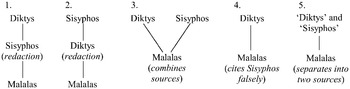
Griffin outlines three possible stemmas for the Sisyphos question; in fact we have five to choose from, shown in Figure 2. The reconstructions that I propose, stemmas 4 and 5, are speculative, but then with the evidence we have it is impossible to avoid speculation. Stemma 4 has at least the virtue of conforming with known characteristics of Malalas' practice; stemma 5 works with the pseudo-documentary nature of the Ephemeris rather than ignoring it. Both also have the merits of explaining why Malalas conflates the two ‘authors’, and why he attributes to one author what we can plainly see belongs to the other.
Possible stemmata for the relationship between ‘Diktys’, ‘Sisyphos’, and Malalas. Stemma 1 is advocated by Noack, Gleye, Griffin, and Dowden; stemma 2 by Patzig; stemma 3 by Haupt and Fürst; stemmas 4 and 5 by the present author.

Both options also come with problems. With stemma 4, the problem is that it is intrinsically unprovable. This is frustrating, but it does not mean that it should be rejected. With stemma 5, the main problem is that there is no tidy explanation for why there is no shred of evidence outside Malalas for Diktys' use of Sisyphos (stemma 2 also shares this problem). Another, lesser, problem is that Diktys attributes the story of Teukros founding a city in Cyprus to Menelaos (Sept. 6.4); that, if anything, ought to have been heard from Sisyphos. On balance, stemma 4 presents fewer problems, and I suspect it is more likely.
The actual existence of a separate chronicle of ‘Sisyphos of Kos’ cannot be decisively ruled out, but Malalas' testimony in favour of it is weak. Even if it could be demonstrated that ‘Sisyphos’ had existed, there would still be gaps in our knowledge. There are open questions about the source(s) from which Malalas and John of Antioch adapted their accounts; the differences between them are big enough that an intermediate post-Diktyean recension seems indicated, as Noack (Reference Noack1892) argued. In passing we have looked at one candidate for such a recension: Bourier's theory that Domninos was the source for Malalas' entire Trojan War narrative has problems, but cannot be ruled out.Footnote 82 Another candidate has recently been proposed, Eustathios of Epiphaneia, another lost historian that Malalas cites in the proem to his Chronographia; Treadgold argues that most of Malalas and much of John of Antioch is copied from Eustathios.Footnote 83 Treadgold's suggestion rests on indirect argumentation, however, and has been poorly received by Byzantinists.Footnote 84
Diktyean scholarship is not exactly a hot topic, but basic errors can at least be averted. The most fundamental error is to equate ‘Diktys’ with Septimius' Latin version. Several episodes that Septimius elides or ignores are reported in detail in Byzantine sources: the youth of Paris; the descriptions of the Greeks and Trojans; much of Septimius Book 6. The Latin text is not the be-all and end-all, and it would be misrepresenting Diktys to pretend that it was.