

Introduction
Active labour market policies (ALMPs) are government initiatives designed to improve the efficiency of the labour market by facilitating adjustments of the demand and supply (Kluve and Rani Reference Kluve and Rani2016; McKenzie Reference McKenzie2017). The aim is to preserve existing employment opportunities, create new ones, promote retention in the labour market, support the re-entry of workers who have been unemployed long-term, and expedite job search and matching processes (McKenzie Reference McKenzie2017; Ernst et al Reference Ernst, Merola and Reljic2022). One example of ALMPs is government-sponsored training programmes which provide new technical and interpersonal skills to improve the employment prospects of participants. These enhanced skills are expected to help inactive or unemployed individuals re-enter the workforce and develop their careers (Brown and Koettl Reference Brown and Koettl2015; Ingold and McGurk Reference Ingold and McGurk2023). By fostering a more adaptable and skilled workforce, such initiatives contribute to greater economic resilience and labour market dynamism more broadly.
In Indonesia, the ALMP is managed through the Pre-Employment Card Programme, established under Presidential Regulation 76/2020. This initiative focuses on developing workforce competencies, productivity, competitiveness, and entrepreneurial skills (Al Ayyubi et al Reference Al Ayyubi, Pratomo and Prasetyia2023; Nguyen et al Reference Nguyen, Putra, Considine and Sanusi2023). Since its inception during the COVID-19 pandemic, it has provided training and cash transfers to over 11.4 million recipients, with a total budget of 41.05 trillion rupiah, reflecting the government’s strong commitment to its success (APEC 2021; Coordinating Ministry for Economic Affairs of the Republic of Indonesia 2022). This optimism is bolstered by Indonesia’s current demographic dividend, with a significant increase in the productive-age population expected to peak between 2020 and 2030 (BPS 2022). Integrating this labour supply into productive employment is crucial for sustaining economic growth and overall well-being (Lutz et al Reference Lutz, Cuaresma, Kebede, Prskawetz, Sanderson and Striessnig2019; Misra Reference Misra2015).
Unemployment is a crucial macroeconomic indicator because it reflects a mismatch between labour demand and supply in the job market, leading to the underutilisation of workforce resources (Romer Reference Romer2012; Sage Reference Sage2018). Like many developing economies, the youth labour market in Indonesia is characterised by high unemployment, skill mismatches, and a strong reliance on the informal sector (ILO 2022). According to Statistics Indonesia (BPS), the youth unemployment rate (ages 15–24) is nearly five times higher than that of adults, reflecting the difficulties young people face in securing stable jobs. Moreover, a significant portion (38.95%) of young workers are classified as non-full-time workers, with less than the standard number of working hours (35 hours a week) (BPS 2021). Addressing these challenges is essential for leveraging Indonesia’s demographic dividend, as well as enhancing the labour force’s potential, and mitigating the economic implications of an ageing population.
Nonetheless, the effectiveness of ALMPs in boosting employment, especially among young people, remains a topic of debate. While some studies point to positive impacts on youth employment (Escudero et al Reference Escudero, Kluve, López Mourelo and Pignatti2019; Focacci Reference Focacci2020; Kluve et al Reference Kluve, Puerto, Robalino, Romero, Rother, Stöterau, Weidenkaff and Witte2019; Kruppe and Lang Reference Kruppe and Lang2018; Mourelo and Escudero Reference Mourelo and Escudero2017; Pastore and Pompili, Reference Pastore and Pompili2020), others report less promising results. Similarly, a large-scale review by Card et al (Reference Card, Kluve and Weber2018) found mixed outcomes, with less consistent positive effects for younger participants. In contrast, McKenzie (Reference McKenzie2017) was firmer in arguing that ALMPs have not met policymakers’ expectations in developing countries. These varying findings suggest that the success of ALMPs hinges on their specific design and implementation, which may vary across nations and demographic groups.
Indonesia’s Pre-Employment Card Programme has been heralded as an important step in improving employment outcomes since the COVID-19 pandemic. However, its impact on young people remains under-evaluated. This study aims to fill this gap by examining the Programme’s effectiveness in increasing opportunities to secure employment and adequate work hours among young Indonesians. Using the propensity score matching (PSM) method, the study compares outcomes between programme participants and non-participants, considering similar characteristics, such as age, sex, education level, classification of area of residence, and work experience. The findings reveal that the programme positively impacts employment probabilities among unemployed youths. However, no statistically significant impact was found on participants’ work hours after joining the programme. These results highlight the Pre-Employment Card Programme’s potential efficacy and indicate areas for improvement, thus providing a preliminary basis for labour policy evaluations to tackle high unemployment and underemployment among the youth in Indonesia.
Literature review
Intermediation in labour markets and pre-employment card programme
The history of labour market policies has its roots in the economic depression of the 1930s, as it became clear that high unemployment and economic depression could only be eliminated by interventions. Scandinavian countries were among the first to implement these policies. Other European countries and the USA followed suit in the late twentieth century as they developed more advanced labour market practices due to the sharp increase in unemployment rates (Bonoli Reference Bonoli, Deeming and Smyth2017; Nordlund and Greve Reference Nordlund, Greve and Greve2018). These policies have been generally categorised into passive and active interventions (ILO 2016).
The first approach involves passive labour market policies (PLMP), mainly focusing on providing income support to unemployed people. The idea behind PLMP is for the government to create a safety net for people without employment (Nordlund and Greve Reference Nordlund, Greve and Greve2018; Risak and Kovács Reference Risak and Kovács2017). However, this scheme may result in unfavourable outcomes as it increases voluntary unemployment and engenders dependence on unemployment benefits (Kraft Reference Kraft1998; Lewis et al Reference Considine, Sol, Lewis and O’Sullivan2015). Additionally, the scheme incurs higher costs due to the broader coverage (Pignatti and Van Belle Reference Pignatti and Van Belle2021).
In response to these shortcomings, governments have shifted towards ALMPs, focusing on enhancing employability and helping individuals secure employment (Esping-Andersen Reference Esping-Andersen1990; Martin Reference Martin2015). This shift has led to the concept of welfare-to-work, mandating job seekers to engage in work or training activities as a precondition for receiving benefits (Lewis et al Reference Lewis, Nguyen and Considine2021; Nguyen et al Reference Nguyen, Considine and O’Sullivan2016). Job seekers are activated by having to meet strict requirements to qualify for unemployment benefits, encouraging them to re-enter the workforce (Nguyen et al Reference Nguyen, Putra, Considine and Sanusi2023). ALMPs are generally classified into cash benefits, employment assistance, and labour market training (Bonoli Reference Bonoli, Deeming and Smyth2017; Caliendo and Kopeinig Reference Caliendo and Kopeinig2008; Kluve et al Reference Kluve, Card, Fertig, Góra, Jacobi, Jensen, Leetmaa, Nima, Patacchini, Schaffner, Schmidt, Bvd and Weber2007; Martin Reference Martin2015). Each category focuses on different aspects of employment support, from incentivising job search to providing the necessary skills for employment.
A practical example of these policies is Indonesia’s Pre-Employment Card Programme, initiated in response to the COVID-19 pandemic. Under Presidential Regulation Number 76 of 2020, this initiative distinguished itself by delivering “independent interventions,” operating separately from other government social assistance institutions (Nguyen et al Reference Nguyen, Putra, Considine and Sanusi2023). The strategy adopted by Indonesia contrasted with the more common global responses to pandemic-induced economic challenges, such as wage subsidies, adjustments in labour regulations, reduced working hours, and various activation measures aimed at supporting workers. Instead, the Pre-Employment Card programme prioritised human capital development, encouraging participation by providing training vouchers and offering cash benefits to individuals when they successfully completed their training (Gentilini Reference Gentilini2022).
The Pre-Employment Card Programme offers training to Indonesian citizens aged 18 and above who have not received a formal education. It aims to boost workforce competency, productivity, and entrepreneurship. Recognising that the skill gap is a challenge not exclusive to job seekers, the programme is open to everyone, including employees and entrepreneurs, so long as they meet the registration requirements. The initiative has successfully partnered with 181 training providers across seven digital platforms, offering a total of 1957 training courses in various fields, including information technology, sales and marketing, lifestyle, foreign languages, office administration, engineering, agriculture, finance, food and beverage, management, and others. After completing the training, participants receive an incentive of IDR 600,000 for four consecutive months, which can be used for business capital or other needs. The Pre-Employment Card Programme, with a “complete package” comprising labour training and incentives, is the government’s innovative approach to addressing employment issues, including limited employment opportunities (Ministry of State Secretariat Republic of Indonesia 2020; Coordinating Ministry for Economic Affairs of the Republic of Indonesia 2022).
Prior studies of activation policies
Numerous empirical studies from different countries have shown that ALMPs increase the likelihood of securing employment and high-quality jobs. Positive outcomes have been observed globally, with studies highlighting the benefits of labour market programmes in various countries such as Germany, Italy, the Netherlands, Slovenia, Wales, Spain, and Poland, as well as across 14 OECD countries (Biewen et al Reference Biewen, Fitzenberger, Osikominu and Paul2014; Blázquez et al Reference Blázquez, Herrarte and Sáez2019; Bratti et al Reference Bratti, Ghirelli, Havari and Santangelo2022; Burger et al Reference Burger, Kluve, Vodopivec and Vodopivec2022; Costabella Reference Costabella2017; Dengler Reference Dengler2019; Destefanis et al Reference Destefanis, Fragetta and Ruggiero2023; Kruppe and Lang Reference Kruppe and Lang2018; Lammers and Kok Reference Lammers and Kok2021; Lindley et al Reference Lindley, McIntosh, Roberts, Czoski Murray and Edlin2015; Wiśniewski Reference Wiśniewski2022). Other studies suggest that the effectiveness of these interventions is even more pronounced in middle- and low-income countries, which could be attributed to innovations in the program design and implementation and the lower barrier to the labour market. Moreover, the studies also highlight that such programmes provide substantial benefits to disadvantaged populations, particularly when they incorporate comprehensive measures such as training, counselling, job intermediation, and income support (Escudero et al Reference Escudero, Kluve, López Mourelo and Pignatti2019; Kluve et al Reference Kluve, Puerto, Robalino, Romero, Rother, Stöterau, Weidenkaff and Witte2019). These findings indicate that well-structured ALMPs can play a crucial role in improving employment outcomes across diverse economic contexts.
While the evidence for ALMP effectiveness is encouraging, further research suggests varying impacts on different demographic groups. Young people are more prone to unemployment, so studies have specifically examined the impact of ALMPs on youth. Such studies have shown how vocational training benefits younger participants (Al Ayyubi et al Reference Al Ayyubi, Pratomo and Prasetyia2023; Bernhard and Kruppe Reference Bernhard and Kruppe2012; Focacci Reference Focacci2020; Mourelo and Escudero Reference Mourelo and Escudero2017; Pastore and Pompili, Reference Pastore and Pompili2020). However, not all programs aimed at young workers have been successful, as evidenced by the negative outcomes (Alegre et al Reference Alegre, Casado, Sanz and Todeschini2015; Bratti et al Reference Bratti, Ghirelli, Havari and Santangelo2022; Card et al Reference Card, Kluve and Weber2018; Centeno et al Reference Centeno, Centeno and Novo2009; Dias et al Reference Dias, Ichimura and van den Berg2013; Hohmeyer and Wolff Reference Hohmeyer and Wolff2012; Larsson, Reference Larsson2003). Several factors could have hindered the creation of new jobs, such as high minimum wages, rigid labour laws, and obstacles to financing and infrastructure development, which some scholars argue pose significant challenges to firm growth and concomitantly, also limit job opportunities (McKenzie Reference McKenzie2017).
Despite the broad scope of research on ALMPs’ impacts in various countries, studies focusing on the impact of Indonesia’s Pre-Employment Card Programme, particularly among young workers, remain scarce, perhaps reflecting its recent implementation amid the COVID-19 pandemic. Early research by J-PAL Southeast Asia (2021) and Presisi Indonesia, 2022) has primarily focused on the programme’s broader effects on recipients’ competency, productivity, competitiveness, and entrepreneurship skills. However, the specific impact of the programme on youth employment outcomes remains under-explored. Given the mixed findings on the impact of ALMPs on youth in other countries, further research on Indonesia’s ALMPs is essential.
Materials and methods
Study scope
This research examines the impacts of Indonesia’s Pre-Employment Card Programme on youth employment outcomes. We focused on individuals aged 18–24 years who actively participated in the workforce and registered for the programme, covering all regencies and cities in the country. These individuals are segmented into two primary groups based on their enrolment in the programme: recipients and non-recipients; they are further categorised according to employment status. Additionally, we focused on the year 2021 as the focal point for this study, as it marked a significant turning point in Indonesia’s recovery from the COVID-19 pandemic. This selection also aims to provide stakeholders with insights into the early impacts of the Pre-Employment Card Programme, initiated in response to the pandemic.
Data
The study utilises secondary data from the comprehensive National Labour Force Survey conducted by BPS in August 2021. This survey captured employment trends across all regions and included an updated questionnaire addressing the Pre-Employment Card Programme. From these data, we identified a sample of 8164 eligible individuals, consisting of 3602 and 4562 people who were employed and unemployed, respectively, when registering for the Pre-Employment Card Programme.
Operational definition and measurement of variables
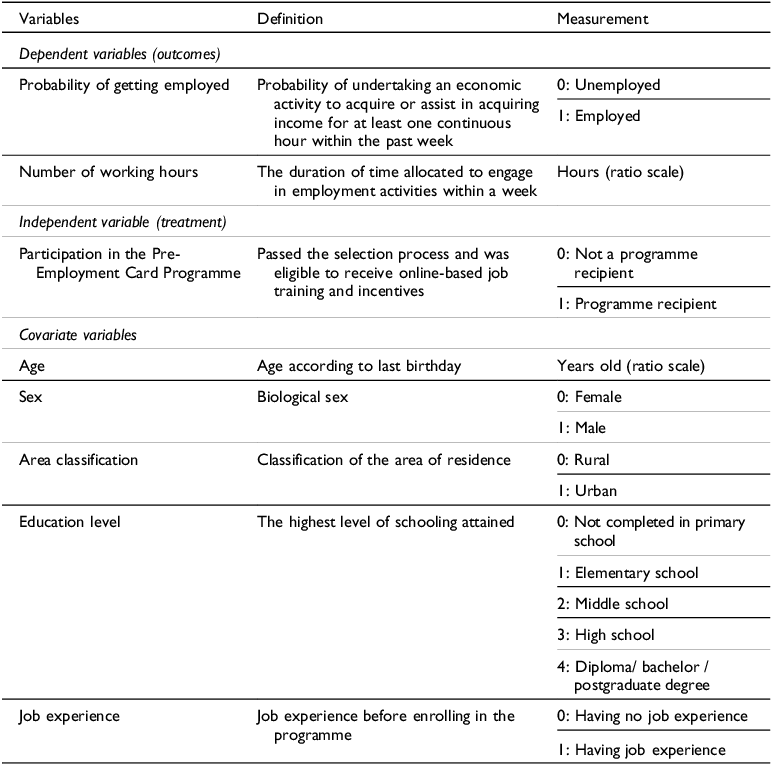
This study considers three variables: independent variable (treatment), covariates, and dependent variable (outcome). The effectiveness of the Pre-Employment Card Programme is assessed by comparing programme recipients and those who did not receive programme benefits (a control group). Therefore, the treatment variable in this study is participation in the programme. These two groups are compared by considering similar characteristics among individuals based on the covariates used, i.e. age, sex, education level, classification of area of residence, and work experience. Subsequently, the programme’s effectiveness is evaluated based on the labour market outcomes, specifically the probability of securing employment and the work hours (Table 1).
The variables’ descriptions and measurements
Methodology
This study employs the PSM method to assess the impact of Indonesia’s Pre-Employment Card Programme on employment probability and working hours among young people in Indonesia. The PSM was chosen to minimise selection bias in cross-sectional data, which is a critical concern when evaluating interventions where participation is not randomly assigned. Developed by Rosenbaum and Rubin (Reference Rosenbaum and Rubin1983), PSM is a powerful tool that matches programme participants with non-participants who share similar observable characteristics, thereby creating a strong comparison group that isolates the programme’s actual effect on employment outcomes (Heckman et al Reference Heckman, Ichimura, Smith and Todd1998; Khandker et al Reference Khandker, Koolwal and Samad2009).
The selection of PSM was driven by the non-random nature of programme participation, ensuring a valid comparison between treated and untreated individuals. While randomised controlled trials (RCTs) would provide the most rigorous causal inference, their implementation was infeasible due to the voluntary nature of enrolment. Similarly, difference-in-differences (DiD) requires panel data to track individual employment status over time, which was unavailable in the dataset. Ordinary least squares (OLS) regression, while useful, does not fully address selection bias and unobserved confounders, which are better accounted for through PSM (Rosenbaum and Rubin Reference Rosenbaum and Rubin1983). Given these constraints, PSM stands out as a robust quasi-experimental approach that allows for fairer comparisons between treated and untreated individuals. This analytical method has been widely used in labour market evaluations (Caliendo and Kopeinig Reference Caliendo and Kopeinig2008; Heckman et al Reference Heckman, Ichimura, Smith and Todd1998), making it the most appropriate choice for this study.
The initial step in this study involved comparing programme recipients and non-recipients using samples with similar characteristics, such as age, sex, education level, classification of area of residence, and work experience. First, we compare a participant group and a non-participant group who were unemployed when enrolling in the programme to examine the programme’s impact on the probability of securing employment. Subsequently, we analyse the programme’s impact on work hours by comparing the participant and non-participant groups who were employed when enrolled in the programme. The steps for applying the PSM method in this research are as follows:
Estimating the propensity score of programme participation
1. We first estimate the likelihood of someone participating in the programme using a probit model that considers relevant observable covariates, like age, sex, education level, classification of area of residence, and work experience. The model generates a propensity score for each individual, reflecting their predicted probability of joining the programme. The formula for the propensity score is as follows:
 $$Prob\;\left( {treatment = 1{\rm{|}}X} \right) = \;{\beta _0} + \;{\beta _i}\;{X_{ij}} + \;{\varepsilon _j}$$
Here,
 ${X_{ij}}$
refers to the i-th covariate variable,
 ${\beta _0}$
is the intercept,
 ${\beta _i}$
is the slope for the i-th covariate, and
 ${\varepsilon _j}$
is the residual for the j-th observation.
2. Defining the region of common support
The term “common support” in this method refers to the area where the propensity score distributions of the treatment and control groups overlap. With a range of propensity scores present in both groups, the comparable control observations are guaranteed to be “near” the propensity score distribution of the treated observations, facilitating more fair comparisons (Heckman et al Reference Heckman, LaLonde and Smith1999).
3. Matching participants to non-participants
Once the propensity scores are obtained, we match participants with non-participants by considering the closest scores. This study uses a specific matching technique called nearest neighbour (NN) matching with n = 5 to control the propensity score matching distance between the two groups. This means each participant is matched with the closest five non-participants in terms of propensity score, which allows the creation of a comparison group with similar observable characteristics.
4. Assessing the matching quality
One indicator to assess the matching quality is using the balancing test suggested by Rosenbaum and Rubin (Reference Rosenbaum and Rubin1985). This test checks if the treatment and control groups are well-balanced in terms of characteristics, as shown in the propensity scores. T-tests are often employed to see if there are significant differences in these characteristics between the groups before and after matching. By ensuring partial mean equality between the two groups, selection bias can be minimised, and the validity of the comparison can be strengthened.
5. Estimating the treatment effects
The average treatment impact (ATT) value is estimated to analyse the average difference between the outcome value in the treatment and comparison groups based on the covariate variable X used, which is generally formulated as follows:
 $$ATT = E\left( {{Y_{1i}}{\rm{|}}\;P\left( X \right),\;{D_i} = 1} \right) - E\left( {{Y_{0i}}{\rm{|}}P\left( X \right),{D_i} = 0} \right)$$
where the ATT value represents the impact of enrolling in the programme on labour market outcomes (Y), which are the probability of securing employment and obtaining adequate work hours for programme participants; D = 1 is the treatment group, i.e., the group of programme participants, and D = 0 is the control group. Then, to ensure that the NN matching estimation results are robust, the ATT estimated values were compared with the radius and kernel matching methods.
6. Applying Rosenbaum sensitivity analysis
While PSM reduces selection bias from observed characteristics, it cannot eliminate unobserved confounders that may influence programme participation and employment outcomes. To test the robustness of our findings to hidden bias, we applied Rosenbaum sensitivity analysis. Using Γ values from 1 to 3, where higher values simulate greater selection bias, we assessed whether hidden confounders could alter ATT estimates. If the treatment effect remains stable as Γ increases, it suggests minimal impact of hidden bias. In contrast, if the effect weakens significantly at low Γ values, it indicates high sensitivity to unobserved confounding, pointing to potential hidden bias beyond what PSM controls.
Results and discussion
Descriptive statistics
The descriptive statistics in Table 2 offer an overview of the variable characteristics in this study, including the total number of observations and the minimum, maximum, mean values, and standard deviations for each variable. This study involved 8164 individuals aged 18–24 years who registered for the programme and comprising 3602 employed and 4562 unemployed individuals. More specifically, 952 individuals were unemployed when they registered and participated in the programme, whereas about 3610 were unemployed but did not participate. Additionally, 943 individuals were employed at the time of registration and had attended the programme, while 2659 employed individuals had not attended the programme. The segregation based on their employment status when enrolled in the programme was subsequently used in the inferential analysis.
The variables’ descriptive statistics
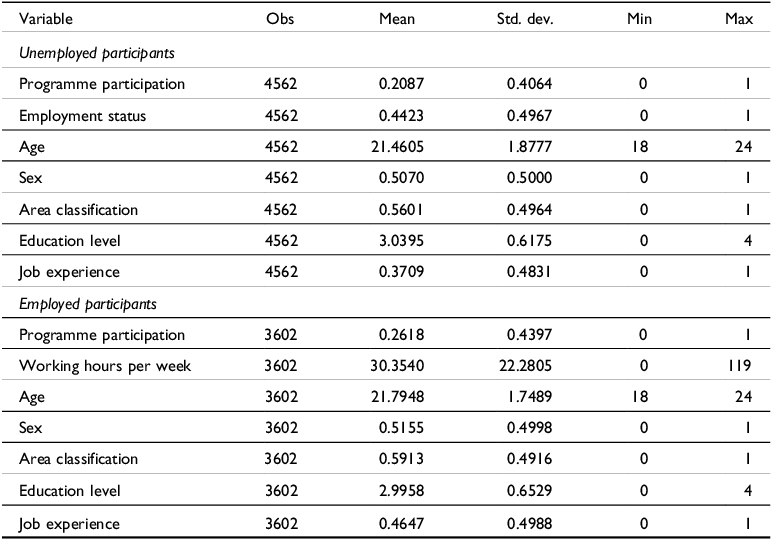
Table 2 also details the characteristics of young individuals who were unemployed when they enrolled in the programme. Among them, 20.87% received the benefits. The gender distribution was nearly balanced, with slightly more male participants in both urban and rural settings. Most participants in this group were high school graduates, with 37.09% having prior job experience. Meanwhile, the participation rate was higher at 26.18% among the employed participants. The gender distribution was also more equal. More than half (59%) resided in urban areas. Their educational level and job experience were similar to those of the former group, predominantly high school, with approximately half having job experience.
The programme’s impact on the employment probability of unemployed participants
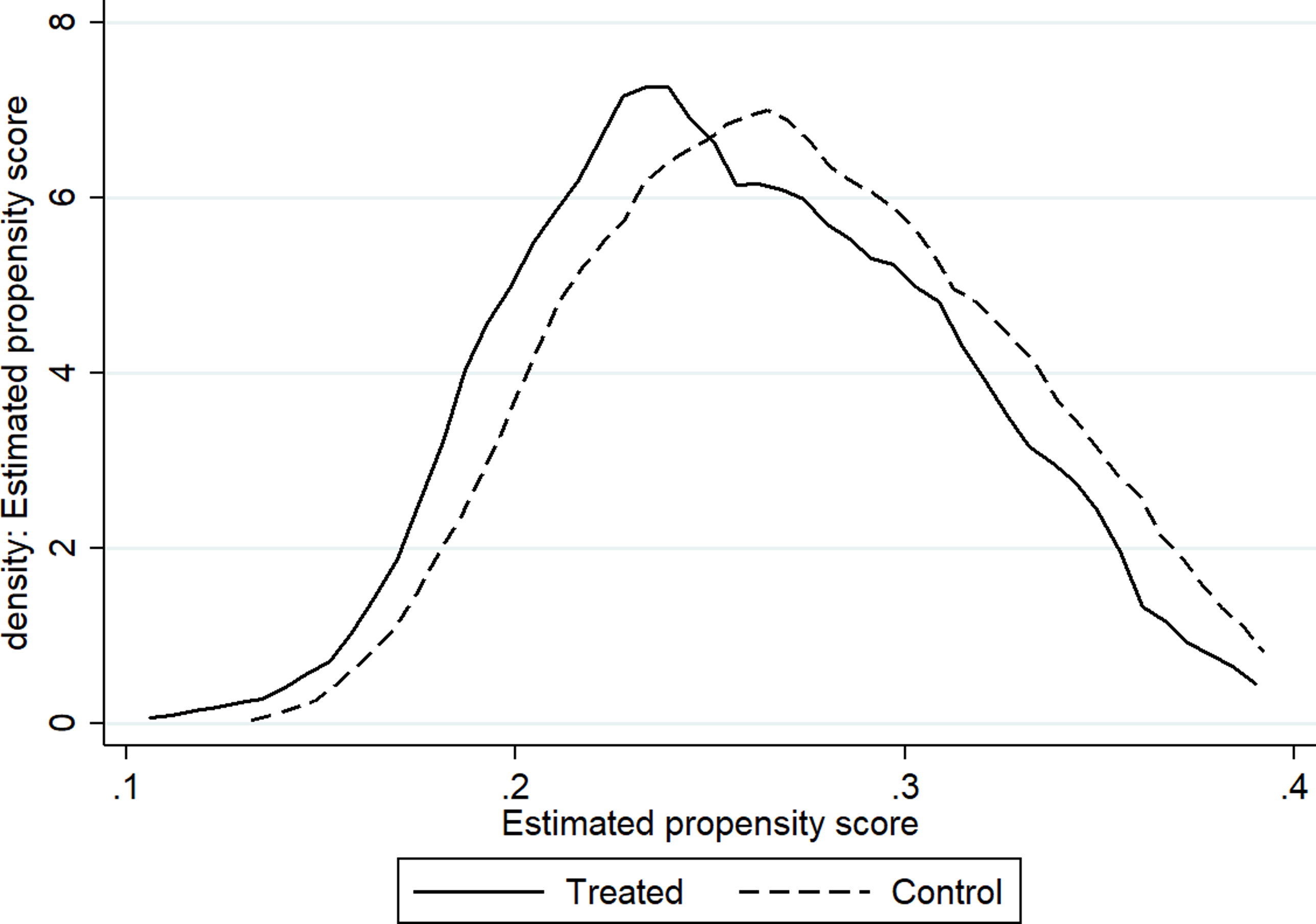
This study examines the impact of the Pre-Employment Card Programme on the likelihood of unemployed participants securing employment. Utilising the PSM method, we compared programme participants to non-participants with similar characteristics such as age, sex, educational background, living area classification, and work experience. This pairing strategy ensures that the two groups have similar characteristics, and any differences in employment outcomes can be attributed to the programme’s impact. By estimating probabilities based on these covariates, we found that the observations of 952 individuals in the treatment group and 3610 individuals in the control group could be matched for comparison. This setup allowed us to identify a common support area where the observation units’ propensity score ranges overlapped, ensuring a viable comparison base between the two groups (Figure 1).
Unemployed observations’ common support.

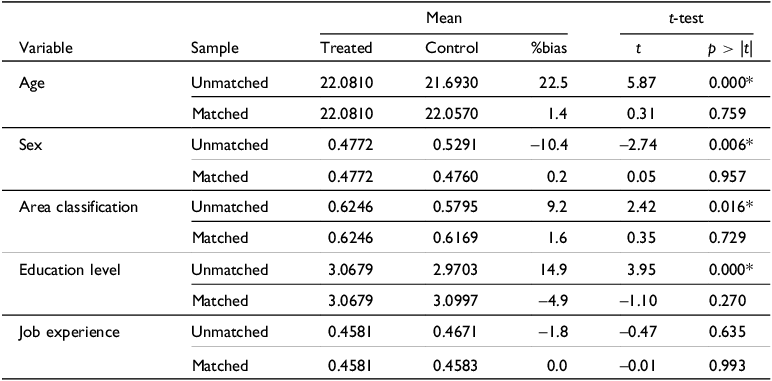
Our methodology included the NN matching to pair subjects based on their closest propensity scores. This step was followed by a balancing test, which verifies the effectiveness of PSM in reducing selection bias by comparing the average scores and covariates across propensity score quantiles. Referring to Rosenbaum and Rubin (1985), the balancing test in this study uses a paired sample t-test on each covariate variable after the matching process. The results indicated no significant differences between groups in all the covariate variables used. In addition, the matching process in this study succeeded in reducing the mean selection bias from 12.8 % to 1.8 % (Table 3).
t-test results for unemployed participants
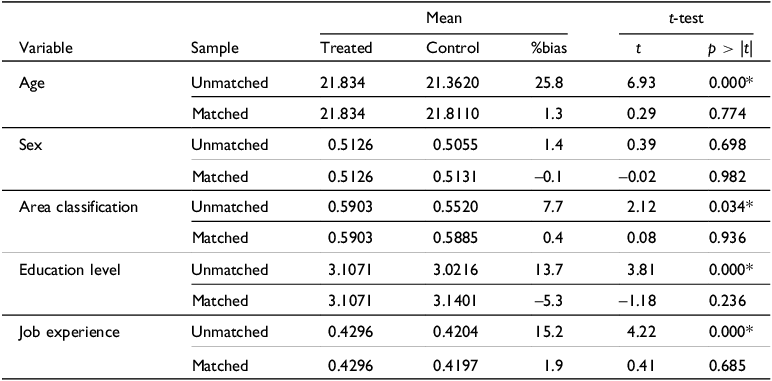
Note: * denotes statistical significance at the 0.05 levels.
A key outcome of this matching process is the estimation of ATT values, which represent the differential impacts of participating in the Pre-Employment Card Programme on the employment probabilities of the enrolled individuals. Our analysis revealed that the programme markedly increased participants’ chances of employment, with a statistically significant impact at a 5% alpha level. This outcome from the NN matching is consistent with the results obtained using both radius and kernel matching techniques, thereby confirming the robustness of the NN matching findings.
To assess the potential influence of unobserved confounders, we conducted a Rosenbaum sensitivity analysis. The results indicate that even under extreme hidden bias at Γ = 3, the estimated effect on employment probability remained stable. Significance levels remained at zero for both upper and lower bounds, suggesting that the estimated effects are resilient to potential unobserved biases. This strengthens our confidence in the validity of the programme’s positive impact on employment outcomes.
In further analysis to examine the programme’s effect on labour market segmentation, we analysed effects on formal and informal employment separately. The results indicate that the Pre-Employment Card Programme participation significantly increases the likelihood of securing formal employment, with ATT values consistently positive and significant at the 5% level across different matching methods. However, the effect on informal employment is statistically insignificant. This possibly indicates that the programme enhances employability without diverting participants into informal work as an alternative to unemployment (Table 4).
The treatment effect on the unemployed participants
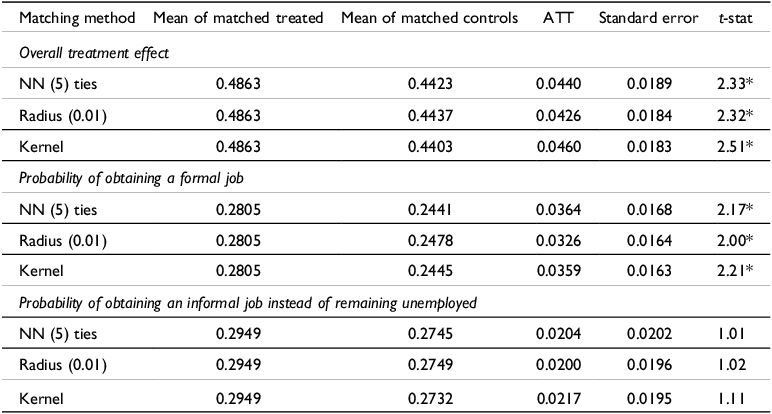
Note: * denotes statistical significance at the 0.05 levels.
These findings align with the research of Bernhard and Kruppe (Reference Bernhard and Kruppe2012), Mourelo and Escudero (Reference Mourelo and Escudero2017), Focacci (Reference Focacci2020), Pastore and Pompili, Reference Pastore and Pompili2020), and Al Ayyubi et al Reference Al Ayyubi, Pratomo and Prasetyia2023), which found that participation in labour market programmes leads to statistically significant positive effects on employment. From a policy perspective, these results highlight the effectiveness of specialised training in equipping young job seekers with technical and soft skills, thereby improving their formal job prospects. However, while the programme does not appear to facilitate a transition from unemployment to informal employment, the outcomes align with the broader objectives of ALMPs, which typically aim to guide participants towards formal sector employment (ILO 2019; 2020).
The programme’s impact on the working hours of employed participants
This research has aimed to evaluate the impact of the Pre-Employment Card Programme on its participants, focusing not only on the programme’s effectiveness in improving the employment probability of unemployed individuals but also in securing more adequate work hours for those who were already employed when joining the programme. Using similar covariates to reduce selection bias, the observations of 943 individuals in the treatment group and 2659 individuals in the control group were matched for comparison. This setup allowed us to identify a common support area where the observation units’ propensity score ranges overlapped (Figure 2).
Employed observations’ common support.
The same NN matching approach with n = 5 was employed to match the characteristics of the treatment group with the control group based on the closest propensity score. This approach ensures that each treated individual is paired with the five most similar untreated individuals, thereby enhancing comparability between the groups. The application of this matching method resulted in a substantial reduction in selection bias, decreasing from an initial imbalance of 11.8% to only 1.6%. To further assess the effectiveness of the matching process, a post-matching balancing test was conducted. The results indicated no statistically significant differences in the observed covariates between the treatment and control groups, confirming that the matching procedure successfully created a comparable control group and mitigated potential confounding biases. This suggests that any estimated treatment effects are more likely to be attributable to programme participation rather than pre-existing differences between participants and non-participants (Table 5).
t-test results for employed participants
Note: * denotes statistical significance at the 0.05 levels.
The ATT results and the comparisons with radius and kernel matching techniques provide a comprehensive view of the program’s effects on the work hours of participants who had been employed when enrolling in the programme. Counterintuitively, the results indicated that programme enrolment led to lower work hours, though this change was not statistically significant at a 5% alpha level. In addition, a disaggregated analysis by employment type reveals that programme enrolment led to a small positive effect on work hours for both formal and informal sector employees, but these results also lacked statistical significance. The negative results observed across all unemployed participants imply that a substantial proportion of programme alumni, initially employed at enrolment, transitioned to unemployment by August 2021.
These findings are consistent with other studies evaluating the effectiveness of similar programs, where ALMPs were observed to have fallen short in improving the employment prospects of young workers (Rotar Reference Rotar2021; Larsson Reference Larsson2003; Centeno et al Reference Centeno, Centeno and Novo2009; Alegre et al Reference Alegre, Casado, Sanz and Todeschini2015). In this case, while the Pre-Employment Card Programme has effectively enhanced employment probability among unemployed participants, its impact on the work hours of employed participants was negligible. These findings highlight the programme’s differential impacts and underscore the complexity of addressing unemployment and underemployment through policy interventions (Table 6).
The treatment effect on the employed participants

Note: * denotes statistical significance at the 0.05 levels.
Discussion
This study investigates the Pre-Employment Card Programme’s impact on participants’ employment outcomes, revealing both positive and counterintuitive findings. The programme demonstrably increased the employment probability among the unemployed participants, with a statistically significant outcome that aligns with prior research (Al Ayyubi et al Reference Al Ayyubi, Pratomo and Prasetyia2023; Bernhard and Kruppe Reference Bernhard and Kruppe2012; Focacci Reference Focacci2020; Mourelo and Escudero Reference Mourelo and Escudero2017; Pastore and Pompili, Reference Pastore and Pompili2020). This success is largely attributable to factors like skills development and financial support for job-seeking efforts. In this case, ALMPs have proven to significantly benefit a disadvantaged segment of the workforce, particularly among low-skilled young individuals (Escudero Reference Escudero2018; Kluve et al Reference Kluve, Puerto, Robalino, Romero, Rother, Stöterau, Weidenkaff and Witte2019; Oesch Reference Oesch2010). According to the National Labour Force Survey, approximately 86.13% of participants were observed to have enhanced their labour skills after completing the programme (BPS 2021), which facilitates the re-entry of inactive and unemployed participants into the workforce (Brown and Koettl Reference Brown and Koettl2015).
Furthermore, ALMPs evidently demonstrated effectiveness during the economic downturn with high unemployment rates during and after the COVID-19 pandemic, which indicates that the decision to implement this programme in response to the global crisis was a well-judged policy move (Card et al Reference Card, Kluve and Weber2018; Kluve Reference Kluve2010). Moreover, involving non-public actors in employment programme implementation was seen to result in moderately greater gains than when it was done solely by the public sector (Auer et al Reference Auer, Efendioğlu and Leschke2005; Kluve et al Reference Kluve, Puerto, Robalino, Romero, Rother, Stöterau, Weidenkaff and Witte2019). The Pre-Employment Card Programme outsources training services to both public and private providers through training vouchers, suggesting the government’s acknowledgement of the value of competitive market forces in enhancing service quality (Nguyen et al Reference Nguyen, Putra, Considine and Sanusi2023).
However, it is interesting to note that the programme did not significantly affect the work hours of participants who were already employed upon enrolment. This finding aligns with previous studies on similar programmes, showing that ALMPs may produce suboptimal results that do not meet policymakers’ expectations for improving the employment prospects of young workers (Rotar Reference Rotar2021; Larsson, Reference Larsson2003; Centeno et al Reference Centeno, Centeno and Novo2009; Alegre et al Reference Alegre, Casado, Sanz and Todeschini2015). This may be determined by how participants utilise the programme’s incentives. The programme adopts a human capital framework by offering participants training vouchers and cash incentives upon completion of training. However, the severe impact of the COVID-19 pandemic might have forced 82.29% of employed participants to utilise cash benefits for their daily needs instead of employment or business investments that could improve labour market outcomes (BPS 2021).
Another key point to consider is that the programme’s effectiveness is also linked to its alignment with the broader concept of ALMPs, which traditionally assumes that formal sector employment is a direct result of participation (ILO 2019; 2020). However, a significant portion of the programme alumni work in the informal sector, and there has not been a noticeable shift from the informal sector to the formal sector in Indonesia (BPS 2020; 2023; Rothenberg et al Reference Rothenberg, Gaduh, Burger, Chazali, Tjandraningsih, Radikun, Sutera and Weilant2016). This suggests that while ALMPs on the supply side are important for improving information skills and matching, they may not address broader economic issues such as insufficient job creation in the formal sector (Verick Reference Verick2023).
Additionally, while ALMPs typically comprise three key components, cash incentives, training, and job-matching, Indonesia’s the Pre-Employment Card Programme lacks a structured job-matching mechanism. Unlike ALMPs in some developed countries that integrate vocational training with direct employment placement services, the programme relies solely on participants seeking job opportunities independently. This limitation reduces its effectiveness in supporting ALMP implementation in Indonesia, as successful labour market transitions often require a stronger alignment between skill development and employer demand (Quintini Reference Quintini2014; Valiente et al Reference Valiente, Zancajo and Jacovkis2020). The absence of job-matching support may explain why the programme increased employment probability, but did not improve work hours, as participants may have secured informal or low-hour jobs without structured placement assistance.
However, the interpretation of these results should not be construed as meaning that the Pre-Employment Card Programme does not work. Rather, variations in its performance are attributable to how it was designed and implemented, as well as differences in the labour market across various groups. In terms of training, it is crucial to provide measures that align with the abilities and skills needed in the job market. For example, many OECD countries utilise forecasting tools to predict job growth trends in both the short and the long term (Auer et al Reference Auer, Efendioğlu and Leschke2005). By aligning training content more closely with the needs of targeted groups, the impact of such programmes can be optimised. On the other hand, providing incentives after the training programme may not guarantee better employment results, since incentives were mainly used for daily living expenses. In this respect, the government should consider ensuring incentives directly benefit businesses by mandating a portion spent on business-related activities, possibly through a voucher system or reimbursement scheme.
Another critical reflection is that the limitation of ALMPs focusing solely on the supply side might not suffice in overcoming broader economic challenges in the labour market. Effective strategies typically involve a combination of both supply and demand measures, especially for less industrialised countries (Escudero Reference Escudero2018; Kluve et al Reference Kluve, Puerto, Robalino, Romero, Rother, Stöterau, Weidenkaff and Witte2019). Integrating the programme with other supportive programmes, such as on-the-job training and job search assistance for the supply side, alongside demand-side approaches like wage subsidies, could establish a more comprehensive framework for enhancing employment support. This integration not only addresses immediate job placement challenges but also fosters a more sustainable labour market environment.
Conclusion
This study evaluates the effectiveness of the Pre-Employment Card Programme, an ALMP in Indonesia focusing on employment probabilities and work hours among the youth. Utilising 8164 observations from the National Labour Force Survey of August 2021, the research employs a matching method for a robust comparison between participants and non-participants. The findings reveal a significant positive effect of the programme on the employment chances among unemployed participants but not on the work hours among those already employed upon the programme enrolment. This suggests the programme’s strength in enhancing job access through skill development, yet a shortcoming in addressing underemployment.
These insights contribute to both scholarly and policy discussions in several keyways. This study extends the ALMP literature, which has been largely focused on developed economies. Methodologically, the study strengthens research on ALMP effectiveness by employing PSM with Rosenbaum sensitivity analysis to evaluate a large-scale program, addressing selection bias concerns common in observational studies. By applying this approach, the study enhances the robustness of impact assessments in settings where experimental designs may not be feasible.
From a policy perspective, it provides empirical insights into ALMP effectiveness in an emerging economy where youth unemployment is driven by informality and skills mismatches. Despite regulatory updates to the Pre-Employment Card Programme between 2021 and 2024, the findings remain policy-relevant, as core program components—including eligibility criteria, digital training modules, and completion incentives—have remained consistent. This ensures that the study serves as a valuable reference for assessing the program’s long-term impact, particularly in economies undergoing structural labour market challenges.
While this study focuses on the program’s first year, early-stage evaluations are widely utilised in ALMP research to capture initial employment effects and inform policy adjustments. Given that the Pre-Employment Card Programme provides immediate training and financial assistance, its short-term impact on job entry is particularly relevant in the context of economic recovery following a downturn. However, long-term structural changes—such as career progression, long-term job stability, and formal sector integration—require further study over extended periods.
This raises the question of the limitations of this study and concomitantly, useful directions for future research in this important area. First, the dataset does not specify when each observation received the treatment. During the survey period, the programme had been running for 17 batches since its initial implementation in April 2020. This lack of specificity affects the estimation results and makes the explanations less precise. Second, as this study relies on cross-sectional data, it cannot track changes over time or capture the long-term effects of program participation on employment outcomes. A panel dataset would allow for a more comprehensive analysis of labour market trajectories following participation in the program.
Further, the dataset lacks several key variables that could influence labour market outcomes. These include job search behaviours, post-training job quality, specific skills acquired, employer preferences, and sector employment transitions. While this study identifies a statistically significant impact on employment probability, it does not fully disentangle the mechanisms driving this effect. The discussion presents plausible explanations, but these remain hypothetical without additional supporting data. Future research should incorporate qualitative interviews or longitudinal participant tracking to better understand why and how the Pre-Employment Card Programme influences labour market outcomes.
In these respects, future studies could enhance policy relevance through disaggregated analyses based on factors such as gender, region, education level, prior work experience, and unemployment duration before program enrolment. Lastly, considering the dynamic nature of macroeconomic conditions and labour market policies, future research using panel data and mixed-method approaches could provide stronger insights into employment outcomes post-program participation. These improvements would help policymakers refine ALMP interventions to better address youth employment challenges in Indonesia and beyond.
Rizki Tri Anggara is a statistician at Statistics Indonesia.
Ilmiawan Auwalin is a lecturer at the Airlangga University, Faculty of Economy and Business.



