Since President Truman's Proclamation of 1945,Footnote 1 the legal regime of the continental shelf has occupied an important place in customary international law. The Truman Proclamation has been cited as establishing “instant customary international law”Footnote 2 or, perhaps more accurately, as a Grotian moment marking the rapid development of customary international law.Footnote 3 Although the basic concept of coastal state jurisdiction over its continental shelf has been accepted for more than seventy years, the question of just how far that jurisdiction extends into the sea has a more complex history. The Truman Proclamation did not specify a geographic outer limit of the continental shelf,Footnote 4 nor did the subsequent practice of states coalesce around common rules for determining the outer limits of the continental shelf. Having undergone considerable evolution, the rules for determining the seaward limit of the continental shelf are now codified in the 1982 UN Convention on the Law of the Sea (LOS Convention).Footnote 5 This article examines whether these rules are now part of customary international law, and thus applicable to all states. The article also examines the legal status of the LOS Convention's procedures relating to continental shelf limits, including whether they are open to participation by coastal states that are not parties to the LOS Convention.
Although most coastal states have joined the LOS ConventionFootnote 6 and are therefore bound inter se by treaty law, the customary status of the Convention's continental shelf rules and procedures is important to all states. First, so long as the United States and other coastal states—such as Colombia and Venezuela—remain non-parties to the LOS Convention, they must rely on customary international law to determine their continental shelf limits. Second, parties to the LOS Convention presumably wish their own treaty-based continental shelf limits to be opposable to all states, and not just other parties. Whether or not they are depends on customary and not treaty law. Third, the growing interest in deep seabed mineral exploitation underscores the need to geographically define the international seabed Area.Footnote 7 It is the outer limits of all coastal states’ continental shelves, including those of non-parties, that collectively constitute the boundary defining the Area beyond national jurisdiction, in which non-living resource exploration and exploitation is administered by the International Seabed Authority (ISA).Footnote 8
I. Introduction to Continental Shelf Limits Under International Law
Motivated by the “long range world-wide need for new sources of petroleum and other minerals,” the 1945 Truman Proclamation asserted that:
the Government of the United States regards the natural resources of the subsoil and sea bed of the continental shelf beneath the high seas but contiguous to the coasts of the United States as appertaining to the United States, subject to its jurisdiction and control.Footnote 9
From a scientific perspective, the continental shelf is the flat or gently sloping seabed and subsoil adjacent to a continent or around an island; its outer limit is generally located near what is referred to as the shelf break, where the shelf ends and a marked increase in ocean depths begins.Footnote 10 The geologic continental shelf, however, has never been coincident with the legal one, and in the decade following the Truman Proclamation, uncertainty persisted as to the seaward extent of the legal continental shelf under customary law. During this period, coastal states enacted an abundance of new and varied maritime claims, some of which were more far reaching than the Truman Proclamation in terms of both the type of jurisdiction claimed and also the geographic extent of that jurisdiction. Such claims, for instance, included the assertion by some Latin American states of “exclusive sovereignty and jurisdiction” over the entire sea (not just the seabed and the subsoil), extending a “minimum distance” of 200 nautical miles from shore.Footnote 11
The proliferation of such claims, including their indeterminacy and inconsistency with respect to seaward limits, led to international efforts, extending from the 1950s to the 1980s, to codify the law of the sea into treaty law. These efforts bore fruit in the form of the four Geneva Conventions on the Law of the Sea adopted in 1958Footnote 12 and, later, the 1982 LOS Convention, which created a single comprehensive “legal order for the seas and oceans.”Footnote 13 One of the 1958 conventions, the Convention on the Continental Shelf, marked the first treaty law definition of the continental shelf.Footnote 14 Its Article 1 defined the “continental shelf ” as follows:
the seabed and subsoil of the submarine areas adjacent to the coast but outside the area of the territorial sea, to a depth of 200 metres or, beyond that limit, to where the depth of the superjacent waters admits of the exploitation of the natural resources of the said areas … .Footnote 15
Thus, the 1958 Convention described the continental shelf as “adjacent” to the coast and set forth two criteria for determining its outer limits, one based on water depth (200 meters) and another based on the more elastic notion of resource “exploitability.” In its 1969 North Sea judgment, the International Court of Justice (ICJ) considered that Article 1 of the 1958 Convention was part of customary international law, and elaborated further that the continental shelf “constitutes a natural prolongation of [a coastal state's] land territory into and under the sea.”Footnote 16
Notwithstanding the ICJ's acceptance of Article 1 of the 1958 Convention as part of customary international law, this continental shelf definition was increasingly regarded by states as inadequate, due to the mounting interest in the potential mineral riches of the deep seabed beyond the limits of national jurisdiction.Footnote 17 In this regard, determining the seaward limit of the continental shelf gained additional significance because it served a dual role of also defining the landward limit of seabed beyond national jurisdiction. Thus, shortly after North Sea, the UN General Assembly stated that Article 1 of the 1958 Convention “does not define with sufficient precision the limits [of the continental shelf] … and that customary international law on the subject is inconclusive.”Footnote 18
Against this backdrop, defining the seaward extent of the continental shelf with “sufficient precision” became a major concern of the Third UN Conference on the Law of the Sea (UNCLOS III, or Third Conference), which extended from 1973 to 1982. As early as 1975, as part of a larger package deal,Footnote 19 the negotiators at UNCLOS III arrived at a basic juridical definition of the continental shelf that would eventually appear as paragraph 1 of Article 76 of the 1982 LOS Convention. This definition describes a seaward limit of the continental shelf based on either of two criteria: (1) “the outer edge of the continental margin” or (2) “a distance of 200 nautical miles” from the coast, where the outer edge of the continental margin does not extend beyond 200 nautical miles.Footnote 20
In the later years of UNCLOS III, negotiators fleshed out the implementation rules for determining the precise location of the “outer edge of the continental margin.”Footnote 21 Paragraphs 2 to 7 of Article 76 provide such rules, and their intricacies are discussed infra in Part III. For present purposes, it suffices to say that the provisions are highly complex, and their application requires a detailed understanding of the shape, depth, and composition of the seabed. Recognizing such complexities, the Convention's drafters developed a treaty body and a procedure to help avoid disputes by enhancing certainty and assisting coastal states in implementing Article 76. Specifically, paragraph 8 of Article 76 requires coastal states to submit “[i]nformation on the limits of the continental shelf beyond 200 nautical miles” to the Commission on the Limits of the Continental Shelf (CLCS, or Commission). This body of twenty-one scientific experts is charged with reviewing data and other materials submitted by coastal states concerning the outer limits of the continental shelf beyond 200 nautical miles and making “recommendations” to coastal states.Footnote 22 Article 76 became applicable as treaty law when the LOS Convention entered into force on November 16, 1994, one year after the UN received the sixtieth instrument of accession.Footnote 23 The Convention now has 168 parties.Footnote 24
As is apparent from this brief recitation of the law of continental shelf limits, the “interplay of custom and international agreements [on the law of the sea] has a long history.”Footnote 25 The continental shelf regime was born under customary international law, but without rules specifying the precise geographic limits of the shelf. The first rules pertaining to continental shelf limits were codified in treaty form in 1958 and considered by the ICJ to be part of customary law in 1969. By 1982, subsequent treaty law—Article 76 of the LOS Convention—provided new and more detailed rules (including procedural ones) pertaining to outer limits.Footnote 26 As will be explored in this article, the LOS Convention also had the effect of altering customary law, and in 2012 the ICJ held that paragraph 1 of Article 76 “forms part of customary international law.”Footnote 27 For the United States, this custom-treaty interplay is an unusual one. Even while remaining a party to the 1958 Continental Shelf Convention, the United States considers itself bound by customary international law reflected in Article 76 of the LOS Convention.Footnote 28 Although the United States has yet to accede to the LOS Convention, the U.S. Extended Continental Shelf Project is currently delineating the U.S. continental shelf in areas beyond 200 nautical miles in accordance with the rules set forth in paragraphs 1 to 7 of Article 76 of the LOS Convention.Footnote 29
Parts II, III, and IV of this article examine, in succession, whether paragraph 1, paragraphs 2 to 7, and paragraph 8 of Article 76 are part of today's customary international law.Footnote 30 Each of these Parts contains three sub-sections that (1) explain the rules in question as they appear in the Convention; (2) briefly consider the formation of these rules at UNCLOS III; and (3) examine whether the provisions in question are now part of customary international law. This third sub-section within Parts II, III, and IV presents the relevant state practice and opinio juris in the context of the traditional understandings of customary international law doctrine.Footnote 31 Although this article sidesteps “the theoretical torment that accompanies custom”Footnote 32 and is more empirically focused, it may nonetheless serve as a useful case study for those focused on doctrinal challenges associated with the identification of customary international law. Part V of this article pivots away from customary international law and addresses the question of whether the LOS Convention's procedures relating to the Commission on the Limits of the Continental Shelf, set forth in paragraph 8 of Article 76 and Annex II of the Convention, are open to non-parties. Prior to concluding, the article addresses the benefits of joining the Convention from the perspective of the United States as a major coastal state, maritime power, and consumer of resources found in its own and foreign continental shelves.
II. Article 76(1): Definition of the Continental shelf
The Rules
Paragraph 1 of Article 76 states:
The continental shelf of a coastal State comprises the seabed and subsoil of the submarine areas that extend beyond its territorial sea throughout the natural prolongation of its land territory to the outer edge of the continental margin, or to a distance of 200 nautical miles from the baselines from which the breadth of the territorial sea is measured where the outer edge of the continental margin does not extend up to that distance.
Paragraph 1 sets forth the basic rule regarding the outer limits of a coastal state's continental shelf, providing two distinct bases for entitlement: one based on a 200 nautical mile (M)Footnote 33 distance from shore (distance criterion) and another based on the physical characteristics of the seabed (continental margin criterion). For any particular location, the more favorable of the two criteria may be used by the coastal state. To understand what is meant by the “outer edge of the continental margin,” it is necessary to refer to paragraph 4 of Article 76, which is discussed in Part III, infra.
Despite the existence of two distinct criteria in paragraph 1, “there is in law only a single ‘continental shelf’ rather than an inner continental shelf and a separate extended or outer continental shelf,” as the Tribunal pointed out in the Arbitration between Barbados and Trinidad and Tobago.Footnote 34 Accordingly, a coastal state's sovereign rights relating to exploring and exploiting the continental shelf apply to the entirety of the continental shelf, whether within or beyond 200 M.Footnote 35 Further, these rights are exclusive (“no one may undertake these activities without the express consent of the coastal State”) and inherent (“[t]he rights … do not depend on occupation, effective or notional, or on any express proclamation”).Footnote 36
Formation of the Rules
The 200 M distance criterion and the continental margin criterion contained in Article 76(1) of the Convention have separate lineages.
200 M Distance Criterion
The 200 M distance criterion in Article 76(1), which gained early and widespread acceptance at UNCLOS III, developed in concert with the newly emerging exclusive economic zone (EEZ). While the EEZ regime is not the focus of this article, broad consensus among states had emerged by the mid-1970s for an economic zone extending a maximum of 200 M from shore. This economic zone concerned a coastal state's sovereign rights to explore and exploit living and non-living resources found in the water column, and also the seabed.Footnote 37 Owing to the symmetry of seabed rights for the EEZ and the continental shelf, a 200 M distance limit for the continental shelf was virtually inevitable. By 1985, the ICJ had held that the 200 M distance criterion in Article 76(1) forms part of customary international law.Footnote 38
Despite early consensus on a 200 M distance criterion for the continental shelf, negotiating states nevertheless disagreed as to whether this distance should represent the absolute maximum outer limit of a coastal state's continental shelf entitlement. Some negotiating states took the view that the Third Conference should fully transform the existing rule on continental shelf limits (then reflected in Article 1 of the 1958 Convention) into one based purely on a 200 M distance from shore.Footnote 39 Other states rejected this view, considering that continental shelf limits must extend beyond 200 M, if justified by the physical characteristics of the continental margin.Footnote 40
Continental Margin Criterion
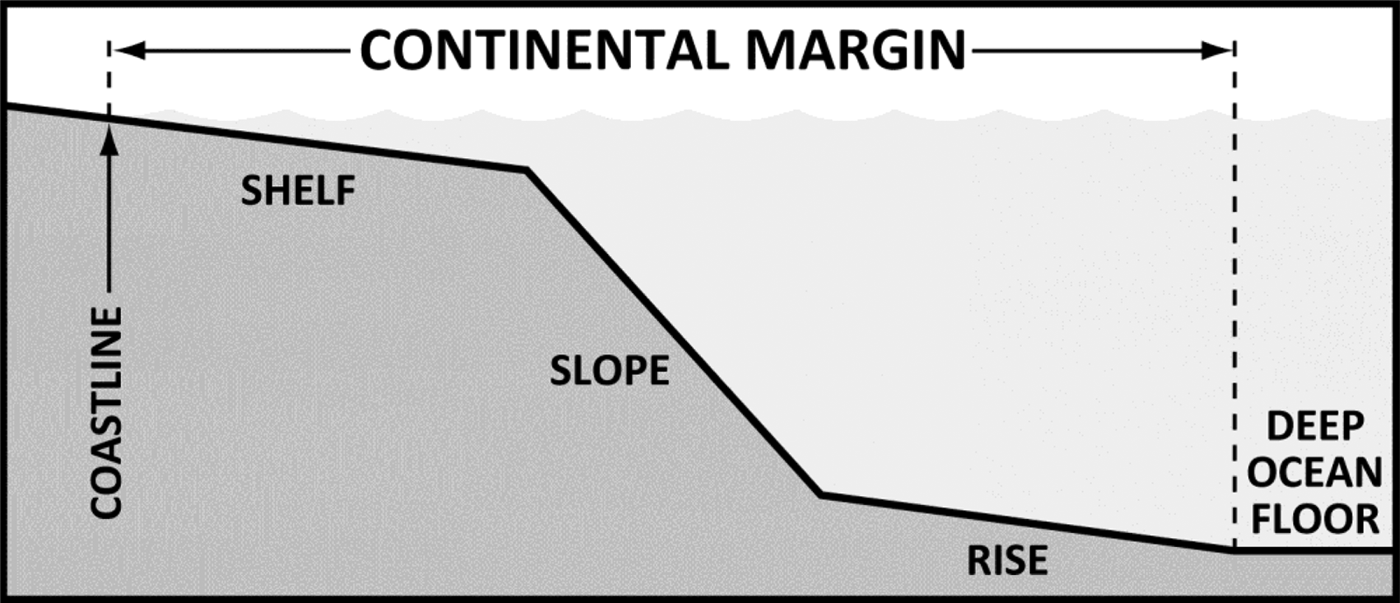
Agreement at UNCLOS III to include the continental margin criterion in Article 76(1) can be explained by three main factors. The first factor is the concept of “natural prolongation,” the phrase coined by the ICJ in its 1969 North Sea judgment to describe the continental shelf as the underwater extension of a coastal state's land territory.Footnote 41 Many states equated the concept of “natural prolongation” with the “continental margin.” In other words, states interpreted natural prolongation in a physical sense, considering the continental margin—the geologic shelf, slope, and rise—as the submarine feature that is the natural prolongation of the land territory (see Figure 1 below).
Simplified two-dimensional representation of the continental margin, consisting of the shelf, slope, and the rise. (Source: Barry Eakins, National Oceanic and Atmospheric Administration.)
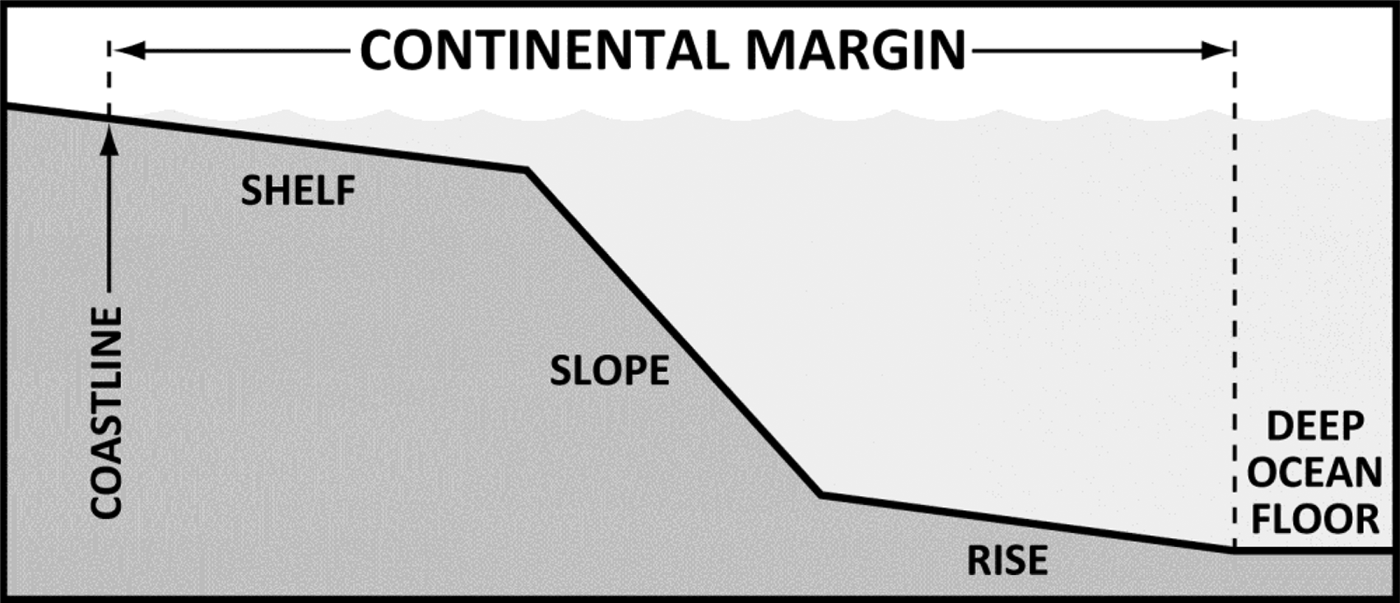
As early as 1971, for instance, Australia described natural prolongation as a concept under which the continental shelf extends “out to the lower edge of the margin, where it slopes down to and merges in[to] the deep ocean-floor or abyssal plain.”Footnote 42 This view was shared by many other states at UNCLOS IIIFootnote 43 and is plainly evident today in the text of Article 76(1), which refers to the “natural prolongation of [the coastal state's] land territory to the outer edge of the continental margin.” As the International Tribunal for the Law of the Sea (ITLOS) would later confirm, the terms “natural prolongation” and “continental margin,” as used in Article 76, “refer to the same area.”Footnote 44
A second and more subtle factor that shaped the development of the continental margin criterion was Article 1 of the 1958 Convention. In North Sea, the Court deemed Article 1, with all its deficiencies and imprecision, to be part of customary international law. With such widespread acceptance, many states considered that they had already acquired rights under the 200-meter depth and the exploitability criteria of the 1958 Convention (or the customary international law reflected therein), including in some areas beyond 200 M from their coasts.Footnote 45 Therefore, simply forgetting Article 1 existed was not an option at UNCLOS III, as evidenced by the firm rejection by many states to the fixing of a 200 M absolute maximum extent of the continental shelf. Instead, what can be seen from state practice prior to UNCLOS III, and statements made during UNCLOS III, is that Article 1 of the 1958 Convention was increasingly understood as being consistent with the view that the continental margin either is, or should be, the determinant of the outer limits of the continental shelf.Footnote 46 Whether this is a sound interpretation of Article 1 may be debated, but the logic is clear: the original and sustaining rationale for continental shelf rights was access to offshore hydrocarbon resources, and the continental margin—consisting of the “shelf, slope, and rise”—was well understood to be the submarine area where such hydrocarbon deposits lie.Footnote 47 In this sense, the outer edge of the continental margin can be understood as the seaward limit of where hydrocarbon resources might reasonably become exploitable, even if not yet exploitable.
Even as a party to the 1958 Convention, the United States had already begun by 1969 to identify the continental margin as the appropriate limit of the juridical continental shelf. At that time, Executive Branch officials testified before the U.S. Senate that the 1958 Convention's exploitability criterion should be interpreted in line with the limits of the continental margin.Footnote 48 A year later, the United States Oceans Policy promulgated by President Nixon in 1970 used the continental margin as division between areas that should be regulated by the coastal state (the margin) and areas that should be regulated by “agreed international machinery” (beyond the margin).Footnote 49
A third factor that shaped the development of the continental margin criterion at UNCLOS III was the negotiating process itself. The Third Conference was a complex and protracted negotiation characterized by a consensus-driven process aimed at producing a package deal acceptable to more than 150 negotiating states. At the broadest level, negotiating states regarded the Convention itself as a unified package. More narrowly, many states considered that a range of provisions dealing with landlocked and geographically disadvantaged states, “the peaceful settlement of disputes, and the outer limits of the continental shelf constituted a package and should be dealt with together … .”Footnote 50 Within this cluster of issues, still smaller package deals eventually enabled full acceptance of the continental margin criterion, including the detailed provisions in paragraphs 2 to 7 of Article 76 and the inclusion of a treaty body that would become the Commission on the Limits of the Continental Shelf (paragraph 8 of Article 76).
The Convention's negotiating history reveals a particularly tight connection between Article 76(1) and Article 82. Article 82 provides that, after five years of mineral exploitation on its continental shelf beyond 200 M, a coastal state must share with other states a portion of the resulting revenues.Footnote 51 Article 82 was instrumental in securing acceptance of the continental margin criterion by those states—mostly landlocked and geographically disadvantaged—that favored an absolute maximum limit of 200 M.Footnote 52
At the close of UNCLOS III in 1982, what was the status of the continental margin criterion in Article 76(1) under customary international law? The North Sea judgment, amplified by subsequent scholarship, has identified three ways by which treaties can contribute to the formation of customary international law: (1) by codifying existing customary international law; (2) by causing an emerging rule to crystallize into customary international law; and (3) by setting forth conventional law that may later progressively develop into new customary international law.Footnote 53 Although the origins of the continental margin criterion pre-date UNCLOS III, it cannot be argued credibly that the Third Conference codified existing customary international law in Article 76(1). To the contrary, UNCLOS III set out to change existing customary international law (then reflected vaguely in Article 1 of the 1958 Convention) by giving greater clarity to the seaward limit of the continental shelf.
A more plausible view is that UNCLOS III contributed to crystallizing or clarifying a rule of customary international law that was emerging. In the early years of the Third Conference, nearly all of the thirty-nine states that supported the continental margin criterion “maintained this to be the present state of general customary law.”Footnote 54 By the close of the Third Conference, at least fifteen coastal states had actually incorporated the continental margin criterion into their domestic law.Footnote 55 Still, this conclusion could be questioned. A considerable diversity of state practice remained during the 1960s and 1970s.Footnote 56 Moreover, for states that favored a strict 200 M limit, the continental margin criterion was acceptable only as part of the broader compromise expressed in treaty form.Footnote 57 Nevertheless, following UNCLOS III, the ICJ leaned toward the view that all of Article 76(1) was part of customary international law. In 1984, the ICJ's Chamber in the Gulf of Maine referred to the “consensus reached [at UNCLOS III] on large portions of the instrument” and stated that the provisions of the Convention concerning the continental shelf (and EEZ), despite “bear[ing] the mark of the compromise surrounding their adoption, may nevertheless be regarded as consonant at present with general international law on the question.”Footnote 58 The next year, in Libya/Malta, the full Court similarly suggested the validity of the continental margin criterion under customary international law.Footnote 59 The status of Article 76(1) under customary international law is examined in more detail in the following subsection.
Status of Article 76(1) Under Customary International Law
In 2012, more than twenty-five years after its Gulf of Maine and Libya/Malta judgments, the ICJ stated plainly in Nicaragua v. Colombia I that it considers the entirety of paragraph 1 “part of customary international law.”Footnote 60 Considering some commentary on the subject, this outcome was not a foregone conclusion, and may still be doubted by some. Suarez's comprehensive examination of the continental shelf, published in 2008, states that “there is a widely-accepted view that the continental shelf beyond 200 [nautical miles] is not part of customary international law.”Footnote 61 In his 2012 treatise, Tanaka considered that “it would be difficult to argue that the continental shelf beyond 200 nautical miles is part of customary international law” owing to the difficulty of finding widespread state practice and opinio juris.Footnote 62 Vladimir Golitsyn, the president of ITLOS, wrote in 2009 that Article 76 “can hardly be viewed as a reflection of customary international law.”Footnote 63 At the final session of UNCLOS III, the president of the Conference, Tommy Koh, stated his view that “a State which is not a party to the Convention cannot invoke the benefits of article 76.”Footnote 64 These views are contradicted by some scholars.Footnote 65 Common to most of these appraisals, including those of the ICJ, is an absence of evidentiary support for the conclusions reached. The remainder of this section attempts to fill this gap.
Brief Doctrinal Considerations
The formation of customary international law requires “evidence of a general practice accepted as law,” to borrow the wording of the ICJ Statute.Footnote 66 This formulation reflects the two well-known elements required for the formation of customary law: state practice and opinio juris. The state practice element refers to what states actually do and may take a wide variety of forms. The opinio juris element is the subjective attitude of the state that accompanies state practice. Although often difficult to discern, this element is necessary to ensure that the state practice in question “occurred in such a way as to show a general recognition that a rule of law or legal obligation is involved” and does not instead reflect “courtesy, convenience or tradition.”Footnote 67 The formation of a rule of customary law requires that the relevant practice of states be “both extensive and virtually uniform in the sense of the provision invoked,” including “States whose interests are specially affected.”Footnote 68 The Court in North Sea also considered that a treaty provision should have a “norm-creating character” in order to pass into customary international law.Footnote 69
With respect to the continental shelf, it is considered here that the assertion by a coastal state of the geographic extent of its continental shelf rights has an inherently legal character, as it represents a claim of rights—and concomitant obligations of other states—on the international plane. Such assertions, by their nature, cannot be made out of “considerations of courtesy, convenience or tradition”Footnote 70 with no legal implication. Despite this, ensuring that state practice is accompanied by the requisite opinio juris presents significant challenges with respect to continental shelf limits. Because the rules under examination here are set forth in a widely ratified treaty, it cannot be assumed that an assertion of continental shelf rights in a particular area is based on customary law rather than treaty law. As stated in the International Law Commission's (ILC) Draft Conclusions on the identification of customary international law, it must be shown that states “engage[d] in the practice … out of conviction that the rule embodied in the treaty is or has become customary international law.”Footnote 71
Accordingly, actions regarding the continental shelf taken by a party to the LOS Convention are unlikely to be probative as to whether Article 76 is part of customary international law, as it is difficult to ascertain whether the party undertook such actions solely pursuant to treaty law or also out of a conviction that the treaty provision embodied customary law. In an effort to ensure the requisite opinio juris, the practice assessed here focuses primarily on non-parties to the Convention. However, the practice of current LOS Convention parties is also considered relevant (1) if it occurred during the period prior to entry into force of the Convention for those states (i.e., before they became parties)Footnote 72 or (2) when undertaken in relation to non-parties (i.e., acts of parties against non-parties).Footnote 73 Attention is paid, in other words, to the practice of states in situations not governed by the LOS Convention.
Evidence of State Practice and Opinio Juris
For analytical and presentational convenience, evidence of state practice and opinio juris is grouped into three categories: enactments, statements, and treaties (primarily maritime boundary treaties).Footnote 74
1. Enactments. This category includes domestic laws, decrees, proclamations, ordinances, or other similar enactments by legislative or executive bodies that constitute state practice and, for the reasons discussed above, also indicate acceptance of the continental margin criterion in Article 76(1) as customary international law. New Zealand's 1977 amendment to its Continental Shelf Act is an example of an enactment that, considering the context, evidences acceptance of the continental margin criterion as customary law. This act asserts New Zealand's exclusive rights to its continental shelf and defines “continental shelf” in a manner consistent with the continental margin criterion in Article 76(1) of the Convention.Footnote 75 Although New Zealand is now a party to the LOS Convention, this enactment in 1977 long preceded the Convention's entry into force for New Zealand in 1996. (Indeed, it pre-dated even the Convention's adoption in 1982.) The international legal basis for New Zealand's continental shelf assertion, therefore, appears to have been customary international law, despite the direct influence of the Convention. Other coastal states with similar enactments made prior to the entry into force of the Convention for that state include: Antigua and Barbuda,Footnote 76 Argentina,Footnote 77 Bangladesh,Footnote 78 Brazil,Footnote 79 Canada,Footnote 80 Chile,Footnote 81 Cook Islands,Footnote 82 Costa Rica,Footnote 83 Dominican Republic,Footnote 84 Ecuador,Footnote 85 Grenada,Footnote 86 Guyana,Footnote 87 Iceland,Footnote 88 India,Footnote 89 Madagascar,Footnote 90 Mauritania,Footnote 91 Mauritius,Footnote 92 Mexico,Footnote 93 Mozambique,Footnote 94 Myanmar,Footnote 95 Namibia,Footnote 96 Norway,Footnote 97 Pakistan,Footnote 98 Russian Federation,Footnote 99 St. Kitts and Nevis,Footnote 100 St. Lucia,Footnote 101 Senegal,Footnote 102 Seychelles,Footnote 103 South Africa,Footnote 104 Sri Lanka,Footnote 105 Syria,Footnote 106 Timor-Leste,Footnote 107 Trinidad and Tobago,Footnote 108 United Arab Emirates,Footnote 109 Vanuatu,Footnote 110 Venezuela,Footnote 111 and YemenFootnote 112 (of these states, Syria, UAE, and Venezuela remain non-parties). These coastal states asserted continental shelf rights under customary international law based on the continental margin criterion in Article 76(1). In doing so, these states are also accepting that other states may do the same, and that they are obliged to respect the corresponding continental shelf rights asserted by other coastal states.Footnote 113
2. Statements. This category includes official statements of government positions, including statements by foreign ministries, written or oral representations in judicial or arbitral proceedings, government memoranda made publicly available, diplomatic protests, and the like. Some statements expressly accept the continental margin criterion in Article 76(1) as part of customary international law, making them the “clearest indication” of opinio juris.Footnote 114 When taken in context, many of these statements also constitute state practice; for instance, if they affirmatively assert continental shelf rights or are made in the context of a bilateral dispute. An example is the 2013 Note Verbale from Colombia (a current non-party) to the UN recognizing that Article 76(1) is part of customary international law and asserting that Colombia's continental shelf extends to the outer edge of the continental margin.Footnote 115 Canada,Footnote 116 France,Footnote 117 Guatemala,Footnote 118 Norway,Footnote 119 Venezuela (a current non-party),Footnote 120 and VietnamFootnote 121 have made similar statements asserting their own continental shelf rights using the continental margin criterion (without a treaty law basis). Other coastal states—including Australia,Footnote 122 Belize,Footnote 123 Costa Rica,Footnote 124 Denmark,Footnote 125 Germany,Footnote 126 Honduras,Footnote 127 Libya,Footnote 128 Malta,Footnote 129 Nicaragua,Footnote 130 Peru,Footnote 131 Trinidad and Tobago,Footnote 132 Tunisia,Footnote 133 the United States,Footnote 134 and UruguayFootnote 135 —have also made statements evidencing acceptance of the continental margin criterion without a treaty law basis, typically in the course of judicial proceeding or other bilateral disputes (of these states, Peru and the United States remain non-parties).
3. Treaties. This category primarily includes treaties that delimit the continental shelf in areas beyond 200 M that were concluded prior to the entry into force of the LOS Convention for one or both parties. As ITLOS remarked in its Bay of Bengal judgment, “[d]elimitation [of a maritime boundary] presupposes an area of overlapping entitlements.”Footnote 136 It is reasonable, therefore, to assume that neighboring coastal states that conclude such maritime boundary treaties have satisfied themselves that they each have a legal entitlement to the continental shelf being divided. If the boundary treaty is concluded prior to the LOS Convention's entry into force for one or both parties, the validity of that entitlement beyond 200 M depends upon customary international law.Footnote 137 Boundary treaties meeting this criteria include the 1980 treaty between Indonesia and Papua New Guinea (Pacific),Footnote 138 the 1988 treaty between the United Kingdom and Ireland (Atlantic),Footnote 139 the 1990 treaty between the United States and Russia (Bering Sea and Arctic),Footnote 140 the 1990 treaty between Trinidad and Tobago and Venezuela (Caribbean),Footnote 141 the 1992 treaty between Australia and France (Pacific),Footnote 142 the 2000 and 2017 treaties between Mexico and the United States (Gulf of Mexico),Footnote 143 and the 2017 treaty between Cuba and the United States (Gulf of Mexico).Footnote 144 While not a boundary treaty, evidence of acceptance of the continental margin criterion as customary international law can also be found among the practice of thirty-three states under the Antarctic Treaty system.Footnote 145
Assessment
With respect to the extensiveness of state practice and opinio juris, the evidence described above comes from about seventy different coastal states. In considering whether this is sufficiently widespread, geographic and legal considerations should be borne in mind, as it would be unrealistic to expect every state to have relevant practice pertaining to the continental margin. First, with respect to geography, among the community of states, only about 150 have coasts, and for those that do have coasts, a continental shelf beyond 200 M is often geographically impossible. Given their geographic setting, some coastal states might consider that they have no need to craft domestic law or otherwise assert that their continental shelf extends to the “outer edge of the continental margin.”Footnote 146 Second, with respect to legal considerations, the ICJ, the 1958 Convention, and the 1982 Convention all confirm that continental shelf rights are inherent and exist even without any express proclamation by the coastal state.Footnote 147 Where a right exists ipso facto, as here, an express claim to it may be regarded as superfluous, such that some coastal states may not feel compelled to perform legal acts asserting their rights. This can frustrate an assessment of the extensiveness of state practice. In fact, about one-third of all coastal states appear to have no domestic legislation whatsoever defining their continental shelf. The inherency of continental shelf rights may also lead to complacency, as some coastal states maintain clearly outdated enactments.Footnote 148
The direct supportive evidence that Article 76(1) is part of customary international law comes from a diverse array of states, including representation from all geographic regions of the world and from states with varying continental margin sizes. Evidence from states with particularly large continental shelves includes all five Arctic coastal statesFootnote 149 —Canada, Denmark, Norway, Russia, and the United States—and also Argentina, Australia, Brazil, Chile, France, India, South Africa, New Zealand, and the United Kingdom. Numerous geographically disadvantaged coastal states, such as those bordering semi-enclosed seas like the Persian Gulf and Mediterranean Sea, have likewise demonstrated acceptance of the continental margin criterion in Article 76(1), notwithstanding that they have little to gain from the continental shelf extending beyond 200 M.Footnote 150
With respect to the uniformity of state practice and opinio juris, the evidence identified is remarkably consistent in its alignment with Article 76(1). State practice and opinio juris that varies from what is presented above is better explained by inertial forces or other factors, rather than a rejection of Article 76(1). Approximately fifteen coastal states, for instance, maintain outdated legislation based on the 1958 Convention. Yet such legislation is almost certainly not reflective of current government views, as many of these states are LOS Convention parties and have made submissions to the CLCS based on Article 76.Footnote 151 Approximately a dozen coastal states—mostly those bordering semi-enclosed seas, such as the Baltic states—define their continental shelf limits with specific geographic coordinates or maritime boundaries. Such enactments are not contrary to Article 76; rather, they merely assert more geographically specific limits that are appropriate in light of national circumstances. Enactments of a handful of other states merely refer to “natural prolongation,” which could readily be interpreted to be consistent with the continental margin criterion, Footnote 152 but is not regarded here as definitive. Most importantly, this review of state practice and opinio juris has identified no states in the period following UNCLOS III that have expressed the view that the continental margin criterion in Article 76(1) is not part of customary international law.
Finally, to the extent that a treaty law provision must possess a “norm-creating character” in order to pass into customary international law, there is little doubt that the continental margin criterion in Article 76(1) (as well as the detailed rules in paragraphs 2 to 7) has such a character. While there is no definition as to what constitutes a “norm-creating provision”Footnote 153 that is amenable to entering into customary law, the rules in question are generalizable and substantive rules of law. In North Sea, the ability of parties to the 1958 Continental Shelf Convention to make treaty reservations to its Article 6 (on boundary delimitation) contributed to the ICJ's conclusion that this provision was not norm-creating and instead “purely conventional” and not part of customary law.Footnote 154 The LOS Convention does not permit reservations.Footnote 155
The state practice and opinio juris presented above constitute an overwhelming amount of “evidence of a general practice accepted as law,” with respect to the continental margin criterion in Article 76(1). The ICJ was justified in its 2012 holding to that effect. A contrary holding would be untenable, as it would imply that only the 200 M distance criterionFootnote 156 in Article 76(1) is part of customary international law. Aside from ignoring the evidence presented here, such a conclusion would create a jarring inconsistency in the historical evolution of continental shelf law by untethering this juridical regime from its origins, which are rooted in the physical characteristics of the seabed and not a particular distance from the coast. None of the juridical concepts in play during the 1950s through the 1970s—depth, exploitability, natural prolongation, or the continental margin—are consistent with a distance-from-shore based limit, and subsequent state practice has not coalesced around 200 M as a maximum limit. Considering the practice of states before, during, and after UNCLOS III, the customary international law of continental shelf limits has never been strictly limited to 200 M.
III. Article 76(2) to (7): The Details
The analysis of paragraphs 2 to 7 of Article 76 begins with the conclusion reached above, namely that the continental margin criterion in paragraph 1 of Article 76 is part of customary international law. This Part considers whether the same can be said for paragraphs 2 to 7, which implement the continental margin criterion in paragraph 1.
The Rules
Paragraphs 2 to 7 provide the detailed rules for how a coastal state is to determine the outer limit of its continental shelf when using the continental margin criterion in Article 76(1):
-
2. The continental shelf of a coastal State shall not extend beyond the limits provided for in paragraphs 4 to 6.
-
3. The continental margin comprises the submerged prolongation of the land mass of the coastal State, and consists of the seabed and subsoil of the shelf, the slope and the rise. It does not include the deep ocean floor with its oceanic ridges or the subsoil thereof.
-
4. (a) For the purposes of this Convention, the coastal State shall establish the outer edge of the continental margin wherever the margin extends beyond 200 nautical miles from the baselines from which the breadth of the territorial sea is measured, by either:
-
(i) a line delineated in accordance with paragraph 7 by reference to the outermost fixed points at each of which the thickness of sedimentary rocks is at least 1 per cent of the shortest distance from such point to the foot of the continental slope; or
-
(ii) a line delineated in accordance with paragraph 7 by reference to fixed points not more than 60 nautical miles from the foot of the continental slope.
(b) In the absence of evidence to the contrary, the foot of the continental slope shall be determined as the point of maximum change in the gradient at its base.
-
-
5. The fixed points comprising the line of the outer limits of the continental shelf on the seabed, drawn in accordance with paragraph 4 (a)(i) and (ii), either shall not exceed 350 nautical miles from the baselines … or shall not exceed 100 nautical miles from the 2,500 metre isobath, which is a line connecting the depth of 2,500 metres.
-
6. Notwithstanding the provisions of paragraph 5, on submarine ridges, the outer limit of the continental shelf shall not exceed 350 nautical miles from the baselines … . This paragraph does not apply to submarine elevations that are natural components of the continental margin, such as its plateaux, rises, caps, banks and spurs.
-
7. The coastal State shall delineate the outer limits of its continental shelf, where that shelf extends beyond 200 nautical miles from the baselines … , by straight lines not exceeding 60 nautical miles in length, connecting fixed points, defined by co-ordinates of latitude and longitude.
Paragraph 2 of Article 76 provides the first textual indication that the extent of the “continental margin”—referred to in paragraph 1—is not necessarily the same as the extent of the legal “continental shelf.” In other words, as will be seen in “paragraphs 4 to 6,” the outer edge of the continental margin may, or may not, be the outer limit of the legal continental shelf.
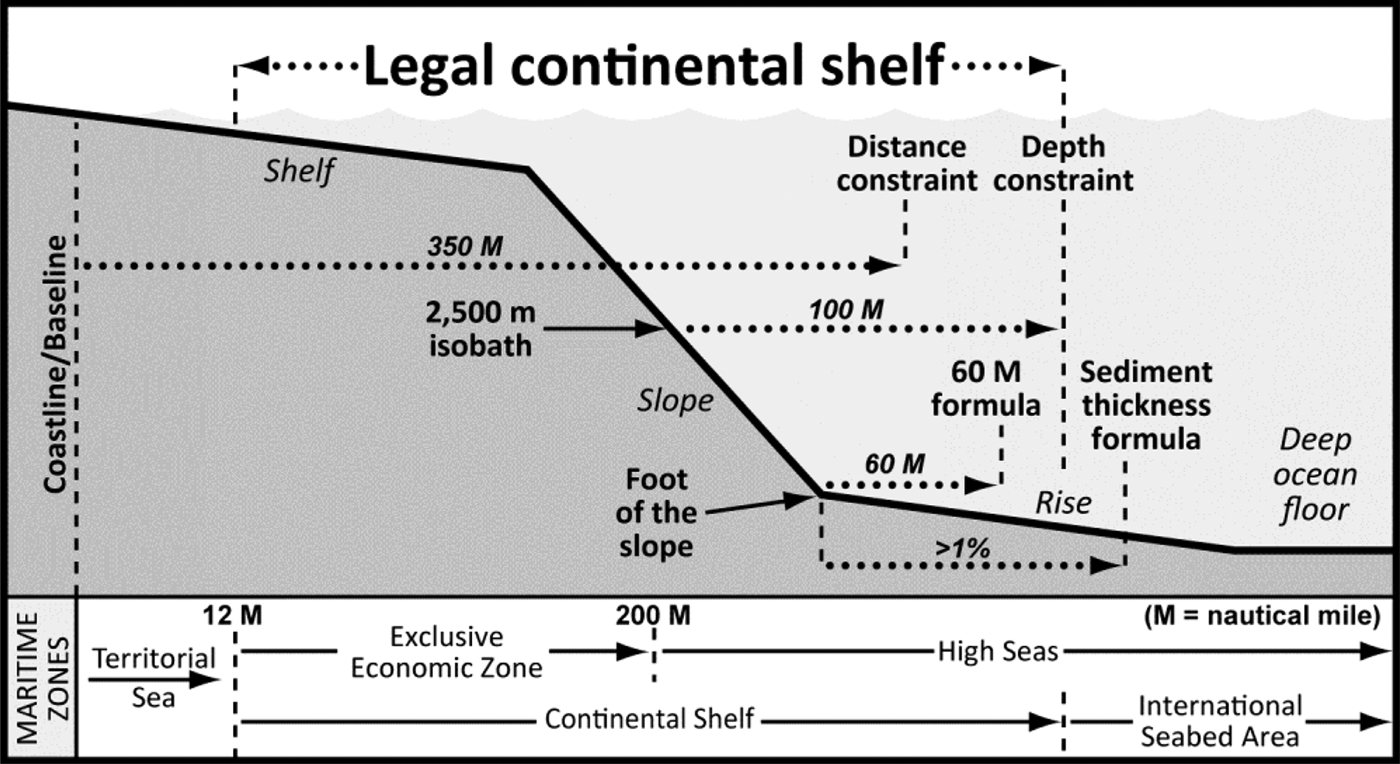
Paragraph 3 defines the components of the continental margin (the shelf, the slope, and the rise), and paragraph 4 provides two formulas for establishing the “outer edge of the continental margin.” Both formulas are applied with reference to the “foot of the continental slope,” which is the point of maximum change in the gradient at the base of the continental slope. One formula is based on distance, and results in a line that is 60 M from the foot of the continental slope. The other formula is based on the thickness of the sediment beneath the seafloor, and results in a line where the thickness of the sediment is at least 1 percent of the shortest distance back to the foot of the continental slopeFootnote 157 (see Figure 2 below). It is the outer-most line formed by the application of both formulas—distance and sediment thickness—that establishes “the outer edge of the continental margin.”
The outer limit of the continental shelf under Article 76. In this example, the outer edge of the continental margin is determined by the sediment thickness formula, which is more seaward than the limit generated by the 60 M distance formula (paragraph 4). However, because the outer edge of the continental margin exceeds the depth and distance constraints (paragraph 5), the outer limit of the continental shelf is located at the more seaward of these two constraints which, in this example, is the depth constraint. (Source: Barry Eakins, National Oceanic and Atmospheric Administration.)
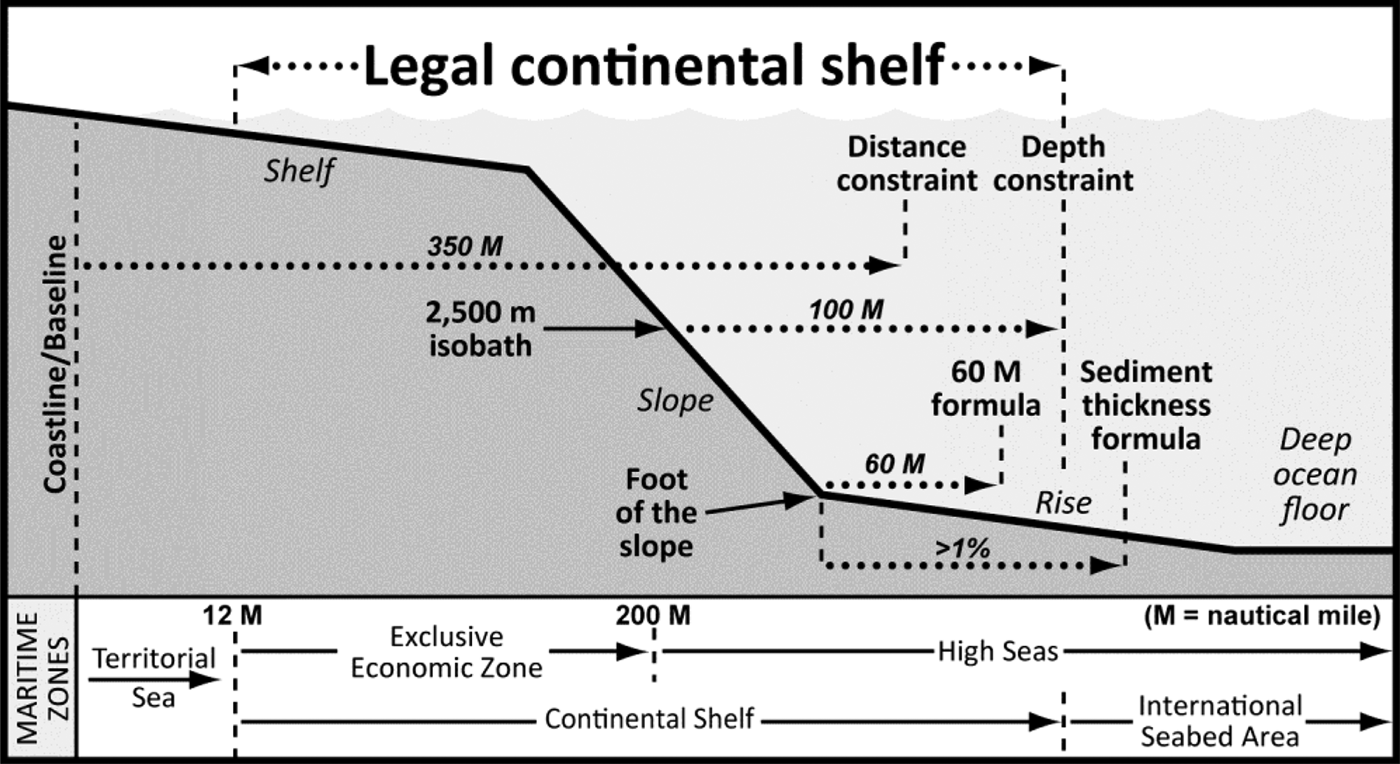
Paragraph 5 describes two constraint lines. The first constraint is based on distance from the coast: “350 nautical miles from the baselines from which the breadth of the territorial sea is measured” (distance constraint). The second constraint is based on water depth: “100 nautical miles from the 2,500 metre isobath, which is a line connecting the depth of 2,500 metres” (depth constraint). Paragraph 5 provides that the outer limits of the continental shelf “either shall not exceed” the distance constraint “or shall not exceed” the depth constraint (see Figure 2 above). Paragraph 6 provides specific rules with respect to applying the constraints to various seafloor highs, including “submarine ridges” (from which the distance constraint must be applied) and “submarine elevations that are natural components of the continental margin, such as its plateaux, rises, caps, banks and spurs” (from which either constraint may be applied). Paragraph 7 provides rules for the overall delineation of the outer limits of the continental shelf in areas beyond 200 M from the coast, and also assists with the implementation of paragraph 4, which refers in two places to paragraph 7.
The interplay between the provisions above illustrate that the “outer edge of the continental margin” is not necessarily the “outer limit of the continental shelf.” Taking paragraphs 1 to 7 together, there are four possibilities for the locating the outer limit of the continental shelf:
-
(1) 200 M, where the outer edge of the margin does not extend this far (paragraph 1)
-
(2) The outer edge of the continental margin (paragraph 4)
-
(3) 350 M (distance constraint, paragraph 5 or 6)
-
(4) 100 M from the 2,500 meter isobath (depth constraint, paragraph 5).
Formation of the Rules
As previously described, the continental margin criterion in paragraph 1 of Article 76, coupled with a 200 M distance criterion, was arrived at relatively quickly in the first few years of the Third Conference. Negotiations on rules for determining the precise outer limits of the continental shelf beyond 200 M, however, stretched from the Conference's Third Session in 1975 through its Ninth Session in 1980 and were shaped by textual proposals introduced by the United States, the Evensen Group, Ireland, the Soviet Union, Australia, and others.Footnote 158 While it is not necessary for present purposes to recount the intricacies of these complex negotiations, several observations are warranted.
First, the objective of the negotiators was to achieve geographic precision regarding the seaward limit of the continental shelf. The indeterminacy of the 1958 Convention's exploitability criterion, it should be recalled, represented the problem to be solved at UNCLOS III. Merely settling on the “outer edge of the continental margin” in paragraph 1 would have been an improvement, but still unsatisfactory given the uncertainties attendant in identifying its location. Developing rules to achieve more precise limits would serve not only the interests of coastal states with broad continental shelves, but also the entire international community because the collective outer limits of coastal states’ continental shelves also delimits the remaining seabed area that is beyond any state's jurisdiction (i.e., the Area). Indeed, the First Committee at UNCLOS III was dedicated to developing a new regime for exploitation of minerals in the deep seabed Area beyond the limits of national jurisdiction.Footnote 159
Second, despite negotiators’ satisfaction with the continental margin criterion in paragraph 1—which was unchanged from 1975 until the adoption of the Convention in 1982—some delegations sought to weaken this criterion during the subsequent negotiation of its implementation provisions, now found in paragraphs 2 to 7. This dynamic again reflects the zero-sum relationship between the continental shelf and the Area beyond national jurisdiction; an expansion of the former necessarily diminishes the latter, and vice versa. The concerns of some states about unreasonable encroachment upon the Area can be seen in paragraphs 5 and 6; when the constraints in these paragraphs are applicable, they deny a coastal state a continental shelf that extends fully to the outer edge of its continental margin. In this way, paragraphs 2 to 7 not only implement the continental margin criterion in paragraph 1, they substantively alter it as well. As Ireland noted at the conclusion of UNCLOS III, the rules adopted in Article 76 “in fact involve cutting off from national jurisdiction parts of the [continental] margin.”Footnote 160
Third, returning to the role UNCLOS III played in forming customary international law, it is apparent from a review of the negotiating history of Article 76 that paragraphs 2 to 7 did not codify existing rules of international law. Aside from the first sentence of paragraph 3 (defining the continental margin as the “shelf, the slope, and the rise”) these provisions were unknown prior to UNCLOS III.Footnote 161 Still, despite the novelty of the detailed rules, at least some states considered that they comported with existing international law. For example, at the close of UNCLOS III, the United Kingdom stated that the provisions of Article 76 “make more precise what is inherent or implicit in existing international law. … [A]rticle 76 accurately reflects the evolution and development of the concept [of the continental shelf].”Footnote 162 Similarly, the United States considered that “[i]n describing the outer limits of the continental shelf, the Convention applies, in a practical manner, the basic elements of natural prolongation and adjacency fundamental to the doctrine of the continental shelf under international law.”Footnote 163
Status of Article 76(2) to (7) Under Customary International Law
Scholarly opinion has varied on whether the implementation rules of Article 76 are part of customary law.Footnote 164 Kwiatkowska expressed doubt in 1991 as to whether the “highly technical” provisions of Article 76 were even capable of entering into customary law.Footnote 165 As of 1995, McDorman considered it “difficult to accept that … the technical criteria of article 76 … have emerged as customary international law.”Footnote 166 Treves, in 2006, took the view that “the basic substantive rules” of Article 76 are part of customary law, but that “it remains open how many of the details and figures set out in these rules partake in this transmigration into customary law.”Footnote 167 In 2008, Oude Elferink stated that “the detailed provisions of article 76” are “[p]robably not” part of customary international law, though paragraph 1 “arguably is.”Footnote 168
Others have regarded the detailed provisions in Article 76 as part of, or likely to become, customary law. In 1985, Hutchinson's thorough examination of continental shelf limits under customary international law concluded that “it is quite likely that Article 76 of the UN Convention, although not yet wholly reflecting the position at customary law, will act as a clear and authoritative guide for future State practice.”Footnote 169 Around the same time, Moore considered the non-seabed mining portions of the Convention to be the “best evidence of customary international law absent a pattern of state practice to the contrary.”Footnote 170 In 1987, Clingan went further, writing that “Article 76 does in fact represent the state of the law … .”Footnote 171 In 1990, Brownlie considered that Article 76 “will probably be recognized as the new standard of customary law” pertaining to the shelf.Footnote 172 Crawford, in 2012, considered Brownlie's forecast to have been accurate, stating that “Article 76 is generally recognized as representing the new standard of customary law for the shelf,” a statement seemingly not limited to Article 76(1).Footnote 173 For its part, the ICJ considered in 2012 that “it does not need to decide” whether the detailed provisions of Article 76 form part of customary international law.Footnote 174 With the notable exception of Hutchinson's detailed review of this topic more than three decades ago, views expressed have not typically been accompanied by an assessment of state practice and opinio juris.
Evidence of State Practice and Opinio Juris Footnote 175
With respect to the practice and attitudes of states today, it is clear that coastal states with continental shelf beyond 200 M are widely implementing paragraphs 2 to 7, as seen in the content of the large number of submissions made by coastal states to the CLCS.Footnote 176 Once again, however, the challenge is to tease out evidence showing the acceptance of these provisions as customary rather than treaty law. The assessment below uses the same three categories of evidence described in Part II—enactments, statements, and treaties.
1. Enactments. The enactments of some coastal states referred to in Part II, such as those of Brazil,Footnote 177 Costa Rica,Footnote 178 Namibia,Footnote 179 and South AfricaFootnote 180 appear to have accepted all of paragraphs 1 to 7 through a general statutory acceptance of Article 76. The enactments of other coastal states, such as Chile,Footnote 181 Ecuador,Footnote 182 Iceland,Footnote 183 Madagascar,Footnote 184 and Trinidad and Tobago,Footnote 185 utilize one or more of Article 76's formulas (paragraph 4) or constraints (paragraphs 5 and 6).
2. Statements. Similarly, the statements of some coastal states referred to in Part II go beyond paragraph 1 and also cover some or all of the detailed rules that follow in Article 76. These include statements by Canada,Footnote 186 Costa Rica,Footnote 187 France,Footnote 188 Nicaragua,Footnote 189 Peru,Footnote 190 Trinidad and Tobago,Footnote 191 and the United StatesFootnote 192 (Peru and the United States remain non-parties). Statements made by one coastal state, Colombia (a non-party), in the course of judicial proceedings indicate non-acceptance of paragraphs 2 to 7 as part of customary international law.Footnote 193
3. Maritime boundaries. The maritime boundary treaties concluded between Ireland and the United KingdomFootnote 194 before they were parties to the Convention and between Trinidad and Tobago and VenezuelaFootnote 195 (Venezuela remains a non-party) were developed on the basis of the detailed rules in Article 76, and not merely paragraph 1.Footnote 196 The treaty concluded between the United States (a non-party) and Cuba in 2017 reflects acceptance of Article 76's delineation provisions.Footnote 197 Paragraphs 2 to 7 were also accepted in the aforementioned practice under the Antarctic Treaty system. In 1988, six years before to the entry into force of the LOS Convention, thirty-three Consultative and Contracting Parties to the Antarctic Treaty agreed that “paragraphs 1 to 7 of Article 76 of the United Nations Convention on the Law of the Sea” constitute the “international law” for determining “the geographic extent of the continental shelf.”Footnote 198 This agreement states the clear legal position of the participating countries, including those such as China and Japan, for which other evidence has not been identified.
Assessment
The direct supportive evidence chronicled above of customary international law formation comes from about forty different coastal states (some appearing multiple times across different categories), with one coastal state, Colombia, taking a contrary view. It is apparent that the relevant state practice for paragraphs 2 to 7 is less widespread than for paragraph 1. Unlike paragraph 1, the evidence for paragraphs 2 to 7 also contains a state with a dissenting view and practice. Nevertheless, when considering the strength of the evidence that does exist, the peculiarities of Colombia's contrary position, and several practical considerations that are somewhat unique to the law of the sea, it may still be concluded that “extensive and virtually uniform” state practice exists that is accompanied by the requisite opinio juris for paragraphs 2 to 7 to form customary international law.
First, in assessing the extensiveness of the evidence, it is important to again bear in mind the legal and geographic considerations discussed above for paragraph 1 of Article 76.Footnote 199 It cannot be expected that every, or indeed even most, countries would exhibit state practice pertaining to the delineation of the outer limits of the continental shelf beyond 200 M from the coast. Moreover, these considerations are more acute for paragraphs 2 to 7 than for paragraph 1. Whereas paragraph 1 assertions of continental shelf are typically made in a generalized fashion (e.g., by referring to the “outer edge of the continental margin”), the proper application of paragraphs 2 to 7 requires continental shelf limits to be “defined by coordinates of latitude and longitude.”Footnote 200 This kind of precision requires the collection, processing, and analysis of large amounts of marine geophysical data, which has only been possible with the passage of time. As a result, the actual implementation of paragraphs 2 to 7 by coastal states has been rare during the period when evidence of customary international law on continental shelf limits is easiest to identify, namely from the 1970s until the Convention's entry into force in 1994. Widespread implementation of paragraphs 2 to 7 did not take place until after 2000, at which point it is harder to disentangle evidence of customary international law formation from treaty implementation by parties.
In this regard, forty coastal states may be regarded as a significant number from which direct supportive evidence can be found. These coastal states are also broadly representative with respect to interests and geography, including many with broad-margins such as Brazil, Canada, France, Iceland, India, South Africa, the United States, and the United Kingdom, and also geographically disadvantaged states that would have little to gain from Article 76. The supportive evidence comes from large and small states, continental and island states, and developed and developing states.
Second, with respect to uniformity of state practice and opinio juris, the clear international standard for continental shelf delineation beyond 200 M is found in paragraphs 2 to 7 of Article 76. No coastal state has relied solely on the continental margin criterion in paragraph 1 of Article 76 or on the exploitability criterion in the 1958 Continental Shelf Convention to delineate its continental shelf limits. With the possible exception of Colombia discussed below, no coastal state has even suggested the possibility of using provisions other than paragraphs 2 to 7 of Article 76 to delineate continental shelf limits.
In the practice of states since UNCLOS III, evidence of non-acceptance of paragraphs 2 to 7 as customary international law appears to come only from Colombia. This non-acceptance, however, is plagued by contradictions and inaccurate factual assertions. For instance, Colombia's initial pleading before the ICJ acknowledged that “the relevant provisions of the Convention dealing with [inter alia] a coastal State's … entitlement to maritime areas … reflect well-established principles of customary international law.”Footnote 201 Paragraphs 2 to 7 are obviously such “relevant provisions,” yet Colombia later took the position that “there is no evidence of State practice indicating that the provisions of paragraphs 4 to 9 of Article 76 … are considered to be rules of customary international law.”Footnote 202 This revised position seems to reflect a litigation posture more than an actual assessment of the matter in question, as it overlooks a large body of conspicuous evidence. Even Colombia's own neighbor, Ecuador, asserted continental shelf limits in 1985 that relied on paragraph 5 of Article 76 as customary international law.Footnote 203
Third, several practical considerations should be borne in mind when considering whether the totality of the evidence identified above amounts to “extensive and virtually uniform” state practice accompanied by the requisite opinio juris such that paragraphs 2 to 7 reflect customary international law. The first consideration is specific to Article 76, and the second pertains to the law of the sea regime more generally.
With respect to Article 76 specifically, it should be recalled that paragraphs 2 to 7 are intended to implement the continental margin criterion in paragraph 1. As ITLOS has confirmed, paragraph 1 “should be understood in light of the subsequent provisions of the article defining the continental shelf and the continental margin,” namely paragraphs 2 to 7.Footnote 204 Paragraphs 1 and 4, for instance, “refer to the same area”Footnote 205 (i.e., the continental margin), with paragraph 4 providing the formulas and methods for determining the exact location of the “outer edge of the continental margin.” In addition, paragraphs 5 and 6 set forth the constraint lines that, when applicable, result in an outer limit of the continental shelf that does not reach the outer edge of the continental margin. Accordingly, illogical and deleterious consequences would follow from regarding only paragraph 1 of Article 76 as part of customary international law. For instance, a non-party would be able to develop its own method of determining the outer edge of the continental margin, even if this results in a more seaward location than paragraph 4. Likewise, a non-party could lawfully ignore the constraints in paragraphs 5 and 6, resulting in a larger continental shelf entitlement than if it were to accede to the Convention. Oxman calls such an outcome, which is suggested by Colombia's position before the ICJ, an “audacious contention” that confers an “exceptional benefit” on non-parties.Footnote 206 Accordingly, if a non-party were to actually ignore any of the provisions in paragraphs 2 to 7 today, in supposed reliance on customary international law, such practice would likely be met by protests from other states.
With respect to the law of the sea more generally, its coherence and effectiveness depends upon all states being bound by common rules.Footnote 207 States undertake resource exploitation, scientific research, shipping, military, law enforcement, and other activities in a shared physical space. Accordingly, an assertion of maritime rights by one state necessarily implies obligations (and implicates rights) of all other states. In this context, where states interact in a shared environment, a coherent system of law cannot exist if different countries subscribe to different legal rules.
Providing a common rule set—“a legal order for the seas and oceans”Footnote 208 —to govern the maritime domain is the historic accomplishment of the LOS Convention, and also one with major implications for the customary international law of the sea. This review of state practice, for instance, has not identified a single Convention party that claims the Convention's territorial sea, EEZ, or continental shelf rights solely against other parties to the Convention. Instead, the seemingly universal practice of coastal states—whether parties or not—is to assert their maritime claims erga omnes (“against all”).Footnote 209 Because this practice is widespread, and because it generally conforms to the Convention's provisions related to maritime zones, it creates a force for the development of customary international law aligned with those treaty provisions. This appears to be what the international community has actively sought, both in the negotiation of the Convention itselfFootnote 210 and its subsequent implementation by states, including non-parties. Since well before the Convention entered into force, for instance, the UN General Assembly has repeatedly stated its request for “States”—whether they have consented to be bound by the Convention, or not—to “observe the provisions of the Convention when enacting their national legislation”Footnote 211 and “the need for harmonization of national legislation with the provisions of the Convention.”Footnote 212 For its part, despite not having joined the Convention, the United States has vigorously supported the Convention's provisions since shortly after its adoption in 1982.Footnote 213
The practice described above, by which states assert their maritime claims erga omnes, is evident with respect to the continental shelf. Many LOS Convention parties, for instance, are (1) using paragraphs 2 to 7 to define their continental shelf limits (pursuant to treaty obligations, at a minimum) and also (2) asserting their continental shelf rights against all states, including against non-parties. The situation of the Philippines is illustrative (and also notable because the Philippines is not among the approximately forty countries for which direct supportive evidence has been identified above). As a party to the Convention, the Philippines has delineated its continental shelf using paragraphs 2 to 7 in the Benham Rise region (east of the Philippine archipelago, beyond 200 M).Footnote 214 The Philippines regards its continental shelf as subject to its “exclusive jurisdiction and control for purposes of exploration and exploitation.”Footnote 215 The expectation of the Philippines appears to be that all states, including non-parties to the Convention, must respect its exclusive continental shelf rights out to the limits provided for under paragraphs 2 to 7. If so, this legal relationship between the Philippines and non-parties is governed by customary international law, not the Convention.Footnote 216 As stated in the commentary to the ILC's Draft Conclusions on the identification of customary international law, when treaty parties “apply conventional obligations in their relations with non-parties to the treaty, this may evidence the existence of acceptance as [customary] law … ,” and not just treaty implementation.Footnote 217
In addition to the Philippines, sixty-six other parties to the Convention have asserted continental shelf limits based on paragraphs 2 to 7, with a large majority of these parties also having made statements within their submissions to the CLCS or enacted legislation providing that the rights within their continental shelf limits are “sovereign” or “exclusive” to that state. Given that continental shelf rights by their nature—under both customary and treaty law—are exclusive to the coastal state,Footnote 218 it seems implausible that any state party would regard its continental shelf limits determined pursuant to paragraphs 2 to 7 as having legal force only against other state parties.
Finally, as the current non-party to the LOS Convention with the largest continental shelf, the state practice and opinio juris of the United States, merits particular attention. The United States lodged diplomatic objections to the 1980s-era continental shelf limits asserted by Chile and Ecuador.Footnote 219 The protests objected to these states’ improper application of paragraphs 5 and 6 and, in doing so, affirmed the views of Chile and Ecuador that these provisions were legally available under customary law. The United States expressly accepted paragraphs 1 to 7 as customary international law in an internal government memorandum in 1987, published by the Department of State in 1993.Footnote 220 In the decades since, the United States has publicly taken substantial steps to implement paragraphs 1 to 7 with seemingly no international objection. To implement the formulas and constraints in paragraphs 4 to 6, the United States has openly conducted at-sea data collection since 2002, including more than three dozen bathymetric and seismic surveys of U.S. continental margins.Footnote 221 As stated on the U.S. government's Extended Continental Shelf Project website:
Like other countries, the United States is using Paragraphs 1 through 7 of Article 76 to determine its continental shelf limits, and considers these provisions to reflect customary international law. As a matter of customary international law, the United States also respects the continental shelf limits of other countries that abide by Article 76.Footnote 222
In light of the evidence and considerations above, the conclusion that paragraphs 2 through 7 of Article 76 reflect customary international law is both well-founded and practical. This conclusion has a firm basis in state practice and opinio juris, and also avoids what has been referred to as “an undesirable divergence between Article 76 of the Convention and customary international law.”Footnote 223 Even if it is doubted that paragraphs 2 to 7 (or some provisions among them) have completed the “transmigration into customary law,”Footnote 224 there is surely no legal obstacle for a non-party to use paragraphs 2 to 7. As Churchill and Lowe state, “[i]t would be difficult to argue that any continental shelf claim consistent with the article 76 formula was not compatible with customary international law.”Footnote 225
IV. Article 76(8): The CLCS
The preceding Parts II and III have answered this article's central inquiry, namely the limits of the continental shelf under customary international law. However, Article 76 consists of more than substantive rules. Paragraph 8 of Article 76 introduces the Commission on the Limits of the Continental Shelf (Commission, or CLCS) and its procedures. In doing so, it likewise introduces a number of legal questions, beginning with whether paragraph 8 is part of customary international law.
The Rules … and the Procedures
Paragraph 8 of Article 76 states:
Information on the limits of the continental shelf beyond 200 nautical miles from the baselines from which the breadth of the territorial sea is measured shall be submitted by the coastal State to the Commission on the Limits of the Continental Shelf set up under Annex II on the basis of equitable geographical representation. The Commission shall make recommendations to coastal States on matters related to the establishment of the outer limits of their continental shelf. The limits of the shelf established by a coastal State on the basis of these recommendations shall be final and binding.
Annex II of the Convention provides that the CLCS “shall consist of 21 members who shall be experts in the field of geology, geophysics or hydrography, elected by States Parties to this Convention from among their nationals.”Footnote 226 Annex II also spells out the Commission's functions and basic procedures. Consistent with Annex II, the Commission has developed its own more detailed Rules of ProcedureFootnote 227 and has promulgated Scientific and Technical Guidelines to assist coastal states in preparing submissions.Footnote 228 Although frequently described as a UN body, the CLCS is actually an independent body of experts for which the UN secretary-general serves as the secretariat.Footnote 229
The core function of the Commission is to consider submissions by coastal states and make recommendations regarding the outer limits of the continental shelf.Footnote 230 Drawing from Article 76(8), Annex II, and the Commission's Rules of Procedure, the submission process can be summarized as follows:
-
1) Submission by Coastal State. A coastal state intending to establish the outer limits of its continental shelf beyond 200 nautical miles must “submit particulars of such limits to the Commission along with supporting scientific and technical data.”Footnote 231
-
2) Receipt of the Submission. The submission is received by the UN secretary-general, which records the submission, notifies all UN member states of its receipt, makes the executive summary of the submission public on its website, and places the submission on the provisional agenda of the Commission's next ordinary session.Footnote 232
-
3) Consideration of the Submission by CLCS. The Commission discharges its mandate to “consider the data and other material submitted by coastal States”Footnote 233 through “sub-commissions composed of seven members.”Footnote 234 Submissions are “queued in the order they are received” and, due to the substantial backlog of submissions received, it is anticipated that it will take many years before a submission made today is considered.Footnote 235
-
4) Recommendation to the Coastal State. After review, the full Commission makes its recommendations to the coastal state.Footnote 236
-
5) Establishment of Outer Limits. As stated in Article 76(8), “[t]he limits of the shelf established by a coastal State on the basis of these recommendations [by the CLCS] shall be final and binding.”Footnote 237 Once the coastal state establishes its outer limits, they are to be deposited with the secretary-general, which gives due publicity to these outer limits.Footnote 238
-
6) Disagreement with the Commission. If a coastal state disagrees with the recommendations of the Commission, it “shall, within a reasonable time, make a revised or new submission to the Commission.”Footnote 239
Several observations regarding the CLCS procedures merit emphasis. First, paragraph 8 describes a mandatory obligation; information “shall be submitted by the coastal State.” While non-compliance with this provision cannot deprive a coastal state of its continental shelf, the Convention nevertheless obligates coastal states that intend to establish continental shelf limits beyond 200 M to make a submission and participate in the Commission's procedures. Second, the CLCS itself is a recommendatory body; it is the coastal state and not the CLCS that actually establishes the outer limit of its continental shelf. Third, despite its recommendatory character, the Commission's role has a legal dimension because “if an outer limit claim is based on the Commission recommendations, then the outer limit is final and binding.”Footnote 240 The meanings of two phrases in Article 76(8)—“on the basis of” and “final and binding”—have been the subject of much commentary.Footnote 241 For present purposes, it suffices to say that if a coastal state follows the Commission's recommendations, it benefits from increased legal certainty and international recognition of its outer limits. It is unclear what happens in the event of a protracted disagreement between the coastal state and the Commission. If disagreement persists even after “mak[ing] a new or revised submission to the Commission,”Footnote 242 then the coastal state may presumably establish its outer limits not on the basis of the Commission's recommendations, in which case the coastal state's limits would not be final and binding, leaving it up to other states to evaluate the credibility of such limits.Footnote 243 Finally, it should be noted that Article 76(8), Annex II, and the Commission's Rules generally refer to “coastal States” rather than “States Parties,” a relevant distinction in the context of possible applicability of these provisions to non-parties, discussed in Section V.
Formation of the Rules and Procedures
The need for an independent treaty body to oversee the implementation of paragraphs 2 to 7 of Article 76 can be explained by the extraordinary complexity of these provisions, coupled with the compelling need for coastal states to establish precise and widely-accepted continental shelf limits. Excessive claims by coastal states would diminish the size and resource potential of the international seabed Area beyond national jurisdiction. As such, Article 76(8) concerning the CLCS was an integral part of the carefully balanced compromises at UNCLOS III.
Paragraph 8 evolved from proposals of the United States and the Evensen Group at the Third Session of UNCLOS III in 1975, providing that a “Continental Shelf Boundary Commission” would make “decisions” regarding a coastal state's continental shelf limits that were “final and binding.”Footnote 244 This approach exceeded the comfort level of many negotiating states, as it would have given the Commission a direct and powerful role in establishing this important jurisdictional limit. The Soviet delegation, for instance, conveyed the view in 1976 that the Commission “should not be allowed to determine the boundary of any State.”Footnote 245 From this point forward, the text of what would become paragraph 8 referred only to “recommendations” of the Commission.
Disagreements persisted, however, with respect to the weight and effect to be given to the Commission's recommendations. Whereas some states wished to see “a closer link between the recommendations of the Commission and the final definition of the outer limit,” others considered it “unacceptable for a third party to be authorized to exceed a recommendatory role.”Footnote 246 A number of states expressed concerns about the meaning and implications of the final sentence of paragraph 8 (referring to the Commission's recommendations).Footnote 247 Of particular note, Canada expressed its concerns on this matter in a plenary statement, noting that Canada was “assured on all sides that [it] is not the intention” of the draft text to “giv[e] the commission the function and power to determine the outer limits of the continental shelf of a coastal State.”Footnote 248 While UNCLOS III did not fully resolve the precise meanings of the phrases “on the basis of” and “final and binding,” the sentiments expressed by Canada and others convey the primacy of the coastal state in establishing the jurisdictional limits in question.Footnote 249
Finally, the negotiating history and the state practice that accompanied UNCLOS III demonstrate that Article 76(8) did not codify an existing rule or crystalize an emerging rule of customary international law. The Commission and its procedures are wholly a creation of UNCLOS III and could only come into existence through the entry into force of the Convention and the election of Commission members by states parties.
Status of Article 76(8) Under Customary International Law
As of the end of 2017, coastal states had made seventy-eight submissions to the CLCS.Footnote 250 Because each was made by a coastal state that was a party to the Convention at the time of its submission, none provide clear support that paragraph 8 reflects customary international law. There is likewise an absence of enactments and statements by coastal states indicating that paragraph 8 is part of customary law.Footnote 251 As discussed above, a number of coastal states have enacted legislation, prior to the entry into force of the Convention, seemingly accepting the entirety of Article 76 as customary law. Still, even from these enactments, it is hard to draw an inference in favor of acceptance of paragraph 8 specifically, considering that the CLCS is an institution that itself could only come into existence if the Convention enters into force. The more defensible view is that Article 76(8) is not part of customary international law. This view is also in accord with the declarations and separate opinions of four judges involved in ICJ proceedings between Nicaragua and Colombia.Footnote 252
V. The CLCS and Non-parties
If paragraph 8 were part of customary international law, the analysis could now satisfactorily conclude. All states would be bound by the same set of rules in Article 76, and also subject to the same procedures. The contrary finding, however, presents a complex legal situation. While the rules for delineating continental shelf limits (reflected in Article 76, paragraphs 1 to 7, as either treaty or customary law) are the same for parties and non-parties to the Convention, only parties are subject to the obligation in Article 76(8) to make a submission to the CLCS. This suggests two possibilities for a non-party intending to establish the outer limits of its continental shelf: (1) establish outer limits without participating in the CLCS process; or (2) seek to establish outer limits through the CLCS process. Both possibilities are explored in this section.
Outer Limits in the Absence of the CLCS Process
Because paragraphs 1 to 7 of Article 76 are part of customary international law, it naturally follows that non-parties have entitlement to the full geographic extent of their continental shelf, consistent with these provisions of law. Of course, if a non-party establishes the outer limits of its continental shelf outside of the CLCS process (e.g., via unilateral declaration), those outer limits could not be “final and binding” within the meaning of paragraph 8 of Article 76 of the LOS Convention. Rather, for a non-party following this course, the outer limits of its continental shelf would have the same status as the outer limits of any other maritime zone, such as the territorial sea. That is, the reactions—or non-reactions—of other states would be relevant in determining the acceptability of a non-party's continental shelf limits.Footnote 253
It should be noted that the above situation is no different for a state party. Continental shelf entitlement is not dependent upon a state party either making a submission or, if a submission is made, following the Commission's recommendations. The Convention contains no obligation for states parties to establish their continental shelf limits beyond 200 M on the basis of the Commission's recommendations; rather, it merely provides that when this is done, the limits are “final and binding.”Footnote 254 As ITLOS has affirmed, the Convention's requirements related to the Commission do “not imply that entitlement to the continental shelf depends on any procedural requirements.”Footnote 255 To conclude otherwise, and predicate entitlement upon a procedure, would overturn long-standing continental shelf doctrine described in Article 2 of the 1958 Convention, Article 77 of the 1982 LOS Convention, and in the ICJ's North Sea judgment, which stated that continental shelf rights “exist ipso facto and ab initio, by virtue of [the coastal state's] sovereignty over the land. … In order to exercise [rights to the shelf], no special legal process has to be gone through, nor have any special legal acts to be performed.”Footnote 256 These are not outdated sentiments from the 1960s, as they are reiterated in the actual submissions of many coastal states to the CLCS.Footnote 257
State practice confirms that entitlement to continental shelf is not predicated on the establishment of outer limits through the CLCS process. Since the inception of the continental shelf regime in the 1940s, coastal states have exercised their continental shelf rights notwithstanding the lack of established outer limits. Even in continental shelf areas beyond 200 M, both parties and non-parties to the Convention have exercised their continental shelf rights in the absence of CLCS recommendations.Footnote 258 There are also at least fourteen boundary treaties involving nineteen different coastal states “in which the outer continental shelf [i.e., beyond 200 M] is delimited before making a submission to the CLCS or receiving any recommendations from the Commission.”Footnote 259 The parties to such boundary treaties have seemingly satisfied themselves that their respective entitlements overlap, even without involvement of the CLCS. Such practice can be explained by the fact that, in many instances, there is no doubt that the area in question is continental shelf.Footnote 260 The central purpose of the CLCS procedures is to establish certainty as to the outer limits of the continental shelf; however, as ITLOS has stated, “[a] coastal State's entitlement to the continental shelf … does not require the establishment of outer limits.”Footnote 261
None of the foregoing diminishes the importance of the Commission. Coastal states must develop their continental shelf limits by applying complex formulas and rules typically requiring large amounts of marine geophysical data and analysis. Even if done transparently, many governments are ill-equipped to easily evaluate the credibility of another country's claimed continental shelf limits. Accordingly, a system of unilateral claims and unilateral reactions might sow confusion and uncertainty from the perspective of both the coastal state and the international community. The lack of a stable boundary separating the continental shelf and the international seabed Area would complicate, and perhaps thwart, fixed site-specific investments for developing mineral resources on both sides of the line. This is particularly the case in those areas where continental shelf limits are difficult to identify without a rigorous assessment of scientific data, which may not even be publicly available. It was these concerns that led drafters of the Convention to establish the Commission. Through its procedures and independent scientific expertise, the Commission serves the function of legitimizing (or not) claimed outer limits, to the benefit of the entire international community, including with respect to defining the Area beyond national jurisdiction.
Non-party Participation in the CLCS Process
As discussed above, while legal entitlement to continental shelf beyond 200 M does not depend on participation in the CLCS process, such participation by coastal states may nevertheless be beneficial. But is non-party participation in the Commission's procedures legally permissible?
Scholarly opinion is divided on this question. McDorman and other scholars see “nothing in the mandate of the Commission that would preclude a non-party … from utilising the Commission.”Footnote 262 Oude Elferink and others, however, consider that a non-party is “not entitled to employ the procedure for establishing the outer limits of the continental shelf involving the Commission.”Footnote 263 Others have viewed non-party participation in the CLCS process from the perspective of what is sensible and beneficial, rather than as a strictly legal question. For instance, Treves has considered this matter “in terms of interest[s],” including the interest of the coastal state in “obtain[ing] more support and certainty for its claim” but also “the interest of everybody else, probably more so than of the coastal state. Everybody has an interest in a precise definition of states’ limits, including limits of States that are not parties to the LOS [Convention].”Footnote 264 Along similar lines, Zinchenko suggested that a non-party submission “should be welcomed for its contribution to the delineation and stability of global boundaries.”Footnote 265 Magnússon considers that making a submission helps a non-party “show its commitment to the principles and legal framework of [the LOS Convention] and present its entitlement to the continental shelf in a format that is well established.”Footnote 266
As an initial matter, non-party participation in the CLCS process would involve two steps with different main actors: (1) the filing of a submission, which would be an act undertaken by a non-party coastal state; and (2) the review of (and recommendations on) a submission, which would be undertaken by the CLCS. Different legal considerations weigh on these steps.
Non-party Submission
First, with respect to the filing of a submission by a non-party coastal state with the CLCS, neither treaty law (which cannot bind a non-party) nor customary law (which is not applicable to paragraph 8) prohibits such an act. Whether invited or not, whether ultimately welcomed or ignored by the CLCS, a submission merely involves the communication of data and other materials to the Commission in a particular format. This would be a permissible act by a non-party coastal state.
One might be tempted to view a non-party submission as being governed by Article 35 or 36 of the Vienna Convention on the Law of Treaties (VCLT).Footnote 267 Those articles describe the conditions under which an obligation or right “arises for a third State [i.e., non-party] from a provision of a treaty.” It is submitted here that the matter is not so complex. The problem with applying Articles 35 and 36 of the VCLT to assess the legality of a non-party submission is that such a submission need not be made as a matter of right or obligation arising under the treaty.Footnote 268 Rather, a non-party submission could be among the many examples of a non-party implementing a treaty provision where there is no requirement to do so. To conclude otherwise, that a submission by a non-party is legally prohibited, would seem to disturb a basic principle of treaty law, pacta tertiis, reflected in Article 34 of the VCLT, in that the treaty qua treaty (i.e., LOS Convention) cannot create a legal bar for non-parties.Footnote 269
CLCS Review of a Non-party Submission
The second and more difficult question is whether the CLCS may consider a submission from and make recommendations to a non-party coastal state. As McDorman has correctly observed, this question engages the mandate of the CLCS under the Convention;Footnote 270 it is not an issue of customary international law and its application to states. Put simply, what is this treaty body authorized to do? Article 3 of Annex II describes the functions of the CLCS as follows (with emphases added):
-
(a) to consider the data and other material submitted by coastal States concerning the outer limits of the continental shelf in areas where those limits extend beyond 200 nautical miles, and to make recommendations in accordance with article 76 … ;
-
(b) to provide scientific and technical advice, if requested by the coastal State concerned during the preparation of the data referred to in subparagraph (a).
Thus, the mandate of the Commission—with respect to both submissions and the provision of scientific and technical advice—pertains to “coastal States,” not “States Parties.” The relevant legal question, therefore, is the meaning of “coastal States” as a matter of treaty law, namely whether or not the term “coastal States” includes non-parties.
In 1997, the CLCS posed to the Convention's Meeting of States Parties the very question of whether “the terms ‘a coastal State’ and ‘a State’ [in Annex II] include a non-State party to the Convention, or do they only refer to a coastal State or a State which is a State Party to the Convention?”Footnote 271 The matter was briefly addressed at the Meeting of States Parties in 1998. No decision was taken, and doubt was expressed as to whether the Meeting of States Parties had the competence to address this legal question.Footnote 272 The matter remains unresolved from the perspective of the Commission. It will likely only be officially considered further “when the problem actually arises.”Footnote 273
The Meaning of “Coastal State”
The Convention does not define the term “coastal State.” Based on rules of treaty interpretation, the ordinary meaning of “coastal State” in the context it is used and in light of the object and purpose of the Convention indicates that this term—and therefore the mandate of the CLCS—includes non-party coastal states.Footnote 274 The ordinary meaning of “coastal State” is any state that borders the sea, including continental and island states with a sea coast (i.e., not land-locked). In the Chagos Marine Protected Area Arbitration, the Tribunal simply remarked: “[t]his term is not defined in the Convention, although its usage in the text [of the Convention] makes evident that it was intended to denote a State having a sea coast, as distinct from a land-locked State.”Footnote 275
A review of the context for the use of the term “coastal States” in the Convention supports this interpretation. In numerous places, the Convention text refers to “all States, whether coastal or land-locked.”Footnote 276 This confirms that the term “coastal States” (like “land-locked states”) refers to a subset of “all States” and not a subset of “States Parties.” In addition, the LOS Convention expressly defines the term “States Parties” as “States which have consented to be bound by this Convention and for which this Convention is in force.”Footnote 277 Therefore, both “States Parties” and “coastal States” are a subset of “States,” with the term “States Parties” excluding non-party states and the term “coastal States” excluding land-locked states. These two subsets of states contain overlaps and outliers; states parties may be coastal states, or not; likewise, coastal states may be states parties, or not.
Article 76 refers exclusively to “coastal States” and contains no references to “States Parties.” Although Annex II to the Convention (pertaining to the CLCS) is replete with references to “coastal States,” its Article 2 refers to “States Parties” as having responsibility for the nomination, election, and defraying of expenses of members of the Commission.Footnote 278 Care clearly has been taken to ensure textual distinctions between provisions in Annex II referring to “coastal States” and those referring to “States Parties.”Footnote 279 Had the drafters wished to exclude non-parties from the Commission's mandate, they could have readily done so, as they did for the Convention's other institutions and procedures. Part XI of the Convention pertaining to the ISA and Part XV concerning dispute settlement (e.g., ITLOS, arbitral tribunals) are textually limited to “States Parties.” The CLCS, with its mandate to work with “coastal States,” is an exception in this regard.
It has been suggested that Article 4 of Annex II presents a “difficulty” with respect to non-party participation in the CLCS process.Footnote 280 The relevant provision in Article 4 of Annex II reads as follows:
a coastal State … shall submit particulars of such limits to the Commission along with supporting scientific and technical data as soon as possible but in any case within 10 years of the entry into force of this Convention for that State.
By referring to “the entry into force of the Convention for that State,” one could argue that only states parties may make a submission and that, therefore, the CLCS should not consider non-party submissions. This argument, however, fails textually. The provision provides that “a coastal State” shall make its submission “as soon as possible but in any case within 10 years of the entry into force of this Convention for that State” (emphasis added). The phrase “within 10 years of entry into force” describes the latest permissible date for a submission by a coastal state. The main thrust of the provision is “as soon as possible”; sooner is better. The provision comfortably accommodates a submission by a coastal state that has not yet joined the Convention. Moreover, the purpose of this provision is not to limit the Commission's mandate (which is stated in Article 3 of Annex II), but rather to impose a deadline to ensure that coastal states delineate the outer limits of their continental shelves in an expeditious manner (thus giving concomitant certainty as to the spatial extent of the Area).
The ordinary meaning of the term “coastal States” in Article 76(8) and in Annex II is not “ambiguous or obscure” and does not lead to a “result which is manifestly absurd or unreasonable.”Footnote 281 To the contrary, the view that non-party coastal states may make submissions and receive recommendations from the CLCS is quite sensible, as it furthers the object and purpose of the Convention, which includes defining the spatial extent of the Area. Accordingly, the rules of treaty interpretation do not call for recourse to the Convention's negotiating history or other supplementary means of interpretation to determine the meaning of “coastal States.”Footnote 282 Still, a review of the travaux préparatoires of UNCLOS III does not reveal whether negotiating states considered this question.Footnote 283 It is possible that some negotiating states did not intend for the CLCS mandate to extend to non-parties.Footnote 284 Even if this is the case, UNCLOS III was a complex and protracted multilateral negotiation evidencing no conclusive meaning of “coastal States” that differs from the text of the Convention and the conclusion reached above.Footnote 285
While the meaning of the term “coastal States” is clear as a matter of treaty interpretation, it leads to a surprising result that the CLCS may cooperate with non-parties. The mandates of most institutions created by a treaty pertain to that treaty's states parties. For instance, the numerous expert bodies created by human rights treaties, such as the Human Rights Committee and the Committee against Torture, are bodies charged with monitoring the treaty implementation by states parties.Footnote 286 As noted above, this is also the case with respect to the LOS Convention's other institutions, such as the ISA.
While unusual, it is not unheard of for a treaty to create an independent institution and give that institution a mandate that extends beyond the parties to that treaty. A close look reveals that this is even the case with respect to ITLOS. Although Part XV of the LOS Convention concerning dispute settlement applies solely to “States Parties,” the Tribunal's Statute, set forth in Annex VI of the Convention, provides that “entities other than States Parties” may access the Tribunal in certain instances (outside of Part XV).Footnote 287 It is even permissible for “state enterprises” and certain “natural or juridical persons” to have access to ITLOS.Footnote 288 While Annex VI (ITLOS) is clearer than Annex II (CLCS) on the matter of non-party participation, the point to be made is that a treaty may create an institution with a mandate that extends to states (or other entities) that are not party to that treaty. Doing so does not create rights or obligations for any third state (i.e., non-party) under that treaty,Footnote 289 but it does enable the third state and the institution to cooperate with one another.
Conclusions and Practical Considerations
To take stock, because the mandate of the CLCS pertains to “coastal States,” the CLCS may review any coastal state submission—including that of a non-party—and make recommendations to the submitting state.Footnote 290
In light of this, it would be appropriate for the Commission and UN Secretariat to treat a submission from a non-party coastal state the same as any other. If a non-party made a submission, however, the Commission would not need to decide on its treatment immediately. Rather, the UN Secretariat could receive the non-party submission just as it would any other submission (including by making the executive summary public on the CLCS website), and then the Commission could simply enter the submission into the queue and decide the matter only after the submission has reached the top of the queue. Given the number of submissions in the queue,Footnote 291 any submission received today will not be substantively considered for many years.
This approach is legally sound and has some practical advantages. Most notably, it allows for the possibility that the matter could resolve itself in the fullness of time. This would be the case, for instance, if the non-party were to subsequently accede to the Convention by the time the submission reaches the top of the queue. This approach also enables states to voice their views through Notes Verbales that are made public on the CLCS website, a standard practice for all submissions.Footnote 292 While some states may argue that the CLCS process should be open only to parties, others may view the matter, for instance, from the perspective reviewing the accuracy of non-party continental shelf limits and giving geographic definition to the Area, which would militate in favor of the CLCS considering all submissions. Indeed, the UN General Assembly affirms annually that “it is in the broader interest of the international community that coastal States with a continental shelf beyond 200 nautical miles submit information on the outer limits of the continental shelf” to the Commission.Footnote 293
The Benefit of Joining the Convention
The conclusions reached in this article are generally favorable from the perspective of a non-party: (1) paragraphs 1 to 7 of Article 76 are part of customary international law and (2) the CLCS may review submissions by and provide recommendations to non-party coastal states. Outcomes for non-parties, however, cannot be predicted with certainty.
Therefore, the safest path for a coastal state to fully secure its continental shelf rights, including establishing its outer limit with certainty, is to access Article 76 and the Commission's procedures as a party to the LOS Convention. The Executive Branch of the United States government has taken this view, including the Clinton, George W. Bush, and Obama administrations.Footnote 294 In November 2015, the U.S. Department of State's special representative for the Arctic expressed this view to Congress:
Becoming a Party to the Law of the Sea Convention would help the United States maximize international recognition and legal certainty regarding the outer limits of the U.S. continental shelf, including off the coast of Alaska.Footnote 295
Joining the Convention would mean relying on treaty law and benefiting from the legal certainty it provides as to the availability of the Convention's rules and procedures. For this reason, the continental shelf has featured among the core arguments—along with national security and economic considerations—made by the Executive Branch to the U.S. Senate in favor of joining the Convention.Footnote 296
VI. Conclusions
This article has assessed the seaward limit of the continental shelf under customary international law and the question of whether a non-party to the LOS Convention may access the procedures of the Commission on the Limits of the Continental Shelf. The article has reached the following conclusions: First, the continental margin criterion in paragraph 1 of Article 76 is a part of customary international law, as held by the ICJ in Nicaragua v. Colombia I (Part II of this article). This view is supported by abundant evidence of state practice and opinio juris. The outer limit of the continental shelf under customary international law is not, and has never been, strictly limited by distance from shore (i.e., 200 M).
Second, paragraphs 2 to 7 of Article 76 are also part of customary international law (Part III). This view, held by the United States for three decades, is both well-founded and practical. From an oceans policy perspective, one may go further and conclude that it would be irresponsible for non-parties to ignore these provisions and detrimental to the order of the oceans to rely solely on Article 76(1) of the LOS Convention or Article 1 of the 1958 Continental Shelf Convention to determine continental shelf limits. These first two conclusions, taken together, mean that the applicable law for determining the spatial extent of the continental shelf is the same for all coastal states, whether a party to the Convention or not.
Third, paragraph 8 of Article 76 concerning the Commission on the Limits of the Continental Shelf is not part of customary international law (Part IV). The absence of relevant state practice and opinio juris compels this conclusion.
Fourth, a non-party (or even a party) may establish the outer limits of its continental shelf in the absence of Commission recommendations (Part V). There is no requirement for any coastal state to ultimately establish its continental shelf limits on the basis of the Commission's recommendations. However, outer limits established otherwise may be subject to scrutiny and possible non-acceptance by other states. This may be especially the case in areas where continental shelf limits are complex and uncertain, benefitting from the kind of independent scientific review provided by the Commission.
Fifth, non-parties may access the Commission's procedures (Part V). This has been a matter of confusion and debate among scholars and judges, who have sometimes drawn an inference that, because paragraph 8 is not part of customary international law, non-parties therefore have no access to the Commission's procedure. Conclusions six through eight, below, are more detailed corollaries of this conclusion.
Sixth, a non-party may communicate information on its continental shelf limits to the Commission. There is no legal basis for the view that such an act is prohibited under customary international law or treaty law (which cannot bind a non-party). Moreover, a non-party submission should be welcomed by the international community because it provides information on continental shelf limits in a format familiar to states and initiates the possibility of international review. Considering that submissions are based on the provisions contained in paragraphs 1 to 7 of Article 76, a non-party submission also promotes conformity between customary law and treaty law on an important issue of maritime jurisdiction.
Seventh, the CLCS may consider a non-party submission and make recommendations to the submitting non-party coastal state. The legal basis for this conclusion is the mandate of the Commission, which is to provide recommendations to coastal states, irrespective of whether they are parties to the Convention. Moreover, the Commission's cooperation with non-party coastal states should be encouraged because it promotes a worldwide interest in clarifying jurisdictional limits, including with respect to the spatial extent of the Area beyond national jurisdiction. As has been observed, “[e]verybody has an interest in a precise definition of states’ limits, including limits of States that are not parties to the LOS [Convention].”Footnote 297 One non-party—the United States—has a boundary with the international seabed Area that is among the longest in the world. Interests on both sides of this boundary would benefit from its stability and certainty.
Eighth, the Commission will ultimately need to decide for itself how to handle a submission by a non-party. In this regard, a pragmatic approach is suggested in which the Commission could defer a decision on the admissibility of the non-party submission until that submission reaches the top of what is presently a long queue of coastal state submissions. When the non-party submission reaches the top of the queue, the matter may have resolved itself (e.g., if the non-party has acceded to the Convention), or the views of states may have evolved and crystalized in such a way as to make the decision more straightforward.
Ninth, and finally, although this article sets forth the reasons why a non-party to the LOS Convention is fully entitled to continental shelf (just as parties are) and may also participate in the CLCS process, accession to the LOS Convention is nevertheless advisable. Doing so would maximize legal certainty and international recognition of a coastal state's continental shelf limits. This is particularly the case for the United States, the foremost maritime power and coastal state that still remains outside the formal treaty governing the world's oceans.