Lactic acid bacteria (LAB) are used in many fermented foods, particularly fermented dairy products, such as cheese, buttermilk, and fermented milk, in which the products of LAB, such as lactic acid and diacetyl/acetoin, contribute to flavour, texture, and prolongation of shelf life (Hassan and Frank, Reference Hassan, Frank, Marth and Steele2001). LAB are known for producing aromatic compounds such as diacetyl/acetoin and acetaldehyde. The former contributes to the characteristic aroma of cottage cheese and fermented butter, while the latter is responsible for the distinctive scent found in yogurt and other acid milk (Elliker, Reference Elliker1945; Hamdan et al., Reference Hamdan, Kunsman and Deane1971). In the case of aged cheese, a more complex aroma profile is developed due to the release of free fatty acids resulting from lipid degradation, as well as amino acids liberated during proteolysis (Attaie and Richter, Reference Attaie and Richter1996; Sousa et al., Reference Sousa, Ardo and McSweeney2001).
Flavour development in dairy products is a complex process involving multiple biochemical pathways and microbial activities. Certain flavour compounds, such as 3-methylbutanal, play complex roles in cheese aroma profiles depending on the cheese type. In cheddar and Gouda-type cheeses, these compounds contribute desirable chocolate, nutty and malty notes (Ayad et al., Reference Ayad, Verheul, Wouters and Smit2000; Afzal et al., Reference Afzal, Ariceaga, Boulahya, Jacquot, Delaunay and Cailliez-Grimal2017; Chen et al., Reference Chen, Yuan, Yu, Wang, Huang, Yuan, Xu, Zhao and Tian2022). However, in other varieties like Manchego, Egyptian Ras cheese and some Swiss-type hard cheeses, the same compounds are perceived negatively due to their unclean, burnt characteristics (Meng et al., Reference Meng, Piccand, Fuchsmann, Dubois, Baumeyer, Stern and von Ah2021). Lactococcus cremoris, a key starter culture used in dairy fermentation, is essential for producing this compound via amino acid breakdown (Smit et al., Reference Smit, Engels, Wouters and Smit2004; Chen et al., Reference Chen, Liu, He, Wu, Ge and Yu2024).
Branched-chain amino acid metabolism is critical in the flavour formation. For example, some strains of L. lactis are particularly effective in producing nutty flavours by breaking down leucine (Carunchia Whetstine et al., Reference Carunchia Whetstine, Drake, Broadbent and McMahon2006). Direct and indirect pathways exist for the production of 3-methylbutanal from leucine (Narvhus et al., Reference Narvhus, Østeraas, Mutukumira and Abrahamsen1998; Afzal et al., Reference Afzal, Ariceaga, Boulahya, Jacquot, Delaunay and Cailliez-Grimal2017; Chen et al., Reference Chen, Yuan, Yu, Wang, Huang, Yuan, Xu, Zhao and Tian2022). In both pathways, leucine undergoes an amino group transfer reaction, resulting in the formation of α-ketoisocaproic acid. In the direct pathway, this compound is decarboxylated by α-keto acid decarboxylase (KADC), producing 3-methylbutanal. In the indirect pathway, pyruvate dehydrogenase (PDH) first converts α-ketoisocaproic acid into isovaleryl-CoA, which is then transformed into isovalerylic acid; aldehyde dehydrogenase then catalyses the conversion of isovalerylic acid to 3-methylbutanal. In Lactococcus, while the direct 3–methylbutanal biosynthesis pathway is well documented (Afzal et al., Reference Afzal, Ariceaga, Boulahya, Jacquot, Delaunay and Cailliez-Grimal2017), the indirect pathway is less well characterized and appears to be strain– and condition–dependent (Luo et al., Reference Luo, Jiang, Zhao, Zhang, Wang, Sun and Ren2018).
The key role of adjunct cultures in enhancing flavour development has been recognized for a long time, and detailed research has advanced in recent years. For example, certain L. lactis strains, when applied as adjunct cultures in cheddar cheese production, can significantly boost the formation of appealing nutty flavours (Ayad et al., Reference Ayad, Verheul, Wouters and Smit2000; Carunchia Whetstine et al., Reference Carunchia Whetstine, Drake, Broadbent and McMahon2006; Luo et al., Reference Luo, Jiang, Zhao, Zhang, Wang, Sun and Ren2018). Although several studies have examined the use of adjunct LAB as starters, few have focused on LAB that produce 3-methylbutanal to achieve high lactic acid production. While Narvhus et al. (Reference Narvhus, Østeraas, Mutukumira and Abrahamsen1998) examined a L. lactis strain capable of producing both 3-methylbutanal and lactic acid, research on LAB that can produce both compounds remains limited. Similarly, while the influence of culture conditions on 3-methylbutanal production has been extensively studied, few studies have examined the effects of fermentation temperature on 3-methylbutanal production (Narvhus et al., Reference Narvhus, Østeraas, Mutukumira and Abrahamsen1998; Wu et al., Reference Wu, Guo, Liu, Yang, Wang and Zhang2023), and none have examined its effects on Lactococcus cremoris. Finally, although supplementing leucine and α-keto acids is known to increase 3-methylbutanal production (Meng et al., Reference Meng, Piccand, Fuchsmann, Dubois, Baumeyer, Stern and von Ah2021; Chen et al., Reference Chen, Liu, He, Wu, Ge and Yu2024), the underlying mechanisms remain unknown.
In this study, we investigated the effects of fermentation temperature and leucine supplementation on 3-methylbutanal and acid production by L. cremoris AJ01 in milk, aiming to determine whether it can function as a starter LAB (rather than as an adjunct starter) for the production of aromatic substances. In the actual production of fermented dairy products, starter cultures consist of multiple strains and species. This is important for the rapid acid production, the formation of complex flavours and the enhancement of phage resistance. In this study, a single strain was employed to evaluate specific metabolic pathways and compound production. Mixed cultures may, in certain strain combinations and conditions, exhibit nutty notes through complementary metabolic activities. This possibility lies outside the scope of the present work. We assessed the enzymatic activity of the indirect pathway and conducted a genetic analysis of the PDH gene to elucidate its function. These findings will serve as foundational data for the design of starter cultures for nutty flavours and enhance our understanding of the formation of flavour during dairy fermentation and contribute to the development of better techniques to manage flavour in dairy products.
Materials and methods
Bacterial strain and growth conditions
Lactococcus cremoris AJ01, was isolated from raw cow milk in Aomori, Japan. This strain was identified following previously reported methods, utilizing physiological and biochemical properties as well as 16S rRNA gene analysis (Tsuda and Kodama, Reference Tsuda and Kodama2021) (Supplemental Data 1), and was utilized based on its ability to impart a nutty aroma when fermenting milk. The strain was subcultured in TYLG broth (tryptone (Wako pure chemical, 558-35905, Japan) 10 g/L, yeast extract (Wako pure chemical, 553-35895) 5.0 g/L, lactose (Wako pure chemical, 128–00095) 5.0 g/L, glucose (Wako pure chemical, 049-31165) 5.0 g/L, Tween 80 (Nacalai tesque, 35703-75, Japan) 1.0 g/L, and L-cysteine HCl monohydrate (Wako pure chemical, 031-05273) 0.1 g/L, pH 6.8 ± 0.2) at 30 °C. The activated culture was incubated for 18 h at 30 °C. Cells were harvested by centrifugation (1,500 × g, 10 min), washed once with an equal volume of sterile 0.9% NaCl solution. The cells were then resuspended in sterile 0.9% (w/v) NaCl solution and used as inoculum. Unless otherwise stated, a 1% (v/v) inoculum was used for all tests. A stock of this strain was stored in 10% reconstituted skim milk at − 20 °C.
Identification of 3-methylbutanal
Volatile compounds in milk fermented by strain AJ01 for 24 h at 30 °C were extracted by stir-bar sorptive extraction and analysed by thermal desorption-GC-MS. Milk (5 mL) was placed in glass vials with NaCl adjusted to 20% (w/v) to promote salting-out. A polydimethylsiloxane-coated stir bar (Twister, Gerstel, Mülheim an der Ruhr, Germany) conditioned according to the manufacturer’s instructions was added to each vial. Samples were stirred at 800 rpm for 60–90 min at room temperature. After extraction, the stir bar was rinsed with ultrapure water, dried with lint-free tissue, and transferred to a glass thermal-desorption tube for GC–MS analysis. Analyses were performed on an Agilent 7890A gas chromatograph coupled to an Agilent 5973 mass spectrometer (Agilent, Santa Clara, USA). Helium carrier gas was set at 1.0 mL/min with splitless injection. The thermal desorption unit (TDU) conditions were as follows: initial temperature 25 °C (1 min), ramped up by 60 °C/min to 230 °C (held for 4 min). The cold injection system (CIS4) conditions were as follows: initial temperature 10 °C (0.5 min), ramped up by 12 °C/s to 260 °C (held for 10 min). Separation was achieved using an HP-INNOWAX column (60 m × 0.25 mm i.d., 0.25 μm film thickness). Helium was used as a carrier gas at a constant flow rate of 1.0 mL/min. The TDU was operated in splitless mode. The GC oven-temperature program was as follows: an initial temperature of 40 °C (5 min), ramped up by 3 °C/min to 240 °C (held for 15 min). Mass spectra were recorded in scan mode (m/z 30–350), and chromatograms were recorded as total ion current (TIC). Chromatographic data were processed by deconvolution for peak identification and compound estimation. Compounds were identified by comparing the mass spectra with the NIST 14 mass spectral database, using a minimum match score of 70. Peaks with areas greater than 50,000 points were considered for analysis.
Quantification of 3-methylbutanal
The amount of 3-methylbutanal in fermented milk was quantified by high-performance liquid chromatography (HPLC) following the protocols of Day et al. (Reference Day, Bassette and Keeney1960) and Matsuura et al. (Reference Matsuura, Fujiyama, Minagawa and Sawa1990). Skim milk powder (Snow Brand Megmilk, Japan) was dissolved in water to make a 10% (w/v) solution and sterilized at 110 °C for 20 min. Strain AJ01 was inoculated into this reconstituted skim milk (RSM). Approximately, 1 g of fermented milk was accurately weighed, and three volumes of 80% acetonitrile (Wako pure chemical, 012–00387) were added. The mixture was thoroughly homogenized using a homogenizer. After centrifugation (1,000 × g, 5 min), the supernatant was filtered through a 0.22 µm pore size filter, and the filtrate was used as the sample. 3-methylbutanal was detected after derivatization with 2,4-dinitrophenylhydrazine (DNPH; Nacalai tesque, 13521-64). The DNPH solution was prepared by dissolving 50 mg DNPH in 70 mL methanol (Wako pure chemical, 132–06471) and 10 mL hydrochloric acid (Wako pure chemical, 080-01066), followed by the addition of 20 mL aniline (Wako pure chemical, 019-03996) after cooling. The DNPH solution and sample were mixed at a ratio of 1:10, incubated in the dark at 30 °C for at least 30 min, and analysed within 24 h. HPLC analysis was conducted under the following conditions: column, Mightysil RP-18 GP (Kanto chemical, Japan); column temperature, 38 °C; mobile phase, 60% acetonitrile; flow rate, 1.0 mL/min; detection wavelength, 365 nm, and injection volume, 20 µL. A calibration curve was constructed using 3-methylbutanal standard solutions (0.1, 0.5, 1.0, and 5.0 mg/L). The peak for 3-methylbutanal was verified by spiking RSM with known concentrations of 3-methylbutanal and also by employing an internal standard method to ensure accuracy and reliability of the measurements. For samples that exceeded the calibration range, appropriate dilutions were performed prior to measurement.
Effect of leucine supplementation on 3-methylbutanal production in milk
Leucine (Wako pure chemical, 124-00852) solutions were prepared at concentrations of 0, 5, 10, 50, 100, 500, 1,000, and 5,000 mg/L (w/v). Leucine-supplemented RSM was prepared by dissolving skim milk powder in leucine solutions to achieve a final concentration of 10% (w/v). To preserve the integrity of heat-sensitive leucine, the leucine-supplemented RSM was subjected to a mild sterilization protocol (105 °C for 5 min). Strain AJ01 was inoculated into the leucine-supplemented RSM, and the test tubes were sealed with silicone stoppers to prevent the loss of volatile compounds, then fermented at 30 °C for 18 h. The concentration of 3-methylbutanal in the fermented milk was measured as described above, using 3-methylbutanal in sterilized leucine-supplemented RSM as a blank. The amount of 3-methylbutanal produced by strain AJ01 was calculated by subtracting the blank value from the amount of 3-methylbutanal in the milk after 18 h of fermentation. Data are reported as mean ± SD from n = 3 independent biological fermentations, each measured in n = 3 technical replicates.
Acid production and viable cell counts in the fermented milk were measured. Acid production was determined based on titratable acidity using 0.1 M NaOH (Wako pure chemical, 194-18865), and viable cell counts were determined using TYLG agar [TYLG broth supplemented with 1.5% agar (Wako pure chemical, 551-35875)].
Effects of temperature on 3-methylbutanal production in milk
The effects of fermentation temperature on 3-methylbutanal production by strain AJ01 were determined. Strain AJ01 was inoculated in RSM supplemented with 100 mg/L leucine. Fermentation was conducted in test tubes sealed with silicone stoppers at 10 °C, 20 °C, and 30 °C. The concentration of 3-methylbutanal and titratable acidity were monitored for up to 48 h of fermentation. The 3-methylbutanal concentration and acid production were measured as described above.
Preparation of cell-free extract and determination of KADC and PDH activity
The cell-free extract (CFE) was prepared as follows: RSM (20%, w/v) and agar solution (3%, w/v) were prepared separately and sterilized at 105 °C for 5 min. These solutions were mixed in a 1:1 ratio and poured into sterile Petri dishes to prepare skim milk agar plates. Strain AJ01 was spread on skim milk agar plates and incubated at 20 °C for 18 h, as 20°C was the optimum temperature for 3-methylbutanal production. After incubation, cells were harvested by adding sterile saline to the plates and scraping with a glass rod. The cell suspension was collected, and the aliquots of 200 µL were transferred to 2-mL tubes containing 1.5 g of 0.5 mm glass beads. The cells were disrupted using a bead beater at 3,000 rpm for 5 min and cooled on ice at 1-min intervals. The disrupted cell suspension was diluted 10-fold with saline and centrifuged at 10,000 × g for 5 min at 4 °C. The supernatant was filtered through a 0.22 µm filter, and the filtrate was used as the CFE, which was stored at 4 °C and used within 12 h. Additionally, CFE was prepared from cells grown on an agar medium supplemented with leucine (100 mg/L) to investigate the effects of leucine on enzyme expression. CFE protein content was determined via protein-dye binding, using bovine serum albumin (Wako pure chemical, 013-15121) as a standard (Bradford, Reference Bradford1976).
Activities of KADC and PDH complex were measured. All measurements were performed in triplicate using three independently prepared CFEs (n = 3).
KADC activity was measured following the protocol of Smit et al. (Reference Smit, Engels, Wouters and Smit2004). The reaction mixture contained α-ketoisocaproic acid (Wako pure chemical, M220748) (10 mM), MgCl₂ (Wako pure chemical, 131-00162) (1 mM), and thiamine pyrophosphate (Wako pure chemical, 031-03833) (0.1 mM), in 50 mM sodium citrate buffer (pH 6.3). The reaction was performed at 30 °C for 15 min, and 3-methylbutanal formation was quantified via HPLC as described above. KADC activity was calculated as nmol 3-methylbutanal formed per mg protein per 15 min and is reported in nmol/mg/min.
PDH activity was measured following the protocol described by Chen et al. (Reference Chen, Yuan, Yu, Wang, Huang, Yuan, Xu, Zhao and Tian2022). The reaction mixture contained NAD+ (Wako pure chemical, 308-50441) (25 mM), α-ketoisocaproic acid (7.5 mM), MgCl₂ (35 mM), thiamine pyrophosphate (1 mM), and CoA (Wako pure chemical, 306-50481) (7.5 mM), in 100 mM phosphate buffer (pH 6.0). NAD+ reduction was monitored at 340 nm for 30 min at 30 °C. The initial 10 min period was used for calculating PDH activity. Specific activity was calculated as nmol NAD+ reduced per mg protein per 10 min and is reported in nmol/mg/min.
Leucine concentration in fermented leucin-supplemented RSM
Leucine concentration in leucine-supplemented RSM (0, 10, 50, and 100 mg-leucine/L) was quantified after fermentation at 30 °C for 18 h. Free amino acids in the RSM were extracted according to the manufacturer’s protocol. Briefly, RSM was mixed with an equal volume of 5% trichloroacetic acid (Wako pure chemical, 204-02405) and centrifuged at 12,000 rpm for 10 min at 4 °C. The supernatant was combined with n-hexane for defatting and centrifuged again under the same conditions. The aqueous phase was collected and passed through a membrane filter. The filtrate was then mixed with an equal volume of 0.02 M HCl, and 20 µL of the mixture was injected for analysis. Amino acids were quantified using a Hitachi L-8900 amino acid analyser (Hitachi High-Tech, Japan).
Genomic DNA extraction and KADC and PDH gene detection by PCR
Genomic DNA was extracted according to the method of de Los Reyes-gavilán Cg et al. (Reference de Los Reyes-gavilán, Limsowtin, Tailliez, Séchaud and Accolas1992). With this genomic DNA, KADC and PDH complex genes were amplified via PCR using Takara EX Taq (Takara Bio, Shiga, Japan). Specific primers for the KADC gene and PDH complex genes were used (Table 1) (Chen et al., Reference Chen, Yuan, Yu, Wang, Huang, Yuan, Xu, Zhao and Tian2022). PCR conditions included an initial denaturation at 95 °C for 30 s, followed by 30 cycles of 95 °C for 30 s, 55 °C for 30 s, and 68 °C for 1 min. PCR products were purified using the Fast Gene gel/PCR extraction kit (NIPPON Genetics, Japan). Purified fragments were sequenced. Sequencing of the purified fragments was performed on a Bio-Rad DNA Engine Dyad PTC-220 Peltier thermal cycler using an ABI BigDye Terminator v3.1 cycle sequencing kit with AmpliTaq DNA polymerase (FS enzyme, Applied Biosystems, Waltham, MA). Fluorescently labelled fragments were purified following an ethanol precipitation protocol. The samples were resuspended in distilled water and electrophoresed on an ABI 3730xl sequencer (Applied Biosystems). The obtained sequences were analysed using the BLAST search program (NCBI).
Primers used for kdcA and PDH complex genes

The PCR products of the PDH complex were purified and sequenced via primer walking. The obtained sequences were analysed using BLAST and were aligned with sequences from two related strains using Clustal Omega (EMBL-EBI). Nucleotide sequences were translated into amino acid sequences using VectorBuilder. The resulting amino acid sequences were analysed using BLAST to identify homologous proteins.
Statistical analysis
For each condition, fermented milk was prepared in three independent batches. For each batch, measurements were performed at least in triplicate. For statistical analyses, the batch means were used as independent observations. To examine the differences in 3-methylbutanal, titratable acidity and viable cell counts, one-way ANOVA was performed within each fermentation temperature, comparing leucine concentrations. Significance of differences between means was determined using the Tukey–Kramer test (P < 0.05) with EZR version 1.68 (Saitama Medical Center, Jichi Medical University, Japan). Significant differences in CFE enzyme activity were identified using Student’s t-test (P < 0.05) in Excel 365 (Microsoft, Redmond, WA, USA).
Results and discussion
Identification of 3-methylbutanal
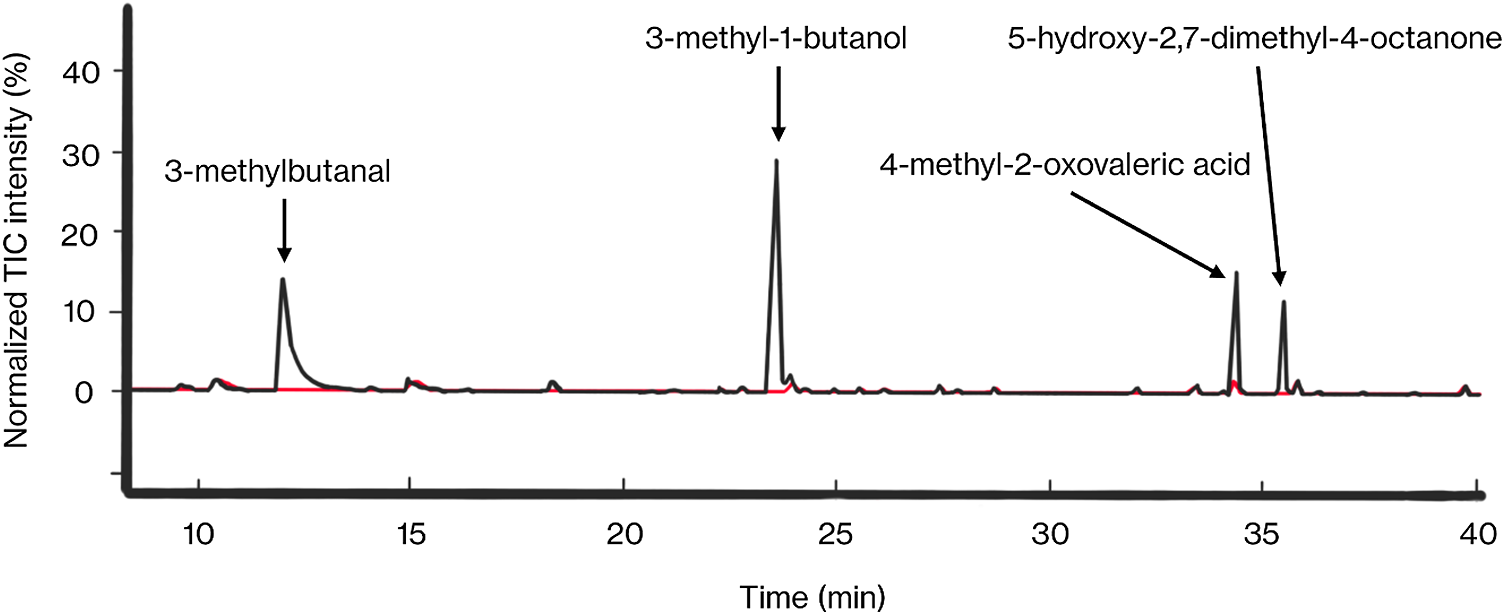
The flavour compounds in the milk fermented with strain AJ01 were identified via GC-MS, and 3-methylbutanal was detected (Fig. 1). Because this compound is known to contribute to nutty-like aroma notes, we consider that 3-methylbutanal is a likely contributor to the nutty-like aroma of fermented milk prepared with strain AJ01. Additionally, 3-methylbutanol was detected. This compound results from the breakdown of 3-methylbutanal by alcohol dehydrogenase. Furthermore, fermented milk prepared with this strain exhibited a decrease in nutty aroma over time. These findings suggest that this strain is capable of converting 3-methylbutanal into 3-methylbutanol.
Gas chromatography–mass spectrometry TIC chromatograms (scan mode) of milk fermented with Lactococcus cremoris AJ01. The y-axis shows normalized TIC intensity (%), where the maximum peak intensity in each chromatogram was set to 100%. Baseline (red): reconstituted skim milk (not fermented). Peaks were tentatively identified by deconvolution and library matching against NIST 14 (match score ≥ 70).

Effects of leucine supplementation on 3-methylbutanal production in milk
We measured the production of 3-methylbutanal, titratable acidity, and the viable cell counts in leucine-supplemented RSM, at leucine concentrations of 0, 5, 10, 50, 100, 500, 1,000, and 5,000 mg/L (Fig. 2). The production of 3-methylbutanal increased with leucine concentration, peaked at 100 mg/L, and was lower at 5,000 mg/L. At leucine concentrations of 0, 5, and 10 mg/L, 3-methylbutanal production was measured at 1.17, 1.14, and 1.52 mg/L, respectively, with no significant differences (P > 0.05). At 50 mg/L leucine, 3-methylbutanal production increased to 2.23 mg/L. At leucine concentrations of 100, 500, and 1,000 mg/L, 3-methylbutanal production was at 3.15, 2.98, and 3.15 mg/L, respectively, representing a 2.6-fold increase relative to the control. However, at a leucine concentration of 5,000 mg/L, 3-methylbutanal production was at 2.48 mg/L, significantly lower than at leucine concentrations of 100, 500, and 1,000 mg/L (P < 0.05). Leucine concentrations above 100 mg/L reduced acidity (Fig. 2). The titratable acidity at 0 h ranged from 0.11% to 0.14%, regardless of leucine concentration. However, after 18 h, the titratable acidity decreased with increasing leucine concentration, with values of 0.66, 0.61, 0.51, and 0.33% at leucine concentrations of 0, 100, 1,000, and 5,000 mg/L, respectively. Leucine concentrations of up to 100 mg/L caused milk to coagulate after 18 h, whereas concentrations of 500 and 1,000 mg/L reduced coagulation, with no coagulation observed at 5,000 mg/L. Viable cell count did not vary significantly with leucine concentration (P > 0.05) (Fig. 2). The initial viable cell count of strain AJ01 was 3.8–3.9 log cfu/g, regardless of leucine supplementation. After 18 h of fermentation, the viable cell count reached ca. 9.4 log cfu/g at all leucine concentrations, showing no significant differences (P > 0.05). Strain AJ01 produced 1.17 mg/L of 3-methylbutanal when cultured in RSM, higher than that reported by Narvhus et al. (Reference Narvhus, Østeraas, Mutukumira and Abrahamsen1998), but lower than that reported by Meng et al. (Reference Meng, Piccand, Fuchsmann, Dubois, Baumeyer, Stern and von Ah2021). Narvhus et al. (Reference Narvhus, Østeraas, Mutukumira and Abrahamsen1998) reported 0.8 mg/L of 3-methylbutanal production when L. lactis subsp. lactis biovar diacetylactis INF-DM1 was cultured in milk at 37 °C for 18 h. Meng et al. (Reference Meng, Piccand, Fuchsmann, Dubois, Baumeyer, Stern and von Ah2021) found that L. cremoris FAM-17841 produced ca. 30 μM (2.6 mg/L) of 3-methylbutanal when cultured in RSM at 30 °C. Further, consistent with our findings, Meng et al. (Reference Meng, Piccand, Fuchsmann, Dubois, Baumeyer, Stern and von Ah2021) found that adding 1 mM (131 mg/L) leucine to the RSM caused 3-methylbutanal production to triple. Here, 100 mg/L leucine supplementation resulted in 3.15 mg/L 3-methylbutanal, approximately three times the 1.17 mg/L produced in the absence of leucine. These findings indicate that the nutty aroma of fermented milk can be effectively enhanced by adding leucine to milk. Increasing leucine concentrations beyond 1,000 mg/L reduced the titratable acidity of milk fermented by strain AJ01. Initially, we hypothesized that leucine might inhibit the growth of strain AJ01 because certain amino acids, such as glycine, suppress bacterial growth. This inhibition could lower the viable cell count, thereby reducing titratable acidity. However, our results showed no reduction in viable cell count. Thus, rather than inhibiting growth, supplementing leucine at concentrations >500 mg/L enhanced its conversion to 3-methylbutanal, while suppressing the conversion of lactose to lactic acid. When leucine is abundant and amino acid metabolism is active, it may increase the cellular demand for α-ketoglutarate. In that case, pyruvate and phosphoenolpyruvate (PEP) could be diverted towards α-ketoglutarate via intermediates such as oxaloacetate and citrate, potentially lowering the available PEP pool. Consequently, lactose uptake via the PEP/phosphotransferase system might be reduced.
Production of 3-methylbutanal (mg/kg), titratable acidity (%), and viable cell count (log cfu/g) in leucine-supplemented reconstituted skim milk after fermentation with Lactococcus cremoris AJ01 for 18 h at 30 °C.

Effects of temperature on 3-methylbutanal production in milk
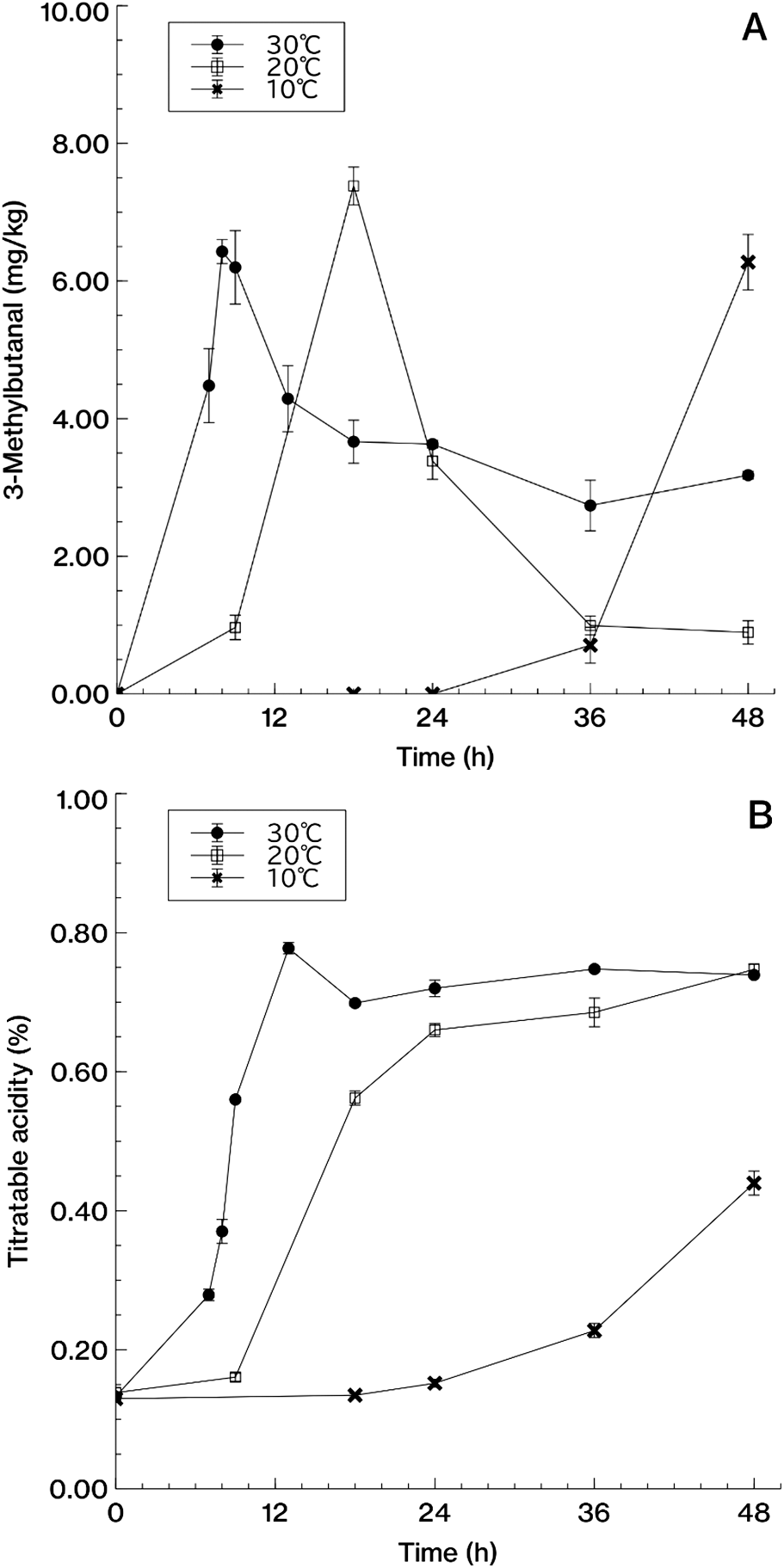
The effect of fermentation temperature on the production of 3-methylbutanal (Fig. 3A) and titratable acidity (Fig. 3B) by strain AJ01 in RSM supplemented with 100 mg/L leucine was assessed. Under culture at 20 °C for 18 h, 3-methylbutanal production peaked at 7.38 mg/L. At 10 °C, 3-methylbutanal was not detected during the first 24 h, but reached a concentration of 6.27 mg/L after 48 h. At 20 °C, it was undetectable until 13 h of fermentation, peaking at 7.38 mg/L after 18 h, then decreasing. At 30 °C, 3-methylbutanal appeared as early as 7 h, peaking at approximately 6.3 mg/L between 8 and 9 h, then declining. Titratable acidity exceeded 0.7% after 48 h at 20 °C and after 13 h at 30 °C, resulting in milk coagulation. In contrast, at 10 °C, titratable acidity remained at 0.44% even after 48 h, and no coagulation was observed. Based on these findings, 30 °C was identified as the optimal temperature for acid production by strain AJ01. At this temperature, the strain exhibited vigorous acid production and rapid coagulation. In contrast, 3-methylbutanal production by strain AJ01 was greater at 20 °C than at 30 °C. These findings suggest that the optimal temperatures for acid and 3-methylbutanal production differ for strain AJ01. Acid production increased at higher temperatures, whereas 3-MB production was greater at lower temperatures (20 °C) despite a growth optimum near 30 °C. This contrasts with prior reports for lactococci and streptococci: Narvhus et al. (Reference Narvhus, Østeraas, Mutukumira and Abrahamsen1998) observed that in L. lactis both lactic acid and 3-MB increased with temperature and peaked at 37 °C, and Wu et al. (Reference Wu, Guo, Liu, Yang, Wang and Zhang2023) found that Streptococcus thermophilus produced more 3-MB at 42 °C than at 37 °C, likely reflecting enzymes with optima above 37 °C. Taken together, these findings underscore that the temperature optimum for 3-MB production is strain dependent: unlike L. lactis, L. cremoris AJ01 favours lower temperatures for 3-MB formation.
Effect of fermentation temperature on the production of 3-methylbutanal (A) and titratable acidity (B) in 100 mg/l leucine-supplemented reconstituted skim milk fermented with Lactococcus cremoris AJ01.

Determination of PDH and KADC activity
The PDH activity of strain AJ01 was ca. 10 nmol/mg/min and was not significantly altered by supplementation with leucine (P > 0.05) (Table 2). In contrast, KADC activity was not detected even when leucine was added to the RSM (Table 2).
Enzyme activity of α-ketoacid decarboxylase (KADC) and pyruvate dehydrogenase (PDH) in the cell-free extract (CFE) from reconstituted skim milk (RSM)

a Figures in parentheses are standard deviation values (n = 9).
ND: not detected.
The presence of PDH activity and lack of KADC activity indicate that strain AJ01 synthesizes 3-methylbutanal via the indirect pathway involving α-ketoisocaproic acid. Chen et al. (2021) investigated several LAB, evaluating their KADC and PDH activity and corresponding 3-methylbutanal production; they found that LAB strains that produced higher levels of 3-methylbutanal exhibited PDH and KADC activity, while strains lacking KADC activity produced less 3-methylbutanal. Here, in contrast, strain AJ01, which lacks KADC activity and relies solely on the indirect pathway to produce 3-methylbutanal, produced large amounts of 3-methylbutanal, thus revealing that substantial 3-methylbutanal production is possible even without the direct pathway. Strain AJ01 exhibited lower PDH activity than some other LAB strains. For instance, Chen et al. (Reference Chen, Yuan, Yu, Wang, Huang, Yuan, Xu, Zhao and Tian2022) reported PDH activity of 2–12 nmol/mg/min for LAB that did not produce 3-methylbutanal. PDH converts pyruvate into acetyl-CoA and plays a significant role in various metabolic processes beyond the metabolic pathway of 3-methylbutanal. This suggests that the high production of 3-methylbutanal by strain AJ01 is not associated with PDH activity and that it produces 3-methylbutanal via the indirect pathway. Further research is required to clarify whether this ability is specific to this strain or is also found in other Lactococcus species. In this strain, several factors other than the direct pathway may contribute to 3-methylbutanal production; these include the increased activity of other enzymes involved in the indirect pathway, the presence of alternative pathways beyond the direct and indirect pathways, and the low conversion rate of 3-methylbutanal to 3-methylbutanol, which could have resulted in the accumulation of 3-methylbutanal. Adding leucine to the milk did not increase the PDH activity in strain AJ01 but did increase its 3-methylbutanal production: when 100 mg/L leucine was added, 3-methylbutanal production approximately tripled (relative to baseline). Although adding leucine might have increased PDH expression in strain AJ01, thus enhancing its production of PDH, its PDH enzyme activity did not change significantly (P > 0.05), regardless of the concentration of leucine added. Therefore, the increased 3-methylbutanal production by strain AJ01 following leucine supplementation in RSM is likely due to the increased substrate concentration, rather than heightened PDH activity. To confirm whether leucine was depleted during fermentation, we measured the residual leucine concentration after fermenting leucine-supplemented RSM with strain AJ01.
Leucine concentration in fermented leucin-supplemented RSM
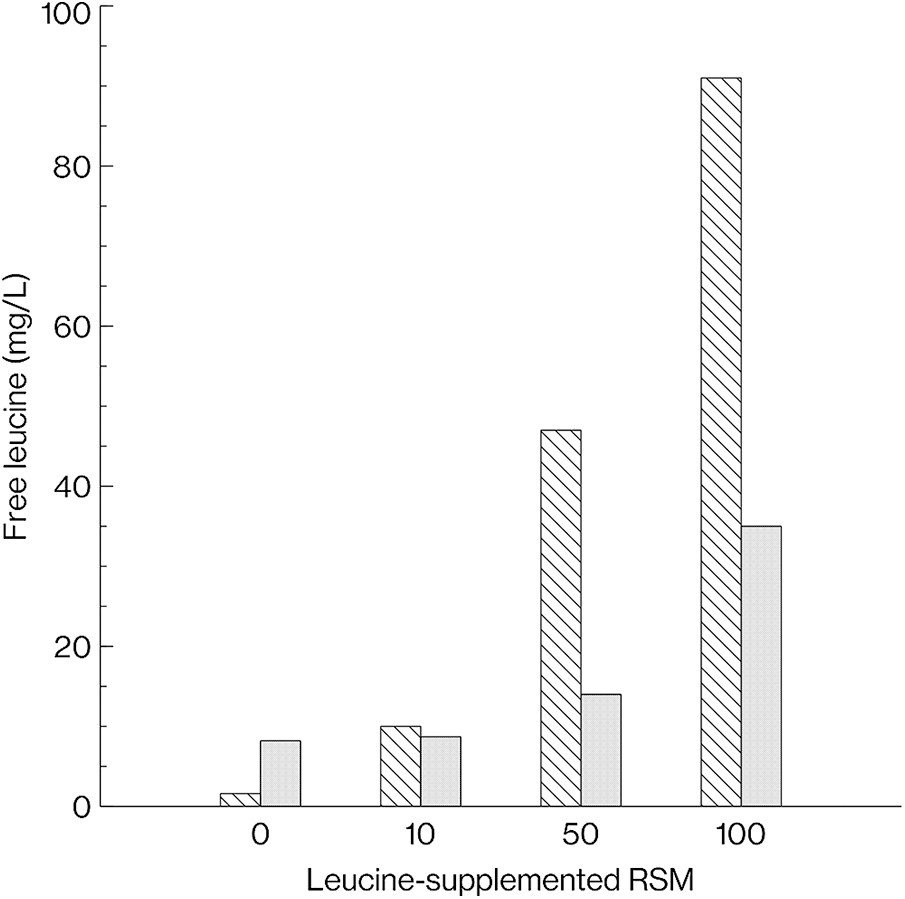
The concentration of free leucine in the leucine-supplemented RSM (0, 10, 50, and 100 mg/L) before fermentation corresponded to the supplemented amount (Fig. 4). After 18 h of fermentation at 30 °C, the free leucine concentrations were 8.2, 8.7, 14 and 35 mg/L, respectively. In this study, 3-methylbutanal increased with leucine dosing up to 100 mg/L, whereas no significant change was observed in PDH activity. Therefore, we infer that the increase in 3- methylbutanal is primarily driven by substrate availability rather than by PDH upregulation. Consistently, at 0 and 10 mg/L, residual leucine levels were nearly the same, indicating that the added 10 mg/L was nearly depleted and suggesting substrate limitation. Conversely, when leucine was supplemented at 50 mg/L or above, at least 14 mg/L free leucine remained after 18 h, indicating sufficient substrate availability. Taken together, these findings suggest that under our experimental conditions, leucine dosage substantially contributes to the increase in 3-methylbutanal. However, not all enzymes in the indirect pathway were assayed (e.g., branched-chain amino acid transaminase, the α-ketoisocaproate-to-aldehyde step, and aldehyde dehydrogenase); therefore, factors other than PDH may also be involved. Hence, relying solely on PDH activity when screening for high-yield strains may lead to overlooking potential candidates.
Residual free leucine in leucine-supplemented RSM after fermentation (18 h, 30 °C). RSM was supplemented with leucine at 0, 10, 50, and 100 mg/L. Hatched bars indicate measurements before fermentation; grey bars indicate measurements after fermentation.

Genomic DNA extraction and detection of KADC and PDH genes using PCR
Based on PCR analysis, strain AJ01 possesses a PDH complex gene (total length, ca. 4,000 bp) and lacked the KADC gene. The nucleotide sequence of this PDH complex gene was determined via primer-walking, and the obtained sequences were deposited with GenBank (Supplemental Data 2, pdhA: LC859859; pdhB: LC859245; pdhC: LC859246; pdhD: LC859860). This sequence was used as a query to search for homologous sequences using BLAST. This revealed >99% sequence similarity between the PDH sequence of strain AJ01 and that of Lactococcus cremoris and 89% similarity with that of Lactococcus cremoris. Then, the nucleotide sequences were translated, and BLAST homology searches were performed for E1–α, E1–β, E2 and E3 (Supplemental Data 3). Strain AJ01 showed 100% amino acid identity to L. cremoris for E1–α, E2, and E3, and 99.69% identity for E1–β, indicating that strain AJ01 PDH complex is highly conserved. These data suggest that the high 3–methylbutanal production by strain AJ01 is unlikely to be driven by PDH. Accordingly, although it has been believed that measuring PDH activity is of importance, PDH activity, while necessary for the indirect pathway, would not be sufficient alone to explain strain-specific differences in 3-methylbutanal production. Other factors (e.g., branched–chain amino acid supply, competing pathways, or regulatory mechanisms) likely determine the 3-methylbutanal production.
A nutty aroma, which is common in aged cheeses, is often due to 3-methylbutanal. Based on our findings, L. cremoris AJ01 appeared to produce considerable amounts of 3-methylbutanal from milk. When 100 mg/L of leucine was added to the milk, 3-methylbutanal production tripled, and its production was highest at the relatively low temperature of 20 °C. Although LAB can produce 3-methylbutanal via both direct and indirect pathways, our findings to date suggest that strain AJ01 may rely predominantly on the indirect pathway. However, the activity of PDH, which is involved in the indirect pathway, did not differ from that of LAB strains that do not produce 3-methylbutanal. This suggests that a high PDH activity did not lead to an increase in the production of 3-methylbutanal. The mechanisms underlying the substantial production of 3-methylbutanal by strain AJ01 remain to be clarified. Future work should include whole-genome sequencing to assess pathway gene content, together with transcriptome analyses (e.g., RNA-seq) to quantify expression of leucine catabolism. Comparative studies with other known 3-methylbutanal-producing strains will also be informative. This study employed a single strain to evaluate specific metabolic pathways and compound production. Generally, starters consist of multiple strains, which necessitates the investigation of strain combinations in future research. These findings provide foundational data for designing mixed starters with nutty flavour profiles, enhancing our understanding of flavour formation during dairy fermentation, and supporting improved flavour management techniques in dairy products.
Supplementary material
The supplementary material for this article can be found at https://doi.org/10.1017/S0022029925101957.
Competing interests
The authors declare none.