





1 Introduction
A simplicial complex is flag if every set of vertices pairwise connected by edges spans a simplex. For
$k\geq 5$
 , a simplicial complex is k-large if it is flag and has no induced cycles of length
$4\leq n<k$
 . A simplicial complex is locally k-large if each of its vertex links is k-large. This notion was introduced by Januszkiewicz and Świątkowski [Reference Januszkiewicz and Świątkowski8], and independently by Haglund [Reference Haglund5], as a simplicial analogue of a locally
$\mathrm {CAT}(0)$
 (i.e. nonpositively curved) cube complex. They showed that such complexes are abundant in any dimension, and come with interesting automorphism groups. A cornerstone feature is that for
$k\geq 6$
 they are aspherical. The
$1$
 -skeleta of simply connected locally
$6$
 -large simplicial complexes were studied earlier in graph theory under the name of bridged graphs; see [Reference Bandelt and Chepoi1] for a survey.
The boundary of the icosahedron is locally
$5$
 -large, so in order to obtain asphericity under this weaker condition, Osajda introduced an extra hypothesis of m-location [Reference Osajda12] (we will give the definition in a moment).
$7$
 -located locally
$5$
 -large simplicial complexes include many
$3$
 -manifolds, as well as all locally weakly systolic complexes [Reference Hoda and Lazăr6], which were studied earlier in [Reference Chepoi and Osajda4,Reference Osajda11]. The properties of m-located complexes were investigated in [Reference Hoda and Lazăr6,Reference Osajda12]. A related condition was introduced in [Reference Lazăr9].
Maybe the most prominent example of a
$7$
 -located locally
$5$
 -large simplicial complex is the triangulation of the hyperbolic space
$\mathbf {H}^4$
 where each of the vertex links is isomorphic to the boundary of the
$600$
 -cell. The symmetry group of that triangulation is the Coxeter group with Coxeter–Dynkin diagram the linear graph of length
$4$
 with consecutive labels
$5333$
 . We are interested in this triangulation since the associated Artin group is one of the smallest Artin groups for which the
$K(\pi ,1)$
 conjecture, asking for the contractibility of the associated Artin complex, is still open.
In this paper, we prove the following related result.
Main Theorem. Every
$7$
 -located locally
$5$
 -large simplicial complex is aspherical.
2 Location
Let X be a flag simplicial complex. Note that we do not assume X to be locally finite or finite-dimensional.
Definition 2.1. A k-wheel W in X is an induced subcomplex isomorphic to the cone over the k-cycle. We write
$W = (v_0, v_1v_2\cdots v_k)$
 , where the centre
$v_0$
 is the cone vertex and
$v_1,\ldots ,v_k$
 are the consecutive vertices of the boundary cycle.
A pair
$W=(W_1,W_2)$
 of wheels, with
$W_1=(v_0, v_1\cdots v_k),W_2=(w_0, w_1\cdots w_\ell )$
 , is a
$(k,\ell )$
 -dwheel if
-
• $v_k = w_0$
 ,
-
• $w_\ell = v_0$
, -
• $v_{k-1} = w_{\ell - 1}$
, and -
• $v_1$
either equals
$w_1$
or is a neighbour of
$w_1$
.





The boundary
$\partial W$
 of the dwheel W is the cycle
$v_1\cdots v_{k-1}w_{\ell - 2} \cdots w_1$
 . (If
$v_1 = w_1$
 , then we discard the redundant
$w_1$
 .) If
$v_1 = w_1$
 , then we say that W is planar.
Definition 2.2. Let
$m\geq 4$
 . X is m-located if for every dwheel
$W=(W_1,W_2)$
 with
$|\partial W|\leq m$
 , all the vertices of
$W_1\cup W_2$
 have a common neighbour in X.
Here vertices
$v\neq w$
 are neighbours (or neighbouring) in X if they span an edge of X.
Example 2.3. Let X be the simplicial complex that is the triangulation of the hyperbolic space
$\mathbf {H}^4$
 into hyperbolic simplices with all dihedral angles
$\frac {2\pi }{5}$
 . Each of the vertex links of X is isomorphic to the boundary
$\mathbf {S}^3_{600}$
 of the
$600$
 -cell, which is
$5$
 -large. Note that the vertex links of
$\mathbf {S}^3_{600}$
 are isomorphic to the boundary
$\mathbf {S}^2_{20}$
 of the icosahedron. Since each induced
$5$
 -cycle in
$\mathbf {S}^3_{600}$
 and
$\mathbf {S}^2_{20}$
 is the boundary of a
$5$
 -wheel, each
$5$
 -wheel in X can be extended to the join of the
$5$
 -cycle and a triangle
$\Delta $
 . Furthermore, each induced
$6$
 -cycle in
$\mathbf {S}^3_{600}$
 is the boundary of a
$6$
 -wheel, and so each
$6$
 -wheel in X can be extended to the join of the
$6$
 -cycle and an edge e. Hence X does not contain a planar
$(5,6)$
 -dwheel
$(W_1,W_2)$
 with
$W_1\cup W_2$
 without a common neighbour, since otherwise appropriate
$\Delta $
 and e are disjoint and so
$\Delta ,e$
 and
$v_1=w_1$
 span a simplex of dimension
$5$
 in X, which is a contradiction. The
$(5,5)$
 -dwheels are excluded similarly, which implies that X is
$7$
 -located.
2.1 Disc diagrams
A disc diagram in X is a simplicial map
$f\colon D\to X$
 from a simplicial disc D that is nondegenerate, i.e. does not send any edge to a vertex. The boundary (cycle) of f is the closed path
$f_{|\partial D}$
 , which we identify with its image
$f(\partial D)$
 whenever it is embedded. A disc diagram
$f\colon D\to X$
 is minimal if it has minimal area (i.e. the number of triangles in D) among all the disc diagrams in X with the same boundary cycle. We say that f is reduced if it is locally injective at
$D\setminus D^{0}$
 . The following is a well-known variation of a result by Van Kampen.
Lemma 2.4 [Reference McCammond and Wise10, Lem 2.16 and 2.17].
Any homotopically trivial cycle embedded in
$X^1$
 is the boundary cycle of a disc diagram in X. Any minimal disc diagram in X is reduced.
Lemma 2.5 [Reference Hoda and Lazăr6, Thm B].
If X is
$7$
 -located and locally
$5$
 -large, then so is D for each minimal disc diagram
$D\to X$
 . In other words, D has no
-
• interior vertices of valence $3$
or
$4$
, or -
• neighbouring interior vertices with valences $5$
and
$5$
or
$6$
.


Corollary 2.6. Each D as in Lemma 2.5
-
(i) is $5$
-large, and -
(ii) each of its induced $5$
-cycles is the boundary of a
$5$
-wheel.


Proof. Let
$D'\subseteq D$
 be a simplicial disc with boundary
$\omega $
 a
$4$
 -cycle or a
$5$
 -cycle. Following the proof of [Reference Hoda and Lazăr6, Cor 4.7], we metrise each
$5$
 -wheel of
$D'$
 as the regular Euclidean pentagon P of side length
$1$
 , and each remaining triangle of
$D'$
 as the regular Euclidean triangle of side length
$1$
 . Consequently, all triangles have area
$\geq \frac {1}{5}\mathrm {Area}(P)>0.34$
 (which is larger than in [Reference Hoda and Lazăr6, Cor 4.7], where
$4$
 -wheels were allowed). Since
$D'$
 is
$\mathrm {CAT}(0)$
 [Reference Hoda and Lazăr6, Thm 4.6], by [Reference Bridson and Haefliger3, III.2.17], the area of
$D'$
 is
$\leq \frac {|\omega |^2}{4\pi }$
 . Consequently, the number of triangles of
$D'$
 is
$\leq \Big \lfloor \frac {|\omega |^2}{1.36\pi }\Big \rfloor $
 , which equals
$3$
 for
$|\omega |=4$
 , and equals
$5$
 for
$|\omega |=5$
 . Thus
$\omega $
 is not induced or it is the boundary of a
$5$
 -wheel, as desired.


3 Lunar diagrams
We metrise the
$1$
 -skeleton of each simplicial complex with the path metric, where all the edges have length
$1$
 .
Definition 3.1. Let D be a simplicial disc and let
$x,v$
 be vertices of
$\partial D$
 . We say that D is lunar (between x and v) if the two distinct injective paths
$\gamma _1$
 and
$\gamma _2$
 in
$\partial D$
 from x to v are geodesics in
$D^1$
 .
More generally, let X be a simplicial complex and let x and v be distinct vertices of X. Suppose that
$\gamma _1$
 and
$\gamma _2$
 are geodesics from x to v in
$X^1$
 that are disjoint except at the endpoints. A minimal disc diagram
$D\to X$
 with boundary
$\gamma _1 \cup \gamma _2$
 is a lunar disc diagram (between x and v). Note that if
$D\to X$
 is a lunar disc diagram, then D is a lunar simplicial disc.
Let D be a lunar simplicial disc. Then for a vertex u of
$\partial D$
 , an interior vertex of D of valence
$5$
 is u-exposed if it is a neighbour of both neighbours of u in
$\partial D$
 .
Let D be a lunar simplicial disc between x and v that is
$7$
 -located and locally
$5$
 -large. By Corollary 2.6(i), if z is u-exposed, and the neighbours of u in
$\partial D$
 are denoted
$u_1,u_2$
 , then the cycle
$u_1uu_2z$
 has a diagonal. (Note that if
$u\neq x,v$
 , then z is a neighbour of u.) Consequently, for each u there is at most one u-exposed vertex.
Proposition 3.2. Let D be a lunar simplicial disc between x and v and let
$v_1,v_2$
 be the neighbours of v in
$\partial D$
 . If D is
$7$
 -located and locally
$5$
 -large, then
-
(i) either $v_1$
and
$v_2$
are neighbours and have a common neighbour closer to x than
$v_1,v_2$
, or -
(ii) $v_1$
and
$v_2$
are not neighbours, and there is a v-exposed neighbour
$v'$
of
$v_1,v,v_2$
, whose remaining neighbours
$v_1',v_2'$
are closer to x than
$v_1,v_2$
.


In the proof, we need the following. We are using the path metric d on
$D^{1}$
 , the path metric
$d'$
 on
$D^{\prime 1}$
 and the path metric
$d"$
 on
$D^{\prime \prime 1}$
 .
Lemma 3.3. Let D be a lunar simplicial disc between x and v and let
$v_1,v_2$
 be the neighbours of v in
$\partial D$
 . If D is
$7$
 -located and locally
$5$
 -large, then there is a lunar simplicial disc
$D'\subseteq D$
 between z and v such that
-
(1) the path $v_1vv_2$
lies in
$\partial D'$
, -
(2) the function $d(\cdot ,x)-d'(\cdot ,z)$
is constant on all the vertices of
$D'$
at
$d'$
-distance
$\leq 2$
from v, -
(3) each vertex on $\partial D'$
has valence at least
$4$
, except possibly for z, v,
$v_1$
or
$v_2$
, -
(4) each interior vertex of $D'$
of valence
$5$
that is a neighbour of
$\geq 3$
vertices of
$\partial D'$
is u-exposed in
$D'$
with
$u\in \{z,v,v_1,v_2\}$
.






Remark 3.4. By (1) and (2), if
$D'$
 satisfies Proposition 3.2(i) or (ii), then so does D.
In the proof of Lemma 3.3, we will use the following.
Lemma 3.5. Let
$D'\subseteq D$
 be connected simplicial complexes with vertices
$z'\in D',z\in D$
 . Let
$I\subset D'$
 be a subcomplex, and let C be a connected component of
$D'\setminus I$
 that is equal to a connected component of
$D\setminus I$
 , with
$z,z'\notin C$
 . If the function
$d(\cdot ,z)-d'(\cdot ,z')$
 is constant on all the vertices of I, then it is constant on all the vertices of
$I\cup C$
 .
Proof. Denote the constant value of
$d(\cdot ,z)-d'(\cdot ,z')$
 on the vertices of I by K. Let
$\overline C$
 be the closure of C in D, and let
$d_C$
 denote the path metric on the
$1$
 -skeleton of
$\overline C$
 . For each vertex w of C, each path in
$D^1$
 from w to z decomposes into a (nontrivial) path in
$\overline C^1$
 from w to some
$i\in I$
 and a (possibly trivial) path in
$D^1$
 from i to z. Thus we have

Analogously,

Since the last terms always differ by K, we have
$d(w,z)=d'(w,z')+K$
 , as desired.
Lemma 3.6. Let D be a lunar simplicial disc between z and v, and let
$D'\subseteq D$
 be a simplicial disc with
$\partial D'$
 a concatenation of paths
$\gamma _1',\gamma _2'$
 from
$z'$
 to v. Suppose that for
$j=1,2$
 there is a vertex
$u_j$
 on
$\gamma ^{\prime }_j$
 with
$d(u_j,z)-d'(u_j,z')=d(v,z)-d'(v,z')$
 and such that
$\gamma _j'$
 is a concatenation
$\alpha _j\beta _j$
 of the subpath
$\alpha _j=vu_j$
 of the geodesic
$\gamma _j$
 , and a geodesic
$\beta _j$
 of
$D^{\prime 1}$
 . Then each
$\gamma ^{\prime }_j$
 is a geodesic in
$D'$
 and so
$D'$
 is a lunar simplicial disc between
$z'$
 and v.
Proof. By the hypothesis, for each j we have

and so
$\alpha _j\beta _j$
 is a geodesic, as desired.
Proof of Lemma 3.3.
Let
$D'\subseteq D$
 be a lunar simplicial disc of minimal area between z and v satisfying (1) and (2), among all the vertices z of D. We denote by
$\gamma _1', \gamma _2'$
 the geodesics in
$\partial D'$
 from z to v.
To verify (3), suppose without loss of generality that
$z_0\in \gamma ^{\prime }_1\setminus \{z,v,v_1\}$
 has valence
$\leq 3$
 , which then equals
$3$
 , since
$\gamma _1'$
 is a geodesic in
$D^{\prime 1}$
 . Let
$z_1,z_2,z_3$
 be the consecutive neighbours of
$z_0$
 in
$D'$
 , where
$z_1$
 separates
$z_0$
 from v on
$\gamma _1'$
 . If
$z_2\notin \gamma _2'$
 , then let
$D"$
 be the lunar simplicial disc between z and v obtained from
$D'$
 by removing the open star of
$z_0$
 , which is the union of
$z_0$
 and all the simplices of
$D'$
 containing
$z_0$
 in their closure. Then
$D"$
 still satisfies (1) and (2), which contradicts the minimality hypothesis. If
$z_2\in \gamma _2'$
 , then let
$D"$
 be the simplicial disc that is the closure of the connected component of v in
$D'\setminus z_1z_2$
 . Observe that
$d'(z,z_1)=d'(z,z_2)+1$
 , and so by Lemma 3.6 applied to
$D"\subset D'$
 with
$z'=u_2=z_2,u_1=z_1$
 , we have that
$D"$
 is a lunar simplicial disc between
$z_2$
 and v. Applying Lemma 3.5 to
$D"\subset D', I=z_1z_2$
 and
$C=D"\setminus I$
 , we obtain that
$d'(\cdot ,z)-d"(\cdot ,z')$
 is constant on the vertices of
$D"$
 . Thus
$d(\cdot ,x)-d"(\cdot ,z')=\big (d(\cdot ,x)-d'(\cdot ,z)\big )+\big (d'(\cdot ,z)-d"(\cdot ,z')\big )$
 is constant on the vertices of
$D"$
 at
$d"$
 -distance
$\leq 2$
 from v. Hence
$D"$
 still satisfies (1) and (2), which contradicts the minimality hypothesis.
To verify (4), let
$z_0$
 be an interior vertex of
$D'$
 of valence
$5$
 that is a neighbour of
$m\geq 3$
 vertices of
$\partial D'$
 .
If
$m=5$
 , then by (3),
$z_0$
 is v-exposed in
$D'$
 . The same holds for
$m=4$
 , unless
$z_0$
 has exactly two neighbours on each
$\gamma _i'$
 , which are distinct from
$z,v$
 , and consecutive by Corollary 2.6(i). We will discuss this possibility below, together with the case
$m=3$
 . Namely, if
$m=3$
 , then
$z_0$
 is u-exposed in
$D'$
 with
$u\in \{z,v,v_1,v_2\}$
 , unless it has, say, two consecutive neighbours
$z_1,z_2$
 on
$\gamma _1'$
 and a neighbour
$z_3$
 on
$\gamma _2'$
 , all of which are distinct from
$z,v$
 . We can assume
$d'(z_1,z) = d'(z_2,z)+1$
 .
In each of the cases below, we will prove that
$z_0$
 is u-exposed in
$D'$
 , with
$u\in \{z,v,v_1,v_2\}$
 , or we will reach a contradiction by finding a properly contained lunar simplicial disc
$D"\subsetneq D'$
 between a vertex
$z'$
 of
$D'$
 and v satisfying (1) and (2) and hence contradicting the minimality hypothesis. In fact, property (1) will always follow directly from the construction, so we will not be mentioning it. The simplicial disc
$D"$
 will always be a lunar simplicial disc between
$z'$
 and v by Lemma 3.6 applied to
$D"\subsetneq D'$
 and
$u_j\in I\cap \gamma ^{\prime }_j$
 , as before. The path
$\beta _j=u_jz'\subset \partial D"$
 will always have length
$0,1$
 or
$2$
 and it will be clear that it is a geodesic, as desired. Thus we will only be focusing on justifying (2) in each case. We will be applying Lemma 3.5 with C the connected component of
$D"\setminus I$
 containing v.
Consider the top and bottom connected components of
$D'$
 minus the path
$z_1z_0z_3$
 containing v and z, respectively. Each of the two neighbours of
$z_0$
 distinct from
$z_1,z_2,z_3$
 is top (resp. bottom) if it lies in the top (resp. bottom) component.
If
$z_0$
 has no top neighbours, and
$d'(z_1,z)\neq d'(z_3,z)$
 , then let
$D"$
 be the lunar simplicial disc between
$z'=z_1$
 or
$z_3$
 and v that is the closure of the connected component C of v in
$D'\setminus z_1z_3$
 . Applying Lemma 3.5 to
$D"\subsetneq D'$
 and
$I=z_1z_3$
 contradicts the minimality hypothesis. If
$z_0$
 has no top neighbours, and
$d'(z_1,z)= d'(z_3,z)$
 , then let
$D"$
 be the lunar simplicial disc between
$z'=z_0$
 and v that is the closure of the connected component of v in
$D'$
 minus the path
$z_1z_0z_3$
 . Applying Lemma 3.5 to
$D"\subsetneq D'$
 and
$I=z_1z_3$
 , we have that
$d'(\cdot ,z)-d"(\cdot ,z')$
 is constant on all the vertices of
$D"$
 except possibly for
$z_0$
 . However, if
$z_0$
 is not v-exposed in
$D'$
 , then
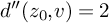
$d"(v,z_0)>2$
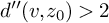 , and so
$D"$
 still satisfies (2).
If
$z_0$
 has no bottom neighbours, and
$d'(z_2,z)\neq d'(z_3,z)$
 , then let
$D"$
 be the lunar simplicial disc between
$z'=z_2$
 or
$z_3$
 and v that is the closure of the connected component of v in
$D'\setminus z_2z_3$
 . Applying Lemma 3.5 to
$D"\subsetneq D'$
 and
$I=z_2z_3$
 contradicts the minimality hypothesis. If
$z_0$
 has no bottom neighbours, and
$d'(z_2,z)= d'(z_3,z)$
 , then let
$z'$
 be the common neighbour of
$z_2,z_3$
 distinct from
$z_0$
 . Let
$D"$
 be the lunar simplicial disc between
$z'$
 and v that is the closure of the connected component of v in
$D'$
 minus the path
$z_2z'z_3$
 . Applying Lemma 3.5 to
$D"\subset D'$
 and
$I=z_2z_3$
 , we again obtain that
$D"$
 satisfies (2). Note that
$D"\neq D'$
 , unless
$z_0$
 is z-exposed in
$D'$
 .
Thus from now on we can assume that
$z_0$
 has exactly one top neighbour
$z_t$
 and one bottom neighbour
$z_b$
 (one of which might lie in
$\partial D'$
 if
$m=4$
 ). Let
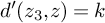
$k=d'(z_0, z)$
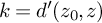 . By the triangle inequality, we have
$d'(z_1,z)=k+1$
 or k, and
$d'(z_3,z)=k+1,k$
 or
$k-1$
 .
-
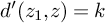
Case 1: $\hspace{16pt} d'(z_1,z) = k+1$
. -
(a) $d'(z_3,z) = k+1$
. Let
$D"$
be the lunar simplicial disc between
$z'=z_0$
and v that is the closure of the connected component of v in
$D'$
minus the path
$I=z_1z_0z_3$
. We can then apply Lemma 3.5 to
$D"\subsetneq D'$
and I as above. -
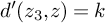
(b) $d'(z_3,z) = k$
. Then
$d'(z_b,z) = k-1$
. We take
$z'=z_b$
and
$D"$
to be the closure of the connected component of v in
$D'$
minus the path
$I=z_2z_bz_3$
. By Lemma 3.5, the function
$d'(\cdot ,z)-d"(\cdot ,z')$
is again constant on all the vertices of
$D"$
. Note that
$D"\neq D'$
, unless
$z_0$
is z-exposed in
$D'$
. -
(c) $d'(z_3,z) = k-1$
. We take
$z' = z_3$
and
$D"$
to be the closure of the connected component of v in
$D'$
minus the path
$I=z_1z_0z_3$
. -
Case 2: $\hspace{16pt} d'(z_1,z) = k$
. -
(a) $d'(z_3,z) = k+1$
. We take
$z' = z_2$
and
$D"$
to be the closure of the connected component of v in
$D'$
minus the path
$I=z_2z_0z_3$
. -
(b) $d'(z_3,z) = k$
. Let
$z'$
be the common neighbour of
$z_2$
and
$z_b$
distinct from
$z_0$
. Let
$D"$
be the lunar simplicial disc between
$z'$
and v that is the closure of the connected component of v in
$D'$
minus the path
$z_2z'z_bz_3$
. Let
$I\subset D"$
be the path
$z_2z_0z_3$
. Note that
$d'(\cdot ,z)-d"(\cdot ,z')\equiv k-2$
on I. By Lemma 3.5, the function
$d'(\cdot ,z)-d"(\cdot ,z')$
is constant on all the vertices of
$D"$
except possibly at
$z'$
and
$z_b$
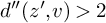
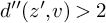
. Note that
$d"(z',v)>2$
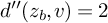
. If
$d"(z_b,v)=2$
, then
$d'(z,v)=k+1$
and so v is a common neighbour of
$z_1$
and
$z_3$
. Thus
$z_0$
is v-exposed in
$D'$
. Note that
$D"\neq D'$
, unless
$z_0$
is z-exposed in
$D'$
. -
(c) $d'(z_3,z) = k-1$
. We take
$z'=z_b$
and
$D"$
to be the closure of the connected component of v in
$D'$
minus the path
$z_2z_bz_3$
. Let I be the path
$z_2z_1z_tz_3$
. Note that
$d'(\cdot ,z)-d"(\cdot ,z')\equiv k-2$
on I. By Lemma 3.5, the function
$d'(\cdot ,z)-d"(\cdot ,z')$
is constant on all the vertices of
$D"$
except possibly at
$z'$
and
$z_0$
. Note that
$d"(z',v)>2$
. If
$d"(z_0,v)=2$
, then
$d'(z,v)=k+1$
and so v is a neighbour of
$z_1$
and connected by the path
$vv_2z_3$
of length
$2$
with
$z_3$
. By Corollary 2.6(ii) applied to the
$5$
-cycle
$z_0z_1vv_2z_3$
, we have that either
$z_t=v_2$
, and so
$z_0$
is v-exposed, or this
$5$
-cycle is the boundary of a
$5$
-wheel with centre
$z_t$
, and so both
$z_t,z_0$
have valence
$5$
, which is a contradiction. Again
$D"\neq D'$
, unless
$z_0$
is z-exposed in
$D'$
.



































Proof of Proposition 3.2.
By Remark 3.4 and Lemma 3.3, we can assume that
$D=D'$
 and that it satisfies Lemma 3.3(3,4). For any interior vertex w of
$D'$
 , let
$\kappa (w)=6$
 minus the valence of w. For w in
$\partial D'$
 , let
$\kappa (w)=4$
 minus the valence of w. By the combinatorial Gauss–Bonnet theorem (see e.g. [Reference McCammond and Wise10, Thm 4.6]), the sum of all
$\kappa (w)$
 equals
$6$
 . For each interior vertex w of valence
$5$
 , let
$\kappa '(w)=\kappa (w)-\frac {N(w)}{3}$
 , where
$N(w)$
 is the number of the interior neighbours of w (all of which have valence
$\geq 7$
 by Lemma 2.5). For each interior vertex w of valence
$\geq 7$
 , let
$\kappa '(w)=\kappa (w)+\frac {N_5(w)}{3}$
 , where
$N_5(w)$
 is the number of the interior neighbours of w of valence
$5$
 . We let
$\kappa '(w)=\kappa (w)$
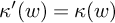 for the remaining w. Note that the sum of
$N(w)$
 over interior w of valence
$5$
 is equal to the sum of
$N_5(w)$
 over interior w of valence
$\geq 7$
 , since in each of these sums we count the number of pairs of interior neighbours of valence
$5$
 and
$\geq 7$
 . Thus the sum of all
$\kappa '(w)$
 equals
$6$
 as well.
Claim 1.
$\kappa '$
 is nonpositive except possibly at
-
• $x,v$
, where it is
$\leq 2$
, -
• $v_i$
, where it is
$\leq 1$
, -
• u-exposed vertices, for $u\in \{x,v,v_1,v_2\}$
, where it is
$\leq 1$
. It is
$<1$
if the u-exposed vertex has at least one interior neighbour.





Indeed, if an interior vertex w of valence
$5$
 is not u-exposed for
$u\in \{x,v,v_1,v_2\}$
 , then by (4), we have
$N\geq 3$
 , and so
$\kappa '(w)=\kappa (w)-\frac {N}{3}\leq 1-1$
 . On the other hand, if an interior vertex w has valence
$7$
 , then by Lemma 2.5, we have
$N_5\leq 3$
 and so
$\kappa '(w)=\kappa (w)+\frac {N_5}{3}\leq -1+1$
 , and if it has valence
$k\geq 8$
 , then
$N_5\leq \frac {k}{2}$
 and so
$\kappa '(w)=\kappa (w)+\frac {N_5}{3}\leq 6-k+\frac {k}{6}=6-\frac {5k}{6}<0$
 . This justifies the Claim.
If there is a v-exposed vertex, then we call it
$v'$
 . If such a vertex does not exist, but there are
$v_j$
 -exposed vertices, then we call them
$v_j'$
 . Note that if
$v'$
 exists, then we do not define
$v_j'$
 , because if a
$v_j$
 -exposed vertex exists, then it equals
$v'$
 . If there is an x-exposed vertex, then we call it
$x'$
 . By the Claim, the sum of
$\kappa '$
 over all the vertices except at
$v,v',v_j,v_j'$
 is at most
$3$
 . Consequently, the sum of
$\kappa '$
 at
$v,v',v_j,v_j'$
 is at least
$3$
 .
To verify (i) or (ii), it suffices to check that
-
(i) $\kappa '(v)=2$
and
$\kappa (v_j)=1$
for some j, or -
(ii) $v'$
exists and
$\kappa '(v)=\kappa '(v_1)=\kappa '(v_2)=1$
.



We will justify that the only remaining possibilities, up to a symmetry, are:
-
(a) $\kappa '(x)=\kappa '(v)=2,\kappa '(x')=\kappa '(v')=1, \kappa '(v_1)=\kappa '(v_2)=0$
, -
(b) $\kappa '(x)=2, \kappa '(v)=\kappa '(v_1)=\kappa '(x')=\kappa '(v')=1, \kappa '(v_2)=0$
, -
(c) $\kappa '(x)=2, \kappa '(v)=\kappa '(v_1)=\kappa '(v_2)=\kappa '(x')=1$
, and there are no
$v',v_j'$
, -
(d) $\kappa '(x)=2,\kappa '(v_1)=\kappa '(v_2)=\kappa '(v^{\prime }_1)=\kappa '(x')=1,\kappa '(v)=0$
, and there are no
$v',v_2'$
, -
(e) $\kappa '(x)=2, \kappa '(v_1)=\kappa '(v_2)=\kappa '(v^{\prime }_1)=\kappa '(v^{\prime }_2)=\kappa '(x')=1, \kappa '(v)=-1$
.







Indeed, consider first the case where
$v'$
 exists. If
$\kappa '(v)=2$
 , then
$\kappa '(v_1),\kappa '(v_2)$
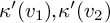 are nonpositive. This brings us to case (a). If
$\kappa '(v)=1$
 , then we have (ii), or, say, we have
$\kappa '(v_2)\leq 0$
 . This brings us to case (b).
Second, suppose that there is no
$v'$
 . Note that if one of the
$v^{\prime }_j$
 exists, then
$\kappa '(v)\leq 0$
 . If both
$v^{\prime }_j$
 exist, then they are not neighbours by Lemma 2.5, and so
$\kappa '(v)\leq -1$
 . This brings us to (i) or cases (c–e).
However, in all cases (a–e), by (3), the vertex
$x'$
 has at least one interior neighbour, which contradicts
$\kappa '(x')=1$
 .
4 Contractibility
Here, as before, we do not assume our simplicial complexes to be locally finite or finite-dimensional.
Lemma 4.1. Suppose that K is a nonempty flag simplicial complex
-
(1) of diameter $\leq 2$
, -
(2) $5$
-large, and -
(3) such that any induced $5$
-cycle is the boundary of a
$5$
-wheel of K.


Then K is contractible.
In the proof, we will use the following.
Lemma 4.2 [Reference Huang and Przytycki7, Lem 8.11].
Let K be as in Lemma 4.1. Then for any pair of simplices of K with vertex sets
$A_1,A_2$
 , there is a vertex a of K that is a neighbour of or equal to each of the elements of
$A_1\cup A_2$
 .
Consequently, both
$A_1\cup \{a\}$
 and
$A_2\cup \{a\}$
 span a simplex.
Proof of Lemma 4.1.
By the Whitehead theorem, it suffices to show that any finite subcomplex
$K'$
 of K is contained in a contractible subcomplex
$K"$
 of K. We consider all the subsets
$V_0,\ldots , V_n$
 of the vertex set of
$K'$
 that span a simplex of K. Let
$M_0$
 be the simplex spanned by
$V_0$
 . Using Lemma 4.2, we inductively construct simplices
$M_1,\ldots , M_n$
 so that
$M_i\supseteq M_{i-1}$
 and
$M_i$
 contains a vertex
$a_i$
 such that
$V_i\cup \{a_i\}$
 spans a simplex. Let
$K"$
 be the span of the union of
$K'$
 and
$M_n$
 . Note that
$K"$
 is flag and each maximal simplex of
$K"$
 intersects
$M_n$
 . Then
$K"$
 is contractible (which follows essentially from gradually collapsing
$K"$
 to
$M_n$
 ; see e.g. [Reference Huang and Przytycki7, Lem 8.13]).
A subcomplex C of a simplicial complex K is 3-convex if it is a connected induced subcomplex of K and for every path
$abc$
 with vertices
$a,c$
 in C at distance
$2$
 in the
$1$
 -skeleton
$K^1$
 , we have that b also belongs to C.
Remark 4.3. Let K be as in Lemma 4.1. If C is a
$3$
 -convex subcomplex of K, then K also satisfies the hypotheses of Lemma 4.1.
4.1 Downward links
In the entire subsection, we assume that X is a simply connected,
$7$
 -located (in particular, flag) and locally
$5$
 -large simplicial complex.
We fix a basepoint vertex x of X. The ball
$B_n(x)$
 (resp. the sphere
$S_n(x)$
 ) is the subcomplex of X spanned by all the vertices at distance
$\leq n$
 (resp.
$=n$
 ) from x in
$X^1$
 . Let
$n> 0$
 and let
$\sigma $
 be a simplex contained in
$S_n(x)$
 . The link of
$\sigma $
 is the intersection of the links of all the vertices of
$\sigma $
 , treated as subcomplexes of X. The intersection
$K(\sigma )$
 of the link of
$\sigma $
 with
$S_{n-1}(x)$
 is the downward link of
$\sigma $
 . We will prove in Proposition 4.7 that
$K(\sigma )$
 is nonempty, which is obvious only in the case where
$\sigma $
 is a vertex.
Our goal is to show that downward links satisfy the hypotheses of Lemma 4.1, and so they are contractible. Note that they are flag, since they are induced subcomplexes of the flag simplicial complex X. To start with, let
$\sigma =v$
 be a vertex. Note that
$K(v)$
 satisfies Lemma 4.1(2) since X is locally
$5$
 -large.
From Proposition 3.2, it follows that
$K(v)$
 satisfies Lemma 4.1(1), and more generally:
Corollary 4.4. Let
$v_1,v_2$
 be vertices of
$K(v)$
 .
-
(i) If $v_1$
and
$v_2$
are neighbours, then
$K(v_1)$
intersects
$ K(v_2)$
. -
(ii) If $v_1$
and
$v_2$
are not neighbours, then they have a common neighbour
$v'$
in
$K(v)$
such that there is an edge
$v_1'v_2'$
with
$v_1'$
in
$K(v_1v')$
and
$v_2'$
in
$K(v_2v')$
.


Proposition 4.5. Any induced
$5$
 -cycle in
$K(v)$
 is the boundary of a
$5$
 -wheel in
$K(v)$
 .
Proof. Let
$\gamma =v_2w_2w_1v_1u$
 be an induced
$5$
 -cycle in
$K(v)$
 . Let
$v', v_1',v_2'$
 be as in Corollary 4.4(ii). Since
$K(v)$
 is
$5$
 -large, u and
$v'$
 are either equal or neighbours. If
$v'$
 is a neighbour of
$w_1$
 or
$w_2$
 , then, since
$K(v)$
 is
$5$
 -large, we have that
$(v',\gamma )$
 is the required
$5$
 -wheel. Otherwise,
$W_1 = (v,v_2w_2w_1v_1v')$
 is a
$5$
 -wheel. Since
$W_2=(v',v_2v_2'v_1'v_1v)$
 is also a
$5$
 -wheel,
$(W_1,W_2)$
 is a
$(5,5)$
 -dwheel, and so all the vertices of
$W_1\cup W_2$
 have a common neighbour y in X. Since y is a neighbour of both v and
$v^{\prime }_1$
 , we have that y is a vertex of
$K(v)$
 . Since
$K(v)$
 is
$5$
 -large, considering the cycle
$v_1uv_2y$
 , we obtain that y is also a neighbour of u. Thus
$(y,\gamma )$
 is the required
$5$
 -wheel.
Corollary 4.6. Each
$K(v)$
 satisfies the hypotheses of Lemma 4.1, and so it is contractible.
Proposition 4.7. Let
$n> 0$
 , and let
$\sigma $
 be a simplex of
$S_n(x)$
 . Then
$K(\sigma )$
 is nonempty.
Proof. Suppose first that
$\sigma $
 is an edge of
$S_n(x)$
 with vertices
$v_1$
 and
$v_2$
 . We may obtain a new complex
$X'$
 by artificially adding to X a vertex v and a triangle
$vv_1v_2$
 . This does not affect local
$5$
 -largeness or
$7$
 -location, so the proposition follows from Corollary 4.4(i) applied to v in
$X'$
 .
Now suppose
$\dim (\sigma )> 1$
 . We fix two distinct vertices v and y of
$\sigma $
 . Let
$\sigma '$
 be the subsimplex of
$\sigma $
 spanned by all the vertices except for y, and let
$e=vy$
 . By induction, we have vertices
$v_1$
 in
$K(\sigma ')$
 and
$v_2$
 in
$K(e)$
 . If neither
$v_1$
 nor
$v_2$
 lies in
$K(\sigma )$
 , then there is
$u\neq v$
 in
$\sigma '$
 that is not a neighbour of
$v_2$
 , and y is not a neighbour of
$v_1$
 . By the
$5$
 -largeness of the link of v, the vertex
$v_1$
 is not a neighbour of
$v_2$
 . Let
$v',v^{\prime }_1,v^{\prime }_2$
 be the vertices from Corollary 4.4(ii). Note that if
$v'$
 is a neighbour of y, then by the
$5$
 -largeness of the link of v, it lies in
$K(\sigma ')$
 . Thus we can assume that
$v'$
 is not a neighbour of y and so
$W_1=(v, v_2yuv_1v')$
 is a
$5$
 -wheel. Since
$W_2=(v',v_2v_2'v_1'v_1v)$
 is also a
$5$
 -wheel,
$(W_1,W_2)$
 is a
$(5,5)$
 -dwheel, and so all the vertices of
$W_1\cup W_2$
 have a common neighbour z, which lies in
$K(v)$
 . By the
$5$
 -largeness of the link of v, the vertex z lies in
$K(\sigma ')$
 , and hence also in
$K(\sigma )$
 .
Lemma 4.8. Let
$n> 0$
 , and let
$\sigma $
 be a simplex of
$S_n(x)$
 . Then for any vertex v of
$\sigma $
 , the complex
$K(\sigma )$
 is a
$3$
 -convex subcomplex of
$K(v)$
 .
Before the proof, let us note that from Corollary 4.6, Proposition 4.7, Lemma 4.8, Remark 4.3 and Lemma 4.1, we deduce:
Corollary 4.9. Each
$K(\sigma )$
 is contractible.
Proof of Lemma 4.8.
Let
$abc$
 be a path in
$K(v)$
 with
$a,c$
 in
$K(\sigma )$
 at distance
$2$
 in
$K(v)$
 . Let y be any vertex of
$\sigma $
 distinct from v. Applying the
$5$
 -largeness of the link of v to the cycle
$abcy$
 , we obtain that b is a neighbour of y. Since this holds for each y, we have that b belongs to
$K(\sigma )$
 , as desired. The connectivity of
$K(\sigma )$
 now follows from the fact that
$K(v)$
 has diameter
$\leq 2$
 .
Below, the open star of a simplex
$\sigma $
 of a simplicial complex X is the union of the interior of the simplex
$\sigma $
 and all the open simplices of X containing the interior of
$\sigma $
 in their closure.
Proof of the Main Theorem.
Let X be a
$7$
 -located locally
$5$
 -large simplicial complex (possibly not locally finite and infinite-dimensional). By passing to the universal cover of X, we can assume that X is simply connected. It suffices to prove that each
$B_n(x)$
 is contractible, which we do by induction on n. Note that each finite subcomplex of
$B_n(x)$
 is contained in the span of the union of a finite subcomplex of
$S_n(x)$
 and the entire
$B_{n-1}(x)$
 . Hence, by the Whitehead theorem, to prove the contractibility of
$B_n(x)$
 , it suffices to show that for each finite induced subcomplex A of
$S_n(x)$
 , the span
$A_0$
 of
$A\cup B_{n-1}(x)$
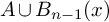 is homotopy equivalent to
$B_{n-1}(x)$
 . To this end, we order the simplices of A in the order of nonincreasing dimension as
$\sigma _1,\sigma _2,\ldots ,\sigma _k$
 . Let
$A_i$
 be the (not necessarily induced) subcomplex obtained from
$A_{i-1}$
 by removing the open star of
$\sigma _i$
 . Equivalently,
$A_{i-1}$
 is the union of
$A_i$
 and the join of
$K(\sigma _i)$
 with
$\sigma _i$
 along the join of
$K(\sigma _i)$
 with
$\partial \sigma _i$
 . Since both of these joins are contractible,
$A_{i-1}$
 and
$A_i$
 are homotopy equivalent [Reference Björner2, Lem 10.3(i)]. Consequently,
$A_0$
 is homotopy equivalent to
$A_k=B_{n-1}(x)$
 .
Acknowledgements
We are grateful to the anonymous referee for pointing out several omissions in the original version of the article, and for suggesting how to improve the presentation. We also thank Jingyin Huang for pointing us to [Reference Björner2].
Funding
The first author is partially supported by NSF DMS-2402105. The second author is partially supportedby NSERC.


 Open access

