We fully endorse the authors’ argument on the importance of using Worldwide, Insitu, Local and Diverse (WILD) approaches in developmental psychology. While operationalizing broader constructs such as joint engagement across cultural contexts remains challenging, the authors’ intent is commendable: narrow perspectives not only foster fundamentally flawed developmental theories but may also have deeply discriminatory effects on cultural minorities. To explore these potential effects, we examined possible biases in social interventions targeting children from different cultural backgrounds. Unless otherwise specified, our analyses drew on data from national statistical offices in Western, Educated, Industrialized, Rich and Democratic (WEIRD) countries (Table 1). These differed in the type of data collected (e.g., social interventions included) and in how key variables (e.g., cultural background) were operationalized, as briefly outlined below. Several statistical offices reported that they do not collect data by cultural background. For example, collecting data on ethnic or racial origin and religion is prohibited in France by law, based on the principle of equality and the prevention of discrimination. While such decisions prevent the misuse of cultural data for discriminatory narratives (e.g., “some cultures maltreat children more than others”; Hahmann et al., Reference Hahmann, Lee and Godin2024), they also hinder empirical assessment of potential systemic biases in social intervention practices. When data were available, we used chi-squared tests for proportions in R (2021) to assess within-country intercultural differences in the number of children (i.e., minors) receiving social interventions, relative to the number of children within each cultural group.
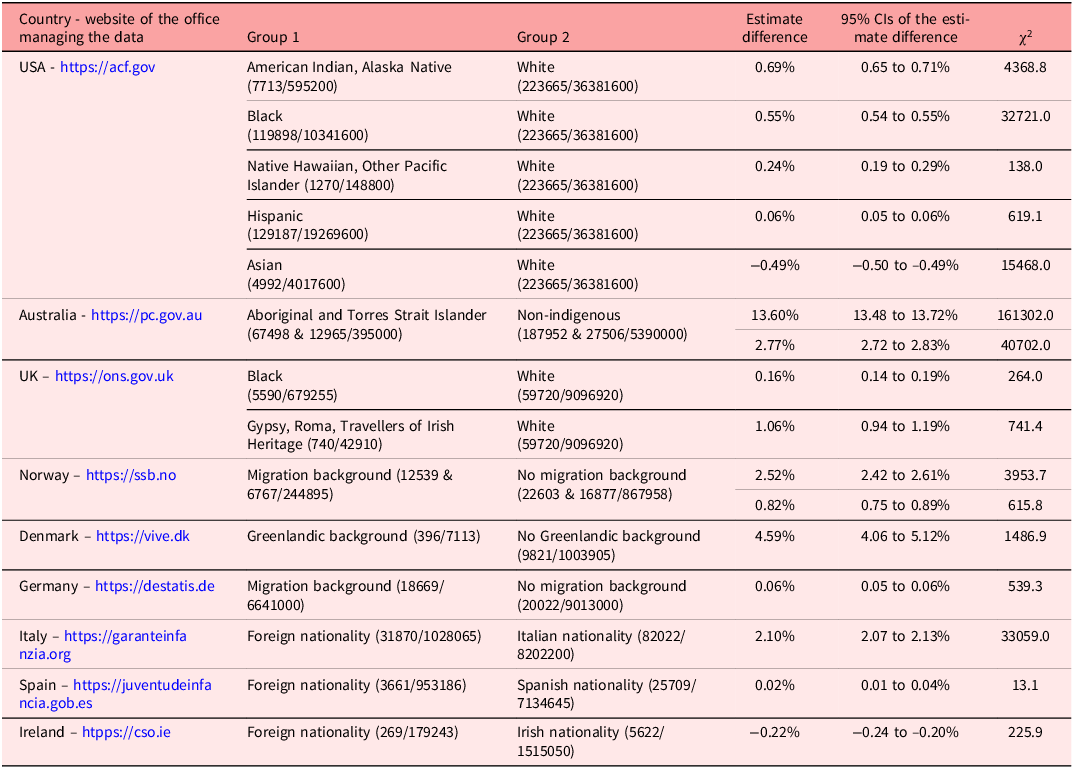
Table 1.
For different WEIRD countries, estimate difference between the proportion of children being targeted by social interventions (number of children targeted/total number of children) in groups with different cultural backgrounds (group 1: minority groups), including 95% confidence intervals (CIs) of the difference and chi square for the chi-squared tests comparing the proportions. All tests had one degree of freedom and p values <0.001
In 2023, the Children’s Bureau of the U.S. Department of Health and Human Services reported 546,159 victims of child abuse and neglect. Compared to White children (0.61%), the proportion of victims was significantly higher among American Indian and Alaska Native (1.30%), Black (1.16%), Native Hawaiian or Other Pacific Islander (0.85%), and Hispanic children (0.67%), but significantly lower among Asian children (0.12%; Table 1). In 2021, in Canada, Indigenous (i.e., First Nations, Métis, Inuit) foster children in private households accounted for 53.7% of all foster children, despite representing only 7.6% of the same-age population; moreover, over half of Indigenous foster children lived with non-Indigenous caregivers (Hahmann et al., Reference Hahmann, Lee and Godin2024), despite the importance of cultural continuity in supporting the development of children’s identity and welfare (e.g., United Nations, 2007). In 2023–2024, in Australia, 255,450 children were notified for alleged maltreatment, of which 40,471 cases were substantiated. Among Aboriginal and Torres Strait Islander children, the proportions of notifications (17.09%) and substantiations (3.28%) were significantly higher than among non-Indigenous children (3.49% and 0.51%; Table 1). In 2024, in New Zealand, 4,391 individuals under 22 were in state or approved care, of whom 2,985 identified as Māori, despite the group comprising a much smaller proportion of that age group (Aroturuki Tamariki, 2025).
In 2021, in the United Kingdom, 80,770 children were subject to care or placement orders or were placed in foster homes. Compared to White children (0.66%), this proportion was significantly higher among Black children (0.82%) and among Gypsy, Roma, and Irish Traveller children (1.72%; Table 1). These latter groups have historically included nomadic populations and have faced longstanding marginalization, systemic discrimination, and persecution across Europe. According to a report by the European Roma Rights Centre (2021), Roma children are vastly overrepresented in state care in Bulgaria, the Czech Republic, Romania, and Slovakia. Although these countries officially collect no data on the cultural background of children in care, estimates suggest that Roma children represent at least 30% of all children in care, despite comprising no more than 15% of the population, and often less. In Norway, in 2024, the Child Welfare Services started 35,142 investigations involving children. Among those with a migration background, the proportions of investigations (5.12%) and child protection measures (2.76%) were significantly higher than among other children (2.60% and 1.94%; Table 1). In Denmark, in 2020, the proportion of children placed in out-of-home care was significantly higher among children with at least one parent born in Greenland (5.57%) than among other children (0.98%; Table 1). In Germany, in 2024, there were 69,477 interventions in which the youth welfare office took children into temporary care. The proportion of targeted children was significantly higher among those with migration background (0.28%, unaccompanied children excluded), compared to other children (0.22%; Table 1). Similar patterns emerged in Italy (2023: 3.10% of foreign vs. 1.00% of national children under care due to maltreatment) and in Spain (2022: 0.38% of foreign vs. 0.36% of national children in foster care; Table 1). The only exception was Ireland, where the proportion of children in care was higher among Irish (0.37%) than those of other nationalities (0.15%; Table 1), although these data should be interpreted with caution, as the cohorts covered different age spans.
Notably, the majority of child protection interventions were based on charges of neglect or psychological maltreatment (e.g., USA: 67.6%; Aboriginal and Torres Strait Islander children: 76.0%; Germany: 94.4%). While these forms of harm can be severe, they also partially allow greater subjectivity in evaluation compared to physical or sexual abuse, since what is considered neglect or emotional deprivation in one cultural setting may sometimes be viewed as appropriate in others. For instance, practices such as leaving children unsupervised for short periods, expecting them to contribute to household chores, using “emotionally distant” communication styles, or delegating nurturance and education to caregiving networks beyond the nuclear family may be interpreted as fostering autonomy and resilience in some societies, but as neglect or lack of parental warmth in others (e.g., Goody, Reference Goody1973, Levine et al., Reference Levine, Dixon, Levine, Richman, Leiderman, Keefer and Brazelton1996).
Overall, these data show a highly consistent trend across countries: children from minority cultural backgrounds are disproportionately represented in child protection systems. This might be due to several factors, including cultural biases in evaluating parenting practices that differ from one’s own, and the fact that cultural minorities are more likely to face socio-economic disadvantages (e.g., lower incomes, higher unemployment rates), increasing the probability of social interventions. Future research will need to draw on datasets that disaggregate social interventions by cultural background and socio-economic indicators, explicitly test causal links between cultural background and social interventions, conduct more systematic cross-cultural comparisons, and experimentally assess whether WILD approaches in developmental psychology can help reduce discriminatory effects on cultural minorities. For sure, child protection systems cannot be grounded in developmental norms and theories derived primarily from WEIRD populations, as doing so risks defining “appropriate” parenting in ways that perpetuate assimilationist pressures on cultural minorities. To prevent inequities, policies should prioritize supportive interventions that genuinely recognize and respect cultural diversity, provided that such practices do not compromise children’s safety, well-being, or developmental needs.






 Jeremy I. Borjon
[Opens in a new window]Jeremy I. Borjon
,
 You have
Access
We fully endorse the authors’ argument on the importance of using Worldwide, Insitu, Local and Diverse (WILD) approaches in developmental psychology. While operationalizing broader constructs such as joint engagement across cultural contexts remains challenging, the authors’ intent is commendable: narrow perspectives not only foster fundamentally flawed developmental theories but may also have deeply discriminatory effects on cultural minorities. To explore these potential effects, we examined possible biases in social interventions targeting children from different cultural backgrounds. Unless otherwise specified, our analyses drew on data from national statistical offices in Western, Educated, Industrialized, Rich and Democratic (WEIRD) countries (Table 1). These differed in the type of data collected (e.g., social interventions included) and in how key variables (e.g., cultural background) were operationalized, as briefly outlined below. Several statistical offices reported that they do not collect data by cultural background. For example, collecting data on ethnic or racial origin and religion is prohibited in France by law, based on the principle of equality and the prevention of discrimination. While such decisions prevent the misuse of cultural data for discriminatory narratives (e.g., “some cultures maltreat children more than others”; Hahmann et al., Reference Hahmann, Lee and Godin2024), they also hinder empirical assessment of potential systemic biases in social intervention practices. When data were available, we used chi-squared tests for proportions in R (2021) to assess within-country intercultural differences in the number of children (i.e., minors) receiving social interventions, relative to the number of children within each cultural group.
For different WEIRD countries, estimate difference between the proportion of children being targeted by social interventions (number of children targeted/total number of children) in groups with different cultural backgrounds (group 1: minority groups), including 95% confidence intervals (CIs) of the difference and chi square for the chi-squared tests comparing the proportions. All tests had one degree of freedom and p values <0.001
In 2023, the Children’s Bureau of the U.S. Department of Health and Human Services reported 546,159 victims of child abuse and neglect. Compared to White children (0.61%), the proportion of victims was significantly higher among American Indian and Alaska Native (1.30%), Black (1.16%), Native Hawaiian or Other Pacific Islander (0.85%), and Hispanic children (0.67%), but significantly lower among Asian children (0.12%; Table 1). In 2021, in Canada, Indigenous (i.e., First Nations, Métis, Inuit) foster children in private households accounted for 53.7% of all foster children, despite representing only 7.6% of the same-age population; moreover, over half of Indigenous foster children lived with non-Indigenous caregivers (Hahmann et al., Reference Hahmann, Lee and Godin2024), despite the importance of cultural continuity in supporting the development of children’s identity and welfare (e.g., United Nations, 2007). In 2023–2024, in Australia, 255,450 children were notified for alleged maltreatment, of which 40,471 cases were substantiated. Among Aboriginal and Torres Strait Islander children, the proportions of notifications (17.09%) and substantiations (3.28%) were significantly higher than among non-Indigenous children (3.49% and 0.51%; Table 1). In 2024, in New Zealand, 4,391 individuals under 22 were in state or approved care, of whom 2,985 identified as Māori, despite the group comprising a much smaller proportion of that age group (Aroturuki Tamariki, 2025).
In 2021, in the United Kingdom, 80,770 children were subject to care or placement orders or were placed in foster homes. Compared to White children (0.66%), this proportion was significantly higher among Black children (0.82%) and among Gypsy, Roma, and Irish Traveller children (1.72%; Table 1). These latter groups have historically included nomadic populations and have faced longstanding marginalization, systemic discrimination, and persecution across Europe. According to a report by the European Roma Rights Centre (2021), Roma children are vastly overrepresented in state care in Bulgaria, the Czech Republic, Romania, and Slovakia. Although these countries officially collect no data on the cultural background of children in care, estimates suggest that Roma children represent at least 30% of all children in care, despite comprising no more than 15% of the population, and often less. In Norway, in 2024, the Child Welfare Services started 35,142 investigations involving children. Among those with a migration background, the proportions of investigations (5.12%) and child protection measures (2.76%) were significantly higher than among other children (2.60% and 1.94%; Table 1). In Denmark, in 2020, the proportion of children placed in out-of-home care was significantly higher among children with at least one parent born in Greenland (5.57%) than among other children (0.98%; Table 1). In Germany, in 2024, there were 69,477 interventions in which the youth welfare office took children into temporary care. The proportion of targeted children was significantly higher among those with migration background (0.28%, unaccompanied children excluded), compared to other children (0.22%; Table 1). Similar patterns emerged in Italy (2023: 3.10% of foreign vs. 1.00% of national children under care due to maltreatment) and in Spain (2022: 0.38% of foreign vs. 0.36% of national children in foster care; Table 1). The only exception was Ireland, where the proportion of children in care was higher among Irish (0.37%) than those of other nationalities (0.15%; Table 1), although these data should be interpreted with caution, as the cohorts covered different age spans.
Notably, the majority of child protection interventions were based on charges of neglect or psychological maltreatment (e.g., USA: 67.6%; Aboriginal and Torres Strait Islander children: 76.0%; Germany: 94.4%). While these forms of harm can be severe, they also partially allow greater subjectivity in evaluation compared to physical or sexual abuse, since what is considered neglect or emotional deprivation in one cultural setting may sometimes be viewed as appropriate in others. For instance, practices such as leaving children unsupervised for short periods, expecting them to contribute to household chores, using “emotionally distant” communication styles, or delegating nurturance and education to caregiving networks beyond the nuclear family may be interpreted as fostering autonomy and resilience in some societies, but as neglect or lack of parental warmth in others (e.g., Goody, Reference Goody1973, Levine et al., Reference Levine, Dixon, Levine, Richman, Leiderman, Keefer and Brazelton1996).
Overall, these data show a highly consistent trend across countries: children from minority cultural backgrounds are disproportionately represented in child protection systems. This might be due to several factors, including cultural biases in evaluating parenting practices that differ from one’s own, and the fact that cultural minorities are more likely to face socio-economic disadvantages (e.g., lower incomes, higher unemployment rates), increasing the probability of social interventions. Future research will need to draw on datasets that disaggregate social interventions by cultural background and socio-economic indicators, explicitly test causal links between cultural background and social interventions, conduct more systematic cross-cultural comparisons, and experimentally assess whether WILD approaches in developmental psychology can help reduce discriminatory effects on cultural minorities. For sure, child protection systems cannot be grounded in developmental norms and theories derived primarily from WEIRD populations, as doing so risks defining “appropriate” parenting in ways that perpetuate assimilationist pressures on cultural minorities. To prevent inequities, policies should prioritize supportive interventions that genuinely recognize and respect cultural diversity, provided that such practices do not compromise children’s safety, well-being, or developmental needs.
Financial support
We thank the Alexander von Humboldt Foundation for supporting Lucas M. Bietti’s research stay at the Human Biology and Primate Cognition Group, Institute of Biology, Leipzig University.
Competing interests
We have nothing to declare.
Funding Statement
Open access funding provided by Max Planck Society.