





No CrossRef data available.
Article contents
Dissecting the neuroanatomy of creativity and curiosity: The subdivisions within networks matter
Published online by Cambridge University Press: 21 May 2024
Abstract
Ivancovsky et al. argue that the neurocognitive mechanisms of creativity and curiosity both rely on the interplay among brain networks. Research to date demonstrates that such inter-network dynamics are further complicated by functional fractionation within networks. Investigating how networks subdivide and reconfigure in service of a task offers insights about the precise anatomy that underpins creative and curious behaviour.
Information
- Type
- Open Peer Commentary
- Information
- Copyright
- Copyright © The Author(s), 2024. Published by Cambridge University Press
References
Andrews-Hanna, J. R., Reidler, J. S., Sepulcre, J., Poulin, R., & Buckner, R. L. (2010). Functional-anatomic fractionation of the brain's default network. Neuron, 65(4), 550–562.CrossRefGoogle ScholarPubMed
Assem, M., Glasser, M. F., Van Essen, D. C., & Duncan, J. (2020). A domain-general cognitive core defined in multimodally parcellated human cortex. Cerebral Cortex, 30(8), 4361–4380.CrossRefGoogle ScholarPubMed
Assem, M., Shashidhara, S., Glasser, M. F., & Duncan, J. (2022). Precise topology of adjacent domain-general and sensory-biased regions in the human brain. Cerebral Cortex, 32(12), 2521–2537.CrossRefGoogle ScholarPubMed
Beaty, R. E., Benedek, M., Silvia, P. J., & Schacter, D. L. (2016). Creative cognition and brain network dynamics. Trends in Cognitive Sciences, 20(2), 87–95.CrossRefGoogle ScholarPubMed
Benedek, M., Beaty, R. E., Schacter, D. L., & Kenett, Y. N. (2023). The role of memory in creative ideation. Nature Reviews Psychology, 2(4), 246–257.CrossRefGoogle Scholar
Branzi, F. M., & Lambon Ralph, M. A. (2023). Semantic-specific and domain-general mechanisms for integration and update of contextual information. Human Brain Mapping, 44(17), 5547–5566.CrossRefGoogle ScholarPubMed
Chiou, R., Cox, C. R., & Lambon Ralph, M. A. (2023a). Bipartite functional fractionation within the neural system for social cognition supports the psychological continuity of self versus other. Cerebral Cortex, 33(4), 1277–1299.CrossRefGoogle ScholarPubMed
Chiou, R., Humphreys, G. F., & Lambon Ralph, M. A. (2020). Bipartite functional fractionation within the default network supports disparate forms of internally oriented cognition. Cerebral Cortex, 30(10), 5484–5501.CrossRefGoogle ScholarPubMed
Chiou, R., Jefferies, E., Duncan, J., Humphreys, G. F., & Lambon Ralph, M. A. (2023b). A middle ground where executive control meets semantics: The neural substrates of semantic control are topographically sandwiched between the multiple-demand and default-mode systems. Cerebral Cortex, 33(8), 4512–4526.CrossRefGoogle ScholarPubMed
Dixon, M. L., De La Vega, A., Mills, C., Andrews-Hanna, J., Spreng, R. N., Cole, M. W., & Christoff, K. (2018). Heterogeneity within the frontoparietal control network and its relationship to the default and dorsal attention networks. Proceedings of the National Academy of Sciences, 115(7), E1598–E1607.CrossRefGoogle Scholar
Gao, Z., Zheng, L., Chiou, R., Gouws, A., Krieger-Redwood, K., Wang, X., … Jefferies, E. (2021). Distinct and common neural coding of semantic and non-semantic control demands. NeuroImage, 236, 118230.CrossRefGoogle ScholarPubMed
Krieger-Redwood, K., Steward, A., Gao, Z., Wang, X., Halai, A., Smallwood, J., & Jefferies, E. (2023). Creativity in verbal associations is linked to semantic control. Cerebral Cortex, 33(9), 5135–5147.CrossRefGoogle ScholarPubMed
Sternberg, R. J., & Kaufman, J. C. (2010). Constraints on creativity: Obvious and not so obvious. In J. C. Kaufman & R. J. Sternberg (Eds.), The Cambridge Handbook of Creativity, (pp. 467–482). Cambridge University Press.CrossRefGoogle Scholar
Vatansever, D., Smallwood, J., & Jefferies, E. (2021). Varying demands for cognitive control reveal shared neural processes supporting semantic and episodic memory retrieval. Nature Communications, 12(1), 2134.CrossRefGoogle ScholarPubMed
Yeo, B. T., Krienen, F. M., Sepulcre, J., Sabuncu, M. R., Lashkari, D., Hollinshead, M., … Buckner, R. L. (2011). The organization of the human cerebral cortex estimated by intrinsic functional connectivity. Journal of Neurophysiology, 106(3), 1125–1165.Google ScholarPubMed
Zhang, M., Bernhardt, B. C., Wang, X., Varga, D., Krieger-Redwood, K., Royer, J., … Jefferies, E. (2022). Perceptual coupling and decoupling of the default mode network during mind-wandering and reading. eLife, 11, e74011.CrossRefGoogle ScholarPubMed
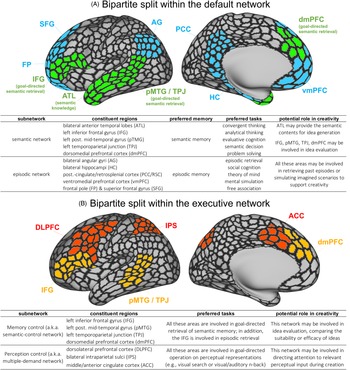
Figure 1. (A) The bipartite split within the brain's default network. (B) The bipartite split within the brain's executive network. Note that the network affiliations of the IFG, left pMTG/TPJ and dmPFC are fluid – while these regions are classified as nodes of the default network during the resting-state, they can also be involved in controlled retrieval of semantic/episodic memory in task situations.
Target article
Related commentaries (29)
A shared “optimal-level of arousal”: Seeking basis for creativity and curiosity
Beyond novelty: Learnability in the interplay between creativity, curiosity and artistic endeavours
Breaking down (and moving beyond) novelty as a trigger of curiosity
Computational models of intrinsic motivation for curiosity and creativity
Creativity is motivated by novelty. Curiosity is triggered by uncertainty
Curious? The relationship between curiosity and creativity is likely NOT novelty
Dissecting the neuroanatomy of creativity and curiosity: The subdivisions within networks matter
Distinct neurocognitive pathways underlying creativity: An integrative approach
Expanding horizons in reinforcement learning for curious exploration and creative planning
Getting curiouser and curiouser about creativity: The search for a nuanced model
Is a wandering mind a novelty-seeking mind? The curious case of incubation
Mood regulation as a shared basis for creativity and curiosity
Prediction error minimization as a common computational principle for curiosity and creativity
 You have
Access
Researchers generally agree that creative ideation needs to fulfil two criteria (Sternberg & Kaufman, Reference Sternberg and Kaufman2010) – originality and effectiveness. Originality pertains to combining pre-existing concepts in novel and unique ways, while effectiveness relates to whether the new combination of old ideas can satisfactorily solve a problem or appropriately fit into a context by considering relevant constraints. These definitions naturally map onto distinct stages of cognitive processing (Benedek, Beaty, Schacter, & Kenett, Reference Benedek, Beaty, Schacter and Kenett2023) – idea generation (forging novel links between concepts) and idea evaluation (assessing whether the new idea is goal-relevant or sufficiently innovative). Neuroimaging evidence has demonstrated that the two stages rely on distinct dynamics amongst several brain networks – for example, the default, salience, and executive control networks (Beaty, Benedek, Silvia, & Schacter, Reference Beaty, Benedek, Silvia and Schacter2016). The theory paper by Ivancovsky et al. comprehensively reviewed the neuroimaging literatures of creativity and curiosity, identified multiple similarities in the neurocognitive mechanisms of the two, and proposed a novelty-seeking model to account for the commonalities between creative pursuits and curiosity-driven behaviour.
We agree with Ivancovsky et al.'s proposal that both creativity and curiosity are multidimensional constructs that entail multiple stages of cognitive processing and depend on the interaction between multiple brain networks. One important caveat, however, should be considered – decades of connectomic research have demonstrated that the default network and executive network are both highly heterogeneous systems, consisting of multiple subnetworks that differ with respect to their functional tunings and connectomic fingerprints. For example, research from our laboratories and other research teams have shown that the default network is functionally fractionated into (at least) two subnetworks – one is more associated with semantic memories, evaluative cognition and convergent thinking, while the other is more associated with episodic memories, free association, simulating hypothetical scenarios and divergent thinking (e.g., Chiou, Humphreys, & Lambon Ralph, Reference Chiou, Humphreys and Lambon Ralph2020, Reference Chiou, Cox and Lambon Ralph2023a; Krieger-Redwood et al., Reference Krieger-Redwood, Steward, Gao, Wang, Halai, Smallwood and Jefferies2023; Zhang et al., Reference Zhang, Bernhardt, Wang, Varga, Krieger-Redwood, Royer and Jefferies2022). As illustrated in Figure 1(A), the “semantically oriented” subnetwork consists of the inferior frontal gyrus, anterior temporal lobe, temporoparietal junction and dorsomedial prefrontal cortex, while the “episodically oriented” subnetwork consists of the ventromedial prefrontal cortex, posterior-cingulate/retrosplenial cortex, hippocampi and angular gyri. This “semantic versus episodic” dissociation topographically accords with conventional taxonomy of subregions within the default network (e.g., Andrews-Hanna, Reidler, Sepulcre, Poulin, & Buckner, Reference Andrews-Hanna, Reidler, Sepulcre, Poulin and Buckner2010) – the semantic subnetwork overlaps substantively with the dorsomedial subsystem, while the episodic subnetwork overlaps significantly with the medial-temporal and core subsystems. Such dissociation was not only observed in the subnetworks' tuning for task contexts but also in intrinsic connectivity under task-free situations (e.g., Yeo et al., Reference Yeo, Krienen, Sepulcre, Sabuncu, Lashkari, Hollinshead and Buckner2011). Like the default network, the brain's executive control network can also be functionally split into (at least) two subnetworks. One is associated with exerting cognitive control over memory-based representations, including both semantic memories and episodic memories (e.g., Chiou, Jefferies, Duncan, Humphreys, & Lambon Ralph, Reference Chiou, Jefferies, Duncan, Humphreys and Lambon Ralph2023b; Gao et al., Reference Gao, Zheng, Chiou, Gouws, Krieger-Redwood, Wang and Jefferies2021; Vatansever, Smallwood, & Jefferies, Reference Vatansever, Smallwood and Jefferies2021), while the other is associated with exerting control over perception-based representations (e.g., Assem, Glasser, Van Essen, & Duncan, Reference Assem, Glasser, Van Essen and Duncan2020, Reference Assem, Shashidhara, Glasser and Duncan2022; Branzi & Lambon Ralph, Reference Branzi and Lambon Ralph2023). As shown in Figure 1(B), the subnetwork biased towards the control of memory includes the inferior frontal gyrus and the posterior mid-temporal gyrus, while the subnetwork biased towards controlling perception includes a large swath of the dorsolateral prefrontal cortex, middle/anterior cingulate cortex and intraparietal sulcus. Furthermore, connectivity evidence shows that regions biased for mnemonic/semantic control tightly couple with the default network, while regions biased for perceptual control closely link with the visual cortex and dorsal-attention network (Dixon et al., Reference Dixon, De La Vega, Mills, Andrews-Hanna, Spreng, Cole and Christoff2018).
(A) The bipartite split within the brain's default network. (B) The bipartite split within the brain's executive network. Note that the network affiliations of the IFG, left pMTG/TPJ and dmPFC are fluid – while these regions are classified as nodes of the default network during the resting-state, they can also be involved in controlled retrieval of semantic/episodic memory in task situations.
Given this functional heterogeneity, we suggest that Ivancovsky et al.'s proposal that “creativity relies on the interaction amongst brain networks” and “the generation and evaluation of creative ideation relies respectively on the default and executive network” is under-specified. Further research is needed to pinpoint how the division of default and executive systems into subnetworks enables distinct facets of creativity. Recently, we have begun to unravel how different types of creative ideas are underpinned by distinct component regions of these networks. Using a multivariate regression approach with functional MRI, we showed that when creativity is built on semantic memory, it is associated with greater activity in regions involved in semantic retrieval (the inferior frontal gyrus and dorsomedial prefrontal cortex) while minimally engaged those regions for episodic memory; on the other hand, when creativity is built on episodic memory, it is associated with greater activity in regions involved in episodic memory (the retrosplenial cortex) while minimally recruited those regions for semantic memory (for details see Krieger-Redwood et al., Reference Krieger-Redwood, Steward, Gao, Wang, Halai, Smallwood and Jefferies2023). Particularly, when participants attempted to produce creative links between word-pairs that are barely semantically related (e.g., marigold and sphinx), the brain reacted to such a semantically challenging situation with extensively distributed activation spread across the semantic subnetwork (inferior frontal gyrus) and executive network (dorsolateral prefrontal cortex and anterior cingulate cortex), potentially reflecting the mental manoeuvre between paying attention to text and recombining semantic concepts. Interestingly, such widespread, cross-network activation disappeared when participants produced creative links between closely related words (e.g., flight and holiday); instead, this situation elicited activation of the retrosplenial cortex, which dovetailed with participants' report that they inclined to episodic retrieval in this context (e.g., recalling a recent trip).
Taken together, multiple evidence consistently indicates that both semantic and episodic memory contribute to the emergence of creative ideas (Benedek et al., Reference Benedek, Beaty, Schacter and Kenett2023). Under different circumstances, the brain employs distinct cognitive tactics and neural machineries to engender creative ideas, depending on whether semantic concepts are assembled in a novel way or episodic memories are used to create quirky contents.
While the novelty-seeking model proposed by Ivancovsky et al. nicely integrates two forms of introspective processes, creativity and curiosity, with various cognitive processes and brain networks, it remains to be clarified how their model fits with evidence for the fractionation of networks into subparts and their flexible network-wide reconfiguration to suit different contextual requirements. Although fractionations and reconfigurations complicate current theories about the neural substrates of creativity, these considerations provide a more truthful description of the underlying mechanisms. A fruitful direction for future research is to consider the fusion and fissure within and between networks, which can provide valuable insights regarding how the brain implements flexible cognition.
Acknowledgement
None.
Financial support
None.
Competing interest
None.