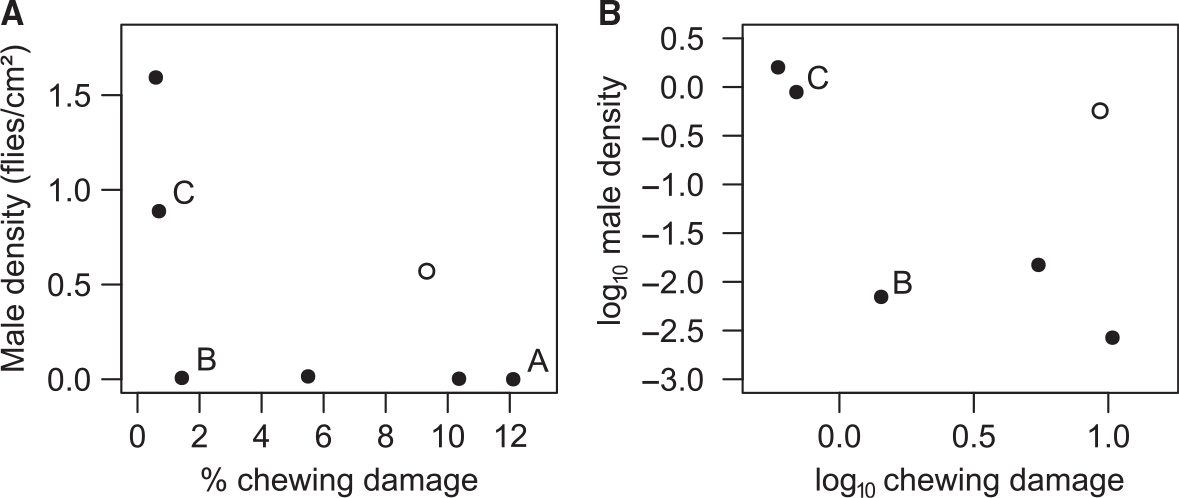
The original published version of this article (Angell and Cook Reference Angell and Cook2019) contained an error in the calculation of antler surface area in Table 1, which also affected the estimates of male density in Table 1 and Fig. 2. The relative patterns remain unchanged. This corrigendum presents corrected versions of Table 1 and Fig. 2.
Attributes of three moose (Alces alces) antlers containing larval Protopiophila litigata.

* Because not all larvae eclosed successfully and a few escaped before they could be measured, the statistical analyses included only 19, 176, and 57 individuals from each antler, respectively.
The relationship between the proportion of antler surface area damaged by animal chewing and the mean male Protopiophila litigata density (antler attractiveness) on seven moose antlers in 2017. A, untransformed data; B, log10-transformed data. Previous work by Bonduriansky (Reference Bonduriansky1996) demonstrated a strong correlation between these variables on a log–log scale (r = −0.97). Letters correspond to antlers in Table 1. Antler A does not appear on the log10 plot as it had a male density of 0. One antler (hollow circle) had been stored inside a shed, away from access by P. litigata, for a year prior to the study.