The antler fly, Protopiophila litigata Bonduriansky (Diptera: Piophilidae), is a necrophagous fly that oviposits exclusively into discarded Cervidae (Mammalia: Artiodactyla) antlers (Bonduriansky Reference Bonduriansky1995). Over a summer, at least 10 and up to a few hundred mated females may oviposit into an antler (C.S.A., personal observation). Antlers are patchily distributed and vary in quality, based at least partly on age (i.e., time since being shed). A given antler will support multiple cohorts of larvae for approximately four years, but it will gradually become unsuitable and stop attracting adults (Bonduriansky Reference Bonduriansky1996). Other factors, such as the size and nutrient composition of antlers and larval density, are also likely to affect their quality as a natal environment. Although P. litigata is a valuable model species for studying ageing in the wild (Bonduriansky and Brassil Reference Bonduriansky and Brassil2002), the life histories of the larvae and pupae are not well characterised.
Both adult body size and timing of eclosion – and thus growth and development rate – are likely to be under directional selection in P. litigata. Growth rate describes the rate of increase in size, while development rate describes the rate of cell differentiation (van der Have and de Jong Reference van der Have and de Jong1996); these physiological processes are often correlated but are distinct. Larger males are more successful in agonistic intrasexual contests (Bonduriansky and Brooks Reference Bonduriansky and Brooks1999a) and are preferred by females as mates (Bonduriansky and Brooks Reference Bonduriansky and Brooks1998). Female fecundity is also correlated with body size in P. litigata (Bonduriansky and Brooks Reference Bonduriansky and Brooks1999b). Therefore, all else being equal, directional selection for rapid growth is likely in both sexes. Furthermore, theory predicts that fast development will be favoured by both natural (Stearns Reference Stearns1992) and sexual selection (Andersson Reference Andersson1994) in seasonal organisms such as P. litigata.
However, if growth and development are both energetically expensive, they may trade off with one another, both within and between life stages. For instance, individuals that allocate highly to growth and/or development as larvae may suffer slower development during the pupal stage. The ultimate body size of an individual is also constrained temporally by development rate, as fast larval development affords less time for growth. The optimal allocation to growth and development across life stages will depend ultimately on the net fitness effect of the resulting life history, but this is beyond the scope of this note. Allocation patterns are likely to vary plastically among different larval environments. Differences in resource availability, competition, predation, or other factors may influence growth and development individually, as well as their covariation. Here we characterise the differences in larval growth and pupal development of P. litigata of both sexes among three larval environments (natal antlers).
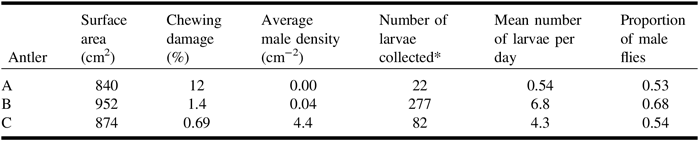
Three discarded moose (Alces alces (Linnaeus) (Artiodactyla: Cervidae)) antlers were collected from Algonquin Provincial Park, Ontario, Canada, in May and June 2017 and relocated to the Algonquin Wildlife Research Station (45.591373, −78.522472). The antlers varied in size, attractiveness to adult flies, as measured by the average density of males on the antler surface at 13:00–14:00 between 7 July and 15 July 2017, and per cent surface area chewed by rodents (Rodentia) and other animals (Table 1). Michael (Reference Michael1965) found that the extent of chewing damage to a white-tailed deer antler (Odocoileus virginianus (Zimmerman) (Artiodactyla: Cervidae)) is significantly related to the age of the antler (time since shedding). Admittedly, chewing is an imperfect index of antler age, as Michael (Reference Michael1965) reported that antlers occasionally escaped chewing damage for up to three years; however, rodent abundance was extremely low for the duration of that study, which likely contributed to a lower frequency of chews than is typical (Michael Reference Michael1965). In Algonquin Provincial Park, the degree of chewing damage on an antler is negatively correlated with the density of adult P. litigata (Bonduriansky Reference Bonduriansky1996), which probably respond to biologically relevant sensory cues (e.g., odour) to determine antler quality.
Antlers A and B were located in May, and larvae were collected from these antlers between 31 May and 11 July, while antler C was found on 22 June, so larvae from this antler were collected between 22 June and 11 July. For this reason, the absolute number of larvae collected should not be compared between them, but antler A yielded by far the fewest mean pupating larvae per day over the collection period (Table 1).
Mature piophilid larvae leave their larval environment (the bone matrix) to pupate when they detect the sound and moisture caused by rain (Bonduriansky Reference Bonduriansky2002). Thus, P. litigata larvae were collected by hand from the antlers, either after rain or while simulating rain by spraying the antlers with water and drumming on them with sticks and pens. Each larva was placed individually in a 23-mm-diameter plastic vial filled with 2–3 cm of coco peat (Cocogro, Botanicare, Vancouver, Washington, United States of America) and capped with a foam plug, where they burrowed to pupate. Upon eclosion, adults were gently immobilised under a layer of plastic wrap following Bonduriansky and Brooks (Reference Bonduriansky and Brooks1997), sexed based on their terminalia (Bonduriansky Reference Bonduriansky1995), and photographed under a dissecting microscope with an ocular micrometer. Thorax length was measured as a proxy for adult size, using ImageJ version 1.51 (Schneider et al. Reference Schneider, Rasband and Eliceiri2012). This measurement is repeatable and correlated with body size in P. litigata (Oudin et al. Reference Oudin, Bonduriansky and Rundle2015). Voucher specimens were deposited in the Canadian National Collection of Insects, Arachnids, and Nematodes (Ottawa, Ontario, Canada).
We tested for differences in adult body size using Gaussian linear models in R 3.5.1 (R Core Team 2018). Previous research has reported a negative relationship between the date of eclosion and body size in this species (Bonduriansky and Brooks Reference Bonduriansky and Brooks1999a), so we included the date of pupation (i.e., emergence from the antler) as a covariate. Our initial model included fixed effects of antler, sex, and date of pupation, as well as all interactions, on thorax length. Pupation date was standardised to a mean of 0 and a standard deviation of 1 prior to analysis (Schielzeth Reference Schielzeth2010). The model was simplified using a stepwise deletion procedure.
Second, we tested for differences in pupal development time (in days) with Gaussian linear mixed-effects models, using the R package lme4 (Bates et al. Reference Bates, Mächler, Bolker and Walker2015). The initial model included fixed effects of antler, sex, and thorax length (standardised as described above), as well as all possible interactions. Pupae were kept in an uninsulated wood cabin subject to natural fluctuations in temperature depending on when they were collected, which likely influenced development rates. These fluctuations were highly variable and not monotonic, so the date of pupation was included as a random effect rather than a covariate. As above, the model was simplified using a stepwise deletion procedure. Significance testing for both analyses was performed with the R package car (Fox and Weisberg Reference Fox and Weisberg2011), and partial residual plots were produced with the R package visreg (Breheny and Burchett Reference Breheny and Burchett2017).
The three antlers in this study differed in a variety of ways (Table 1). Antler A was highly damaged, unattractive to adult flies, and yielded few mature larvae. Based on these combined lines of evidence, we consider antler A as a relatively old, low-quality antler. In contrast, antler C was damaged very little, highly attractive, and yielded many larvae, suggesting a fresher, high-quality antler. Antler B was only slightly more damaged than antler C but nearly as unattractive to antler flies as antler A. It also had a high density of larvae and a much more skewed sex ratio at eclosion than other antlers. Overall, 76% of collected larvae eclosed (86% from antler A, 74% from antler B, and 78% from antler C).
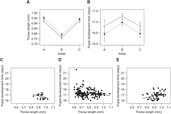
The reduced model for thorax length (F 3,251 =52.1, P < 0.001) included significant additive effects of antler (F 2,250 = 71.7, P < 0.001) and sex (F 1,250 = 4.59, P = 0.033), and no interactions. Antler B yielded smaller flies than other antlers, and males were smaller than females (Fig. 1A). There was also a marginally nonsignificant trend for larvae pupating later to reach greater adult sizes (reduced model + pupation date: β = 0.014 ± 0.007 standard error, F 1,250 = 3.73, P = 0.055).
The reduced model for pupal development time (likelihood ratio test: χ 2 6 = 40.2, P < 0.001) included main effects of antler, sex, and thorax length, and the interaction between thorax length and antler. Antler (F 2,234.95 = 6.20, P = 0.002) and sex (F 1,235.42 = 9.55, P = 0.002) significantly influenced pupal development time, with males and flies from antler B pupating for longer (Fig. 1B). Thorax length was not correlated with pupal development time overall (F 1,234.18 = 0.78, P = 0.378), but it significantly interacted with antler (F 2,235.18 = 3.71, P = 0.026) such that larger flies pupated more slowly in antler C, but more quickly in antlers A and B (Fig. 1C–E). There was a marginally nonsignificant interaction between sex and thorax length, in which males displayed a stronger negative correlation between thorax length and pupal development time than females (reduced model + sex × thorax: F 1,232.81 = 3.62, P = 0.058). However, when one small male with an unusually long pupal development time was removed, this interaction no longer approached significance, and the other results were qualitatively unchanged.
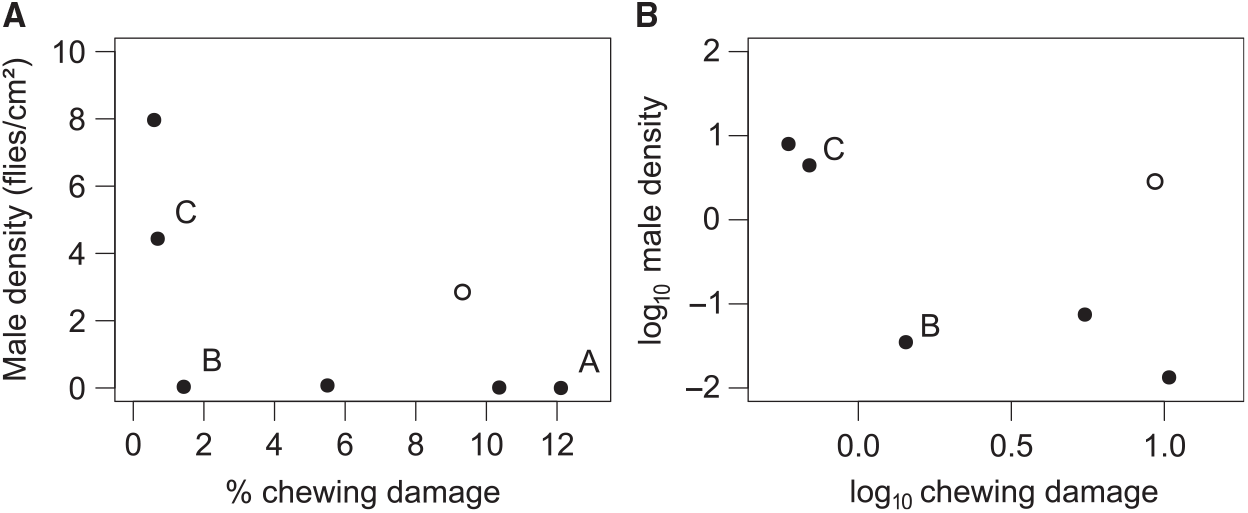
Here we show that growth and development in P. litigata differ significantly between the sexes and among natal antlers. Surprisingly, although antler B was not highly chewed (Table 1), individuals from this antler were smaller and pupated for longer than those collected from either other antler (Fig. 1A–B). Antler B was much less attractive to adult flies than would be expected given its level of damage (Fig. 2), suggesting that it may actually be an old antler that largely avoided chewing by chance (Michael Reference Michael1965). If this is the case, old age alone still cannot explain the differences between the flies from antler B and the similarly unattractive antler A. Antler B may have been a poor larval environment due to another factor beside antler age, such as its high larval density (Table 1) or unmeasured variables related to the moose the antler came from (e.g., nutrition, stress, resource allocation, etc.).
Interestingly, the correlation between body size (i.e., growth) and pupal development time differed among the antlers, which suggests the larval environment influences allocation among juvenile life history traits. Flies from antler C, the least damaged and most attractive antler, eclosed more quickly if they were smaller (Fig. 1E), consistent with a growth–development trade-off. Conversely, individuals from antlers A and B eclosed more quickly if they were larger (Fig. 1C–D). Theory suggests that a positive covariation between costly traits indicates a high variation in resource acquisition, whereas a negative covariation indicates variation in allocation (van Noordwijk and de Jong Reference van Noordwijk and de Jong1986). Since a large body size (i.e., greater growth) was correlated with faster pupal development in the two less attractive, and likely lower-quality, antlers, perhaps competitive resource acquisition is more important in a depleted environment, while variability in allocation was only apparent in the attractive, and plausibly resource-rich, antler C.
Surprisingly, although a previous mark–recapture study of P. litigata reported that body size decreased significantly in later-emerging males (Bonduriansky and Brooks Reference Bonduriansky and Brooks1999a), we found that body size did not change significantly with pupation date. This discrepancy may be due to the fact that our analysis takes into account among-antler differences, whereas Bonduriansky and Brooks (Reference Bonduriansky and Brooks1999a) measured body size at the whole population level. If flies from low-quality antlers are generally both smaller and slow developing, as in antler B (Fig. 1A–B), this effect may drive population-level changes in body size through the season.
Finally, we note that the sex ratio at eclosion was notably male-biased in antler B only (Table 1). Assuming an even sex ratio at oviposition, this suggests sex differences in mortality in this species during the larval or pupal stage alongside sexual dimorphism in other juvenile traits reported here. Specifically, females may be less resilient to the high larval density of antler B. This single observation is far from conclusive, but it suggests a sex-specific effect, which occurs prior to maturity. Alternatively, the sex ratio of eggs may have been male-biased initially. Male antler flies are smaller than females, and presumably require less energy to grow, so mothers could favour male offspring when ovipositing into a high density or depleted environment (see Wiebe and Bortolotti Reference Wiebe and Bortolotti1992).
Overall, these results demonstrate that growth and development differ among larval environments in P. litigata. Antler age, larval density, and other factors likely all contribute to environmental quality, and this study does not have sufficient independent replication to distinguish between the effects of each. The genetic background of the eggs that were oviposited into each antler may also have contributed to differences in growth and development among antlers. This work represents an important first step in characterising natural variation in life history traits in P. litigata, and a longitudinal study of several antlers through time would be even more informative in distinguishing the factors that influence this variation. Given the suitability of P. litigata for ageing research, future work should also investigate how antler quality affects lifespan and reproductive senescence throughout adulthood.
Factors affecting the growth and development of Protopiophila litigata. A, Mean (± standard error) thorax length among antlers and between sexes; B, mean (± standard error) pupal development time among antlers and between sexes. In panels A and B, hollow circles are males and filled circles are females. C–E, Partial residual plots showing the partial effect of thorax length on pupal development time separately in antler A (panel C), antler B (panel D), and antler C (panel E).

Relationship between the proportion of antler surface area damaged by animal chewing and mean male Protopiophila litigata density (antler attractiveness) on seven moose antlers in 2017. A, Untransformed data; B, log10-transformed data. Previous work by Bonduriansky (Reference Bonduriansky1996) demonstrated a strong correlation between these variables on a log-log scale (r = −0.97). Letters correspond to antlers in Table 1. Antler A does not appear on the log10 plot as it had a male density of 0. One antler (hollow circle) had been stored inside a shed, away from access by P. litigata, for a year prior to the study.

Attributes of three moose (Alces alces) antlers containing larval Protopiophila litigata.

* Because not all larvae eclosed successfully and a few escaped before they could be measured, the statistical analyses included only 19, 176, and 57 individuals from each antler, respectively.
Acknowledgements
We are grateful to Howard Rundle, Patrick Moldowan, Jasmine Veitch, Dezene Huber, Leah Flaherty, and two anonymous reviewers for helpful feedback on this manuscript. This research was supported by a grant from the Natural Sciences and Engineering Research Committee of Canada to Howard Rundle (number 210108).