

I. INTRODUCTIONFootnote *
The transmission of Proclus' commentaries on the works of Plato and Aristotle has not exactly had luck on its side. Among the few that survive at least partially in Greek is his commentary on Plato's Timaeus, finished by Proclus according to Marinus' of Neapolis biography of ProclusFootnote 1 at the age of 27. The tradition of the Greek manuscripts transmitting this commentary breaks off at Proclus' comments on Tim. 44d. A short section of this commentary has been preserved in a 9th century Arabic translation.Footnote 2 This fragment contains Proclus' commentary (or extracts thereof) on Tim. 89e3–90c7, i.e. a section lost in the Greek original, but it is also notable for the fact that it includes at least some thoughts by Proclus on medicine, bodily health and physical disorder, topics almost completely neglected in his other philosophical writings. Although most of the fragment has been translated into German by F. Pfaff as early as in 1939, the present article contains the editio princeps of the Arabic version.Footnote 3 A French translation of the fragment, prepared by G. Vajda, has been published as an appendix to Festugière's annotated translation of the parts extant in Greek.Footnote 4 The hitherto available details on the Arabic transmission and reception were collected by G. Endress.Footnote 5
II. MANUSCRIPT EVIDENCE, TRANSLATION, TRANSMISSION
The transmission of the Arabic fragment is embedded in the Syro-Arabic circulation and reception of the Corpus Galenianum. The Istanbul codex Aya Sofya 3725, the unique manuscript preserving the fragment, is a collective Arabic manuscript combined of two originally separate volumes. The first part (fols. 1–72), which contains four medical and pharmacological writings by Arab authors, dates according to the description by H. Ritter and R. WalzerFootnote 6 from the 6th/12th century. The bulk of the second part (fols. 73–218) is formed by Arabic translations of ten Galenic treatises. According to H. H. Biesterfeldt, the colophon of one of the treatises displays the year 457/1064–5 as date of copying.Footnote 7
The last Galenic treatise in this collective manuscript (fols. 194b–206b) is the Arabic translation of Περὶ ἐθῶν (On Habits), which was edited, together with an English translation, some three decades ago by F. Klein-Franke.Footnote 8 As in his other philosophical writings, Galen quotes in this treatise (among others) Hippocrates and Plato. The Hippocratic quotations are taken from the Aphorisms, On Regimen in Acute Diseases, the Epidemics, and On the Physician's Business, the Platonic quotation covers exactly Timaeus 89e3–90c7. The fragment of Proclus’ Timaeus commentary forms one of two attachments appended to Galen's Περὶ ἐθῶν for the purpose of elucidating these Hippocratic and Platonic quotations. The Explicit of the translation of Galen's treatise is immediately and without any caesura followed by the following introduction to these two texts (fol. 206b8–9):
[Text 1]
وهذا شرح ما دخل في هذه المقالة من كلام بقراط وافلاطون وأوّله شرح معانى كلام بقراط من قول جالينوس قال جالينوس…
The following is an explanation of Hippocrates' and Plato's teachings quoted in the preceding treatise [by Galen]. The first [section] is an explanation of the meaning of Hippocrates' teaching through Galen's [own] words. Galen says…
This note is followed by a lengthy excerpt of Galen's commentary on Hippocrates' On Regimen in Acute Diseases (fols. 194b2–213a15), which deals with the Hippocratic text quoted by Galen in the preceding Περὶ ἐθῶν.Footnote 9 Neither this excerpt nor the extant complete Arabic translation of Galen's commentary has been edited so far.Footnote 10 The excerpt ends with the following words (fol. 213a15–16):
[Text 2]
فهذا ما أردناه من شرح ما دخل في هذه المقالة من كلام بقراط على سبيل المثال
This now is what we wanted to explain about the Hippocratic teaching adduced by way of exemplification in this treatise [i.e. Περὶ ἐθῶν].
After this excerpt of Galen's commentary, the manuscript contains the fragment of Proclus' Timaeus commentary edited below. The fragment is introduced by the following short transition (fol. 213a16–17):
[Text 3]
وأمّا ما دخل فيها من كلام افلاطن على طريق المثال فإنّ بروقلس يقول فيه هذا القول
As for the Platonic teaching adduced in it [i.e. Galen's Περὶ ἐθῶν] by way of exemplification, Proclus comments on it as follows.
And at the end of the Proclian text, which is also the last text in this manuscript, we read again a corresponding Explicit (fol. 218a17–19):
[Text 4]
تمّ ما شرح به قول بقراط وافلاطن وتمّ كتاب العادات والحمد  ذي القدرة التامّة والنعمة العامّة وصلواته على رسوله محمّد وآله وسلّم تسليماً
This is the end of the explanation of Hippocrates' and Plato's words and the end of [Galen's] book On Habits. Praise be to God, who possesses perfect power and all-embracing graciousness, and God's blessing upon His prophet Muḥammad and his family! May He keep [them] safe.
The translation of Galen's Περὶ ἐθῶν itself preserved in MS Aya Sofya 3725, is preceded by an introduction (fols. 193b1–194b1) which comprises a letter from Ḥunayn ibn Isḥāq's hand addressed to Salmawayh ibn Bunān, court physician and personal doctor of the ʿAbbāsid caliph al-Muʿtaṣim.Footnote 11 From this letter we learn that Ḥunayn prepared a translation of Galen's Περὶ ἐθῶν and attached the two excerpts of the commentaries by Galen and Proclus to this translation, because he deemed them suitable for a better understanding of the Galenic work. In Ḥunayn's letter to Salmawayh we read:
[Text 5, MS Aya Sofya 3725, fols. 193b13–194a1, 194a6–b1]
فسّرت لك المقالة التي سألتنيها من مقالات جالينوس وهي مقالة في العادات وبعثت بها إليك ولم أفسّرها وأبعث بها مفردة لكنّي أضفت إليها وألحقت بها تفسير الشرح وذلك بسبب ما دخل فيها من كلام ابقراط وكلام افلاطون على طريق المثال فإنّي وإن كنت أعلم أنّه لا يذهب عنك ولا يفوتك شيء من مثل هذا الكلام وإن لم يكن معه شرحه لما أقتله علماً من أنّك في أعلى طمعات من شرح معاني كلّ ما قيل في الكتب قولاً جيّداً صواباً […] رأيت أنّه ينبغي أن أضيف إلى كلّ كلمة من هذا الكلام الذي دخل في هذه المقالة على طريق القياس والمثال تفسيراً لشرحFootnote 12 معانيها كيما يقدر من لم ينظر بعقله في واحد من الكتب التي منها انتزع جالينوس هذا الكلام أن يفهم معانيه بسرعة وسهولة ورأيت أنّ أوّل من ينبغي أن يختار لتفسير معاني كلام بقراط جالينوس صاحب سرّه والمقابل فيه بالحقّ وأحقّ من يتولّى شرح معاني كلام فلاطن برقلس المشهور في العلماء ولما رأيت أنّ هذا أمر ينبعي أن أفعله وظننت أنّه ليس كلّ إنسان يستصوب أن يكون كلام واحد بعضه مشروحاًFootnote 13 وبعضه قد ترك بلا شرح رأيت أنّ أمرّ بعد ذلك بسائر الأبواب التي ذكرها جالينوس في هذه المقالة وأشرح معانيها وإن أنا زدْت في ذلك وأضفت إليه شيئاً فإنّما أتي بالشيء الذي أزيده أو أضيفه ممّا هو لجالينوس ومن ذخائره المخزونة في كتبه لا من فكرتي التي لا نتيجة لها ولا حصول وذلك من أمرها معروف ولو لم أتفوّه به.
[(a)] I translated for you the treatise of Galen you asked me for, namely the treatise On Habits, which I send to you [here].
[(b)] However, I did not only translate and send this [treatise]. Rather, I attached and appended to it the translation of the [relevant] explanation,Footnote 14 because [Galen] adduces in this [treatise] Hippocratic and Platonic teachings by way of exemplification. The reason is that, although I am sure that nothing of this kind of teaching will escape you or be neglected by you, even if it is not accompanied by its explanation, I am no less aware of the fact that you strive most eagerly to obtain explanations of what all that is taught in the books in an excellent and correct way means. […] I deemed it suitable to attach to each word of these teachings quoted in this treatise by way of comparisonFootnote 15 and exemplification a translation of what explains their meaning, in order that he whose mind has not yet studied any of the books from which Galen excerpted this teaching will be capable of grasping its meaning immediately and easily. Furthermore, I thought that the one who must be given preference with respect to the interpretation of the meaning of Hippocrates' teaching is Galen [himself], who shared the secrets of Hippocrates' [thoughts] and is compatible to him in trustworthiness, and that [the one] who deserves most to attend to the explanation of the meaning of Plato's teaching is Proclus, the [philosopher who is] well-reputed among scholars.
[(c)] Now, seeing that this had to be done and taking into consideration that not everybody might approve of [the fact] that one part of one [and the same] teaching is [additionally] explained, whereas the other part is left without explanation, I thought I should, after this, go through the other sections quoted by Galen in this treatise and explain their meanings. Whenever I supplied and attached something to this, I set forth only those things I [could] supply and attach from what [originates] from Galen and from the treasures stored in his books, not from my own thoughts which are – as is well-known and goes without saying – unproductive and fruitless.
Ḥunayn speaks in this letter about four different texts. He mentions in section (a) his translation of Galen's On Habits, in section (b) translations of two sections of Galen's and Proclus' commentaries on Hippocratic and Platonic quotations in this work, and in section (c) his own explanations on “the other sections quoted by Galen in this treatise” excerpted from or alluding to other works by Galen. The appended explanations announced in section (c) are neither extant in the present manuscript nor testified in Ḥunayn's Letter on the Translations of Galen's Works. In all likelihood, Ḥunayn dealt there with Galen's quotation from Hippocrates' works other than Περὶ διαίτης ὀξέων, i.e. Aphorisms, Epidemics, and On the Physician's Business (cf. above), on which Galen had also composed separate commentaries. As for the texts mentioned in sections (a) and (b), the letter raises three questions: (i) Into which language did Ḥunayn translate Galen's On Habits? (ii) Were the translations referred to in section (b) originated by Ḥunayn himself or did he extract them from already existing translations (Ḥunayn speaks of attaching [aḍāfa] and appending [alḥaqa] the texts, but does not explicitly say that he translated them)? (iii) Was the Arabic version of the excerpts of Galen's and Proclus' commentaries preserved in our manuscript prepared on the basis of the Greek original or a Syriac translation?
The first and third questions are easily answered on the basis of additional bibliographical material. First, we have Ḥunayn's statement regarding Galen's On Habits in his Letter on the Translations of Galen's Works:Footnote 16
[Text 6]
كتابه في العادات: هذا الكتاب مقالة واحدة […] ترجمت هذه المقالة إلى السريانيّة لسلمويه بن بنان ويتلو هذه المقالة تفسير ما أتى به جالينوس فيها من الشهادات من قول افلاطن بشرح ابروقلسFootnote 17 له وتفسير ما أتى به من قول بقراط بشرح جالينوس له. وترجمه حبيش إلى العربيّة لأحمد بن موسى.
[Galen's] Book on Habits: This book [consists of] one treatise. […] I translated it into Syriac for Salmawayh ibn Bunān. This treatise is followed by an explanation of the testimonies of Plato's words quoted in it by Galen by means of Proclus' commentary on them as well as by an explanation of Hippocrates' words quoted by [Galen] by means of Galen's commentary on them. Ḥubaysh translated [all] this into Arabic for Aḥmad ibn Mūsā.Footnote 18
This note clarifies question (i): Ḥunayn translated Galen's Περὶ ἐθῶν into Syriac. As regards question (iii), Text 6 seems to indicate that it was Ḥunayn's nephew Ḥubaysh ibn al-Ḥasan al-Dimashqī rather than Ḥunayn himself who prepared the Arabic translation of the two commentaries. However, it still leaves open the possibility that the Arabic translation was produced on the basis of Greek texts, because Ḥunayn simply refers to the fact that these excerpts “follow” (yatlū) the Galenic text without mentioning any translation. Fortunately, MS Aya Sofya 3725 contains another note which helps clarifying this question definitely. In a short preamble prefixed to Ḥunayn's letter to Salmawayh and possibly originated by Ḥubaysh himself, we read the following:
[Text 7, MS Aya Sofya 3725, fol. 193b3–7]
رسالة حنين بن اسحق إلى سلمويه بن بنان فيما أسأله من ترجمة مقالة جالينوس في العادات من اللسان اليوناني إلى اللسان السرياني كتبها إليه سريانيةً وترجمها مع مقالة جالينوس وما يتلوها من التفسير من اللسان السرياني إلى اللسان العربي حبيش بن الحسن لأبي الحسن أحمد بن موسى.
Letter by Ḥunayn ibn Isḥāq to Salmawayh ibn Bunān on the translation of Galen's treatise On Habits from the Greek language into the Syriac language entrusted by [Salmawayh] to [Ḥunayn]. [Ḥunayn] sent it to [Salmawayh] in Syriac, and Ḥubaysh ibn al-Ḥasan translated this [letter] together with Galen's treatise and with the commentary following it from the Syriac language into the Arabic language for Abū al-Ḥasan Aḥmad ibn Mūsā.
Hence, there can be little doubt that [1] Ḥunayn ibn Isḥāq translated Galen's Περὶ ἐθῶν from Greek into Syriac; [2] it was due to Ḥunayn's activities that – within the Syro-Arabic reception – excerpts of Galen's commentary on the Hippocratic Περὶ διαίτης ὀξέων and of Proclus' commentary on Plato's Timaeus were appended to and transmitted in the company of Galen's Περὶ ἐθῶν; [3] Ḥunayn himself put all this together in Syriac for Salmawayh ibn Bunān; and [4] Ḥubaysh – possibly in cooperation with or under the supervision of Ḥunayn – translated the entire convolute, comprising Ḥunayn's letter to Salmawayh, the Graeco-Syriac texts (presumably including the explanations mentioned in Text 5[c] and omitted in the present manuscript), and the editorial remarks inserted by Ḥunayn between these texts, from Syriac into Arabic for Abū al-Ḥasan Aḥmad ibn Mūsā.Footnote 19
The second question, that is whether Ḥunayn himself prepared the Syriac translation of the fragment of Proclus' commentary or he extracted it from an already existing (possibly even complete) translation of Proclus' commentary, can be answered only indirectly. First, we know that Ḥunayn translated Galen's commentary on Hippocrates' Περὶ διαίτης ὀξέων.Footnote 20 Thus, the fact that he refers to “having appended” – as he puts it – extracts of this work without mentioning his translation into Syriac does not necessarily point to an earlier version by another translator which was later on extracted by Ḥunayn. Secondly, and more important, we have the textual evidence of MS Aya Sofya 3725. This manuscript contains both the Hippocratic quotations as well as the Platonic quotations twice, first as part of Galen's Περὶ ἐθῶν and once again as lemmata of the following commentaries, the Hippocratic quotations in Galen's commentary on Περὶ διαίτης ὀξέων, and the Platonic quotations as lemmata in Proclus' commentary. Now, if the Syriac versions of the excerpts of Galen's and Proclus' commentaries had been prepared by a translator other than the one who had translated Galen's Περὶ ἐθῶν into Syriac, this must have been reflected by terminological, technical and stylistic differences between the correlating sections in Galen's Περὶ ἐθῶν on the one hand and the two commentaries on the other hand. And since, as we have seen above, all three texts were translated by the same translator, Ḥubaysh, from Syriac into Arabic, at least some traces of these differences in the Syriac versions should still be noticeable and distinguishable within their Arabic translation. Yet this is not the case. On the contrary, the correlating sections, both the Hippocratic as well as the Platonic quotations, correspond to each other word by word in each version, notwithstanding minor variations due to the manuscript transmission.Footnote 21 Hence, there can be no doubt that Ḥunayn translated into Syriac not only Galen's Περὶ ἐθῶν and his commentary on Hippocrates' Περὶ διαίτης ὀξέων, but also the section of Proclus' commentary on the Timaeus, the Arabic version of which is preserved in the present manuscript. Furthermore, the interpolated metatextual notes we encounter in our manuscript (Texts 1–4, above) in all probability go back to corresponding Syriac notes by Ḥunayn himself, which is why we find almost literal parallels of these notes in Ḥunayn's letter to Salmawayh (compare Texts 2 and 3 with Text 5, lines 2–3).
Unfortunately, Ḥunayn does not give any details as to what his source looked like (whether or not he had access to the complete commentary on the Timaeus) and whether the section he selected for his appendix to Galen's Περὶ ἐθῶν is all that he translated of this commentary. Syriac sources do not mention Proclus' Timaeus commentary. As already suggested by G. Endress,Footnote 22 Ḥunayn may have found this fragment (and only this fragment) in the Greek manuscript he used for his Syriac translation of Galen's work. Be that as it may, we can be quite sure that apart from the fragment preserved in MS Aya Sofya 3725, no complete or substantial Arabic version of Proclus' commentary on the Timaeus circulated among medieval Arabic writing philosophers. Medieval Arabic bibliographies, which mention commentaries or exegetical works on the Timaeus by Galen and Plutarch of Chaeronea,Footnote 23 are likewise altogether silent about Proclus' commentary, with the exception of Ibn Abī Uṣaybiʿa (d. 668/1270) who merely repeats in his ʿUyūn al-anbāʾ fī ṭabaqāt al-aṭibbāʾ almost literally the bibliographical information supplied by Ḥunayn in his Letter on the Translations of Galen's Works (Text 6).Footnote 24 And the only textual testimony hitherto known, preserved in Abū al-Rayḥān al-Bīrūnī's Taḥqīq mā li-al-Hind, stems precisely from the section translated by Ḥunayn and Ḥubaysh. Al-Bīrūnī summarizes there some lines of Proclus' comment on Tim. 90a7–b1. Although al-Bīrūnī does not mention his source and the reference is of quite paraphrastic nature, partly even misrepresenting Proclus' thoughts, the terminological correspondences leave little room for doubt about the fact that he used Ḥubaysh's translation of the section selected by Ḥunayn, as becomes clear from the following collation:

Taking into consideration that no other part of Proclus' commentary left any trace in the medieval Arabic philosophical and bibliographical literature, while Arabic writing scholars displayed a remarkable interest in Plato's Timaeus, we may assume that the section translated by Ḥunayn and later on by Ḥubaysh was the only fragment of this commentary accessible in Syriac and Arabic.
III. STRUCTURE AND COMPLETENESS
Judging from the elaborated comprehensiveness of Proclus' Platonic commentaries in general and the parts of his commentary on the Timaeus extant in Greek one may be surprised by the relative conciseness of the sections translated by Ḥunayn/Ḥubaysh. After all, the passage Tim. 90a–d is one of the few loci classici of one of the central doctrines of Platonism, the ὁμοίωσις θεῷ.Footnote 25 However, excepting the first section, the mere structure of the Arabic fragment as such does not point to any extensive lacunae, omissions or abridgements.
The Arabic text falls into five main sections: at the beginning we find a sort of “Preamble” which is followed by four quotations of the Platonic text, namely Tim. 89e3–90a2, 90a2–b1, 90b1–c4, and 90c4–7, each of which accompanied by Proclus' commentary. What I called “Preamble” mirrors in all likelihood a certain portion of the first part of a τμῆμα or βιβλίον of Proclus' commentary. It starts, after the formula “qāla Burūqlus” (“Proclus says”), with a summary of Tim. 87c1–89e2 and proceeds with an introduction to the section beginning Tim. 89e3 in which, according to Proclus, Plato turns from the general discourse (ʿāmmiyyatan) on remedies for all kinds of living being and for the body to the more specific discourse (khāṣṣatan) on remedies of the soul. This discourse is further subdivided, in this “Preamble”, into Plato's remarks on all three types of the soul and a section devoted solely to the rational soul. Hence, there can be little doubt that the “Preamble” is not the beginning or any other part of a πρᾶξις of Proclus' commentary. Its skopos goes beyond any particular lemma of the following commentary sections, certainly beyond Tim. 89e3–90a2, the first lemma of what follows; and it displays the literary features of the genre of prefaces or introductions to the main subdivisions or τμήματα of the text to be commented upon. Furthermore, it is not subdivided into lemma, theoria and lexis, as is the case with almost all πράξεις of Proclus' commentary.Footnote 26
Whether the preceding section or book of the commentary dealt exclusively with Tim. 87c1–89e2, the section summarized at the beginning of the “Preamble”, or included also previous sections of Plato's work, is not quite clear. A remark at the end of the “Preamble”, which mentions that Plato dealt in the previous discourse with the body as opposed to the following section devoted to the soul, rather points to the latter. Note that for Proclus the distinction between general and specific elements of creation is closely related to the opposition between the realm of matter and necessity and the realm of soul and intellect. Possibly it is exactly this transition from the treatment of the body and its health to the medicine of the soul, i.e. from Tim. 87c–89d to Tim. 89e–90d, that Proclus is referring to in his Prologue to the commentary, where he says:
In addition to what we have mentioned, the final stages of creation have also been elaborated, both their general kinds and specific details, those that arise in the skies or on earth or within living creatures – those that are contrary to nature and those that conform with it. Just here the basic principles of medicine are also revealed, this being the point where the natural philosopher leaves off (λήγει), since he is a student of nature – for what accords with nature goes together with nature, while what is contrary to nature involves passing beyond it. Accordingly, it is the physicist's job to establish in how many ways this deviation occurs, and how one may be restored to balance and to the natural state, but it is for the medical craft (τῆς ἰατρικῆς τέχνης) to unravel what follows from all this.Footnote 27
Likewise, it is not evident, whether the present “Preamble” is supposed to introduce the reader only to Tim. 89e3–90d7 or to the entire remaining part of the dialogue. As we have seen above, it is due, not to the literary structure of Proclus' commentary, but to Galen's quotations of the Platonic text that the Arabic fragment breaks off after the comments on Tim. 90c7.
While the above observations indeed corroborate the assumption that the Arabic “Preamble” reflects Proclus' preface to a new τμῆμα or βιβλίον starting at this point of the Platonic text, there is good reason to doubt its completeness. The extant Greek portion of the commentary is divided into five books.Footnote 28 Four of these books comprise prefaces in their own right, which display a number of characteristic features. Among other things, they introduce the reader to the new topic of the following section, explain how this topic is embedded in the overall plan of the Platonic work and how it is internally structured, summarize what has been achieved so far, discuss literary and stylistic features of the Platonic text, and reflect in a rather independent – Proclian – way on central issues of the following section. However, the last two aspects are entirely absent from the Arabic “Preamble”. Furthermore, even leaving out of consideration Proclus' preface to Book I of his commentary, which serves simultaneously as a prologue of the whole work as such, the discrepancy between the comprehensiveness and richness of contents of the three Greek prefaces to Books II, III and V on the one hand and the Arabic “Preamble” on the other hand is significant. The latter covers no more than 11 lines, whereas Proclus' preface to Book II extends over more than nine pages (ed. Diehl, vol. 1, pp. 205–14), that to Book III over three pages (ed. Diehl, vol. 2, pp. 1–3), and the preface to Book V again over 10 pages (ed. Diehl, vol. 3, pp. 162–71). Probably, Ḥunayn either summarized Proclus' preface or his source contained only the last paragraph of the preface, i.e. the section immediately preceding the first Platonic lemma. I tend to favour this latter assumption, because it is supported by the fact that the last section of Proclus' preface to Book III (ed. Diehl, vol. 2, p. 3.9–28) displays striking parallels in style and structure to the present Arabic section. In other words, the Arabic “Preamble” may be a literal translation of the closing paragraph of Proclus' preface to the last book of his Timaeus commentary.Footnote 29
The four sections following this “Preamble” comply more or less with the structure of the πράξεις of Neoplatonic commentaries. All sections start with a lemma of the Platonic text. As already noted by Lamberz,Footnote 30 the lemmata of Proclus' Timaeus commentary are, unlike those of Proclus' commentaries on Alcibiades I and Parmenides, not abbreviated by ἕως τοῦ or μέχρι τοῦ and, more important, represent a reading of the Platonic text earlier than and independent from its Medieval and Renaissance transmission. The Arabic transmission, dating back to the early 9th century, is thus also of interest for the constitution of the Platonic text. This involves the problem of textual discrepancies between the lemma at the beginning of the πρᾶξις and the quotations within the commentary proper (usually also called lemmata) which is well-known from the Greek tradition, but occurs in the Arabic fragment, too.Footnote 31E.g., the third lemma reads for τῷ μὲν οὖν περὶ τὰς ἐπιθυμίας ἢ περὶ φιλονικίας τετευτακότι καὶ ταῦτα διαπονοῦντι σφόδρα πάντα τὰ δόγματα ἀνάγκη θνητὰ ἐγγεγονέναι (Tim. 90b1–3) fa-man kānat himmatuhu fī al-shahawāti wa-ḥubbi al-ghalabati wa-kāna yataʿabbadu lahumā taʿabbudan shadīdan fa-lā budda ḍarūratan an yakūna ārāʾuhu kulluhā ārāʾan māʾitatan. The last part of this sentence is quoted again within the commentary. However, in this quotation the word kulluhā, which renders πάντα, is omitted. The reading πάντα becomes even more questionable, once we take into consideration that the word kulluhā, in our manuscript, seems to be added interlinearly in the lemma and is entirely omitted in the correlating quotation of the Platonic sentence in the Arabic version of Galen's Περὶ ἐθῶν (p. 148.23 ed. Klein-Franke). In the same πρᾶξις, the lines Tim. 90b6–7, τῷ δὲ περὶ φιλομαθίαν καὶ περὶ τὰς ἀληθεῖς φρονήσεις ἐσπουδακότι, are rendered through fa-ammā man kānat himmatuhu fī ḥubbi al-taʿallumi wa-fī fahmi al-ḥaqqi. Yet, the corresponding lemma within the commentary reads wa-ammā alladhī yuʿnā bi-ḥubbi al-taʿallumi wa-bi-fahmi al-ḥaqqi wa-bi-taʿabbudin lahumā, which apparently indicates that Proclus replaced – in his comment – ἐσπουδακότι by another word similar in meaning (taking for granted that Ḥunayn and Ḥubaysh were consistent in their use of Syriac and Arabic terminology) and, secondly, added after this word a phrase similar to Plato's καὶ ταῦτα διαπονοῦντι (Tim. 90b2).Footnote 32
The individual lessons of Proclus' commentaries proper are often subdivided into (A) a section explaining in a general way the philosophical contents of the Platonic lemma (the so-called θεωρία) and (B) a section examining particular words or phrases of the text under discussion (the so-called λέξις).Footnote 33 This structure is also visible in the Arabic text. The first πρᾶξις of our fragment (on Tim. 89e3–90a2) falls into (A) a philosophical discourse on the three types of soul and the role of proportionality and stability in their different motions and (B) a section on “the meaning of the terms [employed] in the discourse” (maʿānī alfāẓ al-kalām), in which Proclus explains the phrases τρία τριχῇ ψυχῆς ἐν ἡμῖν εἴδη and ἕκαστον κινήσεις ἔχον. Similarly, the third πρᾶξις provides first (A) a general interpretation of Tim. 90b1–c4, before it (B) investigates the phrases τῷ δὲ περὶ φιλομαθίαν καὶ περὶ τὰς ἀληθεῖς φρονήσεις ἐσπουδακότι and καθ' ὅσον δ' αὖ μετασχεῖν ἀνθρωπίνῃ φύσει ἀθανασίας ἐνδέχεται in detail. Again, the fourth πρᾶξις on Tim. 90c4–7 is splitted into (A) a short general remark and (B) καθ' ἕκαστα discourses on the phrases τὰς οἰκείας ἑκάστῳ τροφάς and τὰς οἰκείας … κινήσεις as well as on the words εὐδαίμονα and θεραπεία.
However, as noted by Baltzly and Tarrant,Footnote 34 Proclus does not comply rigidly with this structure. Sometimes, Proclus skips, so to speak, the λέξις, in other cases he appends to his comments proper an excursion rather independent from the Platonic text. Furthermore, Proclus now and then inverts the order of θεωρία and λέξις.Footnote 35 Similar phenomena occur in the second lesson of the Arabic version (on Tim. 90a2–b1). This πρᾶξις starts with (A) the θεωρία on Tim. 90a2–3, which is followed by (B) a terminological analysis of δαίμων (90a3) and its use in other Platonic works. After this terminological section, Proclus resumes the general interpretation (A) by discussing the remaining parts of the lemma, to which he finally adds (C) an excursion on “an admirable issue” (maʿnan ʿajībun) present in this lemma, namely the reason for the upright posture of the human body.
To sum up, the four lessons preserved in the Arabic fragment display all characteristic structural and textual features known from Proclus' commentaries and especially from his commentary on the Timaeus. Furthermore, the lemmata quoting the Platonic text are in themselves complete, without caesura or omissions between the sections quoted, and in correct succession. Finally, the Arabic version of Proclus' comments proper does not show any inconsistency or rupture in the chain of argumentation.
On the other hand, the reader of the Arabic fragment is struck by the conspicuous absence of certain elements of Proclus' philosophy in general and of his commentary on the Timaeus in particular. As mentioned above, one would expect in the present context a much broader discussion of Proclus' conception of ὁμοίωσις θεῷ, taking into consideration the relevance of this topic in Neoplatonic philosophy and the elaborated comprehensiveness of the commentary parts extant in Greek. Secondly,Footnote 36 one misses entirely the pagan theologian Proclus, the discussion of esoteric concepts (such as the theory of pneuma-ochêma), as well as Proclus' usually very detailed consideration of the ancient tradition. One may try to explain all this by the fact that Proclus, at the present place of his commentary, has almost reached the end of the Platonic text and refrained from repeating what he had already explained in detail in the preceding parts. However, this assumption is not supported by the Proclian commentaries which are extant in full, which is why I rather tend to the conclusion that we are faced with a revised abridged version of the original Proclian text. If that is indeed the case, this revision probably goes back, not to Ḥunayn, but rather to a Greek scholar of Late Antiquity, and it may have come down to Ḥunayn in the form of scholia in the margins of Galen's Περὶ ἐθῶν.
IV. TEXT AND TRANSLATION
The following edition of the Arabic text is based on the Istanbul manuscript Aya Sofya 3725, fols. 213a17–218a19.Footnote 37 Descriptions of this manuscript are found in the works by Ritter & Walzer, Biesterfeldt, and Klein-FrankeFootnote 38 and need not be reiterated here. The constitution of the Platonic lemmata at the beginning of each “lesson” is additionally based on the relevant sections of the Arabic version of Galen's Περὶ ἐθῶν preserved in this very manuscript.Footnote 39 Orthographical inconsistencies in the use of Hamza and Alif maqṣūra as well as in the spelling of the names Aflāṭun (Plato, in the manuscript افلاطن ,افلاطون, or فلاطن) and Burūqlus (Proclus, بروقلس ,برقلس, or ابروقلس) have been standardised tacitly. Any other changes to the manuscript reading as well as the few cases of illegibility or uncertainty are noted below the text.
The attached English translation is, hopefully, of benefit to the historian of philosophy. The notes discussing the relation between the Arabic version of the Platonic quotations, which represent the version quoted by Proclus as transmitted in an 8th or 9th century manuscript, and their Greek parallels may also be of some value for philologists interested in the Greek transmission of Plato in Late Antiquity. Furthermore, a new translation seemed to be in order, because both Pfaff's and Vajda's translations omit the first section of the fragment (what I called “Preamble”) and misread the Arabic manuscript at some places.Footnote 40 Pfaff's translation is also lacunose at other places (e.g. it omits the first sentence of the third Platonic lemma, Tim. 90b1–5) or fails to grasp the Arabic syntax.Footnote 41
In the notes to the English translation I point here and there to other writings by Proclus and Plato or to the modern scholarly literature. However, a number of passages are not quite clear to me; and I leave it up to the experts of Proclus' philosophy to analyse in detail the text of this fragment philosophically. In the following translation, words, phrases, or paragraph numbers added in order to render the text more fluent and unambiguous or to make the structure of the argument readily accessible are set between square brackets. The same applies to the translation of personal pronouns replaced by the relevant word or concept to which they refer and to translations of implied subjects and objects of finite verbs.
Proclus on Plato's Timaeus 89e3–90c7
(Arabic text, MS Aya Sofya 3725, fols. 213a17–218a ult.)
قال بروقلﺲ
 إنّ افلاطن ﳌﹽﺎ وصف في كتابه المسمّى طيماوس مداواة جملة الحيوان الكاملةأيّ مداواة هي ومداواة (fol. 213b) البدن ﺃيّ مداواة هي أقبل على ذكر النفس خاصّة ليصف كيف ينبغي أن تداوىFootnote 42 وذلك أنّ كلّ واحد من البدن والنفس جزء جزء ﻟلحيوان لكن ليس على جهة واحدة بل النفس جزء للحيوان من طريق أنّها رئيسة وسيّدة لجملة الحيوان والبدن جزء له من طريق أنّه عبد وخادم لفعلها وﺁلة لها لأنّ النفس هي التي تحرّك البدن وتدبّره وإذ كان الأمر منها على هذا فبالواجب صارت أحقّ بالعناية وأولى بالمداواة كيما إذا بقيت على حال سلامتها وفضيلتها كان تدبُّرها للبدن بالوجه الأفضل.
ولأنّ كلامه الذي قطعه وفرغ منه كان في البدن لم يخرج بالكلام من ذكر البدن إلى ذكر النفس الناطقة بلا واسط بينهما لكنّه يصف أوّلا مداواة تعمّ النفسين البهيميتين والنفس الناطقة فيقول هذا القول :
[89e3–90a2] قال افلاطﻦ
وكما قلنا مراراً شتّى إنّ فينا ثلثة أنواع نفوس في ثلثة مواضع وكلّ واحد منها له حركة كذلك ينبغي أن نقول هاهنا أيضاً بحسب ذلك القول إنّ النوع الذي يتعطّل ويُمسِك عن حركته من هذه الأنواع يجب ضرورةً أن يكون ضعيفاً جدّاً والنوع الذي يُراض منها يجبFootnote 43 أن يكون قويّاً جدّاً. وإذFootnote 44 كان الأمر على هذا فقد ينبغي أن نحفظهاFootnote 45 ليكون حركة ﺑعضها إلى بعض معتدلة.
قال بروقلﺲ
إنّ افلاطن يذكّرنا أوّلا بثلثة أجزاء النفس وأنّه ينبغي أن تكون حركاتها بعضها إلى بعض على (fol. 214a) اعتدال كيما لا يغلب أحد الثلثة فيُغمر الآخران فإنّه ليس ينبغي للنطق أن يبطل وينقص45 فعل الغضب وفعل الشهوة لأنّه ينتفع بهما في معاونتهما له على العناية بمصالح البدن (إذ كان الملك لا ينبغي له أن يُهلك من في طاعته وفي ملكه) ولا ﻳنبغي للغضب والشهوة أن يبطلا فعل النطق وذاك أنّ النطق إذا فتر عن فعله صار جميع تدبُّر البدن يجري  Footnote 46 وعلى غير نظام.
وفعل هذه يُحفظ على هذه الصفة: أقول إنّه ﳌﹽﺎ كان كلّ شيء لا يتحرّك ولا يعمل يكون ضعيفاً جدّاً وكلّ شيء يرتاض يكون قويّاً جدّاً صار من الواجب أن تكون حركات النفس معتدلة كيما يفعل كلّها فعلَها. واعتدال هذه الحركات هو أن يكون النطق المدبّر والأصل الذي منه مبدأ الحركة ويكون الغضب والشهوة خاضعين سامعين مطيعين للنطق ويكونان لا يحرّكان ويفعلان إلا بمقدار ما يوافق النطق ويُبلغ له ما يريد. فإنّه إذا كانت حركات هذه على هذا من الحال كان لجملة النفس قوامFootnote 47 وموافقة واعتدال ونظام.
وبعد أن قال هذا القول في ثلثة أجزاء النفس صار إلى الكلام في النفس الناطقة التي هي المقدّرة لهاذين الجزئين المائتين مقادير حركتهما والمدبّرة للبدن والمتمّمة لنفسها. وقبل أن نصير إلى الكلام فيها ينبغي لنا أن نشرح معاني ألفاظ الكلام الموضوع فنقول إنّ قوله ثلثة أجزاء النفس يريد به النطق وهو الاشتياق إلى الأمر الأفضل والشهوة وهو (fol. 214b) الشوق إلى إتمام ما ينجزFootnote 48 البدن والغضب وهو الشهوة لدفع ما يؤذي البدن وذاك أنّا نشتاق إلى الشيء ونشتهيه وتتوق أنفسُنا إليه إمّا لأنّه في نفسه جيّد وإمّا لأنّه جيّد لمكان شيء آخر. وشهوتنا للشيء الجيّد في نفسه تكون بالنطق وذاك أنّا إنّما نشتهي معرفة الحقّ ومعرفة الأشياء الموجودة من طريق ما هي موجودة بالنطق وأمّا الشيء الذي إنّما هو جيّد لمكان شيء آخر فهو الشيء الذي يحفظFootnote 49 علينا وفينا ما ﻟلطبع والصحّة. وهذا لا يخلوFootnote 50 من أن يكون إمّا اجتلاب أمر نافع أو أمر متمّم وإمّادفع أمر ضارّ وأمر فيه خسران. واشتياقنا إلى الشيء النافع المتمّم يكون بالشهوة ودفعنا الشيء الضارّ المخسّر يكون بالغضب.
وإذ كان الأمر على هذا فقد يعلم ممّا قلنا أنّ أجزاء النفس ثلثة وذاك أنّها يقابل بعضها بعضاً والأشياء التي يقابل بعضها بعضاً ليست شيئاً واحداًFootnote 51 بعينه. ومع هذا فإنّ لكلّ واحد ﻣنها تمام غير تمام الآخر وإصلاح كلّ واحد منها إذا دخله الفساد غير إصلاح الآخر والنطق يفعل فعله في الدماغ والشهوة تفعل فعلها في الكبد والغضب يفعل فعله في القلب. والدليل على ذلك من الآفات العارضة في هذه الأعضاء ومنFootnote 52 مداواتها وذاك أنّه متى حدثت بالدماغ آفة أضرّ ذلك بالفكرة ومتى حدثت بالفكرة آفة داوينا الدماغَ وعلى هذا المثال يجري أمر ذينّك (fol. 215a) الآخرين.
[90a2–b1]قال افلاطﻦ
فأمّا نوع النفس الذي هو أشرفها <فينا>Footnote 53 فينبغي أن نعلم أنّه شيء من جنس الملائكة حباFootnote 54 اﷲ به كلّّ واحد منّا فنحن نقول في هذا النوع إنّ مسكنه في رأس البدن وإنّه بحسبFootnote 55 مناسبته للسماء يرفعناFootnote 56 عن الأرض على أنّ قولنا صواب بأنّاFootnote 57 نوع منFootnote 58 النبات لا نبات أرضي بل نبات سماوي وذلك أنّ النوع الإلهي إنّما هو منFootnote 59 الموضع الذي فيه أوّل كون النفس كيما إذا هو مدّFootnote 60 رأسَنا وأصلَنا ورفعه قوامُFootnote 61 البدن كلّه على الاستقامة.
قال بروقلﺲ
إنّ افلاطن بعد أن فرغ من ذكر المداواة العامّية التي تشملFootnote 62 ثلثة أجزاء النفس أحبّ أن يذكر مداواة الجزء الناطق وقبل أن يتكلّم في هذا الجزء يأخذ في مدحه ووصف محاسنه فيسمّيه62 أوّلا الأشرف وذلك لأنّه كما أنّ أشرف ما في هذا العالم كلّه العقل كذلك الجزء العقلي فينا أشرف ما فينا ثمFootnote 63 إنّه بعد ذلك يقول62 إنّ منزلة هذا الجزء من جملة الحيوان كمنزلة الملك والسفير بين اﷲ تعالى وبين الخلق.
يعني بالملك والسفير بين اﷲ والخلق المدبّر الأقرب وذاك أنّ هذا الاسم الذي يسمّى به افلاطن هذا الجزء الذي من جنس الملائكة يتصرّف62 عنده على ثلثة وجوه وذاك أنّه مرّة ﻳريد به السفير بين اﷲ وبين الناس كائن ما كان ومرّة يقسّم ما هو بين اﷲ والناس إلى ثلثة أقسام كما يفعل في كتب النواميس أحدها الشيء الذي من جنس الملائكة والآخر الشيء (fol. 215b) الذي يسمّى كثرة ايروايس62 والثالث الملائكة ومرّة يصرّفه على نحو آخر كما فعل في كتابه المسمّى بوليطيقوس62 فيعني بقوله شيء من جنس الملائكة العقل أي المدبّر القريب لهذا الكلّ فعلى هذا المذهب أيضاً يعني بقوله هذا شيء ﻣن جنس الملائكة الجزء العقلي لأنّ هذا الجزء هو المدبّر القريب.
ثمّ إنّه بعد هذين البابين أخذ في باب ثالث فقال إنّ بسبب هذا النوع من أنواع النفس صرنا نقدرFootnote 64 أنFootnote 65 ننتصبFootnote 66 على استقامة ونجعل ميلنا كلّه إلى فوق بالنفس والبدن معاً أمّا بالنفس فلأنّا بهذا الجزء نعرف الأجرام التي فوقنا وهي الأجرام الأزلية الإلهية وبمعرفتنا بهذه الأجرام نعرف اﷲ تبٰرك وتعٰلى وأمّا بالبدن فلأنّ هذا الجزء هو السبب في انتصاب أبداننا على الشكل المستقيم وذاك أنّ هذا الجزء ﳌﹽﺎ كان ليس من الأرض ولا شيء أرضي بل من السماء وشيء سماوي صار يجعل أصل البدن فوق وبسبب أنّ أصله فوق صار منتصباً على استقامة وذاك أنّه كما أنّ النبات الأرضي أصله ممّا ﻳلي الأرض كذلك نحن إذا كنّا نباتاً سماوياً صار أصل أبداننا ورأسها ومبدأها ممّا ﻳلي السماء فلإنّ افلاطن يسمّينا نباتاً وذلك أنّ تدبير أبداننا كتدبير أجسام النبات لأنّا ﻟسناFootnote 67 بشيء واحد مفرد بل ثلثة أشياء من ثلث جهات مختلفة أحدها الجهة التي نحن فيها نُظراء النبات والثانية الجهة التي نحن فيها نُظراء الحيوانات والثالثة الجهة التي نحن فيها أناس فنحن نبات بالنفس الشهوانية (fol. 216a) وحيواناتFootnote 68 بالنفس الغضبية وأناس بالنفس الناطقة.
وقد دخل في هذا الكلام معنى عجيب وهو السبب في أنّ خلقة أبداننا مهيّئةFootnote 69 على انتصاب واستقامة وذاك أنّه حيث ما كانت النفس الناطقة وحدَها فالجسم الذي هي فيه يكون كرياً مثال ذلك ما نجده في الأجسام السماوية وحيث ما كانت النفس الناطقة والنفسFootnote 70 التي ليستFootnote 71 بناطقة معاً فالكرية والاستقامة موجودتانFootnote 72 جميعاً في ذلك الجسم مثال ذلك ما نجده في أبدان الناس وحيث ما كانت النفس التي ليست بناطقةوهي النفس البهيمية وحدَها فالكرية وحدَها غير موجودة في ذلك الجسم وأمّا الاستقامة فلا مثال ذلك ما نجده في أبدان الحيوانات التي لا نطق لها فإنّ هذه الحيوانات أبدانها  Footnote 73 منحنية إلى ناحية الأرض وحيث لا يكون ولا واحدة من هاتين النفسينFootnote 74 وتكون النفس الغاذية وحدَها فالكرية لا توجد في ذلك الجسم والاستقامة توجد فيه إلاّ أنّها تكون منكوسة ويكون رأسه مركوزاًFootnote 75 في الأرض مثال ذلك ما ﻧجده في النبات وإذ كان الأمر على هذا فاختلاف أشكال الأجسام إنّما جُعل بحسب الأنفس التي تفعل في الأجسام وأقدم الأشكال كلّها الشكل الكري وفي كلّ موضع يُهيّئ الخالقFootnote 76 لكلّ واحدة من النفوس آلات تصلح لها وتوافقها وليس يختلف كلّ نفس بكلّ آلة فقد عرف من هذا القول أنّ افلاطن كان يرى هذا الرأي قبل ارسطوطاليس (fol. 216b) إذ كان قد نسب خلقة الجسم وأضافها إلى مطابقة النفس.
[90b1–c4] قال افلاطﻦ
فمن كانت همّته في الشهوات وحبّ الغلبة وكان يتعبّد لهما تعبّداً شديداً فلا بدّ ضرورةFootnote 77 أن يكون آراءُە كلّهاFootnote 78 آراءFootnote 79 مائتة ويكونFootnote 80 ليس له البتّة ولا أقلّ القليل من الحال التي هي خلاف حال الأشياء المائتة التي يمكن أن تكون خاصّة لمن لا يموت فأمّا من كانت  في حبّ التعلّم وفي فهم الحقّFootnote 81 وكان يروض نفسه في هذين خاصّة فهو ضرورة يتفكّر فكرات إلهية غير مائتة متى التمس الحقّ ولابسه ويجب ضرورة أن يكون لا يعجزهFootnote 82 شيء من الحال التي هي خلاف حال الأشياء المائتة التي يمكن في طبعFootnote 83 الناس قبولها.
قال بروقلﺲ
إنّ افلاطن ﳌﹽﺎ وصف ما الشيء الذي هو أفضل ما فينا وأيّ المراتب مرتبته في الأشياء الموجودة وأنّ هذا الشيء هو مدبّرناFootnote 84 القريب وأنّه متّصل بالقوة الإلهية أخذ في الإخبار ﺑمداواة هذا وابتدأ في ذلك من الحال التي هي خارجةFootnote 85 عن طبيعته أي من مرضه كيما يخبر بالطريق في ردّه إلى الحال الطبيعية وهذا المدبّر ليس سبيله سبيل أولئك المدبّرين الأشراف وذلك أنّ أولئك يعنون بأمر الأشياء منFootnote 86 غير ميل ولا انحراف فأمّا هذاالمدبّرالذي فينا سبيلهFootnote 87 وميل وانحراف وذلك أنّه ربّما صارت له نسبة إلى النوع المدبّرالمائتFootnote 88 من أنواع النفس ثم يتنقّضFootnote 89 إضافته إليه ويعود إلى مناقبهFootnote 90 (fol. 217a) وإن هو مال إلى النوع الغضبي صار يحبّ الغلبة بأكثر ممّا ينبغي فيكون لذلك يدبّرFootnote 91 النوع المائت الذي يتّصل به وينميه ويكون آراءُ ە آراء مائتة ويتبعه جميع الشرّ الهيولاني ويصير ﻣائتاًFootnote 92 لا في جوهره لكن في عيشهFootnote 93 وسيرته.
وأمّا الذي يُعنى بحبّ التعلّم وبفهم الحقّ وبتعبّد لهما وبروض نفسه فيهما فإنّه من قبل أن ملابسته لأمور غير مائتة يكون آراءُە آراء غير مائتة وذاك أنّ طبيعة أنفس الناس هيعلى هذه الصفة أعني أن تسرعFootnote 94 في مشابهة الأشياء التي تصمد صمْدَها فإذا ﻫي جاءت إلى الأمور المائتة صارت مائتة في عيشها وسيرتها وإذا هي عاينت الأمورالتي لا تموت وحاولتها وتصرّفت فيها صارت غير مائتة ولا يعدم الموتَ حينئذ على سبيل ما للّه تبٰرك وتعٰلى عدم الموت ولا على سبيل ما للأجناس التي هي أفضل أجناس الأشياء بل دون ذلك ولذلك قال افلاطن إنّها تقبل الحال التي هي خلاف حال الأشياءالمائتة بمقدار ما يمكن في طبيعة الناس قبول ذلك وإذ كان ذلك كذلك فمداواة ﻫذه القوة الإلهية التي فينا هي أن يُجعلها غيرَ مائتة بمعرفة الأمور الإلهية التي هي غير مائتة.
[90c4–7]قال افلاطﻦ
ومن قبل أنّه لا يزال دائماً يرضى الإلهي وله مدبّر جميل الأمر متقنFootnote 95 ساكن فيه معاً ﻫو ﻓي الطبقة العليا من القوةFootnote 96 وإتيان  Footnote 97 والإرضاءFootnote 98 إنّما هو واحد بدلFootnote 99 كلّ شيءوهو (fol. 217b) أنْ يغذى كلّ واحد من الأشياء بالغذاء الخاصّ به المشاكل له ويحرّكه بالحركة الملا ئمة له.
قال بروقلﺲ
إنّ افلاطن يخبرنا في هذا الكلام بمداواة النفس التي هي مداواة أوّلية تامّة ما هي ويقول إنّ هذه المداواة هي أن يعطى النفسَ حقّها من الحركات الخاصّية بها المشاكلة لها ومن الغذاء الخاصّ بها المشاكل لها ويعني بالحركات الخاصّية المشاكلة  في الأمور الإلهية التي هي غير مائتة والتأمّل لها ويعني بقوله غذاء خاصّ به مشاكل له الحالاتFootnote 100 العسرة الزوال التي تصير للنفسFootnote 101 بتشبّهها بتلكFootnote 102.
فإنّ تمام هذه المداواة هو هذا كما أنّ الصحّة هي تمام مداواة البدن ولكن بمقدار فضل اللّه تبٰرك وتعٰلى على الناس كذلكFootnote 103 يفضل تمام هذه المداواة على تمام مداواة البدن وعلى كلّ تمام وذلك أنّ جميع التمامات الأخر إنّما يحدّها الناس فأمّا هذا التامّ فليس الناس يحدّونه بل اللّه تبٰرك وتعٰلى ولذلك صارت سائر التمامات الأخر يمكن أن يجاوزهاFootnote 104 الناس من طريق أنّ تمامات أخر أعمّ منها وصار هذا التامّ لا يمكن أحد أن يجاوزهFootnote 105 لأنّه ليس شيء أتمّ منه وهو وحدَه حُوِىَFootnote 106 بما معه.
مثال ذلك أنّ تمام فعل الطبيب هو الصحّة لكن هاهنا تمام آخر هو أرفع وأعلى من هذا وهو تمام فعل المدبّر للمدينة وذلك لأنّ الطبيب إنّما يقاوم ويرفع الأسباب التي لا بدّّ ﺿرورة من (fol. 218a) إضرارها بالبدن فأمّا المدبّر للمدينة فإنّه ليس يقتصر على أن يقاوم هذه كالطبّFootnote 107 دون أن يقاوم ويرفع الأسباب التي ليس تعرض باضطرار وهاهنا أيضاً تمام آخر أرفع وأعمّ من تمام فعل المدبّر للمدينة وهو تمام فعل المحبّFootnote 108 المؤثِر للأمورFootnote 109 الجميلة وذاك أنّ هذا ليس يقتصر على أن يصلح ما يصلحه الطبيب أو المدبّر للمدينة فقط لكنّه يحبّ إصلاح كلّ أمر جميل وهاهنا أيضاً تمام آخر أعظم من هذا ومن كلّ تمام وهو التمام الذي للفيلسوف فإنّ الفيلسوف ليس إنّما ينظر في الأمور الجميلة التي إنّما هي في العمل فقط لكن ينظر أيضاً في الأمور الجميلة التي في الجواهر والأسباب الأُوَل الفاضلةFootnote 110 ويُتبِعُ نظرَه فيها أن يتشبّه بها وهذا هو التمام الذي لا ﺗمام بعده ولا يمكن طبيعة الإنسان مجاوزته.
وهذه هي المداواة الأُولى المنسوبة للنفس أعني الاقتداء باﷲ تبٰرك وتعٰلى والفاعل للتشبيهFootnote 111 هو المشاركة في الأمر والفاعل للمشاركة في الأمر هو التعجّب وذاك أنّ المعرفة بالأمور الإلهية تؤول بنا إلى التعجّب والتعجّب يؤول بنا إلى المشاركة في الأمر لأنّFootnote 112 الإنسان ينافس فيما يُعجبه وبسبب مشاركته إيّاه في الأمر يتشبّه به.
تمّ ما شرح به قول بقراط وافلاطن وتمّ كتاب العادات والحمد ﷲ ذي القدرة التامّة والنعمةالعامّة وصلواته على رسوله محمّد وآله وسلّم تسليماً
TRANSLATION
Proclus says:
So far, Plato has described in his book entitled Timaeus Footnote 113 which kinds of remedy are for all living beings generally and in their entirety and which kinds of remedy are for the body [only].Footnote 114 He now turns to a specific discussion of the soul, in order to describe its appropriate treatment. [He proceeds in this way,] because both, body and soul, are parts of the living being, yet not in one and the same way. Rather, soul is part of the living being in so far it is the leader and sovereign of the entire living being, whereas body is its part in so far it is the attendant and servant of the [soul's] activity and an organ for the [soul], for soul is that which moves body and regulates it.Footnote 115 And since this applies to soul, it is necessarily most worthy of care and most deserving of treatment. For [only] when the soul is preserved in the state of health and excellence, it performs the regulation of the body most excellently.
Since [Plato] dealt in that discourse, which is brought to an end and finished [at this place], with body, he does not proceed abruptly from the discussion of body to that of the rational soul, but rather describes first the remedy common to the two irrational souls and the rational soul as follows:
Plato says [89e3–90a2]:
We have often stated that there are in us three kinds of soul [located] at three [different] places, each of them having motion.Footnote 116 Accordingly, the following statement of ours must suffice here again: Any of these kinds, if remaining inactive and ceasing from its motion, must necessarily become very weak, while the kind which is trained must become very strong. This being the case, we should take care of the [different kinds of soul], in order that their motions are in due proportion to each other.
Proclus says:
Plato reminds us first of the three parts of the soul and of the necessity that their motions are in due proportion to each other, in order that none of the three prevails and, as a consequence, inundates the other two. For the rational [part of the soul] should not stultify and diminish the activities of the irascible and the appetitive [parts of the soul], because it can benefit from the two when they assist it in taking care of the body's well-being (as a matter of fact, a kingFootnote 117 should not ruin those who obey him and are ruled by him); and [conversely] the irascible and the appetitive [parts of the soul] should not stultify the activity of the rational [soul], because when the rational [soul] declines in its activity, the entire regulation of the body comes to run into confusion and disorder.
The activity of these [parts of the soul] is preserved in the following way: I say that any motionless and inactive thing is very weak, while anything trained is very strong. Therefore, it is necessary that the motions of the soul are in due proportion, in order that each [part] can perform its activity. Proportionality of these motions consists in that the rational [soul] is the regulator and the origin, from which motion starts, while the irascible and the appetitive [parts of the soul] pay attention and are submissive and obedient to the rational [soul] and move and act only to such an extent which is in accordance with the rational [soul] and gives to it what it demands. For, when the motions of these [parts of the soul] are in this state, there is stability, appropriateness, proportionality and order for the whole soul.
Having said this on the three parts of the soul, [Plato] moves on to a discourse on the rational soul which determines for these two mortal parts [of the soul] the quantities of their motions, regulates the body, and brings itself to perfection.Footnote 118 [However,] before we can proceed to this discourse, we must explain the meaning of the terms [employed] in the discourse set forth [so far]. We say: Speaking of three parts of the soul, [Plato] means the rational [soul], which is the striving for the best thing, the appetitive [soul], which is the longing for the perfection of bodily performances, and the irascible [soul], which is the desire to repel [all] that which harms the body.Footnote 119 For we strive for something and desire it, and our souls yearn for it, either because it is good in itself or because it is good for something else.Footnote 120 If we desire a thing which is good in itself, [this] happens through the rational [soul], because it is only through the rational [soul] that we desire knowledge of the truth and knowledge of the beings in so far they are beings. On the other hand, that which is good only [by being good] for something else, this is something which preserves for us and in us that which is [beneficial] to nature and health.Footnote 121 Such a thing consists by necessity either in the attraction of something helpful or perfective or in repelling something detrimental and harmful. If we strive for something helpful [or] perfective, [this] happens through the appetitive [soul], and if we repel something detrimental [and] harmful, [it] happens through the irascible [soul].
This being the case, it becomes clear from what we said that there are three [different] parts of the soul, because they oppose each other, and things opposing one another are not one and the same thing.Footnote 122 Furthermore, each of these [parts] has a perfection different from the perfection of the other one; and when one of them sustains a loss, it is restored [in a way] different from the restoration of the others. Again, the rational [soul] performs its activity in the brain, the appetitive [soul] does so in the liver, and the irascible [soul] does so in the heart. This is shown by the damages befalling these organs as well as by their [appropriate] remedy. For, when damage occurs to the brain, this harms the faculty of reason, and when there occurs damage to the faculty of reason, we give medical treatment to the brain;Footnote 123 and things are analogous with the other two [parts of the soul].
Plato says [90a2–b1]:
As for the species of soul which is the noblest <in us>, we must consider that it is something that belongs to the genus of angelic things [and] has been given to each of us by God. We thus say about this species that it dwells at the top of the body and, due to its [close] relationship with the heavens, raises us from earth in such a way that we [can] truly say that we are a species of plants which is not an earthly but a heavenly plant. For the divine species is exactly from that placeFootnote 124 where the coming-to-be of the soul first [begins], in order that, when it stretches our head and our root and raises the [head], the position of the whole body be upright.Footnote 125
Proclus says:
Having finished the exposition of the general remedy used as common [treatment] for the three parts of the soul, Plato wishes [now] to expose the remedy of the rational part. However, before discussing this part, he begins by praising it and by describing its advantages. First, he calls it the noblest [part], for just as the intellect is the noblest thing in the whole world, so is the intellectual part in us the noblest thing in us. Then, in what follows, he says that the place this part holds among the entirety of living beings is like the place of an angel and messengerFootnote 126 between God (exalted is He) and the creation.Footnote 127
With the angel and messenger between God and the creation he means the closest regulator.Footnote 128 For this name, applied by Plato [at this place] to this part, which belongs to the genus of angelic things, is employed by [Plato] in three [different] modes: [(i)] Sometimes he refers with it to [any] messenger between God and man,Footnote 129 whatever [this messenger] might be; [(ii)] at other times ‒ e.g. in the book of the Laws ‒ [Plato] divides that which is between God and man into three strata, first that which belongs to the genus of angelic things, secondly that which is called the plurality of Heroes,Footnote 130 and thirdly the angels;Footnote 131 [(iii)] and again at other times he employs this [name] in yet another mode ‒ as he does, for example, in his work entitled Statesman ‒ and means with “something that belongs to the genus of angelic things” the Intellect, i.e. the closest regulator of this universe.Footnote 132 In this way he means also [at the present place] with “something that belongs to the genus of angelic things” the intellectual part,Footnote 133 because this part is the closest regulator.
After these two [preliminary] sections, he begins with a third section and says that it is due to this species of the soul that we are able to stand upright and to direct upwards our posture as a whole, with both soul and body. As for [directing it upwards] with the soul, this is because it is through this part that we know the bodies superior to us ‒ I mean the eternal divine bodies ‒ and through our knowledge of these bodies come to know God (magnified and exalted be He). As for [directing it upwards] with the body, this is so because this part is the cause of our bodies' standing in an upright shape. The reason is that this part ‒ being neither of earth nor of something earthly, but rather from heaven and something heavenly ‒ is such that it raises the root of the body upwards. And since the body's root is [turned] upwards, [the body] comes to stand upright. For just as the root of an earthly plant belongs to what is immediately attached to the earth, so will the root and the head and the beginning of our body, provided we are heavenly plants, belong to what is immediately attached to the heavens. And indeed, Plato calls us a plant. [He does so] because the regulation of our body is similar to the regulation of the plant body, for we are not one unitary thing, but three things in three different respects. In the first respect we correspond with plants, in the second respect we correspond with animals, and in the third respect we are human beings, that is we are plants through the appetitive soul, animals through the irascible soul, and human beings through the rational soul.
Now, this discourse contains one [specifically] admirable issue, namely the cause why the nature of our body is appropriate for standing and upright position.Footnote 134 To be more precise, whenever the rational soul is on its own, the body, in which it is, is spherical, which, for example, is the case with the heavenly bodies. And whenever the rational soul and the irrational [animal] soul are together, sphericity and upright position exist together in this body, as we find, for example, in the body of man. And whenever the irrational soul, that is the animal soul, is on its own, there is no pure sphericity in this body, yet there is no upright position [either]. We can see this, for example, in the body of irrational animals, for the bodies of such animals are thrown down [or] bending down towards the earth. [Finally,] whenever neither of these two souls exists [in a body] and the nutritive soul is on its own, there is no sphericity in that body, yet there is upright position in it, except that this is turned upside down and with the [body's] head stuck into the ground, as is the case with plants. This being the case, it is [clear that] the diversity of shapes of bodies is established solely in accordance with the souls which are at work in these bodies, and [that] the most prior of all shapes is the spherical shape.Footnote 135 Each single [kind of] soul, wherever [it] is placed, has been provided by the creator with instruments that allow it to prosper and are appropriate to it, yet it is not [the case that] each soul is distinct [from the other] with respect to any instrument [whatsoever]. Thus, it becomes clear from this discourse that Plato held this position before Aristotle, since he already correlated and connected the nature of the body and the corresponding soul with one another.Footnote 136
Plato says [90b1–c4]:
Now, when somebody is occupied with the desires and the love of overpowering [others] and devotes himselfFootnote 137 eagerly to these two [activities], all his thoughts necessarily become mortal thoughts, and there will be nothing, not even the smallest part, of that disposition in him, which is different from the disposition of the mortal things, as far as these can occur in the highest degree in him who is immortal.Footnote 138 But he who is [eagerly] occupied with the love of learning and the understanding of the truth, and exercises his soul in these two [activities] in a particular way, must have divine [and] immortal thoughts, when he attains and grasps the truth. It is altogether necessary that he will not miss any part of the disposition, which is different from the disposition of the mortal things, as far as human nature is capable of acquiring this [disposition].
Proclus says:
Having mentioned what is the most excellent thing in us, which rank it occupies among the existing things, that this thing is our closest regulator, and that it is connected with the divine power, Plato starts with informing [us] about the remedy of this [thing]. In doing so, he begins with the disposition which is alien to the nature of this [thing], i.e. with its illness. He does so, in order to inform [us] about how to bring it back to [its] natural disposition, and [because] the behaviour of this regulator is not the same as the mode of behaviour of those noble regulators. The reason is that those [noble regulators] take care of the things without inclination or tendency, whereas the behaviour of this regulator in us shows both inclination and tendency. This is so because sometimes this [regulator] becomes interrelated with the mortal kind of psychic regulators, then his connection with it breaks off, and he returns to his natural disposition.Footnote 139 And when he inclines towards the irrascible kind [of soul], he begins to love overpowering [others] more than necessary. As a consequence, he regulates [only] the mortal kind [of soul], to which he is attached, and lets it grow; and “his thoughts become mortal thoughts”, from him results all material evil, and he becomes [himself] mortal, though not in his substance, but in his way of life and conduct.
With being “occupied with the love of learning and the understanding of the truth” and with devoting and “exercising one's soul in these two [activities]” Plato means [the following]: It is through familiarising with immortal things that somebody's thoughts become immortal thoughts. The reason is that the nature of the human souls is of this character, I mean, that it hastens to assimilation with the things it aims at. Hence, if it reaches mortal things, it becomes mortal in its way of life and conduct; and if it is faced with immortal things, desires them and [finally] masters them, it becomes immortal. However, it is not, in this case, free from death in the way God (magnified and exalted be He) is free from death, neither in the way the most excellent genera of things are, but [in a way] inferior to this.Footnote 140 This is why Plato says that it acquires “the disposition, which is different from the disposition of the mortal things, as far as human nature is capable of acquiring it.” This being the case, the [appropriate] remedy for this divine power in us consists in rendering it immortal through the knowledge of the divine things which as such is immortal.
Plato says [90c4–7]:
And since he never stops to be attentive to the divine [power] and has the well-ordering perfect regulator dwelling together [with him] in himself, he will be at the highest degree of power and realization of happiness.Footnote 141 Now, there is only one way to be attentive in return for each thing,Footnote 142 and this is to feed each thing with its proper and appropriate food and to move it with its adequate motion.
Proclus says:
In this section, Plato informs us about the nature of the primordial and ultimate remedy of the soul. He says that this remedy consists in giving to the soul the correct motion which is proper and appropriate to it as well as the correct food which is proper and appropriate to it. With proper and appropriate motions he means the solid investigation and consideration of the immortal divine things; and with the expression “proper and appropriate food” he means the hardly alterableFootnote 143 dispositions which come to the soul through its assimilation to those [immortal things].
That this remedy is the ultimate [remedy], means this: Just as health is the ultimate [aim] of the body's remedy, yet [must be] measured with respect to God's superiority (magnified and exalted be He) over mankind, so is the ultimate [aim] of this [psychic] remedy superior to the ultimate [aim] of the body's remedy and any [other] ultimate [aim]. The reason is that all other ultimate [aims] are determined solely by man, whereas this ultimate [aim] is determined not by man, but rather by God (magnified and exalted be He). Therefore, it can happen that man transgress all the other ultimate [aims] insofar asFootnote 144 there are other ultimate [aims] which are more general,Footnote 145 whereas nobody can transgress this [divine] ultimate [aim], because there is nothing more complete than it and this alone is encompassed by what is in it.Footnote 146
To give an example: The ultimate [aim] of the physician's activity is health, but there is another ultimate [aim] higher and more elevated than this, namely the ultimate [aim] of the activity of him who regulates civil society. This is so because the physician establishes and removes only those causes which afflict the body against one's will, whereas the regulator of civil society does not restrict himself to the establishment of these [causes] ‒ as medicine does ‒ without establishing and removing [also] those causes which do not occur against one's will. Next, there is another ultimate [aim], again more elevated and more general than that of the activity of the regulator of civil society, namely the ultimate [aim] of the activity of him who loves and adores beautiful things, because this [person] does not restrict himself to merely improving that which is improved by the physician or the regulator of civil society, but rather loves to improve any beautiful thing [whatsoever].Footnote 147 And there is again another ultimate [aim] more honourable than that and than each [other] ultimate [aim], namely the ultimate [aim] of the philosopher. For the philosopher does not only consider the beautiful things which exist in practice only, but also those beautiful things which exist in the substances and in the first excellent causes. And once he considers these [things], he becomes assimilated to them, and this is exactly the ultimate [aim] beyond which there is no [other] ultimate [aim] and which cannot be transgressed by human nature.
And this, I mean the imitation of God (magnified and exalted be He), is the primordial remedy with respect to the soul. The agent cause of assimilation is participation in something;Footnote 148 and the agent cause of participation in something is amazement.Footnote 149 The reason is that knowledge of the divine things makes us turn into amazement, and amazement makes us turn into participating in something, because man desires what he is amazed about, and in order to participate in it in some [respect], he assimilates to it.
This is the end of the explanation of Hippocrates' and Plato's words and the end of [Galen's] book On Habits. Praise be to God, who possesses perfect power and all-embracing graciousness, and God's blessing upon His prophet Muḥammad and his family! May He keep [them] safe.
V. APPENDIX: THE ARABIC VERSIONS OF HIPPOCRATES' Περὶ διαίτης ὀξέων
As stated above, Galen quotes in Περὶ ἐθῶν among other texts Hippocrates' Περὶ διαίτης ὀξέων (On Regimen in Acute Diseases). The quite comprehensive excerpt covers chapters 28.2–3, 29.2–32, and 36–37.3 of the Hippocratic treatise.Footnote 150 The translation of Galen's Περὶ ἐθῶν, in turn, is followed by an Arabic version of extracts from Galen's commentary on these sections of Hippocrates' Περὶ διαίτης ὀξέων, which contains the same quotations once again in exactly the same wording. Regardless of the fact that the Arabic translation of Galen's commentary has not yet been edited, the two texts preserved in MS Aya Sofya 3725 provide occasion to address anew the still pending question who prepared the extant complete Arabic translation of the Hippocratic text edited by M. C. Lyons.Footnote 151 This translation contains an Arabic version different from the sections quoted twice in MS Aya Sofya 3725.
The manuscripts used by Lyons point unanimously to Ḥunayn ibn Isḥāq as translator.Footnote 152 However, Ḥunayn himself reports in his Letter on the Translations of Galen's Works to have translated the Hippocratic text together with Galen's commentary into Syriac,Footnote 153 without mentioning any Arabic translation by his hand, and adds the information that (a) he heard about (balaghanī) a translation prepared by Ayyūb (presumably Ayyūb al-Ruhāwī, i.e. Ayyōḇ Urhāyā = Hiob of EdessaFootnote 154), and (b) ʿĪsā ibn Yaḥyā translated three of the five chapters of this work into Arabic for Abū al-Ḥasan Aḥmad ibn Mūsā.Footnote 155 Furthermore, Ḥunayn writes about (c) an abridged version of the contents or major points of the treatise (ikhtaṣartu maʿāniyahu) he had composed himself following the method of question and answer.
Lyons presents no definite solution to these conflicting bibliographical data, but proposes to conceive the ascription to Ḥunayn in the Arabic manuscripts as referring to Ḥunayn's Syriac translation of Galen's commentary from which ʿĪsā ibn Yaḥyā then extracted the lemmata of the Hippocratic text and translated them from Syriac into Arabic.Footnote 156 This proposal has been refuted by R. Degen, who argues that both the references to Ḥunayn in the manuscripts and the literal correspondences between the Hippocratic text edited by Lyons and the Hippocratic quotations in an Arabic translation of Galen's Περὶ τῆς κατὰ τὸν Ἱπποκράτην διαίτης ἐπὶ τῶν ὀξέων νοσημάτων rather point to Ḥunayn as the originator of the extant Arabic version of Hippocrates' Περὶ διαίτης ὀξέων. Galen's Περὶ τῆς κατὰ τὸν Ἱπποκράτην διαίτης is indeed explicitly adduced in the Letter on the Translations of Galen's Works as one of Galen's works translated by Ḥunayn himself into Arabic.Footnote 157 Unlike Lyons, Degen relates Ḥunayn's report on the Arabic translation by ʿĪsā ibn Yaḥyā (v. above, [b]), not to Galen's commentary including the lemmata of Hippocrates' Περὶ διαίτης ὀξέων, but rather to (c), Ḥunayn's own abridged version in form of questions and answers.Footnote 158 However, this raises the question why Ḥunayn in the Letter on the Translations of Galen's Works mentions his Syriac translation of Galen's commentary, yet conceals his Arabic translation. Degen plausibly counterargues that this Arabic translation may date from a period posterior to the latest “update” of Ḥunayn's Letter.
Now, we know from the three documents, Ḥunayn's Letter on the Translations, his letter to Salmawayh ibn Bunān, and the preamble by Ḥubaysh, that the excerpts of Galen's commentary on Hippocrates' Περὶ διαίτης ὀξέων preserved in MS Aya Sofya 3725 were translated by Ḥubaysh from Ḥunayn's Syriac version into Arabic. According to Lyons hypothesis, we are thus faced with two Arabic translations of Ḥunayn's Syriac translation (or translations), the one prepared by ʿĪsā ibn Yaḥyā on the basis of Ḥunayn's complete Syriac translation of Galen's commentary, the other prepared by Ḥubaysh on the basis of Ḥunayn's Syriac translation of the sections quoted in MS Aya Sofya 3725. On the other hand, if we follow Degen's argumentation, we are faced, in MS Aya Sofya 3725, with Ḥubaysh's Arabic translation of these quotations from Ḥunayn's Syriac version, whereas the text edited by Lyons contains Ḥunayn's own Arabic version produced at a relatively late date of his translation activities. In what follows I will try to argue that both hypotheses are not very likely, although, to say this in advance, I am not able to supply any reasonable alternative. I use Ḥ as abbreviation for Ḥubaysh's translation in MS Aya Sofya 3725, L for the version edited by Lyons, and S for Ḥunayn's (lost) Syriac version on which Ḥubaysh drew.Footnote 159 Let us compare some examples:
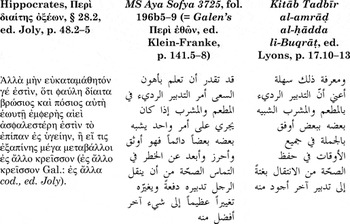
Ḥ renders εὐκαταμάθητόν γέ ἐστιν by a verbal clause and reflects the determinative force of ἀλλὰ μὴν … γεFootnote 160 through the use of the elative bi-ahwani al-saʿyi. L hardly draws on the same Syriac translation as Ḥ, as it uses for εὐκαταμάθητόν … ἐστιν a much shorter nominal phrase, which renders both components of the word εὐκαταμάθητος through Arabic roots other than those used by Ḥ (respectively S). Furthermore, L fails to render the meaning of ἀλλὰ μὴν … γε (or simply ignores it). That Ḥunayn captured the meaning of the Greek particles in S, yet was unable or negligent to do so in L, is quite unlikely. Finally, while Ḥ interprets ὑγεία as “gaining” or “acquiring health” (iltimās al-ṣiḥḥa), it is rendered through “preservation of health” (ḥifẓ al-ṣiḥḥa) in L. Footnote 161

S seems to have renderd χλωρός, “pale-green, greenish-yellow”, by a word meaning “pale, yellow”, translated through aṣfar in Ḥ. The originator of L (or its Syriac antecedent), on the other hand, emphasized the greenish shade.

In this section, L omits τοιαῦτα (rendered through ʿalā mā waṣaftu in Ḥ). This is much easier explicable through an omission (or haplography, ταῦτα τοιαῦτα) in the Greek than through any kind of mistake in the Arabic transmission. However, this being the case, either L must have been produced (contrary to Lyons assumption) on the basis of a Greek manuscript or, following Degen's hypothesis, Ḥunayn must have used for his direct Arabic translation (L) another manuscript than for his Syriac translation (S). Even more significant is the remaining part of the sentence: Ḥ and its Vorlage S are based on the reading εἵνεκεν … μεταβολῆς, παρὰ τὸ ἔθος οὔτε προσθεῖναι λυσιτελέειν φαίνεται…, i.e. they relate, probably correctly, παρὰ τὸ ἔθος to προσθεῖναι λυσιτελέειν φαίνεται. L, on the other hand, relates παρὰ τὸ ἔθος to the preceding μεταβολῆς (“because of the change … into what is beyond their normal practice”), reading εἵνεκεν … μεταβολῆς παρὰ τὸ ἔθος, οὔτε προσθεῖναι λυσιτελέειν φαίνεται… Hence, S cannot be the source of L, nor is it very likely that S and L stem from the same translator.

The two translations differ in that L seems to relate ἧσσον just like μᾶλλον to πόνους ἐμποιεῖ (“one wonders … that it causes pain to the stomach, for some more, for others less”). Presumably, this misinterpretation was caused by the omission of εἰ in the translator's Vorlage. Ḥ correctly related ἧσσον to τις θαυμάσειεν and, unlike L, read εἰ (wa-in) in his Vorlage.
On the basis of this sample, we can rule out the hypothesis that both the version edited by Lyons and the Arabic excerpts translated by Ḥubaysh draw on Ḥunayn's Syriac translation of Galen's commentary (respectively excerpts thereof attached to Ḥunayn's translation of Galen's Περὶ ἐθῶν). First, because the ultimate Greek source of L differed from the source of S and Ḥ; secondly, because S/Ḥ deviate here and there in their interpretation of one and the same Greek text from L. As the bibliographical testimonies concerning Ḥubaysh's version are quite reliable, we are relatively safe in concluding that L does not derive from a Syriac version by Ḥunayn. Is L, then, a direct Arabic translation prepared by the late Ḥunayn himself? – In all likelihood, it is not. Sustaining this hypothesis would presuppose that Ḥunayn used for this translation another and less reliable Greek manuscript than the one he used before for his Syriac translation. Secondly, we would have to assume that Ḥunayn not only changed his mind about the meaning of some words and passages, but at some places even failed to grasp the exact meaning of the Greek which he had rendered correctly in his earlier Syriac translation. In general, Ḥ (respectively S) represents the Greek text in a superior and more faithful way than L. I therefore tend to conceive the attribution to Ḥunayn in the manuscripts used by Lyons as false (a phenomenon which is well known due to Ḥunayn's reputation and not an isolated case), no matter whether this concerns the postulated Syriac Vorlage or the Arabic version itself.
 scripsi : عَما (parum clare) MS; cf. E. Lane s.r. غمّ.
 vel sim. MS supra lin.
 in textu parum clare :
 corr. infra lin. (an يليه
 ?)
 Gal., Fī al-ʿĀdāt, 149.2
 ed. Klein-Franke, Gal., Fī al-ʿĀdāt, 149.2
 vel
 MS


